Software
Houzz Logo Print
bania4ovaltine

Discussion on Lead Paint and Options?

5 years ago

Recently moved in to a 1952 home that has had modest updates. Windows are all newer and vinyl - probably 20 years old or less.


My wife and I are expecting this coming summer so I'm going through the home doing some safety tests, and today we had the XRF lead test. Unfortunately, lead paint is pervasive throughout the home, namely in window trims and sills (not actual windows), door frames and jams, doors themselves, fireplace surround and mantle, crown molding, and some wainscoting. All of the lead paint is very likely underneath the current top coat of white paint.


You can imagine the immediate and nearly overwhelming anxiety that rushed over after the inspector broke the news. I was frankly shocked that the window surround materials were contaminated given that the windows are newer and that they would have left it there.


Now that my anxiety has taken a step back from the cliff, I've moved on to a remediation mindset.


Much of the paint is in good condition on the windows, trims, moldings, and baseboards. Some of the paint on the doors and jams is flaky just given their friction and not being quite square anymore.


Obviously complete removal by a remediation specialist, then installation of new material would be ideal, however that isn't financially viable at the moment, given that we just bought the home and are planning for a child.


Questions

1) If the paint is in good condition and not flaking or chipping, and not subject to any consistent friction, is there any need to abate in the near term? From my initial reading, there shouldn't be any health concerns in this areas. This would include most trims, baseboard, moldings, wainscoting etc


2) If these pieces do get a chip, or a flake, or a nick, is it safe simply to repaint it so long as the rest of the material is satisfactory?


3) Should I repaint all of these items just to ensure they’re covered? Should I or do I need to use a specific encapsulator?


4) Knowing that the door jams and doors themselves are friction areas, that will probably get our attention first. Given that these pieces would likely be removed in whole pieces, and not cut or sanded, can their removal be DIY? Or should I opt for a contractor?


Appreciate everyone's thoughts, or any additional thoughts, opinions, guidance. Trying to prepare for a first child and being told there’s a lot of lead paint around is not easy.


Comments (15)

  • 5 years ago

    My DD is a pediatrician and they bought a 1930's home. She had her first child and had him tested for lead every 6 months. With the second, maybe once or twice. As cat_ky said, if they don't chew on the window sills, little to no problem!

  • 5 years ago

    Thank you both - yes a tad panic mode but am calming down. I am an over thinker so i can't help myself. All things considered we are in pretty decent shape given the wide spread lead within the trim. Definitely plan on doing testing often, and my wife will be getting tested this coming week just for my sanity.


    Will still reach out to a few contractors and painters to get their thoughts. Am reading mixed information on covering/encapsulating and what is required ie special cover or regular high quality interior paint.

  • 5 years ago

    I am walking through the home this morning looking at the contaminated areas and am seeing more chips now that I'm paying more attention. I wouldn't call it peeling generally, just smaller chips and nicks. Can these simply be painted over with a paint or encapsulant? I am seeing mixed messages on when things can be covered vs removed.

  • PRO
    5 years ago


    There is good information on line on how to deal with lead paint. Also, speak with your wife’s OBGYN and get signed up with a Pediatrician who can also advise you.


    In the meantime, your pregnant wife is the main concern. Don’t let her be part of any clean up your may do. After you dust and mop, wash the cleaning utentials.


    If there is lead paint inside the house, there is lead paint outside the house. Chips which have fallen off the house over the years are in the ground, especially around your foundation. Remove your shoes before you come in the house, now and forever.


  • PRO
    5 years ago
    last modified: 5 years ago

    Were you given any information?


    Homebuyers

    Federal law requires that before being obligated under a contract to buy target housing, including most buildings built before 1978, buyers must receive the following from the homeseller:

    • An EPA-approved information pamphlet on identifying and controlling lead-based paint hazards Protect Your Family From Lead In Your Home (PDF).
    • Any known information concerning the presence of lead-based paint or lead-based paint hazards in the home or building.For multi-unit buildings, this requirement includes records and reports concerning common areas and other units when such information was obtained as a result of a building-wide evaluation.
    • An attachment to the contract, or language inserted in the contract, that includes a "Lead Warning Statement" and confirms that the seller has complied with all notification requirements.Sample Seller’s Disclosure of Information (PDF) in English (PDF) and in Spanish (PDF).
    • A 10-day period to conduct a paint inspection or risk assessment for lead-based paint or lead-based paint hazards. Parties may mutually agree, in writing, to lengthen or shorten the time period for inspection. Homebuyers may waive this inspection opportunity. If you have a concern about possible lead-based paint, then get a lead inspection from a certified inspector before buying.
  • 5 years ago

    I am looking through on loan documents now, but certainly nothing was brought to our attention that would have alarmed me at all. I probably would have backed out had I known it was this extensive, as my wife and I planned on starting a family soon after moving in.


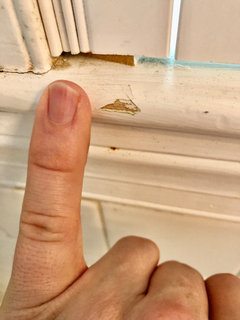
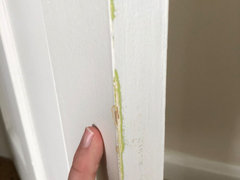
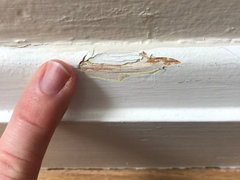
    Below are three examples of typical chipping that I am seeing. They are typically in this size range. No areas that I have found yet have prolific chipping or peeling, most of the concern areas look like the below.


  • 5 years ago
    last modified: 5 years ago

    It should be listed on your disclosure documents. All sellers are required to fill out disclosure forms. You as a buyer, are required to sign it to acknowledge you have read it.


    As for those chips, one on baseboard is common. Probably a vacuum cleaner mark, or something pushed against it. All can be vacuumed off, and wet sanded lightly and touched up. Your trim, looks to be not in the very best condition, and has a whole lot of coats of paint on it, so when finances are good, it may be a good idea to have someone come in and remove all the trim and install all new. You can do it a room or two at a time, if you need to.

    All painted trim, shows chips more than stained trim. It usually ends up with several coats of paint throughout the years like you now have, because of those chips.

  • 5 years ago
    last modified: 5 years ago

    Samantha- You are making unsupportable and unhelpful claims. Lead paint is present in many millions of homes, and is an entirely manageable issue. I don’t know what your credentials are, but I say this as an environmental engineer who worked on regulation and remediation of toxic and hazardous materials, including lead, for many years. The OP has gotten a lot of useful advice in the responses here and does not need to be scared out of her home or conduct a lot of unnecessary further testing in order to manage the situation.


    And Samantha, on re-reading your comment, it looks like you really weren't interested in helping, but just in posting spam about metal coating..

  • PRO
    5 years ago

    kudzu9 In 2002, the United Nations Environment (UNEP) and the World Health Organization (WHO) were invited to establish a Global Alliance to Eliminate Lead in Paint. Subsequently, a phased program of action was developed to achieve international goals. Namely: preventing children from getting lead from paints and minimizing exposure to lead in paints in the workplace. As a result, in the European Union since 2010, all paint and varnish materials that do not meet the lead requirement have been withdrawn from the market. The program provides for the elimination of lead-based paints worldwide by 2020.either You are a poor engineer or you protect manufacturers who pollute the environment. if paint is now in millions of homes people used it because there was no alternative from the unawareness that it is dangerous


  • 5 years ago
    last modified: 5 years ago

    You missed my point entirely. I was simply responding to a spammer who was making vague, unhelpful statements. I never claimed that lead in paint was good, so please don't insult or lecture me.

    I am also well aware of the work by the United Nations and WHO to eliminate the manufacture and sale of paint with lead, but it does not fix the problem of lead paint that was used in many millions of homes for many decades. Not everyone has huge amounts of money to remove all traces of lead paint in their homes, but it's a problem that can be managed using proper remediation techniques and encapsulation.

  • PRO
    5 years ago

    kudzu9 If you saw the insults in my words, then these are only assumptions, perhaps it seemed to me that you were protecting lead paint. Still, I apologize for my harshness. It is worth excluding all unsafe elements from building materials and switching to alternative ones. and if you notice spam it is better to report it to the moderator

  • 5 years ago
    last modified: 5 years ago

    Mike-

    I did regulatory enforcement work for over 20 years, particularly against people who did shoddy abatement work that put people at risk, so I reacted to: "You are a poor engineer or you protect manufacturers who pollute the environment." However, in wanting to avert panic in the OP caused by the spammer, I see how I could have been clearer about my views on lead in general so I understand where you were coming from...apology accepted. I appreciate your concern and level of awareness of this issue.

    I also agree that it's usually best to report spammers, but wasn't sure if this vague one would get taken down, so chose to respond to it.

  • 5 years ago

    bania, I'd worry more about the ground in your front yard than the paint on your trim. since 1923 to the mid 1980's every gallon of gas burned emitted 1.1 grams of lead, and most of it settled in your front yard. Old inner city neighborhoods are the most contaminated areas which produced many brain damaged kids who played in that dirt. It just sits there in the top couple of inches waiting to be eaten by kids or kicked up and inhaled. I'd guess all the lead I've eaten or inhaled knocked down my IQ at least 10 points but I'm still smart enough to know lead paint can be removed, just don't eat or inhale it. It's something which can be taken care of and easier than the dirt in your yard.

    You can't get around lead and is even in the milk you drink, cows consume lead and pass it on. Your world isn't perfect but it's a heck of lot cleaner than the world my generation had to grow up in. Trucks driving down the streets fogging DDT for mosquitos with every kid in the neighborhood running behind them, how sweet it was. So does your old house have the original copper water pipes? 99.99999999% chance the solder used in those pipes contain lead. I shouldn't be like this but you need to know, and to be thankful your world is much safer than mine was, ever eaten mercury contaminated fish or crawled around in an attics full of asbestos? I have but there was no around at the time to warn me.


  • 5 years ago

    Did the testing done on this house include any dust wipe testing, or just an assessment of the paint? It's a different type of evaluation, a lead risk assessment vs. a lead paint assessment.


    If the paint has been there for many years, which all lead paint in US buildings has been, whenever it chipped and flaked and was scraped by window frames etc., it gave off dust. This gets down in tiny spaces in the floors and accumulates in window troughs. If there are carpets, they love dust.


    I would suggest getting some dust testing if you haven't already. The paint can be managed by inspecting for damage on a regular basis. If there is dust, it needs to be managed too. There are safe limits for micrograms per square foot on floors and in window troughs and on sills.