Software
Houzz Logo Print
webuser_680985101

Range Hood Recommendation

5 years ago

I am redoing my kitchen and looking for a 36" stainless hood. I want to go withthe chimmeny version not under cabinet.


Can someone recommend a good hood? I was looking at a 400CFM zline currently.

Comments (16)

  • 5 years ago

    What is the size of the range, and the total BTUs? That will help people give you advice 😊.

  • 5 years ago

    I have an electric stove now. I am about to buy a new gas stove and here is the configuration.


    I assume what is required is all of these added up? I would probaly never use all burners at once.


    Total BTU: 55,500


    Burner #1 Max BTU 18000

    Burner #2 Max BTU 9500

    Burner #3 Max BTU 15000

    Burner #4 Max BTU 5000

    Burner #5 Max BTU 8000

  • 5 years ago
    last modified: 5 years ago

    Wow thanks for all that info. It's great to know but I don't quite understand what all thy means.

    The zline hood I am looking at is 400cfm.

    Also my stove is on an exterior wall so I can exhaust directly out the wall in the ceiling.

  • 5 years ago

    What size is the stove you are buying? 30” or 36”? 400 CFM doesn’t seem like enough for 55,000 btus, especially if your hood size is the same as your range size. CFM isn’t the only thing that matters. CFM just helps move whatever smoke, grease, etc is captured under the hood. It can’t do anything with what escapes out from your pans and never gets under the hood. That’s why the standard recommendation is to buy a hood that is larger than the dimensions of the range. If you install a 36” range with a 36” hood, some of the plumes and grease from cooking escape and don’t go up into the hood. Over time they build up on your walls and cabinets and are a mess to clean. Also, heat from high btu burners can escape and scorch your upper cabinets on either side of the stove (if any).

    Just to be clear, kaseki is a true expert on this and I am not. But I did a ton of research on this (including whether I needed MUA) before buying my hood, and it was confusing as hell to figure it all out. So I’m trying to just give a plain English explanation of what I learned. Hopefully if I’ve said anything that is actually incorrect, kaseki will correct me.

    Many people on Houzz (including some pros) will disagree about the need for a hood to be larger than the range top. But after thoroughly reading all the debates and pros and cons, I decided it wasn’t a chance worth taking, and I went 6” wider.

    About makeup air (MUA) - this was the hardest part for me to figure out whether I needed it. In case you aren’t familiar with what this is, my plain English explanation is this. Your home has air moving through it all the time. It’s a whole ecosystem of air movement. Windows, doors, furnaces, fireplaces, bath fans, etc are all causing air to move. Some of those sources (fireplaces and furnaces) have the potential to release dangerous gasses (carbon monoxide at a minimum, I’m not sure if there are others) into your home. One way that can happen is if something else in the house sucks so much air out of the house that it creates a draft that pulls poisonous gasses from those sources into your home. Have you ever opened a door in a building and heard a whooshing noise? Or heard or seen ceiling tiles momentarily lift and then drop back in place? That’s the phenomenon that this is about. It is much more likely to happen if the home has very tightly sealed windows and doors. High powered hoods have the potential to create the type of strong drafts that are dangerous, bc they are pulling so much air out of the house. So to mitigate that, you may need an MUA that pulls air INTO the house while your hood is expelling air out. These two forces balance each other, so the dangerous “sucking” drafts don’t occur.

    The problem is that MUA is expensive, so of course no none wants to put it in unless they have to (I should note here that in some locations building codes may require MUA so it’s not optional). If your house has enough sources for air to enter the house to balance the air flow while you use your hood, you would not need MUA. That’s why you’ll see some people say that instead of an MUA they just open a window a crack when they use their hood.

    The challenge is that it’s very hard for the typical homeowner to determine if they need MUA. And hood salespeople cannot be trusted to know - they all say something different. Same with HVAC companies. I was tearing my hair out over this while budgeting and preparing for my remodel. Finally I called the engineering firm that did my home inspection when I bought it, to see if they could point me toward a source for help. It turned out they have an engineer on staff who is is an airflow specialist. I can’t remember what the name of the speciality is - maybe an HVAC engineer? At any rate, she asked me a ton of questions about my home and the range and hood, and concluded that I didn’t need MUA, but that if I wanted more peace of mind I could indeed open some windows when the hood is in use. I still ended up paying her a modest fee (maybe $200?) to come to my house in person and do an actual assessment of the air flow. She determined that her original conclusion was correct. She also found I have some sort of shut off feature on my furnace that would prevent any air drafts from allowing gasses to be pulled out (I’m sure I’m not explaining this exactly right, but you get the picture). So I decided not to have MUA installed.

    Hopefully I didn’t just lecture you on a bunch of stuff you already know 😊. I just found that when I was looking it was very hard to find plain English language for explaining all this, so I figured I’d give a shot at providing some.

  • 5 years ago

    That's all great info there. I am buying a 30 stove and want to go with a 36 hood for the very reason you just stated. Since I have the room it makes sens to go with the bigger hood to make sure it catches everything it can.


    It seems the most hoods I looked at are 400cfm. I think i have only ever used 2 burners at once. Note more than 3. I think my main goal for the hood is to allow me to cook a steak or burgers in my cast iron without smoking up the house.

  • 5 years ago

    Lol a worthy goal indeed! So it sounds like the capture area is good. I’ve been told that a rough way to figure out your CFM needs are to divide your btus by 10,000 and then round up to the next highest CFM. So in your case that would be 600 CFM. I’m sure kasecki’s formula is more accurate but I think this method gets close to the same result. Also, if you care about noise, it’s worth considering going to 600 and using it on a low setting, vs using the high setting on the 400. It will probably be quieter.

    If you’re considering z line, it’s worth searching “z line hood” in Houzz and see what comes up. I know that for z line ranges there’s LOTS of people with issues - I was looking at those and ruled them out after reading everything here. The price is tempting but not worth the gamble. Another hood manufacturer that many people really love is Vent a Hood. Broan seems to have developed a good following as well and is pretty reasonably priced. The other thing to look at is the design and how easy it will be to clean. Some designs have filters that must pop out and go in the dishwasher, others are harder to clean. I ended up buying a BlueStar just because I bought a BlueStar range, and they had a well rated hood liner and blower that I needed (my hood has a wood surround).

  • 5 years ago

    You need to know the aperture size of your hood to figure out the required CFM. We know that you are looking for a hood that is 3' wide. So, let's assume it's going to be 2' deep. That's pretty common and provides for OK overlap. In order to achieve the necessary 90ft/min flow rate, it needs to move 6*90 = 540 CFM. But as @kaseki pointed out, manufacturers lie when they specify the performance of the hoods. They measure flow rate without any attached ducts. In practice, even short ducts result in back pressure that the fan has to overcome. And fan performance can drop off quite dramatically with even minimal back pressure. So, a good rule of thumb is to multiply by a factor of 1.5 in order to go from nominal to actual CFM.


    This gives you a required minimum of about 800 CFM that you should shop for. The 400 CFM is about half of the performance that you'd need to adequately remove cooking fumes and combustion by-products.


    But there is a very obvious reason why so many manufacturers make 400 CFM hoods, even though they are almost always ineffective. The building code in must parts of the US requires an expensive make-up-air system when you exceed 400 CFM. So, there is a lot of demand for low-powered hoods to meet the letter of the law.

  • 5 years ago

    So you are saying if I go above 400cfm then I need the mua system?

  • 5 years ago

    It will depend on the building code where you live. I live in a medium size city in NY State and it is not required in my county. But it is in the county next door.

  • 5 years ago

    It's a very good idea to have a MUA system even if your location code doesn't require it (yet). But there are situations that make it more important to have than others. If you have a modern well-insulated building your hood simply won't work. There is not enough air entering the house for it to vent anything. And if you have other gas fired appliances, there is a real risk of backdrafting carbon monoxide from the other appliance's vent flue. This could literally kill you.


    On the other hand, if your 100 year old house leaks like a sieve and you don't have any other appliances, then you might get away with the way things are.

  • 5 years ago
    last modified: 5 years ago

    I guess i need to look up MUA systems. I never heard of this before this post.

    Cant i open a window to do the same thing when i am using the hood?


    Can you provide a link to one?

  • 5 years ago
    last modified: 5 years ago

    How do you want to use your kitchen? What kinds of cooking and baking do you do? What do you want to do in the future? How often? For how many people? Do you entertain? How often? For how many people? How important is indoor air quality and your families health? What weather environment do you live in and how often do you have windows open?

    BTU's are actually kind of a poor way to determine what hood is needed (but like CFM's for hoods it's easy for consumers and kitchen decorators to use). Pan frying over a single burner can easily overwhelm a consumer hood like you're considering - resulting in much of the effluent (odors, moisture, grease, pollutants) spreading out throughout your kitchen and house. If you largely do light cooking (boiling water, etc.) then you'll be OK but otherwise you could find yourself disappointed with both the noise of your hood and poor effectiveness.

    More: https://www.gardenweb.com/discussions/5161173/hood-faq

    So start with getting a rough idea of what your requirements are and then figure out what you need from a hood and then what specific hood.

  • 5 years ago

    I think rather than assert that manufacturers lie about blower flow rate -- after all, they can't know each application's duct and MUA situation -- I would say they mislead when they don't make clear that the blower is rated at zero static pressure. (In VaH case, I think it is zero static pressure across the hood.)

    Causes of pressure loss (non zero static pressure) start with the hood baffles, include the ducting and exhaust cap, and include the pressure drop getting MUA into the house. Note that there is always MUA, or there would be no hood flow at all, but the intrinsic household leakage can be inadequate. Inadequate means that there is too much pressure loss for the intended hood flow rate. In such cases an MUA system is needed. The "system" can be a hole in the wall somewhere with a damper, or can be a complex pressure controlled blower configuration with heating, or something in between.

    The MUA system, relative to the hood system, may be more or less difficult to integrate into the architecture. Many threads here address MUA and can be found by searching on this term.

    In summary, there is a hood system flow rate appropriate to a particular cooking process and choosing a blower to be able to achieve that flow rate requires also choosing an MUA system that is compatible. Aspects of this are described by @lwfromny earlier in this thread.

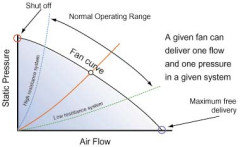
    In the image below, a 'fan curve' is illustrated. The goal of the hood/MUA combination is to achieve the desired flow rate from a capable blower at the pressure loss that will result from the system design operating in the particular residence at that flow rate. This is the point where the tan-colored curve crosses the black-colored curve.


    Based on some typical conditions, and given the rare to non-existant pressure loss vs. flow data for particular manufacturers' hood baffles, thereby making accurate analysis difficult, I usually recommend that the rated (zero static pressure) flow rate adopted for purchase purposes be 1.5X the required flow rate.

    For more on the overall principles and goals of kitchen ventilation, a useful read is the 'Greenheck Guide' available here:

    https://www.tagengineering.ca/wp-content/uploads/2015/02/KVSApplDesign_catalog.pdf

    The first 12 pages or so are aimed mainly at the hood system, and the next dozen get more into MUA. This is all commercially oriented, but the residential system is trying to accomplish the same functions with different equipment, both for the cooking surface and the HVAC, so insight is still possible from reading the commercial view.

  • 5 years ago

    Thank you Kaseki - I should have clarified my comment about the reliability of hood salespeople. I was referring to retail salespeople. But I totally agree that they have no way to know if any individual home needs it. Things I heard included “your home was built in the 70s so you’re fine” “our building code doesn’t require it so you’re lucky” “MUA is only required if the range is 42” or larger” “just open a window” “if it was necessary it would be in the code” “that’s what carbon monoxide alarms are for” and “what’s MUA?”.

  • 4 years ago

    HI Frank Puma, just bumped into this post since we are looking to install a hood as well. Just interested in the final decision and what brand/model did you end up buying with/without MUA and if you are happy about the performance ?