Software
Houzz Logo Print
webuser_72376485

Bryant Legacy or Preferred?

5 years ago

Hi there, I was just recommended two central A/C units:


Bryant Legacy 105ANA, 16 SEER, single stage

Bryant Preferred 126CNA, 17 SEER, single stage


The price difference is about $500 total between the two. Is it worth it to go with the Preferred? I tried to compare the specs and they look very similar electrically except the Preferred more quiet (68dB vs 72 dB).


Are there any other factors that I should consider? I appreciate any input thanks.

Comments (12)

  • 5 years ago

    Warranty? Matching Bryant evap coil? paired with Air handler or furnace?...

    HU-72376485 thanked tigerdunes
  • 5 years ago

    The SEER ratings you posted are the "up to" ratings. That means there is at least one configuration using the condenser which will achieve that SEER rating. Your SEER rating will be lower but not less than 13 or 14 depending where you live. You have to compare the SEER ratings of the complete system configuration if that is important to you.

    Is the extra $500 just for the condenser? Anything else changing? The Legacy usually carries a 5 year parts warranty while Preferred is 10 years. I believe the Preferred has built in pressure safety switches. This protects the compressor if the pressure is too high or low and could extend the life of the equipment is something goes wrong. I don't think the Legacy has this. Overall build quality of the Preferred is better.

    If you plan to live in this house more than 5 years I would recommend spending the extra money on the Preferred. The higher SEER rating may qualify for a utility or state rebate which could offset the difference.


    HU-72376485 thanked mike_home
  • 5 years ago
    last modified: 5 years ago

    The Legacy is the bottom of the line builder-grade model from Byrant. I have the Carrier equivalent and wish I'd gone up a grade (noise, performance)! The warranty is 10 years if you register it. If you're getting a new air handler, I'd get the variable speed FV4 if you can stretch to that - you'll get an extra 1+ SEER and dehumidification capability.

    HU-72376485 thanked sktn77a
  • PRO
    5 years ago

    And, much larger than the older units they replaced. The contractor told me the size increase contributes to better efficiency.


    yes, and to hold a drum of refrigerant. So when you spring a leak the new refrigerant ban takes place your fat wallet turns into an empty wallet. LOL.


    They stayed up late nights thinking long and hard how they can get your freon money. But relax your unit is efficient.


  • 5 years ago
    last modified: 5 years ago

    In your experience, are properly installed systems that are put in using best practices for assembly, handling and brazing likely to leak, absent later physical damage or component failures, before they reach a reasonable end of life? My HVAC contractor answered that question with an immediate "No, it's unlikely".

  • PRO
    5 years ago

    In your experience, are properly installed systems that are put in using best practices for assembly, handling and brazing likely to leak, absent later physical damage or component failures, before they reach a reasonable end of life? My HVAC contractor answered that question with an immediate "No, it's unlikely".


    If your HVAC contractor had said yes, would you have bought from him?


    Back 20 years ago HVAC contractors across America bought R22 Freon by the pallet. It was a given that systems were going to leak. Since that time manufacturer's have made every attempt possible to stop those pesky leaks.


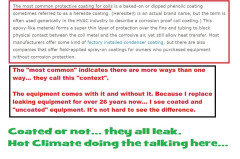
    They've coated coils with various types of coatings, switched from copper tube / aluminum fin to all aluminum yet to this day a large portion of my work involves units with those pesky Freon leaks. (Hot climate here, more it runs, more likely.)


    To this day: regardless what the coil is coated with, what type of metal they use to make it with, no matter the name on the box... it will at some point leak. There is no "exact" time table in which that can occur. It could be as short as a year, 2 or 3.... 8, 9 or 10 or more. It's as random as the wind in most cases.


    Much of the reasons coils develop leaks is attributed predominantly to use in my opinion but there are other factors like VOC's in the home that find their way to the indoor coil thru the return duct of the HVAC where those VOC's get trapped in condensate waste water the evaporator coil sits in. Depending how potent that soup is, time is the only other part to the equation.


    VOC: Volatile Organic Compound. Comes from home furnishings, perfumes, cleaners, etc.


    Certainly there are other parts of the system that can develop Freon leaks but typically those kinds of leaks take much longer or are encouraged by those who do things they should know not to do.

  • 5 years ago
    last modified: 5 years ago

    You said :

    "They stayed up late nights thinking long and hard how they can get your freon money."

    (which didn't make much sense since the equipment companies don't make or sell coolant),

    and

    "Since that time manufacturer's have made every attempt possible to stop those pesky leaks."

    One contradicts the other.

  • PRO
    5 years ago
    last modified: 5 years ago

    The manufactures of the equipment have more say in what the next refrigerant will be than what I say.

    Refrigerants are made by refrigerant companies, new equipment (99% of the time) is shipped with refrigerant installed. So I'm sure there is good relationships between the two.

    Those companies then buy the refrigerant that I buy from them for $$$. So it's an indirect relationship in terms of how they make money on it. I don't buy refrigerant directly from the refrigerant maker. Uh-oh... guess you never thought of that paradigm?

    I don't know everything there is to know about all these "relationships" ----- I'm sure they do it to keep the house of mirrors functioning the way it was designed to function.

    What do you suppose I mean by that?

    There's roughly 7 maybe 8 different manufacturers of HVAC equipment for USA market. But there is a multitude of different brands, models, etc.

    Now if you think that your brand and model is all that how could you have come to that conclusion in a sea of other misfits? ( somebody told you. Gee what was in it for them? A sale? lol. The world is spinning mad I tell you.)

    That being said: If you want cooling, living in a hot climate like I do --- well you have to pick something.

    Just ran a no cool call last night: Turned out to be York, roughly 17 years old. R22 Freon unit. flat. Shipping charge nearly 15 lbs. 2 story home unit sits in the attic so probably around 17-18 lbs to recharge this beast. It would be an interesting story if I get this job... but it's February and I'm sure this homeowner wasn't / isn't prepared for an out of the blue expensive fix.

    I offered to repair it, but I recommended replacing the AC system. Ultimately it's their choice.

    17 years is a long hard life: yes. But it's not that common to find such an old system these days with this kind of problem. I would say an average age might be 5 to 6 years. Some earlier, some later.

    R410a is ready to go down the path of phaseout. It's a much more complicated refrigerant to make because it's a blend. It leaks out faster because pressures are much higher than R22 Freon. The next refrigerants will be likely be similar in operating pressures to R410a than R22 Freon unless they some how get over the hurdle of high flammability / adopt R290 otherwise known as propane. (I will discuss this topic further in up coming new video part to this R410a phase out on my youtube channel. Subscribe to my channel if you want more insight into the up coming changes to HVAC systems.)

    Efficiency is all great and good. I sell energy efficient units, I have one at my house (AC inverter). That efficiency comes at a price most of the time in my experience. I work on them, who would know better than me. (Hint: I'm not selling you. I'm telling you. That's the difference.)

    The greatest contradiction of all: telling you what we know you want to hear and think so we can sell you something for profits.

    I tell you the facts, you decide what you wish to do. (I work for you... in my area) What I put on this board is merely advertising myself and my services.

    I service the Katy, Texas area.

  • 5 years ago

    You've suggested the manufacturers are callous and try to bilk customers with requiring more coolant than necessary (which they don't sell or benefit from doing) , and also that they work hard to avoid leaks. Is it one and not the other, or both?

  • PRO
    5 years ago

    The manufacturers sell equipment and refrigerant. I don't go to a separate place to buy refrigerant. They don't sell refrigerant at cost... they make money on it. (profit)


    coatings on coils to "try" to prevent refrigerant leaks


    I service the Katy, Texas area. I have been known to fix refrigerant leaks.


    I hate someone who thinks they know it all? I am posting in a thread on a subject that I do professionally for over 26 years. After 26 years you would think I actually know something on this subject? #Context.


    I am not in this business to fix people, or their misconceived perceptions of the HVAC industry.

  • 5 years ago
    last modified: 5 years ago

    "I hate someone who thinks they know it all"

    Yes, me too. That's why I tend to comment when I see contributions that don't make sense to the amateur me or seem extreme or biased.