

SOS! My plant babies are all doing weird things!
I have 3 specific plants/types of plant that I'm concerned about.
#1 Fiddle Leaf Fig-
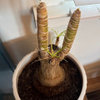
I have already had issues with root rot with this one. A few months ago I repotted it and I think the soil and drainage are inadequate because I have fungus gnats and brown spots/holes in the leaves. It also seems to take weeks for it to dry out in between waterings. I only water it until it drains out the bottom and I don't let it sit in water. It's next to an east facing window and while it was recovering from the repotting, I had a humidifier and heater running next to it at night. Pictures attached.

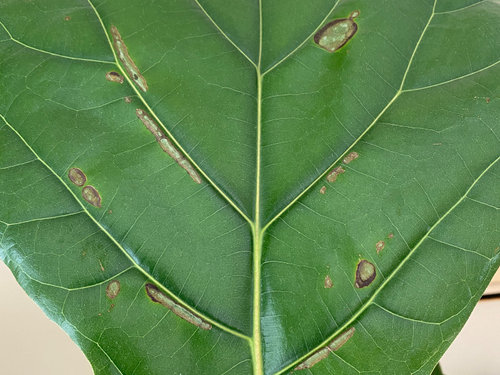
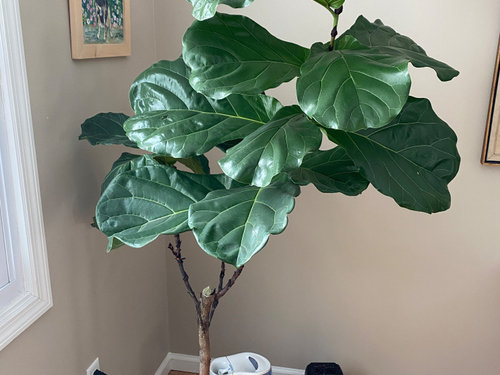
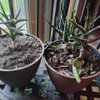
#2 Spider Plants- I have many of these and they all came from baby cuttings from my son's science night at school. I've separated some of them and they all seemed to be thriving until recently. I noticed that a lot of them are getting brownish coloring along the edges of the leaves and brown on the tips. Also some weird striations on some of the leaves.
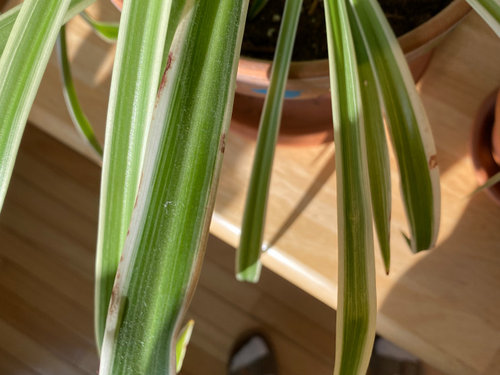
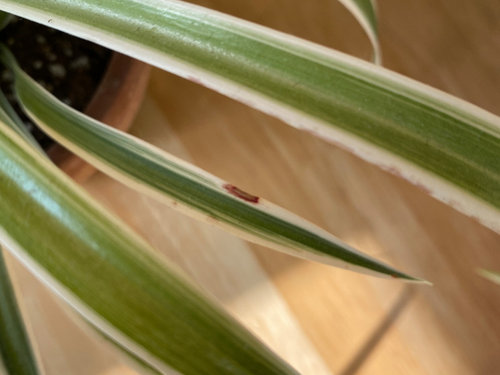
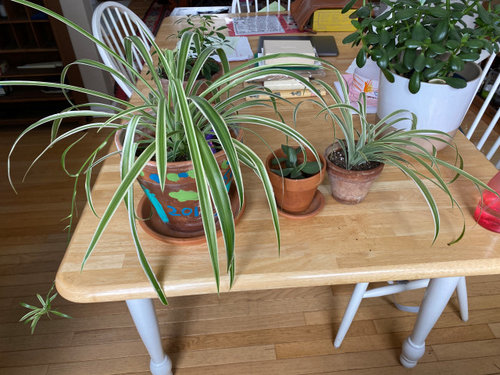
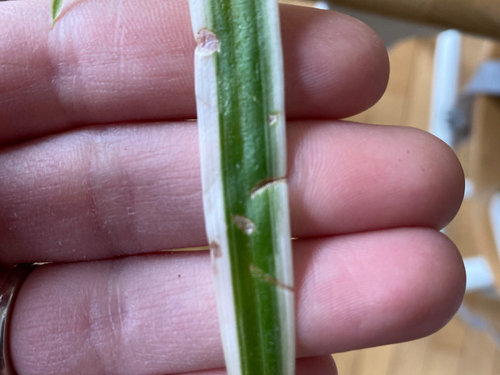
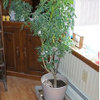
#3 Big Leaf Philodendron- Got this a couple years ago at Home Depot but I think I repotted last year. I only water this one as needed when my meter shows that it's dry. It's in the original plastic pot inside the basket and I let it drain. Now it's starting to show little yellow dots and holes on it and the older leaves have gotten a little brown and almost translucent. Photos attached.
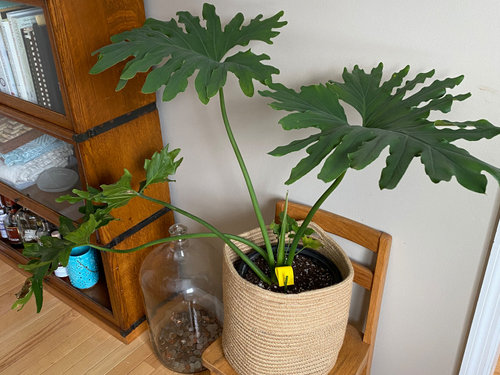
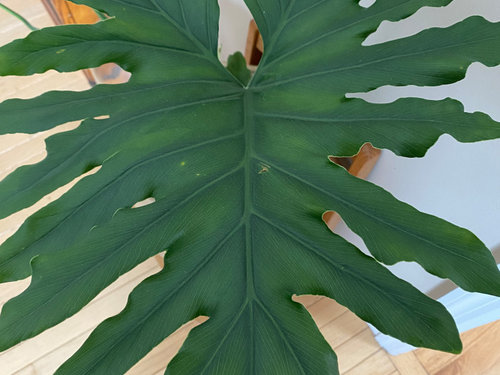
I would appreciate any support in solving these issues. I've been SO depressed all day thinking that maybe they have a bacterial infection or that they are all gonna die :(
I try to take such good care of them. I give them plant food every few waterings (maybe once a month).
Any help is appreciated!
Sad Plant Mom,
Becky
Comments (20)
 5 years ago
#1 Fiddle Leaf Fig-
I have already had issues with root rot with this one...
It does sound like it's staying too wet. If you didn't use a fast-draining soil, I'd repot again using one. If the only thing you can get is a commercial soil, mix it with lots of Perlite. Or check out 5-1-1 mix around here for an option this kind of fig will enjoy. While I'm not generally a fan of that mix (it doesn't retain resources well), this is one case where it's a decent choice.
#2 Spider PlantI sense somebody tends to overwater. :-) Let your spider plant dry thoroughly at least 1" deep before even thinking about watering again. Those brown marks are usually from overwatering, using overly fluoridated or chlorinated water, or not flushing the soil regularly. Not always, but that's the first guess with these as they're almost bulletproof otherwise: https://www.epicgardening.com/spider-plant-brown-tips/
Yes, yes, Epic gardening can be a bit hit or miss. Here it's a hit. When watering, every once in a while make sure to flush the pot thoroughly, allowing at least half again the pot's volume in water to run out the bottom. For these, I always feel distilled water is a bit of overkill, but if your local supply is super-fluoridated to the point where they remove it instead of add it, you may want to consider it (ours is fluoridated up to the minimum level).
#3 PhilodendronThis looks like a simple resource shortage to me (the interveinal color change is a dead giveaway). If you haven't fed in a while, do so gently with half rate of any decent food that contains a wide range of resources and micro-elements--Miracle Gro, DynaGro, and so on. Half rate because this isn't exactly the optimal moment to feed fully. In this particular instance, make sure some calcium and magnesium is listed on the label.
Don't go overboard throwing on bits of this and bobs of that, just feed with any good plant food.
If that improves things, feed again at half rate in April. Again, I'm not particularly a fan of kicking the heck out of a plant indoors in early spring. In May you can feed fully if the plant's resuming growth at that time. :-)
There are other things it could be, but let's start with the easy stuff first as from the looks of the plant, you're otherwise an excellent plant parent and nobody needs a lecture on basic care.
Becky Cohen Gestwick
Original Author5 years agoI can't thank you enough for taking the time to diagnose my plant problems! Also, thank you for saying that I'm an excellent plant parent :). I try really, really hard to keep them happy. Ok, based on your advice, I will repot the FLF with a fast draining soil, let my spider plants dry out longer between waterings and feed my big leaf philly. I'll let you know how it goes! Thanks again!
Related Professionals
Kissimmee Landscape Architects & Landscape Designers · Muskegon Landscape Architects & Landscape Designers · Williamsport Landscape Architects & Landscape Designers · Platteville Landscape Architects & Landscape Designers · Orlando Landscape Contractors · San Luis Obispo Landscape Contractors · Spokane Landscape Contractors · Pensacola Interior Designers & Decorators · Jackson Interior Designers & Decorators · Leominster Interior Designers & Decorators · Escanaba Interior Designers & Decorators · Hempstead Interior Designers & Decorators · Akron Interior Designers & Decorators · San Bernardino Interior Designers & Decorators · Ontario Interior Designers & Decorators- 5 years ago
first one ... fig ... you just repotted it.. i probably wouldnt repot it again so soon ... i would turn off the heater ... and stop misting it ....
the spidey.. looks like typical ugly winter foliage ... and a lot of mechanical damage.. i would probably snip off the ugly ends on an angle ... and leave it alone... i do not water mine.. until it is bone dry .. and the center newest leaves start to wilt ever so slightly ...
the philo is putting out a new leaf.. i would cut off the ugliest old leaf ... and then the second ugly one.. after the new leaf expands and starts processing light to feed the plant ...
i propose you insert your finger and use pot weight to determine when to water.. rather than relying on a gadget ...
it sounds like you have a tendency to overwatering ... next time you feel like watering.. wait another week ... most plants will show you.. when they really need water ... and then you water .. but not cactus.. they just sit there an look stupid all the time.. lol .. but on the other hand.. they rarely need water ... so it doesnt matter... lol ..
ken - 5 years ago
🤣 Thank you so much! I’m relieved that no one thinks it’s bacteria that I inadvertently spread to all of my plants. I have stopped heating and humidifying. do you mean cut off the ugly philodendron leaves now or after the new leaf grows?
thank you!
- 5 years ago
Dead leaves, or leaves that have fully yellowed, can be cut at any time. The leaves you've photographed above are merely unattractive but still happily photosynthesizing dinner for the philodendron in question, who would be unhappy to lose them at this point in the season.
Unless they completely turn, I'd keep them until Phyllis the Philodendron (what, you don't name everything?) grows new ones. Even when she does, the new leaves may simply overshadow the older ones, and you may not notice that they look bad any longer. If you can leave them, do leave them. If the plant isn't unhappy with the leaf, and it's doing its job, and it's not an eyesore, I try my best to ignore any minor issues it has.
Difficult, I know. Eventually that leaf will get buried enough that I can justify cutting it off. "Well, it's not really doing much good three deep in the canopy, now is it?"
- 5 years ago
Ok, i appreciate all of this advice. I will not cut the leaves off of Philly. I also understand what you mean about the soil problem and yes, I have a tendency to overwater. So would you recommend the 5-1-1 mix for most houseplants? I can repot the ones that I feel aren’t drying out. I’m getting differing advice on reporting my fig but I’m worried about it sitting in water as it’s showing obvious signs of excess water retention.
- 5 years agolast modified: 5 years ago
"The idea the 5:1:1 doesn't retain resources well is false."
Pine bark does not have a CEC of 300: https://www.ars.usda.gov/ARSUserFiles/50820500/GPRG/2014PublicationsandSummaries/2014_Influence%20of%20pine%20bark%20partcile%20size%20and%20pH%20on%20CEC%20[Summary].pdf. 80 is about the top, if you get lucky. Very, very lucky.
https://ashs.org/news/209042/Cation-exchange-capacity-analyzed-for-nursery-pine-bark-substrates.htm You'll need access to the site for this one.
For the suggested particle size, we'll be working at the low end of the scale on CEC. I'll stand by my original statement without delving into the other problems:
5:1:1 mix does not retain resources well.
- 5 years agolast modified: 5 years ago
"Ok, i appreciate all of this advice. I will not cut the leaves off of Philly. I also understand what you mean about the soil problem and yes, I have a tendency to overwater. So would you recommend the 5-1-1 mix for most houseplants? I can repot the ones that I feel aren’t drying out. I’m getting differing advice on reporting my fig but I’m worried about it sitting in water as it’s showing obvious signs of excess water retention."
If you feel you can manage the watering by allowing the plant to dry out between waterings, and manage watering by watering moderately, then immediate repotting isn't strictly necessary. It can wait a bit until the plant has readjusted and won't be shocked by an immediate second repot.
Just make sure to occasionally flush the plant to avoid salt build-up, but that's really only necessary every now and again for most things. If using distilled water, quite rarely indeed.
If it's difficult for you to judge when a plant is dry by sticking a finger in an inch or so, then repot shortly, of course. Even if that's only commercial soil with Perlite mixed in, it'll help and be better than what you had. Or a lighter commercial mix like a succulent soil if something like the above homemade mix isn't something you can source or if restrictions in your area make it tougher for you to locate such things.
As I said, 5:1:1 is made for this kind of plant, where you don't want a lot of water sitting around in it. It's a great mix for it and the only reason I don't recommend it more often is the lower ability of the stuff to bind resources (which only bind to particle surfaces, not throughout the mass). Well, plus the fact that it loses its ability as a fast-draining soil when the bark rots and turns to mush. But the resource binding issue isn't particularly significant in this instance, and one should be repotting often enough that the stuff never gets that mushy.
Shrug. What do I use? Miracle Gro Moisture Control for everything. I just mix in measured amounts of grit/sand, and Perlite to lighten it for when I need fast draining. I don't want to keep a lot of stuff on-hand and don't really have space to store it (or didn't until I just cleaned out the basement and freed up 600 square feet...but that goes to a mini-studio for me). Becky Cohen Gestwick
Original Author5 years agoThe problem is that I think the bottom just doesn't dry out, or not before the leaves start to droop. I haven't watered it in probably 2-3 weeks and I just had a breakout of fungus gnats. I think I used a mix of regular potting soil with some orchid soil mixed in because that was what I had on hand. Do you think it will shock it terribly if I repot it in the 5-1-1 mix? Also, what do you mean by flushing it? I am going to look into our water. I live in Saratoga Springs, NY so there are a lot of minerals in our water (it's very hard water). When the fig is dry (by sticking my finger in and by using my meter) I water just until it starts draining out the bottom and then let it drain usually the rest of the day. I can try setting my water out the day before I use it or switch to distilled water.
 5 years agolast modified: 5 years ago
BC...... - Yes, I would recommend it. I don't exaggerate when I say thousands of Houzz/Gardenweb members have adopted the 5:1:1 or similar medium based on a large fraction of coarse particles, a formula which ensures little or no water occupies the spaces between soil particles, which is the water that turns out to be seriously limiting. mix and been vocal about the results. Many of the most experienced and reliable contributors to GardenWeb fora use the 5:1:1 mix or something based on the same concept, an understanding of the concept being far more valuable than the basic recipe as it increases options/flexibility.
There are 2 ways to view care regimens. One perspective is from the grower's POV, the other is from the plant's. More often than not, the two are mutually exclusive. For instance, it's not unusual for some growers to grouse about having to water plants in the 5:1:1 mix or a facsimile more often than they had to water plants in the medium they abandoned because of its excessive water retention. From the grower's perspective, the extra watering, say every 4-6 days as opposed to every 2-3 weeks might be viewed as an inconvenience, but from the plant's perspective the additional effort makes perfect sense; after all, most growers who love tending plants are just getting their nurturing bone scratched. The choice is left to the grower w/o judgement about the decision.
Not that it particularly matters, my connection with the plants/bonsai I care for is grounded in the need to nurture, the enjoyment I get from the practical application of what I know of the plant sciences, the continual pursuit of greater proficiency, and in having found the only real artistic outlet I can think of in my life, except perhaps for what time I share with my local gardening community and here, helping others seeking information with the potential to further pursuits that run parallel to or overlap with my own.
Edited to add: Do you think it will shock it terribly if I repot it in the 5-1-1 mix? Nothing I see requires emergent care beyond closer monitoring your watering habits, making sure your plants are properly fertilized, and making sure light/temperature ranges are appropriate. Plants have natural rhythms during which their level of vitality (health/energy level) gradually but significantly varies. Healthy plants are strongest and best able to deal with heavy work like hard pruning and full repots (as opposed to potting up) as the summer solstice approaches on June 21 in the Northern Hemisphere. Immediately before the solstice is the best time to repot and prune because not only will the plant be at it's highest level of stored energy, it's current ability to make food (photosynthesize) will be peaking. This means the plant's natural defenses against insects and disease should be at peak, and recovery from the work should occur faster than at any other time of year. I would make appropriate changes to your care regimen now, but wait to repot until June. In the interim, I can help you with strategies that will help you deal with any concerns about excess water retention or fertilizing. Also, what do you mean by flushing it? See below, "Flushing soils". When the fig is dry (by sticking my finger in and by using my meter) I water just until it starts draining out the bottom and then let it drain usually the rest of the day. Unless your pot is less than 5 " deep, your finger is an unreliable probe. If you have a 10" deep pot with the top 2 inches feeling dry, it's possible that the bottom 6" of the soil are 100% saturated. Water meters don't measure moisture levels, they measure electrical conductivity. To confirm, clean the probe and insert into a cup of distilled water and witness the reading of "DRY". Add a pinch of salt and watch the needle move to "Wet" or "Moist" - whatever term used on the meter. A wooden "Tell" is a very reliable tool to test moisture levels deep in the pot. See "Using a Tell" below. I can try setting my water out the day before I use it or switch to distilled water. Once you've absorbed this information, we can talk more about watering and some tricks to help reduce the amount of water your containers can/will hold. Remind me if you have interest.
Flushing Soils
When you water, you should be able to flush planting's soil to eliminate the potentiality of salts from fertilizers and tapwater accumulating in the soil, thereby limiting the plant's ability to take up water and the nutrients dissolved in the water. If you think you shouldn't flush the soil during your regular water applications for fear the soil will remain saturated for a lengthy period, limiting root function or worse, you should consider a different soil or take steps to reduce the amount of excess water your soil can hold. By whatever means necessary, getting to the point you can water correctly is going to make a very big difference in the opportunity to realize as much of it's genetic potential as possible. Once you can water correctly, you no longer have to do battle with a water-retentive medium over control of your plant's vitality. There are several methods of limiting how much water your planting can hold, all but 1 or 2 are completely passive, requiring no effort on your part other than set-up, which is monkey easy. I can help if you have interest in that, I'm continually improving my proficiency at monkey easy tasks.
To flush the soil of a planting: Water with room temperature water until the soil is completely saturated. Allow the planting to rest for 15 minutes to an hour to allow as much of the salt accumulation as possible to go into solution, then pour a volume of room temp water equal to at least 10X the volume of the pot the plant is in slowly through the soil. This will remove most of any accumulation of offending salts and resolve any skewing of nutrient ratios.
It's a good idea, no matter what time of year, to fertilize most plants immediately after flushing the soil. Try to be sure you're using a fertilizer that has a ratio as close as possible to the ratio at which the plant uses nutrients. The NPK % listed on fertilizer packaging is not its ratio. 7-7-7 and 14-14-14 are 1:1:1 ratios. 9-3-6, 12-4-8, and 24-8-16, are all 3:1:3 ratios. Container growers should try very hard to avoid use of fertilizers advertised as 'bloom-boosters', or any number with a middle number (Phosphorous) higher than either the first or third numbers (Nitrogen or Potassium). These fertilizers can badly skew nutrient ratios with even the first application). On average, plants use about 6x as much N as P, so there is NO potential for a positive outcome when supplying many times as much P as the plant requires. I, and a large number of other members, use Dyna-Gro's Foliage Pro 9-3-6. It's designed to closely mimic the uptake ratio of the average plant, and has many other attributes not commonly found in other fertilizers. It also has ALL of the nutrients essential to normal growth. Summarized, it makes fertilizing as easy as it can be, and from 1 container.
Using a 'tell'
Over-watering saps vitality and is one of the most common plant assassins, so learning to avoid it is worth the small effort. Plants make and store their own energy source – photosynthate - (sugar/glucose). Functioning roots need energy to drive their metabolic processes, and in order to get it, they use oxygen to burn (oxidize) their food. From this, we can see that terrestrial plants need plenty of air (oxygen) in the soil to drive root function. Many off-the-shelf soils hold too much water and not enough air to support the kind of root health most growers would like to see; and, a healthy root system is a prerequisite to a healthy plant.
Watering in small sips leads to avoid over-watering leads to a residual build-up of dissolved solids (salts) in the soil from tapwater and fertilizer solutions, which limits a plant's ability to absorb water – so watering in sips simply moves us to the other horn of a dilemma. It creates another problem that requires resolution. Better, would be to simply adopt a soil that drains well enough to allow watering to beyond the saturation point, so we're flushing the soil of accumulating dissolved solids whenever we water; this, w/o the plant being forced to pay a tax in the form of reduced vitality, due to prolong periods of soil saturation. Sometimes, though, that's not a course we can immediately steer, which makes controlling how often we water a very important factor.
In many cases, we can judge whether or not a planting needs watering by hefting the pot. This is especially true if the pot is made from light material, like plastic, but doesn't work (as) well when the pot is made from heavier material, like clay, or when the size/weight of the pot precludes grabbing it with one hand to judge its weight and gauge the need for water.
Fingers stuck an inch or two into the soil work ok for shallow pots, but not for deep pots. Deep pots might have 3 or more inches of soil that feels totally dry, while the lower several inches of the soil is 100% saturated. Obviously, the lack of oxygen in the root zone situation can wreak havoc with root health and cause the loss of a very notable measure of your plant's potential. Inexpensive watering meters don't even measure moisture levels, they measure electrical conductivity. Clean the tip and insert it into a cup of distilled water and witness the fact it reads 'DRY'.
One of the most reliable methods of checking a planting's need for water is using a 'tell'. You can use a bamboo skewer in a pinch, but a wooden dowel rod of about 5/16” (75-85mm) would work better. They usually come 48” (120cm) long and can usually be cut in half and serve as a pair. Sharpen all 4 ends in a pencil sharpener and slightly blunt the tip so it's about the diameter of the head on a straight pin. Push the wooden tell deep into the soil. Don't worry, it won't harm the root system. If the plant is quite root-bound, you might need to try several places until you find one where you can push it all the way to the pot's bottom. Leave it a few seconds, then withdraw it and inspect the tip for moisture. For most plantings, withhold water until the tell comes out dry or nearly so. If you see signs of wilting, adjust the interval between waterings so drought stress isn't a recurring issue.
Al- 5 years ago
Then by all means, repot in this case. It's another stress, just as repotting is always a stress, and March repotting is never optimal to begin with (they should really be repotted in more active growth). But we've all done it, and all the evidence you're telling us indicates it needs to be done. The shock in this case sounds like it'll be less than leaving it in a bad mix that the fig just doesn't like.
And it's stressing you out. Repotting it is going to make you happier, so go ahead and do it.
"Also, what do you mean by flushing it?"If one shallow waters over time (guilty, says I, raising a hand, particularly in winter indoors), and waters until the pot is not fully saturated, just saturated, or only a few drops come out, the water then dries, leaving the salts behind (or at least the ones that the plant doesn't use, don't evaporate, and don't soil bind). Every now and again, run water through the pot until the pot dumps water out the bottom, at least half again as much volume as the pot itself has.
I take my pots out in summer, flush them over and over again, let them run clear and completely out until dry, then bring them back in. That washes away all soluble salts.
[I also tend to unbind soils with...and I'm going to get so much flack for this one...a few "drops" of sodium laureth sulfate (it's actually a solid, but...equivalencies) in the initial gallon of water added per every couple of inches of pot, rapidly rising with size. The chemistry is a bit opaque, but I have the stuff around due to being a soap maker.
Long story. Plenty will tell you it doesn't work. Golf courses, gardens, and home lawns have been using it for decades.
I wouldn't do it on very sensitive plants, of course. Your fig is out. So are my desert roses. But a hibiscus? Absolutely.]
"I live in Saratoga Springs, NY so there are a lot of minerals in our water (it's very hard water)."Hard water isn't necessarily a problem. That's usually calcium and magnesium ions, which aren't a major issue. The bond there is usually a carbonate, but it does vary. A lot. But in any case, it's not hurting you or the plants, it just makes your hair crunch and leaves nasty stains.
The issue is if you have a softener, which is dumping sodium into the water. Then your hair is soft, the clothes are soft, and the plant...hates it. If you have a bypassed faucet, get the plant water from that. If not, use distilled or turn off the softener and run the water through to get unsoftened water for the plants.
"I can try setting my water out the day before I use it or switch to distilled water."Setting water out works slowly for systems that use chlorine (days in most cases). Most don't these decades, but some still do, mostly older water systems. Chloramines don't evaporate (many, but not all, municipal systems use them these days). If you can boil the water for a solid hour, the chloramines will boil off, though--at the cost of further concentrating the salts in the water. I don't recommend doing this.
Fluorine in water does not evaporate at any significant rate.
I'm afraid setting out water to evaporate off is an old myth that needs to die. :-)
https://aquanswers.com/how-long-does-it-take-for-chlorine-to-evaporate-from-tap-water-entirely/
I'm beginning to follow some alternate advice here, write the whole freaking mess off as a myth, and realize that: https://laidbackgardener.blog/2018/01/18/no-need-to-let-chlorine-evaporate/One, the tips will burn anyway. Two, leaching the plant occasionally stops salt buildup, which works great for my smaller plants. Three, the 15-step rule comes into play here.
Becky Cohen Gestwick
Original Author5 years agoOK, we do not have a water softener (hence my crunchy hair) so I'll just continue to water with tap water, feed plant food occasionally, and when the weather gets warmer I can flush them and let them dry outside. While I have your attention, I have a question about one more plant. This one is my absolute favorite (don't tell my other plants) and has grown so big since I got it a few years ago. Lately I've noticed that a lot of the bottom leaves are turning yellow and falling off. There is new growth at the top, so I think this might just be what happens, but I'm also wondering if it looks like it needs a bigger pot. I also think I need to wipe down the leaves. Can I just do that with a wet cloth or should I use soapy water? Any advice appreciated. I'm so thankful for all of this support!
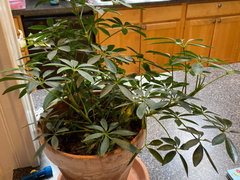
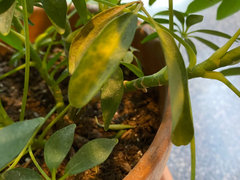
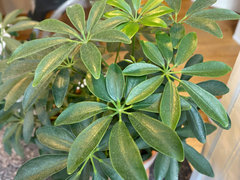
- 5 years ago
There are many cultural influences capable of causing the mottling on the leaves, which signals the leaves are going through the resorption phase, which is the first phase of the Process of shedding (abscission). It signals the plant is breaking down the pigment 'chlorophyll' for the magnesium which is central to chlorophyll molecules. Over/under-watering, root congestion, nutritional deficiencies, insects, root congestion, temperature extremes, low light levels, represent most of the list that commonly cause this condition, but the most frequent would be over-watering and low light levels, followed closely by nutritional deficiencies - particularly deficiencies of the mobile nutrients N, P, K, Mg. You'll need to consider each cause and use your conclusions to eliminate the potential causes you believe are not in play, so you can concentrate on improving cultural influences or practices you feel are most likely to be causal.
It might be helpful to read this Overview of Good Growing Practices so you can compare to your practices. Often, any striking variance will jump out at a grower as a practice that can be improved.
Often, when there is so much info it's overwhelming, the best course is to forget about looking at symptoms as individual issues, and instead start from scratch with a more holistic approach wherein you first learn productive practices (the link above is a very good place to start), then use your practical experience to implement and validate what you already learned.
"........ but I'm also wondering if it looks like it needs a bigger pot. I also think I need to wipe down the leaves. Can I just do that with a wet cloth or should I use soapy water? Any advice appreciated. I'm so thankful for all of this support!" If the root/soil mass can be lifted from the pot intact, the plant would benefit from a repot, but that is insufficient cause (from the plant's perspective) to simply go forward without a plan and repot w/o considering the plant's natural rhythms. Unless there is very good cause to repot now, as in a life threatening emergency, all the plants we've discussed should be repotted in June if you want to make things easier on the plant. You're always free to do what you want at a moments notice, but the best practice is to plan ahead so you repot when the plant is strongest. This can be a critical factor for plants in steep decline.
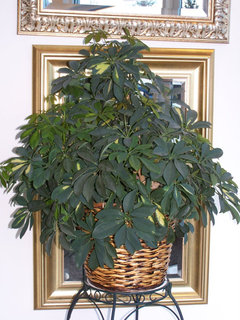
Never use detergents on leaves, and never allow detergents to get into the soil. Detergents DO dissolve protective waxes in the leaf cuticle (skin of the leaf) which prevent water loss and entry of disease pathogens into the plant, and even small amounts of detergent in the soil solution can destroy root lipid membranes. There are (insecticidal) soaps made from long chain fatty acids, which are specially formulated to be safe for most plants; however, schefflera is one of the plants listed as being sensitive even to insecticidal soap. Use a clean cloth, rinsed and moistened with water to clean leaves.
Scheff root-over-rock
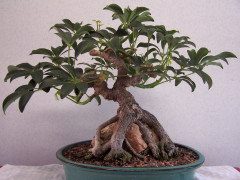
Office scheffs I grew from cuttings: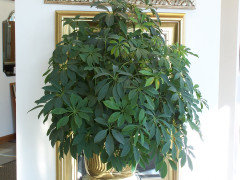
Al - 5 years agolast modified: 5 years ago
Morpheus, go find something else to do. All youre doing is contradicting others who have a lot more knowledge than you and confusing the OP.
Your mention of MG moisture control combined with sand tells me everything I need to know.
Becky Cohen Gestwick
Original Author5 years agoOK, the general consensus seems to be a damp cloth, so I will try that. Thank you for taking the time to help me. This forum has been so helpful!
Becky Cohen Gestwick
Original Author5 years agoOh no, don't fight! This is all in the name of a friendly and helpful plant community. Just like with everything else in life, there are many different ways to reach the same outcome. What works for one plant parent might not work for another. For example, my aunt, who has a green thumb, has 40 year old spider plants that have never been repotted. Most would question that, but her plants are happy and that works for her. I appreciate the advice that people have given me. Let's try a little kindness.
- 5 years ago
Morpheus,
No clue what document you speak of. Nice comeback though.
Name calling? I called you Morpheus. Didn’t know that wasn’t allowed around here.
Becky, listen to what Tapla (Al) has to say. He’s been around here for years and has helped a lot of people with his expertis.
Morpheus likes to stir the pot and spread misinformation.  5 years ago
"likes to stir the pot and spread misinformation."
The classic definition of an online troll! And very apt.
- 5 years agolast modified: 5 years ago
Morphues - “name calling and insults aren’t allowed here”
”the toddler got spanked blah blah blah.“ -Morphues.
”You can’t fix stupid.” -Also Morpheus.
Try making some sense, I guess. You like to talk, but you really don’t have anything to say.
You seem to have a lot of free time. Ive noticed you’re on a roll commenting on everthing you can find. Enjoy.
Note: the site dying has absolutely nothing to do with this. It’s been dying for a long time. Especially ever since Houzz had anything to do with it. But you wouldn’t know that, you’d just blame it on anything that’ll make you standout to be the good guy. This site was better when you hung out in the grass forum bothering them. I’m sure you had the better lawn and all the knowledge in your 200 square foot apartment surrounded by concrete.
Edit: lastly, was the well framed screen shot taken before or after your edits?









tapla (mid-Michigan, USDA z5b-6a)