Software
Houzz Logo Print
mark_ackerley73

Running a new gas line for range/oven

5 years ago
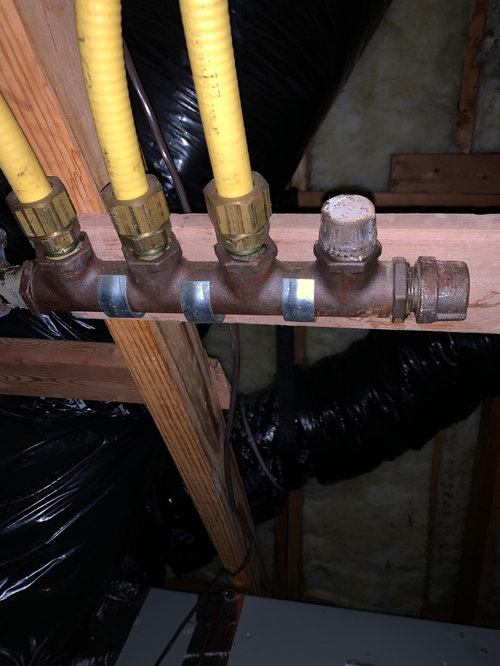
Hi all, homeowner here who wants to add a gas range/oven to my kitchen, which will require running a new line. Here are the facts...


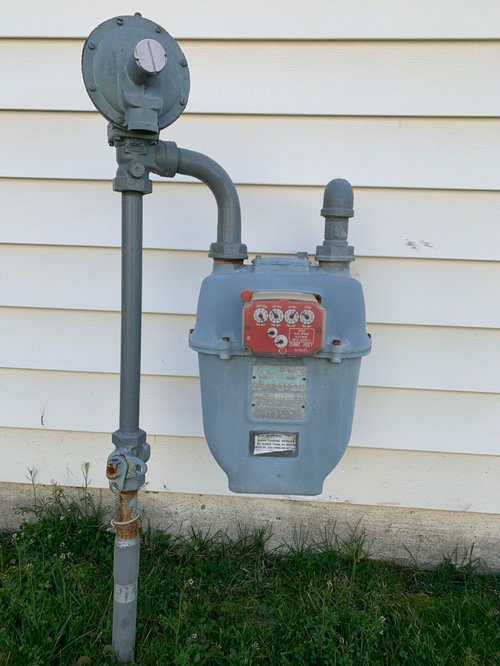
- Total pressure delivered by gas company to house: 2psi

- Existing gas appliances: fireplace (30k btu, rarely used), furnace (60k btu), water heater (34k btu)

- Distance from meter to manifold: 15 feet

- Distance from manifold to appliances: fireplace (70~ feet), furnace (5 feet), water heater (15 feet)

- All of the above appliances are run with 1/2 inch csst

- Gas range/oven I hope to install: https://bit.ly/3bs3G9S which has 63,500 btu (+ whatever the oven needs, which isn't stated in the link, but I assume is around 15k)


QUESTIONS:

  1. Can I run a 3/4 inch line up to 100 feet around the outside of the house, then back inside to where the range will be? The other options is going through the attic for about 75 feet, but that will be difficult due to limited accessibility up there.
  2. If the answer to Q1 is 'yes', can I put a tee fitting right at the gas meter house line and start the exterior line there? Or, does it need to be run from the manifold, which is in the attic?
  3. Whether I run the line outside for 100 feet, or in the attic for 75 feet, is 3/4 inch csst the right size? If that is bigger than necessary, will the regulator in the range bring the pressure to the right level?


Comments (11)

  • 5 years ago

    Running pressure to the range and having a regulator there might be the best option. There are, rightly so, a lot of code issues that must be met with running lines outside.

    However it's done I'd strongly suggest hiring a qualified plumber to install this. Minor mistakes in gas line installations resulting in leaks, damage to the line or fires can result in serious health problems or death.

  • 5 years ago

    This is for planning purposes to be honest. I wanted to first answer the question of whether or not it's even feasible to get a gas range in the kitchen, and if it was, what it would take.

  • 5 years ago
    last modified: 5 years ago

    CSST outside also presents a problem with induced voltages from lightning (it has been a problem with indoor CSST also).

    Read up on grounding and bonding requirements for CSST. It's great stuff, but if it's not bonded properly it can burn your house down. Was happening here with some frequency before the issue was discovered... thunderstorm and new $1 million house went up in flames. The induced voltages caused an arc and punched a small hole in the CSST and ignited the gas leaking out.

  • 5 years ago

    I'd run the new line in the attic. An exterior run of 100 feet would be a huge sign that a non-pro/DIYer did the job. Plus, it's a forever eyesore. In the attic, it's a clean install, protected and out of sight. Your manifold looks to be at least 3/4" so at 2 psi that has plenty of capacity. 1/2" CSST (corrugated stainless steel tubing) from the manifold to the stove will supply about double what you need at 75 feet. If you can safely install the new line, fine, otherwise have a plumber do it.

  • 5 years ago

    You're right about the eyesore, i was looking into getting conduit or a raceway to hide it at least but that might not be possible with code requirements. I would definitely prefer everything to be run inside and sounds like that's the simpler way to go. As for bonding, that is a definite requirement as I've heard tales of what can happen. When my house was built in 2001, they did NOT bond the existing csst so that will be addressed during this project too. Another question: for a house like mine with the aforementioned gas appliances, how many locations throughout the system, and where, need to be bonded? The breaker box is directly below the manifold.

  • 5 years ago

    Only one bonding location is required. The bonding requirement requires that grounding be connected to a brass (CSST) fitting, a steel manifold, or any rigid pipe components, so you may already be properly bonded at a location other than at the CSST tubing connections, so look around. Also, you are not allowed to ground directly to the CSST corrugated tubing (might arc and cause a pinhole). The CSST tubing itself does not require a separate grounding connection because the tubing is grounded via a brass nut that captures a steel ring around a corrugation which is then screwed tight into the brass fitting, this establishes and electrical path between the rigid and flexible sections of piping.


    https://www.youtube.com/watch?v=7QiNMnDdXQ8

  • 5 years ago
    last modified: 5 years ago

    My vote is for the attic also (since I don't have to install it... ).

    A neighbor just had gas logs installed and the black pipe was routed outside the perimeter of the house (was done by gas log installer). It seriously looks like crap.

    For bonding details, follow the instructions provided by the manufacturer.

    If you feel it's outside your pay grade, get a pro to do it.

  • 5 years ago

    "Only one bonding location is required."

    We had to ground each manifold.

  • 5 years ago

    Another question: when the csst is run through the attic, it will need to come back down through an exterior wall to the ground floor where the range will be. Is it possible to do this without opening the walls? I'm assuming not.

  • PRO
    5 years ago

    Just do induction. Better performance. Less upgrade issues.