Software
Houzz Logo Print
oldhomeplace

Landscaping around long pond

5 years ago

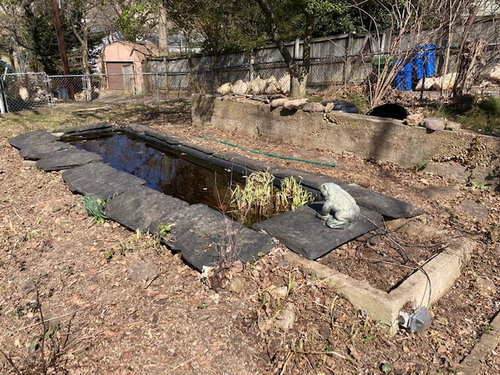
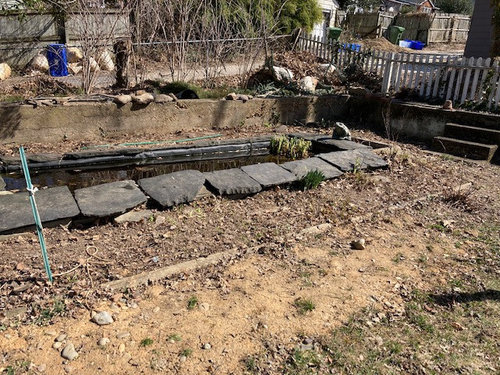
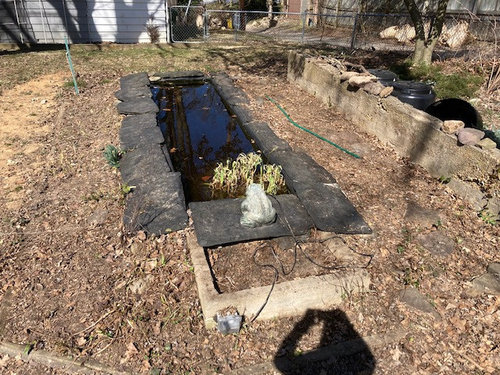
Hi - a bit stumped about what to do around this long pond at the back of our backyard. We are in Maryland. Images are from today when we swept away the leaves and took up a few rocks. It is currently surrounded by hostas although due to tree removal the last couple years, we have more sun now than previously. There had been some rock borders and other plantings but I've neglected it for several years and hoping to start over a bit. My partner really prefers native plants. When the hostas grow in it's difficult to get around back of the pond to scoop leaves, manage the pond cover, etc, and I'm not sure what to do with that area - it's a jumble of random stones, old bricks, and the hostas. There are a few daffodils in the front. Partner has been talking about installing a trellis on the short retaining wall to further separate the pond area from his compost/brush pile empire. The empty sandy area in front of the pond resulted from a pond leakage 7 years ago and nothing grows there now and it collects water when it rains due to how our yard drains. I don't know what to do with the little planting area behind the frog.


I would like for it to look tidy and green and be able to walk around it as needed. Partner prefers lots of (native) plantings to using mulch. Thank you for any suggestions!


Comments (3)

  • 5 years ago
    last modified: 5 years ago

    Rectangular pools are semi-formal to formal. I think they are best outlined in brick or concrete edging, and I would replace the wide slate(?) you have now with narrower concrete capstones. Lay the slate elsewhere on sand for a sitting area.

    If you have not already cleaned the bottom of this pond you should do so. It does not have to be perfect, but you should remove any leaves and as much gunk from the bottom as possible. You should try to remove the bricks and stones as well as the hostas from the area between the pool and the short wall. You can store the hostas in pots in the shade until you can replant them, or plant them where they might be happier.

    I agree that a trellis against this wall is a good idea. Install several posts in front of the wall and attach trellis or lath strips to the posts. Add lots of compost to the soil there and plant a native Wisteria frutescens or Lonicera sempervirens.

    Pool plants are planted in heavier soils (don't add compost as it will foul the water) in pots that sit either on the bottom or on blocks or crates to lift them closer to the surface. Lilies do better in still water so put them on the opposite end from the frog fountain. Nymphaea odorata is the native species, but there are lots of hybrids and cultivars in white, yellow, pink and red. Marginals should be set with the soil level near the water's surface. There are low growers such as Myosotis scorpioides and Mimulus luteus, and taller Iris pseudacorus and Pontederia cordata. The area behind the frog fountain should have a dwarf evergreen. Here is one list of those.

    The above are what you need to do to fix the water garden. Later, when you have time, consider turning the area that already collects rainwater into a rain garden. A rain garden is not a bog garden; the plants used can take short term inundation to dry periods, whereas bog plants require constantly moist soil. Many garden plants will work in a rain garden. Here is a list of some. To avoid hiding the water garden I would use low growing plants only. Remove some soil using it to raise the ground level elsewhere as needed. Add lots of compost to the remaining soil making sure the area remains low. Then plant those species that prefer moist soil in the lowest spot and plants that tolerate drier soil around the edges. Runoff will fill the depression during heavy or extended rain but should soak in within 24 to 36 hours if your drainage is good. Remember that these and other plantings should not overwhelm the water garden.

    P.S. Here is one list of Native Species for Maryland.

    Hannah Koenker thanked mindshift
  • PRO
    5 years ago
    last modified: 5 years ago

    A really big mess is what you have. What is the style of the home ? IMO a rectangular pool is avery contemporary shape so is that what you want? That retaining wall needs some serious work for sure . I need more info and whay do you cover the pond at all. I live in Zone 6 and never cover our pool and leave the pump running all winter . I think you need to provide a lot mor einfo to get help. I find the pond in an odd palce in the yard so what else are you wanting to put there?

  • 5 years ago

    Hi, thanks! Our house dates from the 50s and the backyard is full of these weird concrete walls, steps to nowhere, etc. Pond was here when we bought the place. Lots of leaves accumulate in the pond area, hence the leaf cover in the fall. I agree it’s a big mess. The home is brick, really a ranch but with some colonial elements. Most other homes on the block are 1930s; our neighbors house is from 1890’s.

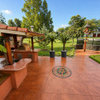
    We are not planning on changing the pool shape, just hoping for ideas on how to layer plants around the pond and maybe how to use the weird interior corners of the concrete walls. Otherwise my partner will just keep storing weed and leaf piles there! First picture below is a wider shot of the yard, the second shows a bit more what it looks like when the hostas and irises come in.