Software
Houzz Logo Print
rock_lee5

Sheathing question for Builders and Contractors.

5 years ago
last modified: 5 years ago

I am building a new home in Austin, Texas in all brick community and the construction will start soon. I noticed in this community for sheathing they use Thermo-ply, its like fancy a card board which says it has super strength, moisture & air resistant and makes your home strong. But you can tear it apart with your hands or punch a hole in it. So I thought they must be placing something behind it like osb or plywood and it will work as just air or moisture barrier. But NO, its all the sheathing the house has. So I started looking in other communities and saw all the builders are doing samething. If they are using stucco they use osb board and if its brick then just thermo ply. If a house has stucco and brick both then they use osb and thermo ply accordingly. When I say all builders then I mean from Toll Brothers too KB homes everyone.

Can any one explain what is the reason of it? Maybe I am wrong, may be thermo ply is really strong thats why all builders are using it (Except Chesmar homes, they use Zip System)

Comments (19)

  • PRO
    5 years ago

    It's inexpensive and meets local code.

  • 5 years ago

    @PPF.thanks for the reply, but which is best sheathing in you opinion?

  • 5 years ago

    You answered your own questions, "But you can tear it apart with your hands or punch a hole in it.". As PPF said it is intensive and meets local code. And with the pandemic probably even more readily available. Win, win for the tract home builder as he is not looking to build you a forever home. He is in it for what is best for his pockets.

    Rock Lee thanked millworkman
  • 5 years ago
    last modified: 5 years ago

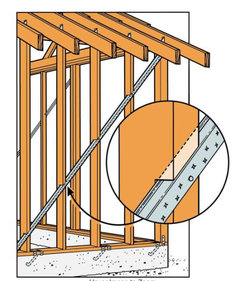
    All houses are required to have lateral bracing to resist high wind and earthquake forces. Codes allow OSB or plywood exterior structural panel sheathing or non-structural sheathing like Thermo-ply with bracing at the corners which can be OSB or plywood corner panels or diagonal "let-in" wood or metal members in notches in the studs.

    Important factors are the size (especially the height) of the house, the wind speed category, the earthquake zone, the climate zone, the type of cladding, what's available from builders, what you can afford and how long you intend to live in the house.

    I get to specify what's used on my projects so I'll use Huber Zip sheathing until something better comes along.

    You can easily upgrade most of what's inside but not the structural shell.

    Rock Lee thanked res2architect
  • PRO
    5 years ago

    The builders you mentioned are large-scale production builders. They've learned how to wring out every nickel of cost to build to at a particular price point and still make their target profit. They are not custom home builders and it would be inappropriate to gauge anything about their homes against a custom home.


    Based on experience in our area (neither of the above builders work in our area) production builders tend to be an annuity stream for smaller-scale remodelers and repair contractors who make their living correcting problems which conveniently show up just after the warranty period expires.

    Rock Lee thanked Charles Ross Homes
  • 5 years ago

    Oops, that question was for builders and contractors. I've never been hired to build a house but I've designed a few.

    Rock Lee thanked res2architect
  • 5 years ago

    It is always amazing what they do in Texas to keep costs low.

    Here in NC (and not in a high wind area), no one from Toll to KB would use anything but an OSB product. Maybe our inspectors wouldn't allow it but I don't think there is anything particular in the code that requires OSB as long as the bracing is there.

    Thermoply is used as an interior insulation covering - like knee walls. Not recommended necessarily but allowed.

    To OP, sounds like it is normal in your area, so you probably just have to live with it or pony up to custom....

    Rock Lee thanked David Cary
  • 5 years ago

    Rigid insulation board has been used as sheathing apparently for over a century. I have seen it used as far back as the 1950s. It started as a fiber product then foam dominated closer to the 1990s and remains today. Very common.

    Rock Lee thanked 3onthetree
  • 5 years ago
    last modified: 5 years ago

    I've built several brick veneer homes with XPS foam board as sheathing, using corner bracing and/or 2x6 bucking between all wall studs as speced by the engineers.

    Number one worthy son moving this month to a new home in an Austin suburb. It doesn't bother him at all. (But being blessedly single, he buys and sells on a whim.)

    Rock Lee thanked worthy
  • 5 years ago

    Celotex started making a sheathing board from bagasse a by-product of sugar cane processing in 1920. There have been many variations of it and they still make a fiberboard sheathing called Blue Ridge Fiberboard.

  • 5 years ago

    ditto what mw said. It's ALL about money!!!!!!!!!!!!!

  • 5 years ago

    I remember when I brought up foam sheathing with my builder, the big concern was sloppy brick layers putting holes in them and not knowing about it. In the right setting that isn't a problem of course. Using foam has a value over OSB.

    Not sure that thermoply has an advantage other than cost. Not that this should be ignored but when buying a home at a fixed cost, the buyer/new owner isn't reaping that benefit.


    Rock Lee thanked David Cary
  • PRO
    5 years ago

    It's ALL about money!!!!!!!!!!!!!


    Yes, Robin, it is. Production builders, like any for-profit enterprise, need to make a reasonable profit to stay in business. That's a valid business objective. They also need to manage the costs of production to be able to sell homes in a particular price point. Substituting less expensive alternative materials and methods is a way they are able to do both. If you don't like the products they offer for sale, you are free to purchase something else.

    Rock Lee thanked Charles Ross Homes
  • 5 years ago
    last modified: 5 years ago

    For me the critical issue is the lateral bracing system. When non-structural insulation sheathing is used, its typical to install 20 ga. diagonal metal straps at the corners. That isn't adequate in my area and I wouldn't accept it anywhere else either. You cannot predict the weather.


    Rock Lee thanked res2architect
  • 5 years ago
    last modified: 5 years ago

    I'd assume Thermo-ply ® Structural Sheathing is structural. I remember using it in the 80's on hundreds of 3 story condos overlooking Boston. Shoot it on with a roofing gun, overlap the seams, then cut one of those metal braces on the interior of the wall.

  • 5 years ago

    Thermo-ply is GARBAGE, a polymer saturated cardboard and if they paid me I wouldn't use it. One thing which makes a difference in a house? Yep, no cardboard.


    Matt Risinger, a builder in Texas highlights the best and worst building methods used. This one; 5 dumbest building products starts out with the dumbest, cardboard siding but he won't mention the product by name.


    Even the installation techniques are horrible, no sealing, taping and tradesmen knocking holes through the stuff with hammers to run pipes and wires and never seal the holes.

    WARNING! If you allow your house to be built with this crap walk around the exterior and inspect for holes and seams not sealed and make them do it right.

    Rock Lee thanked outpaientzero
  • 5 years ago

    no sealing, taping and tradesmen knocking holes through the stuff with hammers to run pipes and wires and never seal the holes


    They'll do that to OSB as well. Roofers love their handy hatchets for opening roof sheathing for vents or smashing the dimensional boards on old roofs. Looks fine from the outside!

  • 5 years ago

    does it mean in this case osb with stucco siding is better than thermo ply with brick siding?