Software
Houzz Logo Print
ymg200

Need advice on fixing over compacted soil around a newly planted tree

5 years ago

I have planted two bare root trees and created a berm around each tree to keep water close to the roots. When I fill each basin inside the berm with a gallon of water, the water seeps through the soil around one tree within minutes, but stands in another basin for an hour. Trees are about 20 feet from each other, so the soil is similar. I believe that I have over compacted the soil around one of the trees and that is why the water doesn't drain properly. What can I do to fix over compaction and improve drainage? I don't want to disturb the tree by digging around it. I'm thinking to use a core aerator to make holes in the ground around the tree. What else can I do? Is over compacting a common problem? Is there a common solution to it?

Thanks all.

Comments (12)

  • 5 years ago

    We had a similar problem with a tree we planted. The company that planted the tree created a basin around the tree. You would fill the basin and 10 to 15 minutes later the water would come out of the ground about 30 feet down slope from the tree. No evidence of spillage or water within 20 feet of the basin.


    In my case I believe the problem is a subsurface lay of more porous soil. With the basin full the water drains through the lay and eventually comes out of the well. sort of a micro springs.


    My lot is about 140' wide with a fall of about 20 feet across the width. It is about 300' deep, with a similar slope to that area. From that pint the land drops another 30' to a small creek which is about 130' from my property line. I know the water pools in the lot behind mine about 50' up slope from my back lot line.


    To me the only explanation is the porous lay that run under my lot.


    That was over 9 years ago and shortly after we moved into this house. Over the years I have found that with the slightest rain that area of the yard becomes wet and stays wet long after the rest of the yard dries out.


    I am not sure how to correct it so, for now I am living with it.


  • 5 years ago

    hmmmm.... you are thinking about fixing something that may not be a problem ..


    your holes drain ... so whats the problem??? .. so what if one drains a bit slower ...


    you dont mention your soil type ...


    you probably should have perked your holes.. to find out about drainage ... before ..


    https://duckduckgo.com/?q=garden+perk+test+soil&t=ffnt&ia=web


    are the trees leafed out... if not.. maybe you should just dig it back out.. perk it.. and react accordingly ...


    in nature... there is no one to drill holes and around trees ... its a tree ant a lawn... i dont see any equivalency ...


    you said bare root .. what kind of tree.. have they leafed out.. when did you plant.. did you amend.. whats you base soil type how about a pic .. or two ...


    you dont list many cultural variables.. other than one hole appears to drain slower ... more facts please .... big city location might help ;.... a little excess water in spring is not definitive all the time ....


    ken

  • 5 years ago
    last modified: 5 years ago

    "true compaction is almost never a problem in home lawns. Hard soil is the problem."

    You will find a whole lot of soil scientists and lawn care professionals that disagree with that statement! Soil compaction is very common, especially with lawns. Anything that creates pressure on the soil surface can lead to compaction and the more moisture the soil holds (as it gets closer to field capacity), the greater the impact of any pressure will be. And it tends to build up over time. Even repeated walking across a lawn along the same path can create problems. Ditto with lawn and garden equipment use, kids' play areas, pet areas, etc. This is why we are cautioned not to walk in planting beds - our weight can cause compaction.

    Soil compaction at planting can occur when one firms the backfill too solidly or partially fills the planting hole, waters to remove air pockets and settle, finishes filling and then firms again. With newly planted stock, this is relatively easy to correct by just piercing the soil surrounding the planting hole deeply with a garden fork and wiggling it back and forth.

    Not nearly as easy to correct if the problem is widespread throughout the lawn and garden. And don't be fooled by fix-it-quick solutions. Compaction happens over time and it takes time and effort to correct as well.

    ymg200 thanked gardengal48 (PNW Z8/9)
  • 5 years ago
    last modified: 5 years ago

    Individual holes poked into the ground by a tool don't aerate the soil between the holes. So you should loosen (cultivate) an additional area of soil around the original planting hole for your tree with a fork in such a way that all of the soil is loosened. Do it when the ground is not wet. Also while being sure to back away as you go rather than stepping on soil you have just worked. And mulch afterward - preferably with wood chips - to help it stay loosened.

    And if even that doesn't seem to have been adequate later you will have to do something more dramatic like making a berm or excavating and replacing a bed sized area of soil, replanting the tree in that.

    wood-chips.pdf (wsu.edu)

  • 5 years ago

    Soap or shampoo is a surfactant.....it reduces surface tension in dry or compacted soils and allows water percolation. But it does NOTHING to reduce or counteract compaction! It cannot recreate pore space. This is a well-recognized concept with any soil scientist as is fully explained by soil physics. Easy to research if one wants to bother.

    I also find it quite humorous that home gardeners with no specific training are intent on disagreeing with highly trained horticulturists that have earned PhD's in the topic. Somehow their meager anecdotal experience makes them more knowledgeable than specialists in the field. How does that work??

  • 5 years ago
    last modified: 5 years ago

    Quote: "Did you see any water seepage from hole #1, the one that drained quickly? "

    There was no water seepage visible form the original hole. As with any new tree we watered it for several months after it was planted. I became a game to find any evidence of leakage from the basin around the hole.

    Since this was 9 years ago, there is nothing else that can be done with the hole, as the 14' Nuttal oak has grown to about 35' and the diameter has more than doubled.

    We are about 25 miles east of Raleigh about half way down the slope of the Piedmont Plateau. on its way to the coastal plain. So we are are living on a eons old mountains side.


    Still fighting the wetness of that area.

  • 5 years ago

    But [a surfactant] does NOTHING to reduce or counteract compaction! It cannot recreate pore space. This is a well-recognized concept with any soil scientist as is fully explained by soil physics.

    You cannot fully explain soil science with physics or even physics and chemistry, as any soil scientist can tell you. Pores are created by roots, worms, fungi, arthropods, and microarthropods, not physics or chemistry. Once the surfactant restores percolation and allows water down to where the soil temperatures are cooler, the environment changes to favor the biology, and the biological population explosion does the work of opening pores in the soil.

    Somehow [home gardeners] meager anecdotal experience makes them more knowledgeable than specialists in the field. How does that work??

    So you're dismissing the numerous university studies of surfactants already done (many years ago), showing that they are as effective as core and tine aeration? How does that work?

    Here's how home gardener dismissal of your phantom science works. You don't have the science you claim to have. For whatever reason(s), the specialists refuse to spend 50 cents to try an experiment on their lawn. Perhaps the reason is that they only do science when someone else pays for it. We're willing to pay for it ourselves. Big Shampoo has yet to realize their products are being used in the garden, so they have not funded the universities to quantify the results. Even when scientists try to make things work, you can end up with the Iowa State fiasco regarding corn gluten meal as an effective organic preemergent weed control. For those who read the research instead of the marketing, their research shows the best they could do was 80% weed control, and that was not repeatable. Eighty percent still leaves a yard full of weeds even under their ideal circumstances. Then they patented the product and we have to pay more for CGM than we used to. So basically we home gardeners are trying things that the universities have not tried (yet). We are not necessarily more knowledgeable, but we might have more experience with some ideas then they are. When we find something that seems to work, we farm it out to our peers for review...our peers being other home gardeners. We don't have the resources to do a large scale, randomized, double blind, placebo controlled, project. All we have is peers. So ours is not scientific evidence, but when a few peers adds up to lots of peers having success, then we might throw it out there for others to try. I'm not calling the Earth flat. I'm trying to help solve a problem common to lawns. Are you a scientist with clear scientific evidence, clear statistical results, proving I am wrong? You can sit there and postulate things until you're blue in the face, but until you try it and make your own observation, I'm more skeptical of you than I am of those reporting success. Do we make mistakes? Sure. I used to tout ordinary cornmeal as a universal antifungal product for lawns. It turns out cornmeal is not universal, but it seems to work only in St Augustine lawns. It has no effect in cool season grass. I don't have any research, but I have lots of people reporting back with pros and cons thanking me for suggesting cornmeal to recover a diseased lawn.

  • 5 years ago

    >> if you held marching band practice on the football field in the same place every day, even after heavy watering or rain, then the marching is going to compact the soil.


    I regret saying this, but that marching band was me.

    I have watered the newly planted tree and then stepped around it to compact the soil. I've never planed a tree before and I didn't know that I shouldn't compact the soaked soil. The water was discharging up from around the trunk as I was stepping on the soaked soil around the tree.


    I've made holes around the tree using a core aerator today, but that hasn't improved drainage at all.


    I will use longer (than coring aerator) metal tubes to make deeper holes tomorrow.


    I've used "Liquid aerating soil loosener" (which is essentially a surfactant that was suggested above) on the lawn about a month ago and it did help. However, I am not sure if it is safe to use this chemical now that I have newly planted trees. Is it safe to use the surfactant now?


    I will use a cultivator to loosen top layer tomorrow and make deeper aerating holes with a metal tube.

    Is there anything else I can do to improve drainage?

    Thanks all.


    Pictures below:

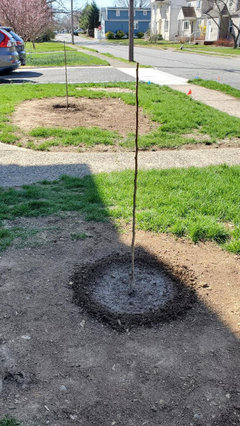
    1. I've planted two trees planted in bald spots. Bald spots are from trees that used to be there, but died because of verticillium wilt. I've planted new trees in exact spots where old trees used to be. I've removed old stumps from the ground (which was a lot of work) and I made sure that new trees are resistant to verticillium wilt. The soil was very loose after stumps removal since I had to do a lot of digging.


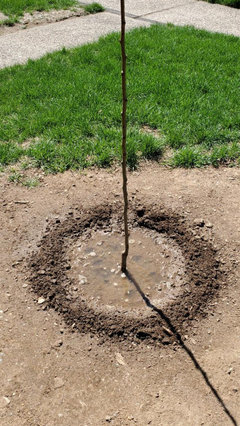
    2. Two hours after I poured a gallon of water into the basin there is still plenty of standing water. Holes that I've made with the core aerator are visible through the water.


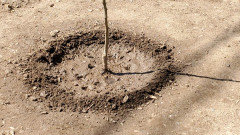
    3. Four hours after watering: almost all water seeped through the soil, but few small puddles are still visible.


  • 5 years ago

    Again the holes you are making will have no useful effect on the aeration of the soil between the holes.

  • 5 years ago

    Very succinct and well said.

  • 5 years ago
    last modified: 5 years ago

    That soil looks very 'Clay' like. It shouldn't be surprising that it drains very slowly. The difference in the two planting areas is not surprising either, clay loams can vary in drainage, one reason could possibly be that one area has more gravel underneath.

    If you're absolutely sure that the reason for the slow drainage is that you compacted the earth yourself, now would be the time to dig the tree up and reset things once you loosen the soil in that area, including the roots.