Software
Houzz Logo Print
michael__ames

Pruning ficus elastica–looking for suggestions on shaping & branching

5 years ago
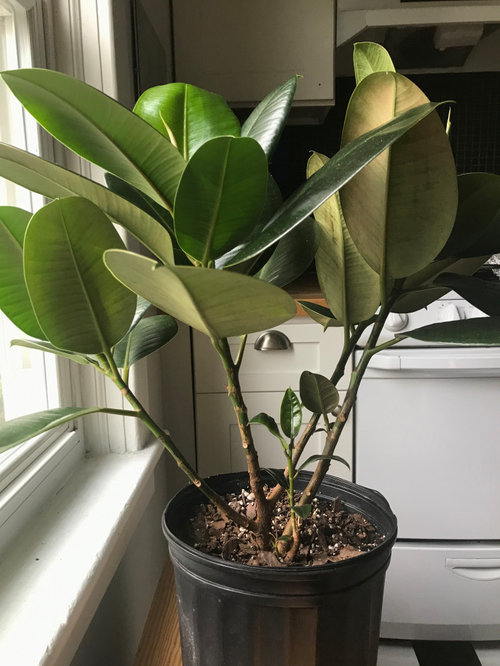
I brought home a ficus elastica in early April. It sits in front of my west-facing kitchen window and has happily been putting out new leaves since then, even backbudding a bit without my intervention.


I'm planning on repotting it in mid-June (following tapla's/Al's advice), getting it out of its peaty-nursery soil into either gritty mix or something like greenman28's "gritty 5-1-1". I'm thinking about dividing it during the repotting process (provided I can do so without damaging the roots), but I'm seeking some advice about subsequent shaping/pruning.


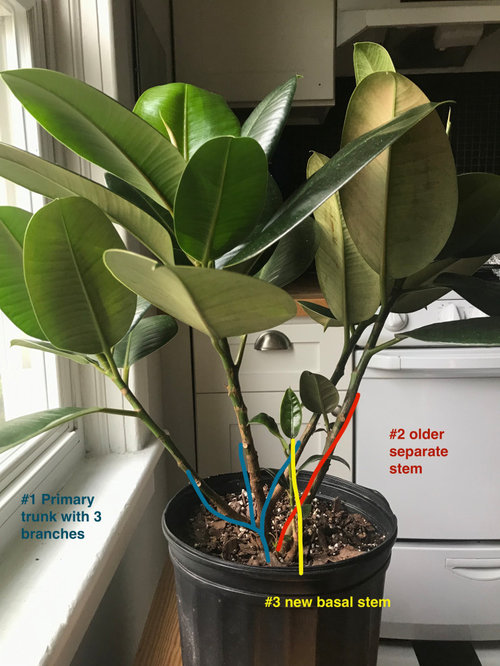
Here's the plant in question, along with some child-like annotations:


There's already three branches on the main trunk (#1 in blue), but that branching junction happens quite low on the tree, and no subsequent branching going up those three stems (clearly no one was following tapla's regular pinching advice at the nursery).


Stem #2 is either wholly separate or, if joined, the juncture is below the soil line.

One both #1 and #2 there is some backbudding (from nascent growth tips up to 2-3 leaf branch starts).


What I'd like to do (unless advised against it):


–Plant the primary trunk (#1) in its own pot; pruning/pinching later in the summer to encourage fuller/more 360 growth (since right now it is very much a trident shape)


–Plant #2 in its own pot; prune hard later in summer to get lower branching (perhaps halfway down its stem, right above a current backbudding-branch)


I'm not sure whether to keep the new basal stem or not.


My questions for any of you who've successfully dared to give your ficus trees such extreme haircuts:


1. I plan on doing some root trimming when I repot. Should I prune at the same time? I've seen it suggested to repot, then prune a month or so later to give the plant the best shot at bouncing back from a hard prune. But I've also seen it suggested to prune top and bottom at the same time, so the plant's reduced root network isn't overtaxed.


2. Should I just do some light pinching on #1 (or #2) to encourage backbudding rather than a hard chop/prune?


2a. Or should I just repot this year and wait until next summer to prune?


3. Any other suggestions for shaping? Overall I'm happy to have some existing branching and seeing (some) signs of backbudding but the current three-prong, long-stem look of #1 isn't something I want long-term.


Thanks.


Comments (2)

  • 5 years ago

    First rule of pruning potted trees: You can always cut it off later, but once it's off ..... you can't put it back.

    You think that would be an extreme haircut?


    With F elastica, if your tree is healthy, you could cut every stem back to just above the soil line and the tree would back-bud profusely from whatever was left, so you really can't prune the top of a healthy elastica unless the tree is quite weak.

    I think you'll find that everything you can see is supported by a single root system. IOW, there is only 1 organism in the pot. What you marked in red is attached to what you marked blue, and yellow is attached to red. I could be wrong, but that's my guess.

    What you have on your want-to-do list is fine, but again, how the tree is actually put together might trump that list.

    If the 3 branches/trunks of the main part of the tree (blue) are pretty much in a line from any angle, one should be removed from an esthetic standpoint. If you make an imaginary cut-through of the 3 trunks a foot or two above the soil line, looking down you'll see the 3 cut ends. If you draw an imaginary line from 1 to 2 to 3 to 1, it should form a scalene triangle. Reason: how many times have you seen 3 trees side by side in nature ..... that weren't planted. I only mention this because you have interest in not only manipulating the tree, but you want it to be as appealing to the eye as possible.

    1. I plan on doing some root trimming when I repot. Should I prune at the same time? I've seen it suggested to repot, then prune a month or so later to give the plant the best shot at bouncing back from a hard prune. But I've also seen it suggested to prune top and bottom at the same time, so the plant's reduced root network isn't overtaxed. I almost always do SOME pruning on trees that I'm repotting. If it's their first repot, or I'm doing a serious reduction in the volume of the root system, I prune quite hard. If I'm repotting or lifting a deciduous tree from the landscape to a pot, I often defoliate entirely. The reasons are, if you get wildly out of balance between the volume of leaves to roots, the tree is likely to collapse. If it doesn't collapse, trees are shedding organisms and they will shed leaves and whole branches in a desperate attempt to do their own balancing. The problem with that is, it might be a key branch the tree decides to shed - there really is no way to tell. The experts who tell you you should never prune the top to "balance" the root:leave ratio are not at all familiar with the repotting process. It's easy to say NEVER, when the only thing you've ever worked with are B&B trees or trees in nursery cans, which already have a balanced root:leaf ratio. Proper planting of a tree should include bare-rooting and correcting root problems at planting time. This will occasionally require some reduction of the canopy of deciduous trees to prevent the tree from simply collapsing. Broad leaf evergreens like Ficus other than carica, the hardy fig, simply shed leaves (if the tree doesn't die) when roots are pruned by a maniac who once has a start cannot be stopped.

    2. Should I just do some light pinching on #1 (or #2) to encourage backbudding rather than a hard chop/prune? It depends on where you want the branching to start. Wherever you pinch or prune, you'll likely get 3 or more branches from nodes most distal after pruning.

    2a. Or should I just repot this year and wait until next summer to prune? You can repot and prune this year with no concern about the tree's well-being. Elastica is very tolerant and would make a perfect tree for bonsai beginners if the leaves were smaller.

    3. Any other suggestions for shaping? Overall I'm happy to have some existing branching and seeing (some) signs of backbudding but the current three-prong, long-stem look of #1 isn't something I want long-term. Why don't you lift the tree from the pot and scrape off enough the soil so you can see what you're dealing with so there aren't so many variables. It won't hurt the tree if you don't gouge the roots too seriously. When bonsai workshop participants get their trees (usually by way of a drawing), the first thing they do is rake off the soil to find where the main roots begin. Often they have to remove up to 6" of soil because the nursery trees are planted so deep.

    Al

  • 5 years ago

    Well I curse myself for my own impatience – had the itch to repot yesterday and went ahead with it before I had the opportunity to read your advice here (though, luckily, after having read your comments on similar discussions here in the past).


    1. On the question of one vs. multiple organisms:

    I'm not sure if the evidence I found when repotting was conclusive. What I found were two distinct, lignified, almost parsnip-like roots right beneath the soil line – almost as if one was 'sitting" atop the other like in this picture below:


    Going on no more than hunch, I interpreted this to mean they were separate organisms at some point in the past and worked to separate them. The longer, finer roots were easy to untangle gently, but I worry I was too rough when separating these lignified roots/uncrossing their legs, as it were.


    2. Post-repotting:


    Here are the two, now repotted separately, about 24h later:

    Pot A — the three-branched one


    Pot B — the perhaps-forcibly-separated twin, + basal stem


    I watered them gently after repotting, and they're sitting about 2ft back from a western window (prior to repotting I had them right up at the sill, but my intuition is to give them a break from direct sun for a few days' post-op recuperation).


    I didn't do any top-pruning at the time of repotting, but I can if it looks like the root system can't manage to support what we've got above ground. I'll be on guard for leaf drop or wilting.


    3. On future pruning/shaping:


    It's good to hear that ficus elastica will (if in relatively good health) branch and/or backbud even if I cut back to a point where no leaves remain on the stem.


    For Plant A, I'm considering making the following cuts (in about a month), with the center branch the tallest, and the two side branches of shorter (but still staggered/non-identical heights):

    Alternatively, I might just cut branch #3 off entirely based on your advice for avoiding 3 branches all in a line.


    For Plant B — which looks quite gangly now — I'd like to prune hard to about half its length:


    One wrinkle:

    There's currently a developing branch about 1/3 of the way up the trunk, so I'm not quite sure a)where/how close to prune in relation to this,

    b)how to maximize the chance that the a new branch forming after pruning doesn't grow in the same direction as the currently developing one.


    For b, I know that cutting right above a leaf node will usually produce a new growing tip heading in roughly the same direction as the leaf (you've posted a nice line drawing of this effect on prior discussions). I'm assuming this will hold true whether there is currently a leaf occupying the node or not?


    Anyway, thanks for your advice thus far. I'll keep thinking about the ultimate shape I'm hoping for, and reading about the best routes to achieving it.

    Fingers crossed my repotting wasn't too rough.


Sponsored
Buckeye Basements, Inc.
Average rating: 5 out of 5 stars40 Reviews
Central Ohio's Basement Finishing ExpertsBest Of Houzz '13-'21