Software
Houzz Logo Print
webuser_812626080

Are planting zone guidelines still important for container gardens?

5 years ago

Hey everyone, new to the forum but hopefully this question makes sense.


I’ve done a ton of research for my planting zone (Nashville - 7A) in regards to what to plant and when. I‘m wondering how accurate/important the zone instructions are, given that everything I plant will be in containers and not in-ground.


Thanks in advance!

Comments (9)

  • 5 years ago
    last modified: 5 years ago

    Zonal information is probably even more important for containerized plantings than it is for inground stuff. Roots tend to be the most cold sensitive portion of a plant but something we do not consider much when planting in the ground. And that's because that enormous soil mass surrounding them never gets extremely cold and acts like a root insulator. But with a container planting, the roots lack that soil insulation and are exposed to ambient air temperatures, which are often well below any winter soil temps....by a very wide margin!

    This is why you see recommendations for permanent or year round container plants to be at least hardy to 2 zones lower than your own. And even that is not a guarantee for survival as root hardiness is not uniform and some are much more sensitive to cold than others. As an example, Japanese maple roots can be fatally damaged at temperatures much below 20F.

    Of course, if you are bringing the containers into a protected location for winter - like a garage, shed or basement - then this is of less critical significance. And really doesn't apply at all for annuals or very seasonal plantings :-))

  • 5 years ago
    last modified: 5 years ago

    Be advised that USDA "planting zones" tell you ONE THING. That's how cold the air gets in the winter. Many people consider these "zones" to be generic climatological indicators. They aren't. I used to garden in the PNW, and my USDA planting zone there was PRECISELY what I have here in Texas. The summer conditions in the two places couldn't be more different. So except to the extent that sometimes how cold it gets in the winter is an indication of what it's like in the summer, planting zones are next to useless for summertime gardening.

    If you're asking a specific question about gardening, please identify yourself by something more precise than USDA gardening zone. State, city, zip code, whatever.

    But that being said, yes, winter survival is probably more critical for plants in containers than for plants in the ground. The soil temperature in the containers is pretty nearly the air temperature, while in the ground it can be quite different - usually warmer.

  • 5 years ago

    SUPER INFORMATIVE! I appreciate the responses!

    To be more specific, I’m in East Nashville with a north (lowkey northwest) facing balcony where I intend to have my container garden. Knowing now that the soil temperature is what’s most affected certainly gives me some more guidance.

  • 5 years ago

    Then again, if you just wanted to grow a few tomatoes in containers AND were prepared to bring them inside if temps were to plummet, it would be fine to start them early and put them outside on beautiful days, bringing them in at night etc. I do this every year with a variety called Maglia Rosa which I grow in 3-gallon pots. I get ripe tomatoes In mid-June instead of late July :).

  • 5 years ago
    last modified: 5 years ago

    Let me add that, with regard to WHEN to do vegetable planting, ignore the USDA zone. It's completely irrelevant. The most important date is that of last frost. That's because many vegetables are simply frost intolerant (tomatoes, peppers, squash, cukes, etc.) That bears on the WHAT. You get to 31.9F, and poof, they're dead. Look up what your local dates are of last frost, and plant out frost intolerant plants accordingly. Be careful, because such dates come with probabilities. Most of the time, they are 50% probabilities, in that there is a 50% chance that you'll get a freeze after that date.

    Dave's has 'em all for you

    https://davesgarden.com/guides/freeze-frost-dates/index.php?q=37211

    For frost intolerant plants, I'd plant out at least a week or two after the 50% dates, and still prepare to protect in case of frost. 20% probabilities are more workable.

  • 5 years ago

    That Dave's site is very cool! Thanks!

  • 5 years ago

    I've done a lot of successful container gardening. For more tender plants, try covering the containers with old sheets or even a very light blanket overnight when the temps begin to fall. I also wrap the container itself in old sheets, several layers. I buy cheap at Goodwill or Salvation Army. Just that extra bit of layering around the plants and container help insulate the leafy tops, fruits and roots. It may not survive a freeze, but many will be OK for a light frost. Also, you can time your final harvest of the tender plants, yank them out of the pots, refresh the soil and replant quick growing ones that will be OK in cooler weather - lettuces, radishes, spinach, carrots, etc. As Dan mentions, go by your likely first frost date and work backwards. Keep in mind that some veggies get a sweet tinge to their taste with the first frost so your container season isn't over just because of the cold. I've also kept many sweet pepper plants alive year over year by bring the containers inside for the winter (trim them back, water sparingly as they go dormant for the winter, set them back outside in the spring). The plants get huge with each year and will need larger pots but you'll have peppers very early.

  • 5 years ago

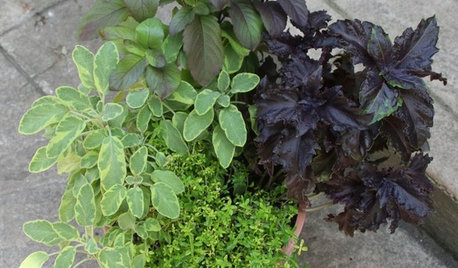
    Don't know if you're planning to include herbs in your container garden, but in 7b northern Virginia, I've had sage, oregano, chives and mint in the same containers, left outside over winters, for years. I give them their last haircut after the first hard freeze and they come right back late winter/early spring. The oregano dies back some, but mostly stays leafy all winter, which makes for a nice winter greenery when everything else is bleak (but it has a bitter taste in the winter so I don't harvest then). I let some of the chive blossoms go to seed every few years so the container reseeds itself, when the older clumps start looking like they're tired. Or get a 25 cents pack of chive seeds from the dollar store and sprinkle a few in the container every couple years to rejuvenate the pot. Store the leftover seeds in their original packet in your fridge veg crisper drawer in a zip baggie. They'll stay viable for a few years, as will many many other seeds.

  • 5 years ago
    last modified: 5 years ago

    For frost proofing, covering containers is a good idea. Wrapping them probably is not. Why? Because what keeps containers warm is the soil underneath. You cover containers, and the soil underneath is covered as well, and that soil warms the air inside the cover. You wrap containers, and there isn't anything warm inside the wrapper. You surround a wrapped container with freezing air and, pretty soon, that container is going to get freezing as well.

    You keep yourself warm by wrapping yourself because you make heat, and you want to keep it in. Plants don't. That is, if you put a coat on a plant, it won't keep it warm.