Software
Houzz Logo Print
jacqueline9ca

OT - four o'clocks

5 years ago
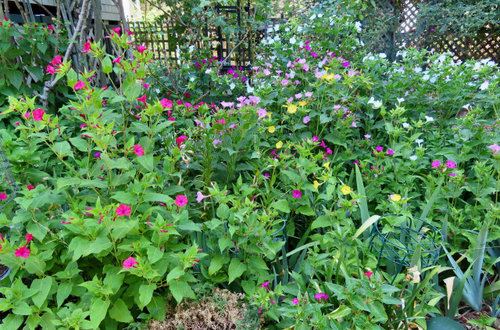
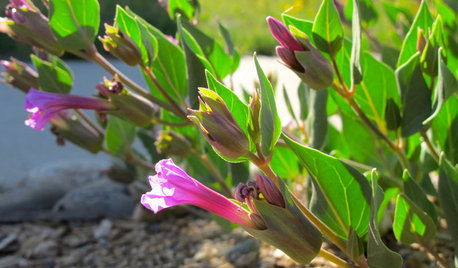
I love four o'clocks, which came into my garden in a seed pack of "mixed flowers". However, I soon discovered that they loved to spread, and did so with energy.


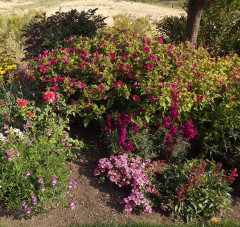
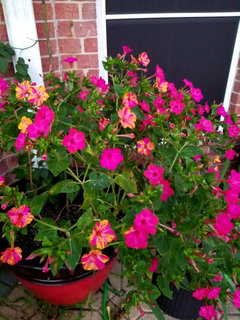
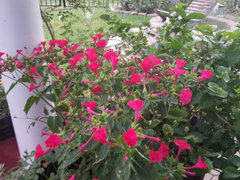
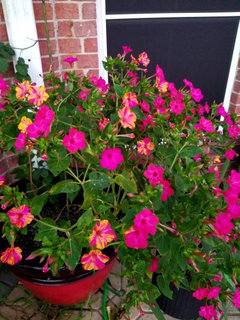
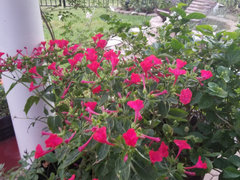
I have since kept them to one bed, where they appear out of nowhere and bloom with abandon for 8-10 weeks every summer. Below is a picture of them blooming in a bed which in Spring is roses, & iris, and later lilies. During that time, no four o'clocks are in evidence whatever - they fade away and completely disappear in the Fall.


I mention them because they go well with climbing roses, and provide a marvelous display when it is hot, and much else in my garden is going dormant.


After working for years to get them out of other places where I do not want them (my fault, I had foolishly let them spread anywhere they wanted to), I realized that this bed, which is surrounded on all sides by either blacktop or a brick patio, is a perfect place for them. ( I have the same theory about vinca, which is a fabulous ground cover if you make sure the bed it is in is surrounded by serious hardscape). Their leaves are distinctive, so if a tiny seedling appears anywhere else, it is easy to pull up, which I do immediately.


Four o'clocks do this appear and then disappear trick because they grow from tubers. Young ones on seedlings are just a wide spot in the single root, but we have dug up ones which were the size of footballs on occasion. Anyway, these tubers get lower under the soil as they get older, so that is the secret of their ability to appear and disappear. In the picture you can see the many colors. I did have some striped ones, but they have all vanished, so I think the solid color ones are what you get long term.


Jackie


Comments (20)

  • 5 years ago

    Your 4 o’ clocks are just lovely, Jackie! They fill the bed with pure cottage charm. I agree that 4 o’ clocks make delightful rose companions, especially around cultivars with bare legs. My mother grew magenta 4 o’ clocks, and hummingbirds flocked to them. An added bonus is that Mom’s were lightly fragrant. Have you noticed that yours have scent? I think the solid colored oned are more long lived, as you said. Wherever I have seen striped ones growing, eventually I see only solids. I’ve tried to get 4 o’ clocks started here in Portland, but I think our harsher winters kill them. I may try potting some and seasonally protecting them. Your photo reminds me how much I miss these flowers which remind me of my mother’s and grandmother’s gardens! Carol

  • 5 years ago

    Four o'clocks do like to wander.

  • 5 years ago

    I planted the white variety from Select Seeds. They self-seed in their area only and come true to color each year. I have had them for about 7 years or so. One year I dug up one of their tubers in the fall (like a giant Idaho potato!) and stored it in the basement along with the other summer bulbs. The next spring I planted it out in the 4 0'clock bed. It bloomed about 10 days earlier than the volunteers from seed -- not enough of a time differential to offset the work of digging it. However, I have noticed that the volunteers that came up close to the house foundation are semi-hardy; they have made it through four winters so far. There tuber must be deep and close to the house foundation.

  • 5 years ago

    portlandmysteryrose - If you get some seed (the last time you will have to buy any!) and plant it in a pot, I'll bet it will come up and bloom, and you will have a baby tuber. Then, if you need to, you could move the pot to a protected place for the worst time of winter. Then bring it out into the sun. After a few years you will have several tubers in that pot, and then you could dig a hole (we have found that the tubers move down by themselves - we found one 2 feet down! ), and plant the largest one maybe a foot under the surface (below where your soil freezes, in any event) where you are sure you want four o'clocks, and I'll bet it will come up, and then be far enough down to survive the winter the next year. Or, if the pot has multiple medium sized ones in it, you could dig them all up, and making SURE they were dry, store them until Spring. Or, Four o'clocks set lots of seed reliably, so it only takes letting one crop to mature in the Fall to have a bounty of seed to sow the next year if you want.


    Jackie

  • 5 years ago

    One of our houses in New Orleans had them in the back yard and the tubers were the size of Jicamas.

    Talking to old timers neighbors (back when NOLA had neighborhoods and only a few newcomers like us), they talked about as children collecting the fragrant blooms, stringing them into necklaces, and taking them by ferry to Jackson Square to sell to the tourists for enough pennies to buy sweets at Angelo Brocchaio's. (Uncertain the spelling of his last time.)

  • 5 years ago

    Inquiring minds would like to know - what is a Jicamas, and how big are they?

    Jackie

  • 5 years ago

    Oh, stillanntn6b, you are going back a ways! Brocato's has not been in the French Quarter for several decades, having relocated to mid-city. (What I wouldn't do for one of their cannolis right now!) But I had an older friend who likewise told of making necklaces of the blossoms when she was a child. When I smell the fragrance of four o'clocks, I'm brought back to NOLA (though not so much I am from the odor of sweet olive!)


    My parents' house -- an old building -- had magenta-blooming four o'clocks with the prodigious tubers you describe. As the de-facto gardener, I did end up trying to extricate some to eliminate them as the plants would get too lanky and huge, but they continued to return every year from seed, and I never really wanted to *totally* eliminate them.


    Some seeds inadvertently hitched a ride in some pots I moved with me to TX, and I have them in my backyard now.


  • 5 years ago

    And jicama are a tuber that is big, easily pealed, tastes vaguely of pineapple, and adds crunch to salads. I first had it at a meeting with a rancher in El Paso.

    Maybe this link will work

    https://encrypted-tbn0.gstatic.com/images?q=tbn:ANd9GcRXbWafo9XJaW03UgHbNbooT1jSUCDMsN9Zdg&usqp=CAU


    jacqueline9CA thanked stillanntn6b
  • 5 years ago
    last modified: 5 years ago

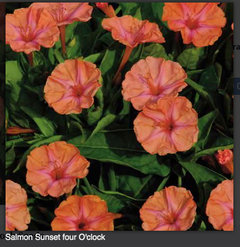
    I'm a big fan of four o'clocks. A really, really nice color of four o'clocks is 'Sunset Salmon', which I grew from seed for the first time this year, to give it a try. It's just as easy and vigorous as the other colors, very strongly scented, and its color would nicely complement many of the roses I grow, at least. This year, it is in its own little bed by the patio, its plants intermingled with volunteer plants of the dusty red/orange colored version of Zinnia peruviana, a pleasing small-flowered species zinnia that, as far as I'm concerned, can grow wherever it wants. They look good together.

    I got the seed from Swallowtail Gardens ('Sunset Salmon' Mirabilis). Here is a screen shot of Swallowtail's photo, to give an idea of the color, which is soft orange with a bit of pink highlight:


  • 5 years ago

    Thank you for the great advice, Jackie! I had no idea that 4 o’ clock tubers grow so substantially. I’m going to try what you suggest—planting seeds in pots, letting the results mature and then planting tubers 12” down when they are large enough to hold their own through our icy winter weather. I’ll let you know how it goes. If I get anything even remotely resembling yours, I’ll be celebrating! Carol

  • 5 years ago


  • 5 years ago

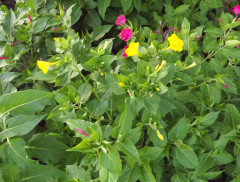
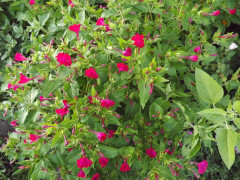
    This has been such an interesting thread, and I've learned a whole lot more about four o'clocks. I grew them for several years, and had to reseed every year, though a few seemed to come up from the previous year. I'd read a bit about the tubers, but I thought it got too cold for them to winter over here. I still have a lot of seed from gathering. The quail around here like the seed, too and were a challenge some years. I never had trouble with four o'clocks spreading. The default color seems to be the magenta, and a bright pink that's almost magenta. You can see the pink in the lower right hand corner of the photo above. One year, I selected for yellow when a few came up, and I seeded them the following year for a few of the yellow again, but it doesn't come back the way the magenta does. Gradually, the above bed was taken over by large roses, heliopsis, and butterfly bushes, and the four o'clocks died out. Now, after reading this thread, I want to grow them again, but no room is my problem. I love the Sunset Salmon shown above. Diane

  • 5 years ago

    Carol, (and anyone else on the rose forum for that matter), if you'd like seed of the white variety -- it will come true from seed if you don't have any other color varieties around -- let me know. I'd be happy to send you seeds in the fall.

  • 5 years ago

    I do have a love hate relationship with 4 o'clock. I love the flowers, fragrance and how easy they are. But man do they take over. I can't find my roses in the summer, just whacked through a forest of 4 o'clock, felt a little sad doing it...but they were suffocating the roses. Its hard to eliminate once planted, I guve it weed stats. Also, every part of the plant is toxic, good news is my cats are not interested in it.i have the red, magenta, yellow, white and there are some plant with various shade sof blended colors, quite beautiful.

  • 5 years ago

    Regarding 4 o'cloks getting "too lanky and huge". Yes, they do get large - but only about 3 ft high at the highest, which is why I have them beneath climbing roses. At least here, in the Fall they get lanky, then start disintegrating all by themselves - no need to pull or dig them out - I just let them fall apart and them pick up the pieces. The stems fall apart into leafless sections about 1 foot long each, and look remarkably like a cartoon picture of animal leg bones. After that I do not see them again until late June, when they begin reappearing.


    I first discovered them in our town, growing and blooming happily in vacant (NOT irrigated!) lots next to the sidewalk, in both the magenta and yellow colors. I just collected the seeds from those plants. Since we get NO rain here (even when we are having our normal 30 inches of rain in the Winter) from April through Sept, I think they are really "water wise" plants, something to do no doubt with the huge far underground tubers they form.

    Jackie

  • 5 years ago

    I love mine


  • 5 years ago

    I love mine


  • 5 years ago

    My four o'clocks are making their growth now but not blooming yet. My experience echoes Jackie's. I let them grow where they won't be in the way and pull them out of beds where they sprout unwanted. I had one or two last year that sprouted from cracks in the paved terrace: they were splendid there, but did drop their numerous seeds in the adjacent narrow bed of herbaceous plants, from which I've been pulling seedlings ever since. Their name in Italian is 'bella di notte': "beauty of the night". While Jackie's garden is more developed and better maintained than mine (it's been around longer and has had time to mature), both are powered to a certain extent by plants that come on their own and take care of themselves. Four o'clocks are great hole fillers in a season when there's not much in flower for those of us who don't water, an asset in the garden.

  • 5 years ago

    I studied and grew several members of the four o'clock family. There is a member that is native Minnesota and one that is native to the American Southwest.


    1. Thomas Jefferson grew this one:

    to https://www.selectseeds.com/heirloom-fragrant/four_o_clock_fairy_trumpets_seeds.aspx

    Yes, it was beautiful and fragrant, but in my garden it was too low and sprawly; it was not a "stop and look/sniff" plant.


    2. This one I still have: https://www.highcountrygardens.com/perennial-plants/unique-plants/mirablis-multiflora

    Text from HighCountry Gardens:

    "15-18" tall x 48-72" wide (seed propagated). In its full afternoon glory, Wild Four O'clock has few rivals. A mature plant will have hundreds of magenta-pink flowers open at one time! This short grass prairie wildflower is one of our most xeric species with an enormous, deep-growing taproot. Plant it in any soil, even clay, where it will get plenty of sun and heat. "


    Also, I have learned to mark where this one is planted -- it comes up only when it gets warm and settled; this year it didn't poke up until the first week of June! I have it planted in almost pure sand it a hot location. It is glorious in late July -- it is easily over 5' across and covered with flowers. It has never reseeded; I wish it would!


    3. This one I wish I had NEVER planted: https://www.minnesotawildflowers.info/flower/wild-four-oclock

    Yes, it is native, beautiful, and tough. But, its long vertical tubers ensure that even one year old volunteers are hard to eradicate, and it self-seeds with abandon. In sandy soil, it can form a dense canopy. I have been trying to eliminate it for two years, and although I've put a dent on their population, I have not been able to eradicate it. The good news is that I've not seen it in the clay areas.