

Bloomfield Abundance (NOT spray Cecile Brunner)
I looked at the pages on HMF for this rose, and am very happy that almost all of the photos of it, except one or two (and several very old ones) are actually of the re-discovered BA, (Fred Boutin identified it) and not of one of the many forms of Cecile Brunner. Yay! It has its own listing on HMF! In order to avoid confusion, if you see on HMF, or anywhere else, a photo that says it is Bloomfield Abundance, but in which the blooms look like a Cecile Brinner, then that photo IS of a CB plant.
They were evidently mixed up in commerce a LONG time ago (perhaps even shortly after the introduction of BA in 1920, as some folks in the UK insist that their families have been growing the false BA for generations) , and eventually what we now call "spray Cecile Brunner" totally replaced the true BA in commerce. This was questioned over the years, by people who grew CB plants, and looked at the purported pics of BA which were advertising the rose in commerce then, and said something along the lines of "if it looks like a duck and it walks like a duck, it IS a duck!". A controversy emerged, as rose folks LOVE to argue over the "true" identity of roses. The "it is a type of CB" side of the argument basically got nowhere, until TA DA! DNA analysis was done on the false BA in commerce, and low and behold, it WAS a type of Cecile Brunner! (There are still evidently hold outs who do not believe DNA analysis - what can you do?).
Then Fred Boutin discovered the true Bloomfield Abundance, which does look just like the old photos of BA from the breeder (which IMO look nothing like a CB plant - even in B&W, as the blooms are larger, and the growth habit is wrong for CB). I now grow both plants (one BA, one Cl Cecile Brunner, one bush CB, and one huge ancient plant which is either Spray CB or bush CB. Anyway, the plant I have of BA has a growth habit like a short HT or a floribunda, nothing like any of the three CBs I have. I love, love the blooms - medium large (much larger than the CB blooms), and a medium pink with sometimes raspberry highlights (much darker than the CB blooms).
I was thinking about Bloomfield Abundance today because when we first got it, my DH built it a special slightly raised bed in the middle of a large flower bed of mostly iris and lilies, with climbing roses at both ends. However...that is also the bed which erupts in Four O'clock plants every July/Aug. They get bigger every year. I was walking by that bed the other day, when I realized that I could not see BA at all, nothing. I pulled back the Four O'clock foliage, and there it was, growing backwards fast because it was not getting any light at all (and had been very well pruned by the deer when they could still see it). So, yesterday when our gardener came, I had him disassemble the small raised bed (not raised enough!), dig up the BA, and plant it in a very large pot, and move the pot to our still totally empty new garden which is now 100% surrounded by a deer fence. I will leave it in that pot until it recuperates, and then plant it in that garden, where it will get 6 hours of direct sun a day. Then I will take pics of it and post them on here. Meanwhile, if you want to see very good pics of the TRUE BA, look it up under its own name on HMF - it is very beautiful.
Jackie
P.S. Nothing above means I do not like all of my CB plants! Two of them were here when we moved in, as my DH's ancestors planted them, and I love all of them.
Comments (24)

jacqueline9CA
Original Author5 years agoThank you Sheila - I love old rose mysteries, and although many antique & mystery/found rose collectors know all about this one, I thought there might be more people on here who did not know about it, and it is nice, I think, to think about something which has nothing to do with "current events", or even current problems in the garden.
JackieRelated Professionals
Jacksonville Landscape Architects & Landscape Designers · Torrington Landscape Architects & Landscape Designers · Portsmouth Landscape Architects & Landscape Designers · Columbus Landscape Contractors · Killeen Landscape Contractors · Worthington Home Builders · Saint Joseph Landscape Architects & Landscape Designers · Gulfport Landscape Architects & Landscape Designers · Clarksville Landscape Architects & Landscape Designers · Greenfield Landscape Architects & Landscape Designers · Olean Landscape Architects & Landscape Designers · Jacksonville Landscape Contractors · Elizabethtown Home Builders · Grand Forks Home Builders · Jamestown Home Builders 5 years ago
Your 4 o’clocks are magical, and your photos have inspired me to try them again, too, but I am so relieved you rescued BA from drowning in the lushness! What a rare beauty!! Cottage gardening keeps us on our toes for sure. My daughter and I read Tove Jansson’s Moomin comics, and one of the strips follows the Moomin family’s adventures as their house is devoured by the garden. It reminds me of my garden, and my daughter and I laugh about all the things that have disappeared or might disappear into my shoehorned beds.
A big thank you to Fred Boutin for rediscovering the real deal BA. I did check out the photos on HMF and was impressed by how different BA is from Spray CB. I think it’s wonderful you grow both multiple CBs and BA in your garden, and it is especially delightful that two of your CBs came with your family’s house. Carol
jacqueline9CA
Original Author5 years agoThanks, Carol. One short story about one of my CB's: when we moved here 30 + years ago, I knew NOTHING about roses, and it took me a few years to notice that there were many, many of them in the garden, some barely clinging to life because the near-by foliage had drowned them. One of these I finally noticed was a rose cane right in front of a huge shrub which emerged every Spring, grew about 24 inches high, and then died back (without blooming, and hardly putting out any leaves). After I had noticed it doing this several years in a row (I was working full time, and way too busy for the garden), I took pity on it and dug it up, and moved it across the driveway to a bed where it would get some sun. BAM! its new growth almost hit me in the back as I was walking away from the transplanted cane. Within 4-6 weeks it was 4 feet tall, and then bushed out and became a nice round Cecile Brunner bush which blooms most of the time! I actually recognized the blooms as the same as a climbing plant of what my Mother called "the baby rose bush" which grew on her house. The ID was easy. That bush is still there, and still happy, and I KNOW that it is very strong, as it survived only the Lord knows how many years in the dark.
Jackie- 5 years agolast modified: 5 years ago
That is a WONDERFUL story about CB, Jackie! It made me smile as I read it. Your garden is like an unfolding mystery series. Every time you post about your decades long renovations, something new and amazing is revealed! Carol
jacqueline9CA
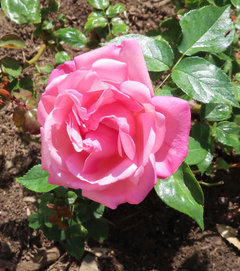
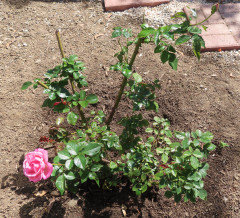
Original Author4 years agoUpdate on my Bloomfield Abundance rose which I had to rescue from the deer and the four o'clocks. My DH finished the deer fence and the path and the irrigation in the new garden, and about 6 weeks ago we planted the Bloomfield Abundance there. Here is a picture of its first bloom, and the entire now still small bush. How this rose got mixed up with the so EASY to identify Cecile Brunners is a mystery to me. It is an early (1920) HT, I believe, but I am not holding that against it - when it was in the other part of our garden, it did not grow tall and skinny like the mid 20th century HTs, but sort of a wider than tall shape. Will be interesting to see what this one looks like when it is mature.
jacqueline9CA
Original Author4 years agoWell, I was hoping to get some other people to post pics of their BAs, but perhaps I will just start a new thread.
Jackie
 4 years ago
I too, Jackie, cannot believe this rose could have been confused with CB. I'm having trouble even believing this is BA. It looks so generic in your lovely photos. DNA was checked though I thought, wasn't it? My Teas look so different from day to day it could really be a mystery of ID if I did not have the tags and memory of all the different looks on the same bush. I do not have BA sadly, so no help here. Yours looks great.
jacqueline9CA
Original Author4 years agoSheila - Bloomfield Abundance was evidently gradually lost in commerce as its name became only used for the plant we now KNOW (yes, DNA was done) was just a sport of Cecile Brunner, now called 'Spray Cecile Brunner'. It is my understanding that the rose Fred Boutin and others found in CA, and was brought from Gilroy "decades ago". There is a book written in/about South African roses in 1988 which shows a picture of BA which closely resembles pictures from the original breeder in 1920. See all of the pictures and stories of BA by looking up in HMF - it is very interesting. Anyway, no one has located a plant of the rose which was in South Africa in 1988, so now there is not anything to do DNA on to compare it to the one which was discovered by Fred Boutin. However, that one resembles the breeder's original photographs amazingly.
Jackie- 4 years agolast modified: 4 years ago
I wonder if the real BA ever made it to Australia. I was born in 1947, and my Nan had a huge bush of what i now know is Spray Cecille Brunner but she told me when I was small that it was BA. 40 years later, when I bought my SCB it was labelled BA. It was about this time that questions started to arise about the true identity of this rose. I was happy to discover here some years ago that it had been identified. It is such a lovely rose, and didn’t deserve to be lost. I hope one day to see the real thing, if some Australian rosarian is caring and keen enough to go through all the extensive and expensive procedures and quarantine and inspections to import it and propagate it here. I can but dream! Thanks for the lovely photos of your plant, Jaqueline
Melodye
- 4 years agolast modified: 4 years ago
Sheila did this rose survive the cemetery purge? Melodye
I love roseseeks photos on HMF They seem to show that there is pretty colour shading on the petals M
- 4 years ago
I've always thought it interesting that Jack Harkness observed that what was called BA was a sport of CB -- that he regularly saw the sport reoccur in their growing fields. But apparently no one paid any attention to that observation.
We've grown Fred's find for a number of years, but I seem only to have flower photos, not whole-plant photos. That's likely because its placement in our garden is such that it's difficult to get a good, clear photo of the whole bush. I'll have to try.
We did the DNA work with Spray CB. And it's been said above, but just to clarify -- that says nothing about whether this "real" BA is the real thing or not; it was not involved in the testing. But from the old photos, it looks like a good candidate. - 4 years ago
Melodye, I do not know if BA survives in the Sacramento cemetery. I am a 4 hr road trip away, and sadly was headed there when the pandemic broke out. I have only seen photos and reports by Anita Clevenger and others of the travesty there.
- 4 years ago
Doctor Manners thank you for your clarification of the situation. Sheila thank you for getting back to me. I’m sorry that you couldn’t get to Sacramento as you planned. Sadly a lot of us had to rethink our plans over the last 2 years. Melodye
- 4 years ago
Jack Harkness: the lone voice of the wise person in the wilderness! :-) Carol
jacqueline9CA
Original Author4 years agoEventually these sorts of confusions work themselves out, and I am hoping that some day a BA which can be traced to the 1920 original will be found, and then DNA can be done with the mystery one.
Jackie- 4 years ago
There honestly are a number of genuine, full-plant photos of BA on HMF. https://www.helpmefind.com/rose/l.php?l=21.336666 https://www.helpmefind.com/rose/l.php?l=21.315814 https://www.helpmefind.com/rose/l.php?l=21.257093 and quite a few nice ones of the flowering growth. https://www.helpmefind.com/rose/l.php?l=21.320689 https://www.helpmefind.com/rose/l.php?l=21.320688 https://www.helpmefind.com/rose/l.php?l=21.320687 https://www.helpmefind.com/rose/l.php?l=21.314553
- 4 years ago
For those interested, who don't have a copy of the Jack Harkness book "Roses" (1978. J. M. Dent and Sons Ltd.), here's the relevant quote, about what we today recognize as 'Spray Cecile Brunner', but which was being called 'Bloomfield Abundance' back then. Page 50, under 'Bloomfield Abundance.' "Like a coarse growing 'Cecile Brunner', with huge heads of buds. The small light pink flowers, like miniature Hybrid Teas, will be familiar to everyone who loves 'Cecile Brunner'. This is a mass supplier of them. It has long been obvious to nurserymen, who see their stock of 'Cecile Brunner' suddenly change into 'Bloomfield Abundance', that the parentage in Modern Roses cannot possibly be right. It is credited to Capt. George Thomas of California, 1920, and whatever the books say, it is a sport of 'Cecile Brunner'." What Harkness apparently didnt realize was that there was the original rose bred by Thomas, but the identities got switched in the nursery industry.
jacqueline9CA
Original Author4 years agoWow - that is so amazing - I did not realize that nurserymen were noticing that their Cecile Brunners sometimes sported to NOT 'Bloomfield Abundance'. That in itself makes the controversy so silly that it is hard to imagine why it took so long (until the DNA analysis of "BA") for the majority of folks (but not everyone, even then!) to get it.
I had a similar experience - I grow both Duchesse de Brabant and Dr. Joseph Schwartz, and had noticed that in a couple of my rose books folks were not sure if DJS was a seedling of DdB or a sport. Then, over a few years I noticed that my DJS was continually sporting "back" to DdB (it is a color sport - pink to white), and that DdB was remaining itself. Case closed as far as I was concerned.
Jackie- 4 years ago
Too often, nurseries are loathe to make those corrections. How long was Softee still offered as "Confederate Rose" after the identity was determined? How many continued offering Grandmother's Hat/Cornet/Barbara Worl/Mrs. R.G. Sharman-Crawford as different entries without referencing them as the SAME plant? How many still list Francis Dubreuil without a cross reference to Barcelona and Irene Watts without the cross reference to Pink Gruss an Aachen? And, don't even get me started on the Basye's Thornless/Commander Gillette/Basye's Legacy Issue. Whatever the blamed plant is called, they are ALL the same plant, supplied by the same original hand.
jacqueline9CA
Original Author4 years agoI don't understand WHY "they are loathe to make those corrections". Does it not affect their credibility, so that potential customers would wonder what other IDs in their selections are wrong, after spotting one?
Jackie- 4 years agolast modified: 4 years ago
Angel Gardens still lists Irene Watts. Peter Beales (who was the source of Pink Gruss an Aachen as Irene Watts) claimed he HAD the "real Irene Watts", though there was never any photographic proof. Why is there such resistance to correcting these errors? Only the nurseries can answer that.


jacqueline9CAOriginal Author