Software
Houzz Logo Print
blitz28179

Compost rant ?

5 years ago

The wait is on for the good compost to be ready to use. All the work of adding stuff, turning, watering, waiting, etc , then to see my compost pile shrinking. So I was thinking I was going to have alot but doesnt looks like its gonna be alot with all the shrinking happening. Just wandering if its better to buy compost than all the work of making my own?


A place near me sells what they call compost but its probaly 50% or more of cow manure so not really 100% compost IMO.

Comments (113)

  • 4 years ago
    last modified: 4 years ago

    I'm one of the lucky ones who has a composting facility nearby that has no supervision. I actually used to go at night and load up leaves. Now they do keep regular, and very reduced, hours, but no one is there ever except people bringing their yard waste. I've been going there since the mid-90s, so now I barely notice the puzzled looks I get. Most people understand nowadays without asking. I've had people pull their trucks up to mine and ask if I want to transfer their bags directly into my truck bed. I've learned now to say, "Only if you've got really good stuff. No branches or bittersweet, right?"

    I have a big space for composting and, only because of composting, I've had to own a truck for the last 31 years---ever since I first discovered the existance of leaf dumps.

    My fall routine is that I go to the leaf dump, dump out leaf bags to make sure there are no deer limbs in the bag and refill them with other people's yard refuse. I grab all the chipped leaves (browns) I can, and every hale or straw bale that's there. I also grab people's grass clippings, delighted if they're mixed with chipped leaves. The very best!! I grab every pumpkin I see which is a LOT following Halloween. There is also always a huge pile of apples when I go, or pears, that people rake off their lawns. Huge amounts of fruit. I get all my dahlia bulbs from the dump. People throw them out.

    When I get home I layer all the stuff in my truck into rugged circles of hardware cloth bins. I have at least six of them, maybe 8. I'm slightly more generous with my brown contributions. After a layer of browns, I put a decent layer of greens----often with a pumpkin in the core of the layer. I cover that with leaves, then more greens---pears, grass clippings, pumpkins or apples. I go get the kitchen scraps. I might toss in the chicken livers I bought and didn't cook. More chipped leaves and on and on. Not for any particular reason I always end with a layer of browns---less attractive to visitors.

    I'm a flipper. I enjoy composting as much or more than gardening and I find it pretty exciting to wait about two weeks, circle my hardware cloth bin as I tug upwards every seven inches, set the bin aside and toss the stuff back into the bin in its new spot a foot away. In another two weeks, I'll do the same circle dance and put the bin back in its original spot and refill it. I can put my bins side by side, then just shift them to the right or the left when I feel like flipping.

    After two weeks, I get steam and settling. In four weeks, those internal pumpkins are hot and flattened. Grass clippings help with the heat. Sometimes when I have a lot of pumpkins, I'll line the bin with carved jack o'lanterns facing through the wire. Because of that my neighbors have taken to dropping off pumpkins. Someone already put a little pumpkin-shaped gourd on my leaf mold bin.

    I keep a winter bin near the house, which receives the kitchen scraps over the frozen months. I try to toss some browns in there, but I don't worry too much. I flip it and mix it better in the spring.

    If a person wanted to flip a pile often, and could refuel it and feed it and keep it hot each flip, they could make some nice compost in a month, I bet. I don't do that, though. I flip them twice nowadays and leave them for winter. I couldn't harvest two bins this year because of those pink pumpkins. I just dug into the bin this week and the redworms were alarming in their numbers and their activities. (A lot of conjoined worms.)

    I'll stop. You got me all wound up on my favorite subject.


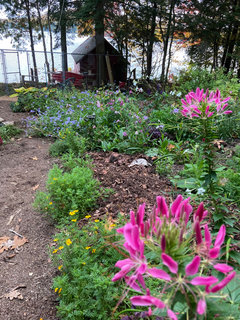
    I'm trying to spread that compost, but self-seeded nicotiana and cleome won't die.


  • 4 years ago
    last modified: 4 years ago

    Wow annpat you are dedicated! Thanks for the description

  • 4 years ago

    I would like to see a photo of your hardware cloth bin.

  • 4 years ago
    last modified: 4 years ago


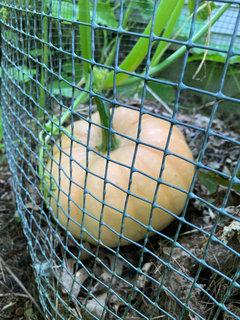
    What doesn't work is chicken wire. It's far too flimsy. My bins need no support and are decades old. Here in Maine, I don't need to worry about my bins drying out like other people might. If I did, I'd probably line the bins with cardboard or the paper bags my leaves come in. I don't usually get sentimental about volunteers in my compost, but I could tell early on that this pumpkin was special.

  • 4 years ago
    last modified: 4 years ago

    I wish I had more trees on my property. I live in ”northern” Ontario surrounded by woods. My property is one acre of lawn (except for the ”gardens” I’ve put in, surrounded by the woods. No rock, full sun, good soil…and every tree I’ve planted is having problems…even the few prexisting ones are dying. I’ve got deer who have kept my spruce to bonsai height. I’m jealous of Klem -lol.

    Reading about the wood chips in the playground and the smoke, I am getting scared because I just had the dead trees chipped and they are sitting on my driveway and the pile is probably about 10 cu yards. (I guess I forgot I am not so young anymore -lol). Is it going to catch on fire?

  • 4 years ago

    Yeah, those piles don't spread themselves, do they?

  • 4 years ago

    "I just had the dead trees chipped and they are sitting on my driveway and the pile is probably about 10 cu yards. (I guess I forgot I am not so young anymore -lol). Is it going to catch on fire?"


    The key word is dead so you have nothing to worry about. The smoking chips were from limbs pruned off live trees 2 days earlier.


  • 4 years ago

    Oh phew - thanks klem

  • 4 years ago

    If they've been piled up a few days, dig into them 1-2 ft and see if it's hot. If so, that's good but bears some watching. If not, no need to worry at all.


    Usually mulch piles that catch on fire are very BIG. Hundreds of cu yds, 5-20 ft high type of thing.

  • 4 years ago

    Thanks Toxic. I’ll start digging…Anyone need wood chips?

  • 4 years ago

    I sort of started looking at methods to compost piles of wood chips. I don’t think I have enough green materials. Has anyone ever tried composting a very big pile of wood chips?

  • 4 years ago

    @ Gargamel. The best thing to do it just let it sit for a yr or 2, But usually by that time weeds and other invasive plants have started growing in it. You could probaly do it faster but would require some sweat. If you move it every 6 months or so it would speed up process but that would be ALOT of work.

  • 4 years ago

    I didn’t think about weeds and invasives Randy…darn! I only had visions of a huge pile of lucious compost.

  • 4 years ago

    I bet you could tarp it? You would have to take it off and water it. Compost is like a plant it cant dry out

  • 4 years ago
    last modified: 4 years ago

    I haven't, but I thing the place I bought pine bark fines does. It was mostly compost when I got it. HOT! HOT! HOT! Smoked for three months where we piled it and we added nothing to it. It was so awesome, that I added to new Lasagna bed with manure. I can only HOPE it cooks as well/fast.

  • 4 years ago
    last modified: 4 years ago


    annpat

    : I think cleome is 'almost' as bad as Bermuda! I've tried for years to get rid of this tyrant, but haven't been successful.

  • 4 years ago
    last modified: 4 years ago

    Really? That's not the problem here. I can keep them in check. My problem with the volunteer cleome and nicotiana is that they bloom late and are lovely when I'm ready to put the garden to bed. Plus I had a late hummingbird come through here once in Nov. and those nicotiana helped him along his way.

    Someone introduced me to a way of dealing with wood chips. My paths are all wood chip paths. The SCM composter said that she builds new paths after a few years, going in different directions, leaving the old paths for planting in. After that I moved my paths once, and incorporated them into my garden, but I need my paths in the orientation they're in right now, so I think I'm going to dig my paths up next week, toss the black, decomposing chips onto my garden and refill the paths to a depth of 4-5 inches with the fresh woodchips I have across the street. I've been just tossing down a piece of cardboard and re-covering the chips with new chips annually, for years, anytime I see a weed penetrating the surface. It's pretty nice stuff right now.

  • 4 years ago

    Thanks for the info annpat…I’ll try that! It sounds like it’s less labour intensive - yippee!

  • 4 years ago

    >"I've been just tossing down a piece of cardboard and re-covering the chips with new chips annually," ___ Does that mean annual cardboard + chips, or initial cardboard + annual chips?

  • 4 years ago

    I have a few places on the paths with persistent problems---one area has rugged native ferns that want to edge their way in---and those areas I often had to re-cardboard for awhile. I noticed this year that I don't have have much going on in my paths. Things seemed to have been well subdued. I'm not crazy about the muddy color, though, and I've had some erosion, so I'm going to the man who makes wood chips the size of peanuts and get as many truckloads as he'll allow, which wil be unlimited, I imagine. I love going into winter with freshened paths and being completely surprised by the sight of them when the snow melts in the spring.. As I recall it took three 6' truckbed loads.


    My little town doesn't have a lot of respect for recycling. In fact, I'm not sure they really recycle anything, but the metal they get cash for. I pretty much either use cardboard under paths or in the back of my garden where wild stuff wants to encroach. I also have an old septic "system" from my childhood that opened up like a sink hole a few years ago across the road. I started putting broken clay pots, cardboard, weeds, dead chickens, and buckets of small rocks from my carrot row into that pit. I started making it a bottle dump, but I'm not sure about doing that.

  • 4 years ago

    That sinkhole will some day drive archaeologists nuts trying to figure out what went on there.

  • 4 years ago

    Annpat....you enjoy the process so much! As I do. I find decomposition fascinating. These days I cannot do much except toss stuff in the bin, but I do like to observe how things break down: corn cobs and whole carrots, very slow, etc. Chopped up stuff goes faster. With the current onion recall, I have two onions which will go in. I'll chop one, not the other. Prediction: the whole onion will still be there in the spring.

  • 4 years ago
    last modified: 4 years ago

    About the archeologists: Mad Magazine had a drawing of a site with labeled items, one of which was a toilet seat labeled "Ceremonial collar warn by priest in worship services".

    (Probably no researchers stretch more than etymologists in many of their derivations.)

  • 4 years ago

    @annpat Put some easter eggs in there for people to find amongst the debris...maybe even a time capsule? Put it in a sealed metal box and wrap it in bright orange tape or plastic sheeting.

  • 4 years ago

    You all are cracking me up! Annpat; I've started doing the same for pathways! It's so much easier and looks nice. The worms love it!

  • 4 years ago
    last modified: 4 years ago

    tox, I found hundreds of white, fancy seashells in the house this year that someone (not me) collected once. I took them to a nearby beach on the lake three or four times, and threw them in the sandy shallows. I was thinking it would puzzle current day swimmers and future archeologists. I was still there when some kids started yelling that they'd found some seashells. They kept running onto shore and giving them to their mother, and they left nothing for the archeologists.

    There are some inexplicable collections in this house. There are well over 100 keys here---lots of them the skeleton-type. Every time I find a key, I sling it under my boathouse, so someone's probably going to wonder about that someday.

  • 4 years ago

    Ha, I love the keys under the boathouse! Find a plastic skeleton and give him a keyring of skeleton keys and bury him under there too.

  • 4 years ago

    Annpat, at the seashore, when we have nicely colored glass or crockery to dispose of, we throw it into the water a little offshore, so it will get tumbled around in the rocks and come up as nice sea glass.

  • 4 years ago

    "...dump out leaf bags to make sure there are no deer limbs in the bag..."


    LOL, I can't believe no one commented on this line! That will certainly make me leery of opening bags of leaves from other people! Not that I need to - I could go into business selling shredded leaves. I have around 50 trees (mostly oaks) on and/or surrounding my just-under-an-acre property. It's a huge job in the fall but I wouldn't want it any other way. My husband doesn't agree, and gripes as we shred the leaves, but I just remind him that that's why the gardens he enjoys so much are the way they are.


    I do the same with my woodchip pathways - every two years or so throw the composted stuff into the garden, put down fresh chips on top of fresh cardboard or newspaper (which is getting to be a harder commodity to find, sadly!)


    :)

    Dee

  • 4 years ago

    >"mostly oaks" ___ I have been excluding oak leaves, based on statements that their high acidity makes them undesirable. Your good results belie sudh statements.

    Have some of your finished compost batches come entirely (or nearly so) from oak leaves?

  • 4 years ago

    Fresh (green) leaves may be acidic in nature but once dry, brown and fallen from the tree, they lose their acidity. Same with conifer needles. And including them as part of a compost mix reduces that acidic potential even more.

  • 4 years ago

    four, my "official" compost piles are mixes of kitchen scraps, shredded paper and light cardboard (like from macaroni boxes or cracker boxes), leaves and grass clippings. I don't bother paying attention to the ratio of the mix, but I'd say kitchen scraps and paper scraps make up the bulk, with grass and leaves getting put in every now and then. I too heard/read early in my gardening life about oak leaves being too acidic, but with so many of them, well, I make use of what I have! :)


    I do have an originally VERY large, now smaller, pile of shredded leaves (was shredding leaves for 20-something years by raking and putting through a shredder. Last year my husband bought a lawn mower tractor which he now uses to vacuum and shred the leaves for me so I have TONS of them). I use shredded leaves as mulch in my garden beds, and didn't get to use this whole pile. Last spring I was overrun with moles! It was a real "doh!" moment. I am so careful to put down the shredded leaves well after the ground freezes, to discourage little critters from getting comfortable for the winter, (keeping the shredded leaves in bags in the garage till I need them) but never thought about the fact that this giant pile of leaves was a virtual mole hotel! Heh heh, a "mole-tel" if you will.


    So this year I am going to make an effort to get the mulch down in the next month (it doesn't freeze here nearly as early as it used to - often out in January spreading mulch!) and then put a good amount in the compost piles and the rest in the woods. There's no way I can keep moles or other critters out of my yard completely (too rural for that) but I don't need to keep a giant leaf pile smack in the middle of my garden beds lol!


    :)

    Dee

  • 4 years ago

    I frequently contend with branched oak limbs that I have sawed off my trees. Will these green leaves, detached and in a big pile, likewise lose their acidity?

  • 4 years ago

    Yes. And composting will also neutralize any lingering acidity.

  • 4 years ago

    I've never taken ph in cosideration when composting but if compost were to lower ph,lime is inexpensive and easy to apply. This raise's the question if it matters whether lime is best added along with leaves,to finished compost or soil.

    What I do worry about in relation to organic matter in general (laying down cardboard topped with wood chips in piticular) is termites.

  • 4 years ago

    Very little concern about the pH of compost or its impact on the garden. With finished - or even partially finished - compost, the pH should trigger out at just about neutral.

  • 4 years ago

    I seen people mention they dont use hickory and walnut leaves because they said they have a substance in them that inhibits plant growth. Myth??

    Just seems like it would be impossible if you have all kinds of trees around and they are all dropping at the same time to keep them seperated? Seems likke it would be time comsuming

  • 4 years ago

    The leaves that I use are not dropped leaves.

  • 4 years ago

    They are fine once composted.

    tj

  • 4 years ago

    True also for camphor leaves? (Concern there other than acidity maybe,)

  • 4 years ago

    ANY kind of leaves can be composted, although some can take longer to break down. And like any acidity they might contain fresh, composting also neutralizes most allelopathic properties.

    When in doubt, compost!! It is the great equalizer :-)

  • 4 years ago
    last modified: 4 years ago

    four; my compost is mostly oak leaves and some small branches with green leaves that all the dang squirrels rip out of the tree when getting acorns. Lots of kitchen scraps, coffee grounds, garden refuse, straw with chicken manure and lots of shredded paper from my office. Been doing this for years. Paper is great in the summer when I don't have leaves and have all the grass clippings! When I start a new pile, I always sprinkle some mostly finished compost in with some manure. Then I beg the guys to go pee on the pile now and again!

  • 4 years ago

    My ingredients all are parts of plants. No longer will I exclude oak leaves, and camphor leaves and semi-woody branches.

  • 4 years ago

    It's no myth that walnut trees surpress plant growth in their root zone. Therefore I don't include walnut leaves, twigs or sawdust in compost/mulch.

  • 4 years ago
    last modified: 4 years ago

    How many of you while working in the yard and you got to pee that you do your thing in a 5 gallon bucket and then you pour it on the compost bin?

    For the ladies this process would be a little more complicated lol

  • 4 years ago

    >"I don't include... twigs or sawdust" ___ Are those parts known to be highly acidic?

    Nothing grows beneath my oaks. Little knowledgeable about this general matter, I wonder whether the cause could be, instead of the leaves, something in the soil that is promoted by the roots.

  • 4 years ago

    5 gallons? That’s impressive! 😉

  • 4 years ago
    last modified: 4 years ago

    four: I hear people say that about nothing growing under oaks, but I suppose light may be the issue. Mine get morning light an seem to do well enough. Now I do know the soil directly under the oaks is not dry, but dryer than anywhere else. So moisture loving plants are not ideally located there.


  • 4 years ago


  • PRO
    4 years ago

    Organically curated compost gives slow but wholesome results that are super favourable for the plants but if you think buying compost near you house is easy option then just go. One thing I would suggest is you ask for any feedback from the older customers so that you get the idea of the quality of its compost.

Sponsored
HomeCraft Remodeling
Average rating: 5 out of 5 stars5 Reviews
Custom Craftsmanship & Build Solutions in Franklin County, Ohio