Software
Houzz Logo Print
dmcjsb

Concealing outdoor pumping station

12 years ago
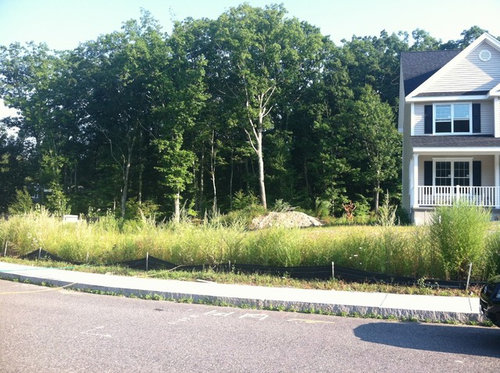
We are building a house that has the streets pumping station on the edge of our property. It's far enough away from the house we thought we can conceal it. It is now time to approach that step. We have two thoughts.
1. Do we have our buildings plant privet around the perimeter of the fence enclosing it?
Or
2. Do we plant privet from the furthest point in our back yard straight down to the tip of the front yard creating a complete barrier separating our yard from the station?
I'm not sure what will have the best look.
On the other side of the pumping station is the street.
My husband prefers option 1 bc it will maximize the yard space. I prefer option 2 bc It gives us more privacy an creates the illusion our property is separate from that station.
Has anyone had experience with this before and how did you handle it?

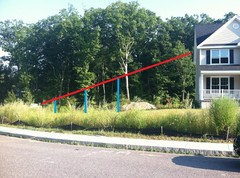
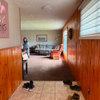
These are the best photos I have. The grass/weeds have overgrown making it hard to see.

Comments (23)

  • 12 years ago
    Ooohhh, be very careful about the privet. It can try to take over your life. Look at some of the smaller growing evergreen trees such as cedar. It would give you cover and not be such a bully as privet. Just a thought.
  • 12 years ago
    Anywhere under the red line would be ok to block the view. But I wouldn't place/build/plant anything closer than the tallest blue line, because it would be too close to the house and too tall. Plant a hedge or let a fence overgrow, somewhere between the shorter two lines. Some strategically placed (U- or L-shape) natural bushes around it will look best I guess.
  • 12 years ago
    last modified: 12 years ago
    HI -- Haven't ever come across this before , but if I am understanding this , I think build a fence in front or around it and then plant some hedging or plants or a hilled bed with some rocks and a few trees and tall grasses on your side so you can't see the pumping station from the house . So I think that is # 2 . You have a lot of yard so I don't think your losing any.
  • 12 years ago
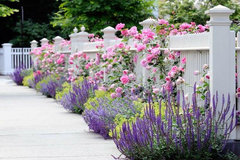
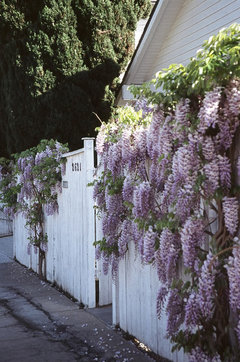
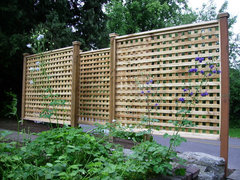
    Since you don't want it to appear to be on your property, a fence would make that declaration. Then enhance the fence with plantings so that would become the focus, not the station.
    Garden Design · More Info

    Katerina Tana Design · More Info
  • 12 years ago
    I've seen many people use large grasses to conceal utilities and I can't think of a reason why it wouldn't work in this application as well!
  • 12 years ago
    I would consider using tall native natural grasses; they can screen without being a fixture. They can be removed if needed; they can be trimmed if necessary. I don't think I would put a permanent fixed in place fence. If it gets backed into or blown down you have more expense and maintenance is always an issue. Good luck.
  • 12 years ago
    You don't say where your home is. I agree with standardc about nixing the idea of privet. We refer to it as 'everygreen kudzu' - horribly invasive. Hope you'll research this.
  • 12 years ago
    You might want to make sure you have a survey of the property lines before even entertaining a permanent structure. Many times fences or other permanent structures are thought to be (incorrectly) at the property line. Those grasses would be just great even though the utility box would be visible it would be minimized or maybe wouldn't even allow any visual of that box.
  • 12 years ago
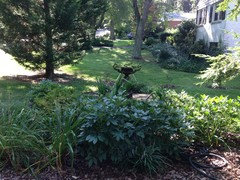
    When we first bought our home, the two raised storm drains were surrounded by rings of bushes. The photinia in the front and holly in the backyard drew your eye like magnets! Do not plant a circle or U to conceal your pumping station. Choose plantings no higher than the obstacle so your eye can skim over the top and open your vista. Our drains are fairly low so we used creeping juniper and yew as year round cammoflage and added peonies, lilies, crocosmia, and liriope for seasonal color and texture. We placed an urn in the center as our focal point of choice ( nicer than the drain).
  • 12 years ago
    I planted arbutus bushes of varying sizes. I love the pay-off. Their sark amber bark sheds, leaving a smooth under skin of taupe. AND it doesn't stop there. The large bushes can be limb twisted carefully to look like "barK art" They are evergreen, in the Fall season they drop a dusting of copper penny shimmering dust with a light blush seed pod. They're in the Madrone Family of evergreens, one of which is the Manzanita tree. They are easy to care for. you have a variety of similar trunking and dark green waxy leaves year round. From scrubs to trees...they are a beautiful compliment to a variety of grey industrial boxes, that are displayed right at the wrong spot....may it's the cold day pass gray...Can't institutions uses a Warm Grey 6 as the "gov grey" or are they attempting to emulate our for founders hair color. Being in the cosmetic biz....that's always a possibility? And a bad one.bye now! But do go online and bing,google, or better yet see the arbutus do their thing....absolutely stunning....If you come across it's history..will you send it my way? I'm enchanted by histories of anything. Here's one I need some help on. When you're not feeling great, life's a bummer for any reason...when we were kids..din't our moms or dads say "go outsie and take a swing". Why? Scientists have suggested that the act of swinging (not the swing dance nor the spouse exchange thing.) I'm talking about a swing. That when you sit on and start pumping your legs, you're transported. My anthopology friend suggests that "the swing" predates man. Is that true? Does anyone have a willingness to help work on the glory of swinging.
    jean ann
  • PRO
    12 years ago
    makeup_mirror, "...the Arbutus also occurs in the neighborhood of Killarney, where its presence is explained by the legend that it miraculously appeared to comfort the monk Bresal, homesick for the Spanish monastery in which he had spent many months when teaching the Irish style of choral music." -"Garden Shrubs and Their Histories", written by Alice M. Coats. It's a gorgeous hardcover botanical history you can usually find dirt cheap on eBay. Check it out, it goes on to give a lot of info about the Arbutus, but you sound like someone who'd dig that passage about Bresal.

    Landscape designers - we're the coolest plant nerds out there.
  • 12 years ago
    I agree with the person who encouraged you to locate property lines, I worked for a city building department for a number of years and it is so unfortunate for everyone if you do not have the correct info. I also agree if you build anything it will only draw attention, better to make it natural, maybe a gentle sloping up in a number of places and use the grasses(leave them plenty of space to grow) and then add to it each season, good luck!
  • 12 years ago
    We built our previous home next to an unmaintained field with lots of blackberry bushes. To avoid my husband having the urge to maintain what wasn't ours we planted small pyramid bushes to stop the eye. Since it was a long distance like you have we got the smallest size at Home Depot to be most cost effective. I'd suggest running the entire property line for a nice clean look. Even when they're small they are very affective in stopping the eye from something beyond b/c there is a long straight line. Dig the holes, fill them with water, place the plant, then back fill with dirt for a nice solid hedge whether you go with 5 foot or 1 foot bushes. We have a lot of wind in our area and have planted both sizes successfully in this way avoiding the unsightly wavy hedge line. The best part of this type of hedge is not loosing much yard space and the ability to choose the finished height. Slightly top them every year to promote growth width wise as well as keeping them all the same height. We mowed two lawnmower widths on the back side to avoid the unmaintained foliage from growing into our hedge keeping it nice and clean looking. Good luck with your project!
  • 12 years ago
    I actually had this same problem. The city would not allow us to fence near it because they have a required setback of 25 feet from the street for solid fence. They would only allow 4 ft picket with 50% open area. I would suggest checking with the building dept on that issue. We actually ended up moving due to the sewerage odor from the pump station.
  • 12 years ago
    last modified: 12 years ago
    I agree that trying to mask the pumping station will simply draw attention to it. So, you have two choices--either celebrate it in your yard by doing something very creative with it (sorry, landscaping around it or fencing one or more sides is not creative); or you can draw the eye elsewhere. In the latter, the mindset is not one of competition with a potential eyesore, but ignoring it. Pretend like it just isn't there: What would you put in that spot as a focal point? The problem is not that you need to take into consideration that it is there, but that, like all spaces, there are strengths you want to play up and weaknesses you want to play down.

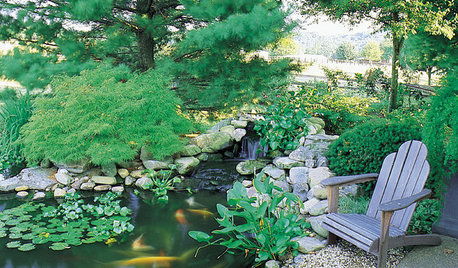
    Examples of the two solutions would be: 1. TO CELEBRATE: make a faux privvy large enough to be a small garden shed in the spot where any equipment can be seen. Decorate it to look like an old outhouse--with the crescent moon on the door, etc. OR, 2. TO IGNORE: create a water feature in that yard space complete with waterfalls surrounded by rocks, pebbles, a bridge at one end and tall, trees of various kinds--a willow by the pond's edge, dogwoods along a path to the bridge etc.
  • 12 years ago
    last modified: 12 years ago
    i don’t understand the “pumping station”. At first I thought you abutted a gas station and then realized it is some kind of a shared septic?

    If so, why are you the only one who is taking responsibility of making it look good or hiding it?

    Where we are, if a development, usually condo/townhouse type neighborhood, assoc fees go into landscaping and maintaining that area.

    If you block it from the street, you still look at it from your yard.
    Portland Patio · More Info
  • 12 years ago
    since weeds are already hiding the pump,
    take that as your clue and plant something similar and functional such as a rain garden, or mini prairie pollinator garden
  • 12 years ago
    I think you need to consider maintenance as part of your decision. How often do you want to deal with your barrier, and how much work do you want to put into it each time. Landscaping a hill around the pump station would be a little more work in the beginning, but very little maintenance from that point on. But, be careful, you cannot create landscaping that causes flooding on adjoining properties. Plant wise I think that the tall grasses are the best bet, and they would be minimal maintenance. I doubt if the "city" or other controlling entity would allow any type of woody plant, they would be concerned about roots entangling their pump station.
  • 7 years ago

    Think I would consult with the city or whoever owns/operates the station first.


    May save you a wad of cash and work if you did something on your own only to have the city tell you to remove it.

  • PRO
    7 years ago
    Old post 2013. Hopefully it has been sorted
  • 7 years ago
    Cedar is a mosquito magnet
  • 7 years ago
    The pumping station belongs to the utility company, and there is probably an "easement" piece of the adjacent land that the utility company controls. You need to go to the utility company's office to find out what you will be allowed to do and exactly where you may put it. They will then need to come out and put markers of some sort to show the actual space they control. If you don't get the utility company's input, you may have to remove anything you plant or build there.