Software
Houzz Logo Print
zachary_harris4

Air handler is “sweating” and causing puddles. Incorrectly sealed?

5 years ago
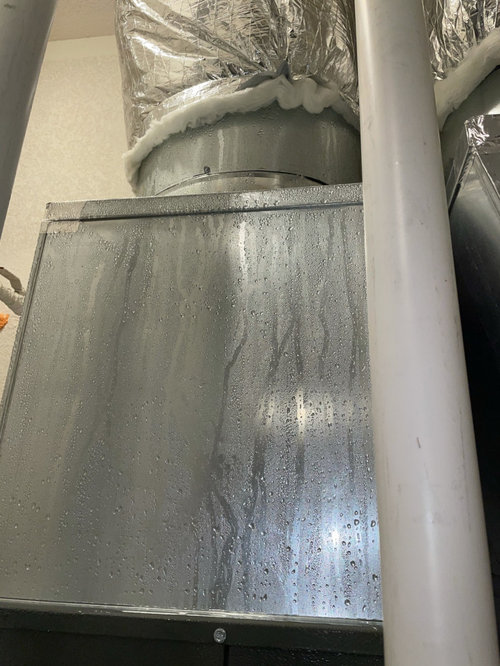
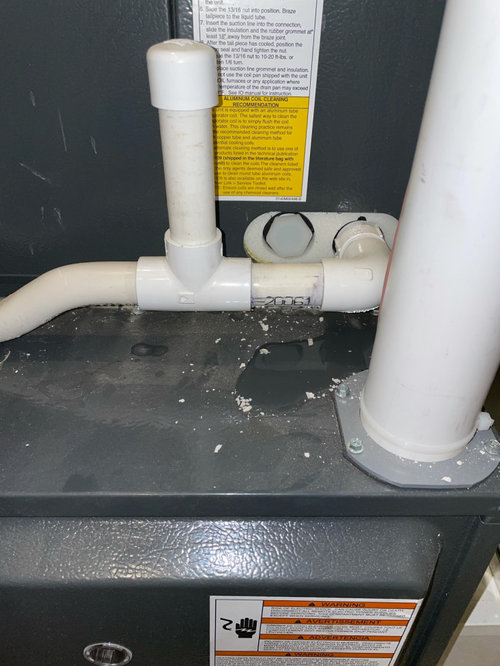
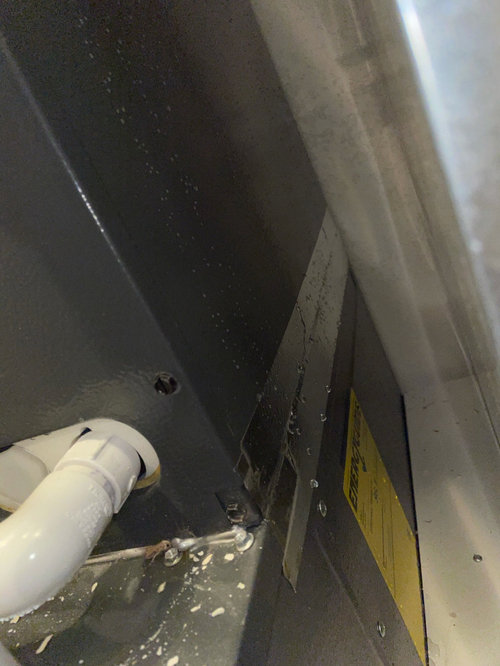
We just moved into our new construction home and noticed our air handler sweating. The company who installed it came back out and just insulated it, but I’m not sure that was a fix? Was my unit not sealed correctly?

Comments (34)

  • 5 years ago

    Air handler should be self insulated from inside, they may be installed a non-standard metal box (without built-in insulation) for that purpose, but this will work anyway, just does not look right.

  • PRO
    5 years ago

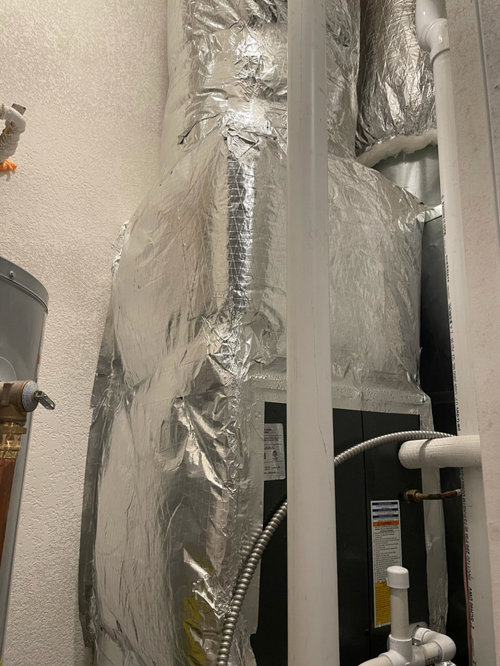
    I think you've got a couple of issues: First is that the duct sealing is questionable. The round transition at the top of the sheet metal plenum and the seams and joints should have been sealed with UL-approved tape or mastic. That makes me wonder about the other joints in the ductwork system. The puddling of water around the condensate drain line could be due to a leak in the pipe or fitting or it may be due to a lack of air sealing at the fitting. If not sealed, cold air leaking out around the fittings can cooling the surrounding air below its dewpoint. Another issue is a lack of (or inadequate) insulation of the sheet metal plenum. The surface temperature is clearly below the dewpoint temperature of the ambient air. While they insulated the plenum, they've apparently "mummified" the air handler as well. Maintenance may require surgery on the insulation to allow access.

  • 5 years ago

    Thanks for commenting! Should I have the HVAC company come back out, remove the insulation around it and seal it with UL-approved tape and check the condensate pipe? The air handler is in a unconditioned space, if that’s helpful.

  • PRO
    5 years ago

    @Zac Harris,

    Air handlers should be installed in conditioned spaces to avoid the problems you're having. I understand that's not always possible. Keeping the air handler and ductwork out of a garage eliminates the potential to draw exhaust fumes, gasoline, solvents, etc. into the HVAC system and distribute them inside your home. If yours is in a garage then sealing ductwork joints is particularly important. Since your HVAC contractor didn't bother to seal the joints on the supply side, I'd bet they didn't do it on the return side either.


    I suggest removing the insulation and properly sealing the joints. It's not rocket science. However, if your HVAC company sends the same caliber technicians that installed your air handler then you're better off doing it yourself.

  • 5 years ago

    The cause of the moisture this is condensation. Condensation occurs when warm humid air comes in contact with a cold surface. The duct seals can be redone but it won't stop the condensation in my opinion.

    Have you measured the surrounding temperature and humidity? You need to bring the humidity down to below 50%. One way of doing this is to install a supply and return and make it a conditioned space. You may have to build a closet around the air handler in order to do this. Another approach is to lower the air temperature of the conditioned air in the air handler. Have you measured the air temperature at the supply and return registers?

    My concern of is if the insulation does not have a tight seal, then warm humid air will find its way underneath it and create condensation. It won't be noticeable until the water accumulates. Adding the insulation is not the best solution to this problem. Your builder needs to spend money to fix this properly.

  • 5 years ago

    Thank you. I’m going to get with the builder since he has a warranty with this company and tell him I’d rather have someone else come make it right. Do you think adding a vent to the garage will help? It would be partially conditioned then.

  • PRO
    5 years ago

    @Zac Harris,

    I don't know what building code applies in your area, but adding an HVAC supply in a Garage would be a building code violation here in Virginia. And a bad idea even if it wasn't.

  • 5 years ago

    I’m in Illinois. I assume the city would have flagged this if it was a violation?

  • 5 years ago

    @Mike_home

    Thanks for commenting. The unit is in a closet that was built into the garage. It’s raised above the floor of the garage.

    Interesting. I’ll see if I can get a supply and a return in that closet. Should I do just the closet or the entire garage?

  • PRO
    5 years ago

    @Zac Harris


    Hold your horses, Zac.


    It is not a code violation to locate an air handler in a garage. It is, however, if you use that same air handling system to condition your home and garage. Here's what the International Residential Code (IRC) says about it:


    M1601.6

    Furnaces and air handling systems that supply air to living spaces shall not supply air to or return air from a garage.


    The code also prohibits installation of a return air duct in a closet.


    M601.5 (5)

    Return air shall not be taken from a closet, bathroom, toilet room, kitchen, garage, boiler room furnace room or unconditioned attic.


    It is not a code violation to heat and air condition your garage. You'll just need to install a separate, dedicated system for that. Doing so to prevent condensation on your existing unit is, quite frankly, silly. There are a lot of air handlers in garages here in coastal Virginia that don't sweat in the summer like yours. The difference is that they're properly air sealed and properly insulated.

  • 5 years ago

    Zac,

    When I made my suggestions I was not aware the air handler is located in a garage. You need to be careful about adding supplies and returns and follow the code.

    If a closet already exists, then I would think insulating it with a moisture barrier would help solve the problem. The air inside the closet would be cooler and should not create the condensation problem. The duct work should be well sealed so that no exhaust fumes can penetrate the house.

  • 5 years ago

    Thank you both for commenting! I jumped to the attic and noticed our duct work up there is spray foamed, so that should be okay?

    I reached out to our HVAC company and shared your comments. Hopefully, they make it right. We’ve only been in this house for 8 days.

  • 5 years ago

    All you need to do is to replace that metal box with an insulated one. The box should be insulated from inside, should not be a big deal.

  • 5 years ago

    Thanks, Cima! Are you talking about the box with the coil in it or the plenum?

  • PRO
    5 years ago

    @Zac Harris,

    Spray foam insulation on the exterior of duct work is great because it provides air sealing as well as insulation.


    There's no need to insulate the interior of a duct or plenum--in fact, it makes it harder, if not impossible-- to clean the interior of the duct. You can insulate the exterior side of the plenums with rigid insulation and eliminate the potential for condensation. I suggest sealing all the seams with approved tape or mastic before installing the insulation.


    On a separate, but related note, I suggest you communicate your dissatisfaction to your builder--not the HVAC contractor. He/she is the one you wrote your check to and he/she should be driving the necessary corrections.

  • 5 years ago

    Both the plenum and all of the attaching boxes should be insulated. This is industry standard, they all come with the inside built-in insulation. Other folks mentioned ducts, seals, etc. they are all correct, those are important too, but your problem is condensation on the plenum. In fact, what they did now, insulate outside, will work. they don't look right, but the problem was solved (in an ugly way), you won't have condensation any more.

  • PRO
    5 years ago

    With respect to the OP's HVAC system, the term "plenum" refers to the shiny sheet metal box structure that connects the air handler to the duct work system. There's one on the supply side and one on the return side. HVAC supply houses usually sell standard size rectangular duct sections and the contractor typically adds the top and transition (in this case to round duct) at the contactor's shop. They are typically not purchased pre-insulated.


    It appears that the contractor taped the foil-faced fiberglass insulation to the wall. I'm betting there's no insulation on the side of the plenum at the wall. I'm also betting there's not tape or mastic sealing any of the joints which are now hidden under the insulation. It's a do-over.

  • 5 years ago

    Hi Charles,

    The HVAC guy came back out today and said all of the joints were tapped (according to him). There was a draft of air coming from the coil box, so they insulated the entire unit (see picture below).

    The builder recommended that and I’m not sure what I can do at this point without voiding his warranty?

    The plenum at the wall would be in the attic, correct? Everything in the attic was spray foamed according to my inspection report. Would this be sprayed too?

  • PRO
    5 years ago

    There's a difference between air sealing and insulation. Covering a leaky joint with insulation doesn't do anything to remedy the leak. The first set of pictures you posted shows a "mummified" air handler with some of the foil-faced insulation taped to the wall. That leads me to believe they didn't insulate the back side of the plenum box. If you don't believe they've taped the joints, you can always cut a slit in the insulation, inspect the duct and tape it back up if everything looks okay. If not, you can invite the builder and HVAC contractor back for "show and tell."


    It doesn't appear they have taped or sealed the joint between the duct and your air cleaner or air filter which I would recommend--especially in a garage.

  • 5 years ago

    Thanks again, Chris!

    Which area is the joint between the duct and the air filter?

    All of the tape I've seen is only on the corners of the unit.

  • PRO
    5 years ago

    The connection between the galvanized ductwork (where the screw heads are and all around the perimeter) and the painted air filter should be sealed. Tape would be a good way to accomplish that.

  • 5 years ago

    Does this look normal to you, Charles? Sorry about messing up your name earlier!

  • PRO
    5 years ago

    It's atypical for ducts to get an application of spray foam insulation due to its high cost. It's great stuff and helps to provide both air sealing and insulation. I say slather it on if you can.


    I can't tell if there is a duct in the cellulose insulation or an alien life form. One is preferable to the other.

  • 5 years ago

    After my horrible experience with Air conditioner and condensation I will suggest you get an independent opinion from a qualified HVAC contractor. I had the same issue a year ago and until today I am still dealing with all the damage Including mold. So far we've spent over $100k and not done.

    Do yourself a favor and get a couple of opinions.

  • 5 years ago

    Thanks, Stars26.

    I'm trying to get a few companies to come out and take a look at the unit.

  • PRO
    5 years ago

    @Zac Harris,

    Getting a second opinion from a knowledgeable contractor is fine. You'll need to navigate the next steps following that with care or risk giving your builder and HVAC contractor a get-out-of-jail-free card. You may be able to get your local building inspector to have a look for any mechanical code deficiencies. In our area, contractors are required to remedy any code deficiencies identified within three years after a certificate of occupancy is issued.

  • PRO
    5 years ago


    stars26

    11 hours ago

    After my horrible experience with Air conditioner and condensation I will suggest you get an independent opinion from a qualified HVAC contractor. I had the same issue a year ago and until today I am still dealing with all the damage Including mold. So far we've spent over $100k and not done.

    Do yourself a favor and get a couple of opinions.


    Thank you stars26 for speaking up.... And there you have it... why builders aren't what they're cracked up to be.


    Here's another gotchya in builder lingo-- On a separate, but related note, I suggest you communicate your dissatisfaction to your builder--not the HVAC contractor. He/she is the one you wrote your check to and he/she should be driving the necessary corrections.


    Why? because to many builders the skilled trades are treated as commodities. Teams are built, they are told what to do. If that translation is lost, trouble - trouble - trouble. Those teams are told they make more money the more jobs they complete in a given time frame.


    Nothing good in this scenario.


    I service the Katy, Texas area.

  • 5 years ago

    Thanks again, Charles!

    Do you think we’ll have mold issues spring up before we can get someone else out here? They are coming Monday.

    The hvac guy has been unhelpful and dismissive to say the least. He doesn’t seem interested in fixing this and that’s why I wanted to avoid him and have someone who can actually fix it (and cares to).

  • PRO
    5 years ago

    @Zac Harris,

    The condensation problem shown in your photos appears to be limited to the portion of your system located in the garage. You're addressing the problem early on. I don't think you need to take more immediate action than you are if someone is coming on Monday.


    I strongly recommend working through your builder on the issue. The builder is the one you purchased the home from--not the second rate HVAC contractor. Your builder will likely have to warrant against defects in materials and workmanship for some period of time depending on your state's contractor laws. Here in Virginia, builders are required to warrant against defects in materials or workmanship for a period of a year, and five years against problems with foundations. Communicate your concerns in writing and keep the builder involved until the condition is corrected. The costs to fix the issue should be his to bear--not yours.

  • 5 years ago

    Very true. We have a year warranty. Thank you for being so helpful!

    I’ve had a few conversations with the builder and he visited our house to take a look and his recommendation was to “add insulation to the outside of the coil box” and that it was normal because the system has only been running for ~10 days and it’s humid out.

  • 5 years ago

    Looking at the photo from a wider angle we can now see that the equipment appears to be a gas furnace and not an air handler. I was wondering why an air handler had a coil installed above it. I have never seen a coil with interior insulation, but perhaps others who install coils for a living may know of model which does. The main supply duct is metal. Again I am not familiar with metal ducts with interior insulation. I suppose you could use a B vent which has a double wall. Finding the correct size and then fabricating a transition duct to the coil could be difficult.

    I think covering the cold coil and supply vent is going to solve this problem as long as the surface temperature of the insulation does not go below the dew point. I think that is unlikely but it is possible. You should not have a condensation problem in the attic during the summer. The temperature is higher and the air is much dryer. You could have condensation problems in the winter if the attic is not properly ventilated.

    There are a few other things that may be installation issues. The condensate trap will eventually clog but unfortunately there is not good way to clean it. I assume the cap on the PVC is not glued on and your are supposed to try to power insert some type of snake to clean it. I would have installed an a clear EZ trap so you can visually see the clog and easily open it up to clean it. You should also understand how the condensate water is drained. Is it connected to the plumbing of the house? I would also recommend installing a condensate overflow cutoff. The condensate drain could be clogged for several days and you would not know it until the water gets past all the taped on insulation. The insulation will have to be replaced if it gets wet.

    I see a wire but not electrical switch. Is it on the other side of the wall? Is it properly labeled so no one accidently shuts it off? The switch should be in the closet so you will never have this issue and the service person doesn't have to go looking for it.

    I see copper tubing on the left. Is that the gas line connection? If it is then that should be replaced with black piping rate for natural gas. A gas supply shut off needs to be at the furnace if one does not exist.

    Finally was this furnace inspected? I don't see any inspection stickers.


  • PRO
    5 years ago

    @mike_home,

    "Looking at the photo from a wider angle we can now see that the equipment appears to be a gas furnace and not an air handler. I was wondering why an air handler had a coil installed above it. I have never seen a coil with interior insulation, but perhaps others who install coils for a living may know of model which does."


    Every forced air HVAC system includes an air handler--that's the part that contains the fan that moves the air that conditions the home that Jack built. Married to the air handler in this installation is a condensing-type furnace unit and an evaporator coil unit. It's a pretty typical HVAC assembly. The copper tubing is a refrigerant line. The gas piping is visible at the lower left.


    Duct work can be insulated on the interior or exterior. I'm not a fan of installing insulation inside a duct to the extent that it adds resistance and makes the duct harder to clean. Depending on the type of insulation used, it could also introduce fibers or particles into the air which occupants breathe if installed on the interior of the duct.

  • 5 years ago
    last modified: 5 years ago

    You are correct that a furnace has an blower which is used as the air handler for heating and cooling. However in my experience most people in the HVAC industry don't refer to a furnace as an air handler. If we want to be precise it is referred to as a fan coil by most manufacturers. The only reason I brought this up was to let the original poster know what equipment he has when he talks to other HVAC companies.

    I could be wrong but the line set (refrigerant lines) appears to be wrapped in white insulation on the right. If the copper tubing is a refrigerant line, then I would expect it would also have condensation and would need to be insulated. If you can see the gas connection then you have better eyes than I do.

  • PRO
    5 years ago

    @mike_home,

    If it were only a furnace unit, it would indeed commonly be referred to as a furnace. But the system as shown consists of an air handler with both a furnace module and an evaporator coil. Calling it a "furnace" wouldn't be correct. It's a typical assembly in a climate with heating and air conditioning needs. An air handler might be fixed speed, two speed, variable speed, etc. and can be paired with different furnace modules and different coils. Here's a link to information about one manufacturer's typical air handler so you can see how the units are referred to in the trade:


    https://www.lennox.com/products/heating-cooling/air-handlers/cba38mv


    In commercial work, the air handler is usual referred to as an air handling unit (AHU.)


    The copper line is a refrigerant line. It's common practice to insulate the liquid line supplying the evaporator to prevent condensation and leave the low pressure gas line uninsulated. The white coating or wrap is for UV protection outdoors. It may be integral to the type of insulation they used.


    My eyes aren't as good as they used to be, but it appears there's a yellow flex line at the bottom left. That's the gas line.

Sponsored
Mary Shipley Interiors
Average rating: 4.8 out of 5 stars34 Reviews
Columbus OH Premier Interior Designer 10x Best of Houzz