Software
Houzz Logo Print
a1an

What happens to Peat - in flowerbeds

5 years ago

If memory recalls peat takes a long time to decompose ?


Flowerbed, Yearly, if not biyearly, between summer annuals and fall/winter annuals, I'm constantly putting new stuff in - and new stuff = peat planting/rootballs. Just today, I planted 42 3qt plant plugs.


Case in point. I removed a summer annual that started as a 4 1/2" pot . This was a 36" overall round bloom that I removed. It was interesting in that when I removed the -established rootball- and shook off any dirt back into the beds, the initial pot plug of peat was -dry- as a bone. Not all of them showed this, but there definitely a few instances when removing said annual summer planting, you could cleary make out a clump of -dry peat clump- deadcenter on the rootball mass. I figured at bare minimum it would be a most clump but it was bone dry peat being held by the rootball.


Which got me thinking. Granted, I'm not spreading out a bale of peat to the flowerbeds yearly, it is getting peat added in bi-yearly with the addition of summer/fall annual plantings. At some point, will there be some negative effect to this ? Or whatever peat is added, will just be -free OM-.


Comments (26)

  • 5 years ago

    What is the rationale for adding peat to your beds? It has no nutritional value and is a finite resource. Are you trying to make an acidic soil? Compost would be better for your garden and for the environment. https://www.bbc.co.uk/gardening/today_in_your_garden/ethical_peat.shtml

  • 5 years ago

    I use peat to grow my tomato etc seedlings each fall. When I transplant them into the ground I've never seen the root ball "dry as a bone". From what you're saying the equivalent would be when I pull the tomato plant in late fall the original ball of peat is dry as a bone. I've never noticed when I knock the root ball to get the soil off that there's dry peat. ?? What am I missing?

  • 5 years ago

    Indeed that was my observation on less than a handful of the annuals I planted this spring. We're talking I already have wet soil from Henri. Everything is still wet. The annual itself was well established into a 3 ft Round Ball. When I removed the annual and pulled on the main stem to remove it, I was quite surprise that dead center (where the original planted medium was) , the peat was dusty -light brown- which was quite the eye opener I wasn't expecting !. I mean it wasn't even at least -dark brown wet-, but bone dry peat !

  • 5 years ago

    In my clay soil my most beautifully delicious garden soils were ammendment generously with compost and peat. I believe it's the peat the creates the foamy structure in that soil and the roots love it. I've never experienced a dry ball of peat if the peat was mixed into the soil well, but any clump of peat can too easily become devoid of moisture, and then it takes significant soaking to rehydrate. Because of that, I'm careful to breakup the peat as completely as possible. By "pot plug of peat" do you mean those little disks for starting seed? If so, maybe in the future breakin up that disk a bit when replanting would be helfpul. Peat can get bone dry in my garden, but only when it's not mixed with the soil/compost around it.


    I've never ammended peat into my garden after my initial soil preparation. I'm with gardengal--the Canadian peat industry appears to be responsibly maintained, and I try to be responsible by only using it during initial soil preparation.

  • 5 years ago

    =pot plug of peat= (annual plants purchased). Wild guess is 4 1/2 pot is about half gallon in volume ? It wasn't a full 4 1/2 round of dry peat in entirety....as the rootball that extends from that does hold onto native soil when removing. It was just a weird quirk in observation that some of them I pulled, literally, the originally potting/planting medium (the peat), was deer in the headlights look when I pulled it out and it was dry as bone. The surround soil still being quite wet from Heni's rainfall

  • 5 years ago

    I once read (Thalassa Cruso) that unless you thoroughly soak peat before incorporating it into soi, it will always (according to her) repel moisture. Since I believe everything that Cruso ever said, I always used to soak and stir peat in a wheelbarrow in the same manner you would mix cement. For just as long. I no longer use peat except in my potting mediums. We don't have to mine everything, and peat can be replaced by other more readily renewable mediums. I once knew someone who used peat as a mulch, and every drop of water that ever fell on it, ran off.

  • 5 years ago

    I also always prewet peat before using it. And most years I mix a little manure into it; but this past season I decided we had enough health concerns without adding more so used all peat until the seedlings could stay out over night. I usually have 3 layers in pots with the bottom (filter) layer and the top (buffer) area all peat.

  • 5 years ago

    I wouldn't say this is universal - as once plants leave the growers and sits on shelves....it's up to the nursery to maintain said plants. IME, the plants once buys at nurseries - the potting/sold/peat medium is plenty wet


    But the plant plugs I speak about - did not need prewetting. It was not hydrophobic @ time of planting. Any they have seen consistent H20 since planting, if not not the 7" of rain we got from Henri. I'm just blown away that indeed - the peat got to a point where it dried it and became hydrophic in the planted/planting enviroment

  • 5 years ago

    One thing i always do when planting any nursery grown plant is to make sure that top layer of media is covered with the surrounding garden bed soil. ill see many times people leave this top layer exposed to the air or barely covered with a mulch. ill also outright remove some of that top media to get a thicker layer of the garden soil on top


    the peat that comes on annuals or the woody material used for perennials dries out many times quicker them the surrounding soil. This drying out will slow the decomposition, solow the root growth of the plant and more so will slow the infiltration of worms that end up mixing the potted media with the surrounding garden soil

  • 5 years ago

    Thx Nevermore. I generally plant the plugs a bit higher than the soil line. Even though I pull back the mulch from around the perimeter of said plantings (which does settle and break down by the end of the growing season), I plant higher so that leaves touch wet mulch


    Literally the soil was a bit -mucky- post Henri. And between the waterings it had during the growing season, wasn't expecting a dry ball of peat !

  • 5 years ago

    Yeah you can have wet soil and a dry peat ball if that peat is exposed to the air.

  • 5 years ago

    But - wouldn't the peat within the soil line still draw water and keep the at least brown or somewhat wet..... Or the water loss due to the exposed top still led to the dry out. The plant itself grew fine....3' overall in perimeter. Just was surprised to see bone dry peat (aka, original plant plug medium). It wasn't even remotely wet at all. And this peat was dry below the soil line. I can't say for sure if it was the whole plant plug (as roots was holding holding native wet soil). Just something in observement

  • 5 years ago

    A1an, that is weird. To have gotten that much rain and have the surrounding soil so wet…I’m surprised the plant didnt’ show some kind of stress to have that amount of rootball in such a dry medium. It would have been hard work on the outermost roots to keep up with moisture intake. Any insights you gather as you try to figure this out are indeed welcome!

  • 5 years ago

    4 1/2 pot has a pretty good sized rootball. Yes, going to be more observant next year but I generally plant them as such - a bit higher as the established leaves on the plug will be wet with the existing mulch


    I have never given much thought to this as the beds fill and grow just fine. Except for a couple of stunters.


    It was only because I observed less than a handful with this dry peat ball that really started this conversation. Really a head scratcher for sure . Forget Henri. I know it's watering schedule and I would think -in general- the peat would have wicked up water for the entire perimeter. If not, at least be -dark brown-. Not bone dry peat....


    This convo also leads what I've thinking/changing as well on buying/planting habitats. I generally prefer to buy #25, #15, #7 at the local nursery. Nice big rootballs, etc. But when you remove it out of the pot, it's hard to root wash the dang thing or remove some of the medium as it's so many many roots that have been super FERTEZED and it's all roots holding locking the peat plug in place. When I buy new stuff, I try to aim for a #5 or #3, as I think plants fare better being small and then roots in native soil vs. having this large peat plug in a #7 or greater. The only drawback to this is the -immediate satisfaction- of a more mature plant, but in the long run, I think the roots fare better.

  • 5 years ago

    If peat is allowed to dry out, it becomes extremely difficult to rehydrate. And this can happen both before and after planting. If the peat rootball had a dry center when planted, it will remain dry unless the surrounding soil stays fully saturated for a period of time. Even a heavy rainfall or consistent irrigation will not be sufficient to rehydrate unless the soil reaches field saturation levels. And then you will have other issues :-)

  • 5 years ago
    last modified: 5 years ago

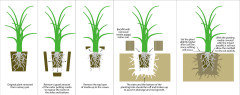
    I had done this illustration a while ago for someone else on the planting "method" that I typically do for perennials. For small annuals I just try and remove some of the top potting media before planting.


  • 5 years ago
    last modified: 5 years ago

    Circling back on this as I thought we came to a conclusion.....

    New Observation today

    I was dividing lilys I had in a 30G fabric pot. Lotsa bulblets that needed some division. It's a pretty big pot, all ProMix. It does not get irrigation but sees plenty of H20 from the weather. The entire pot (peat based) is moist, all the way down to the bottom. I noticed the same dry peat, except this time, I knew it was not a peat **plant plug** as it was bulbs put directly into this potting medium

    I would say roughly, the roots were about 15 inches or so deep into the pot. Pretty fiberous in the soil mix. Upon diving of the roots/bulbs, I noticed some areas where where it was very fiborous in roots ......the peat was bone dry again.

    So maybe, as a second stab at this discussion of - dry peat plug conversation- we are having, it may be how roots hold the -soil- and may form a wall that mitigates moisture to where the root has -fiberishly locked in the planting medium-, mitigating H20 to this area ?

    Maybe ?

  • 5 years ago

    Roots will sometime cross and merge together. Is it possible the roots "formed a wall" aided by the merge along much of the length of the roots????

  • 4 years ago

    'But - wouldn't the peat within the soil line still draw water and keep the at least brown or somewhat wet.....'


    '...and I would think -in general- the peat would have wicked up water for the entire perimeter.'


    'So maybe, as a second stab at this discussion of - dry peat plug conversation- we are having, it may be how roots hold the -soil- and may form a wall that mitigates moisture to where the root has -fiberishly locked in the planting medium-, mitigating H20 to this area ?

    Maybe ?'


    No to all three questions.


    As has been said, if peat gets dry, it is VERY hard to re-wet it. It needs a wetting agent.


    But, you have a lot of success with what you are doing in my opinion, so I wouldn't go crazy trying to fix what you perceive to be a big problem. The plants have plenty of roots and are not worried.


    Personally, I don't like peat plugs for raising plants. We tried them at the nursery where I worked. IMO, you can't beat pots of suitable medium which allows cuttings to root freely, not just in their little peat plugs.

  • 4 years ago

    What medium do you use at the nursery? i justvthough most places for annuals use peat based medium with perlite or the like added

  • 4 years ago

    Most better growers and wholesale nurseries have long ago learned the benefits of a bark based potting media. Generally, peat tends to be a very small fraction of the mix but perlite IS typically included.

  • 4 years ago

    Yeah bark for perennials …. but annuals are still peat right

  • 4 years ago

    Not that it's been on my radar, but I've got some new -trees- in pots I picked up. Going to see what the mindful to pay attention to what the medium is

  • 4 years ago
    last modified: 4 years ago

    'What medium do you use at the nursery?'

    At its best, it contained course washed river sand (soooooooooo hard to come by now) peat and perlite. I don't know the proportions but at a guess I'd say it was mostly perlite and sand and a little bit of peat.

    I've looked for sand. Can't find anything that's good enough. Perlite is easy to obtain of course, but it's not a healthy thing to use. Its dust is very bad for the lungs. It should be wet before you move it around.

    We would fill squat pots with the mix up and over the rims, squash it down hard with a flat board, then line all the pots in a tub. When there were plenty in there, we'd give them a shower overhead, then add more water to the tub so that the pots were sitting in it. They'd sit there while we went into the next room to make cuttings. After half an hour or so, someone would go and take the pots out of the water and place them on a rack to drain. When they were drained, they were filled with cuttings (about 25-30 to a pot).

  • 4 years ago
    last modified: 4 years ago

    There's a lot going on in this thread, but I want to chime in to say you can always use a detergent to help wet a "soilless mix" based on peat, or even a soil that is behaving hydrophobically. For example, the soil under the broad eaves of my 1 story house, is good for xeric plants, but if you have a non-xeric plant that actually needs to get watered, it can shed water off rather than accept it.

    I think any standard dish soap would be ok as long as it doesn't have 'antibacterial' additives, but personally I have a gallon of concentrated decyl glucoside I bought on ebay for that and various other household purposes. It lasts me almost 2 years - I'm due to order another one soon. (I also add it to my laundry) This is a mild and very non-toxic detergent that people purchase from cosmetics suppliers for making their own hand soaps or shampoos. I have used it to water many, many plants with no ill effect, about 1 tsp. per 2 gallon watering can really helps water soak into a rootball.