Software
Houzz Logo Print
legallick

Quartzite countertop disaster!

5 years ago
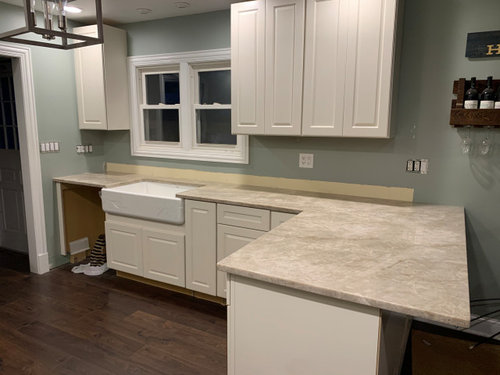
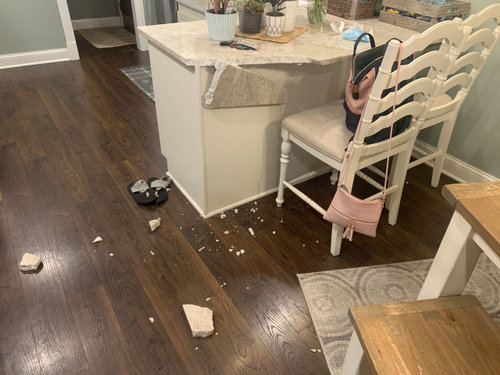
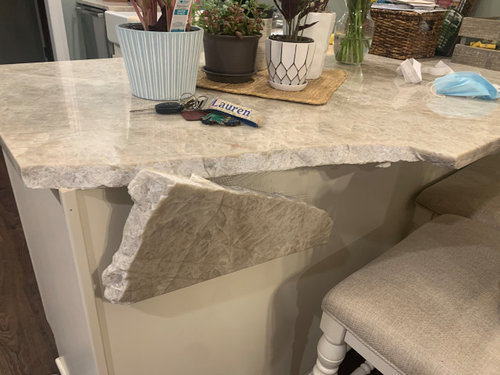
Help! We had these quartzite countertops installed 18 months ago. Last night I was sitting at the counter. I applied some pressure to the counter as I was standing up and this happened. I am furious! We are calling the company who installed it and demanding they take care of it. If not, we will be taking legal action or filing an insurance claim against them. My question is- does this happen? Is the slab faulty? Fabricator/installer error? Any information would be appreciated!


Comments (11)

  • 5 years ago

    This really sucks and I would be angry too but, step back and calm down before flying off the handle and blaming anyone. I would contact both the contractor and fabricator and let them know what happened, and if they will make is right, before threatening legal action. That just gets everyone's hackles up and escalates a situation.


    It doesn't look like there is any support under the overhang. The question is why isn't there any support under the overhang? Did both the contractor and fabricator tell you it was unnecessary?


    There also may have been a natural weakness in the slab that no one could detect.


    Let them try to discern a cause and see what they will do.

  • 5 years ago
    last modified: 5 years ago

    I agree ^^. No support for the overhang. The thing is, if that is how the company installed it - and counter overhang support is Fabrication 101 - they clearly do not have expertise and are unlikely to admit there was a problem.

    It looks like your stone is 3 cm which of course is heavier. Can you say how many inches is the overhang vs how wide total is the counter? It is helpful to have that information to look at the requirements given the dimensions of your counter.

    Lauren Keavney thanked Shannon_WI
  • 5 years ago

    Existing cabinets or new cabinets? Typically the support would be in place or the top installer would refuse to install the tops without thee proper support in place.

  • PRO
    5 years ago
    last modified: 5 years ago

    That is designer error. Who designed the NSI standards approved *cabinet interfaced* support for the overhang? Who did the kitchen design? Was this a refresh, or a gut redo? Who put all the pieces together in a design? Who was the GC of the job that took that designer’s design and double checked the components before implementing them? Thats 2 layers of responsibility before you ever get to the stone fabricators. Start there.

    Any overhang over 10” requires that support be designed for it. It has to be thought about from the *beginning* of the design. It’s not a last minute thing that you assume the stone fabricators will take care of. They drop stone, assume you’re adding aftermarket exterior corbel to it, and off to the next job.

    Who designed this? Or, failed to design this? Who failed in their GC oversight?

  • 5 years ago

    @Shannon_WI The overhang is 10 inches and the entire counter is 36.5 inches. The stone is 1.5 inches thick.

  • 5 years ago
    last modified: 5 years ago

    There is no way that fault is going to fall on the designer, it just doesn't work that way. If it is a faulty installation, it will fall squarely on the stone installers. Maybe the designer and the G.C. should have known better, but it really doesn't matter if they did. They hired someone who is in the profession of installing stone and that person holds themselves out to have some expertise in that field. To defer that responsibility to the designer the installers would have to get a hold harmless agreement, which would really only work if they pointed out the problem and were told to install it anyway.

    Implicit in these situations is the reliance on professional expertise. You hire a designer because you are not an expert in design. They hire a G.C. because they are not an expert in construction. The G.C. hires a stone installer because he is not an expert in stone installation.

  • PRO
    5 years ago
    last modified: 5 years ago

    If its 10”, and it looks like more than that, then it meets written industry standards for a 3 cm cantilever without additional support. Fabricators don’t Xray slabs. They only have surface visuals to guide them.

    Sometimes Mother Nature has surprises in store that cannot be predicted. Sometimes, only she is at fault. That is why accidents are called accidents. Because fault cannot be assessed to any one party. Things can go wrong, even when everyone does things right.

  • 5 years ago
    last modified: 5 years ago

    That is one of the reasons why I got rid of 2 overhangs on the ends when I remodeled my last kitchen. I know better than to apply any weight to such an area, but the men in the house thought I was overly dramatic with my warnings ... wish I'd had these photos when they would place a heavy amazon box on there or use it as support just like the OP did. Getting rid of the overhangs gave met extra storage, less worry and no one missed the overhangs.

    OP glad that big piece didn't fall on your feet. You should remove it now, so it doesn't fall and damage your floors or hurt anyone else.

    This thread is now going to come up as an example every time someone says their installer said they don't need any extra support, which is a good thing for people to understand and actually see what can happen.

  • PRO
    5 years ago

    "My question is- does this happen?"


    Obviously.


    "Is the slab faulty?"


    This slab has reinforcement mesh as evidenced by the picture with the piece hanging. The processing plant applies the mesh because the stone has so many natural fissures that it couldn't be transported or fabricated without it.


    "Fabricator/installer error?"


    Yes. According to industry standards by the Natural Stone Institute, "NOTE: Stones of lesser soundness may require corbelled supports for cantilevers that are less than those specified herein." Page 3, 8.2


    Cleary, meshed stones are of "lesser soundness" than unmeshed stones. This means that the 10" unsupported cantilever for 3cm sound stones rule does not apply. As bry911 notes, there is an expectation that a professional fabricator/installer would or should know this.


    As far as repair goes, save every piece please. It may be possibe to make an inconspicuous repair that will be much stronger than the stone. Of course designing and installating proper cantilever support is part of this.


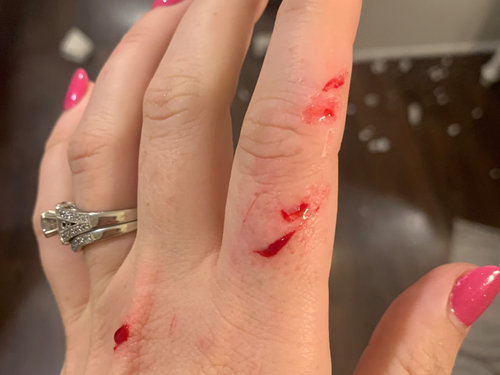
    I'd tell them that if they get it fixed promptly and properly, you promise not to sue for your injuries. They don't want that bloody hand in your online review, believe me.

  • 5 years ago

    Sometimes Mother Nature has surprises in store that cannot be predicted. Sometimes, only she is at fault. That is why accidents are called accidents. Because fault cannot be assessed to any one party. Things can go wrong, even when everyone does things right.


    While the above seems perfectly reasonable, I would argue it is incorrect. The sale of countertops are commerce and are governed by the Uniform Commercial Code. Therefore, they must comply with the implied warranties of the UCC. Countertops are warrantied to be of sufficient quality to perform their intended function. The countertop company need not X-ray slabs but they do have to guarantee that their un-X-rayed slabs are of sufficient quality to stand up to reasonable use, or replace/repair them when they don't.