

Help with 60" Range Hood - No options?
Hi all
could use some help with our kitchen reno.
we are putting a 36" induction cooktop into our island, and next to it a single ~15" gas burner (check out PITT Cooking for those interested). I'm aware there is difference of opinion on putting the cooktop in the island - we have always had it in the island and are happy to continue.
We are a big cooking family, so ventilation is a must. The downstairs is open plan and so low noise is also on the priority list.
Based on the size of the cooktop + burner, I think I need a 60" hood vent. To satisfy my noise concerns I want an external blower that will vent through the roof.
I am stuggling to find many 60" range hoods with an external blower. I have seen a Proline and Bluestar option. Im wondering cannot I find separate hoods and coonect my own blower?
I'm struggling to determine what todo and what my options are? Please help awesome people!
Thanks
Tarun
Comments (33)
 5 years ago
I have a 36-inch induction cooktop in a peninsula with a Cooktek induction wok hob mounted in an adjacent cabinet. I use the largest Wolf Pro Island hood over this pair of cooking devices. This hood is about 60 inches interior aperture, 66 inches wide on the outside. I use a Wolf 1500 CFM (rated) down-roof blower (actually made for Wolf by Broan/NuTone). Inserted into the 10-inch duct in the attic is a Fantech silencer. Actual flow at the hood entry aperture, crudely averaged over the aperture, seems to be about 100 ft/min or 1000 CFM. Your flow rate would depend on your MUA system's performance, essential for most residences.

(Lamp protrusion is due to replacing halogen lamps with then available LED lamps. These are now available in shorter lengths and have been replaced since this photo was taken.)(Note also my hood was manufactured for Wolf by Independent ca. 2008, and while Wolf's drawings -- see Wolf Design Guide -- show the same size and shape, there could be small detail changes in present stock.)
Tarun Mistry thanked kaseki- 5 years agolast modified: 5 years ago
A range hood as wide as I am tall? No. Ventilation is a must, but oversized ventilation is not.
Get a STRONG 36" hood to match the stove.
Related Professionals
California Kitchen & Bathroom Designers · Cambridge Kitchen & Bathroom Designers · Elk City Kitchen & Bathroom Designers · Victoria Bathroom Remodelers · Plattsburgh Bathroom Remodelers · Cookeville Kitchen Remodelers · Redding Kitchen Remodelers · Clarksdale Kitchen & Bathroom Designers · Greenville Kitchen & Bathroom Designers · Chambersburg Kitchen & Bathroom Designers · Houston Kitchen & Bathroom Designers · Manhattan Custom Countertops · Philadelphia Custom Countertops · Wenatchee Custom Countertops · Victoria Custom Countertops- 5 years ago
@Mrs Pete: You may wish to review the OP's post. The OP has a 36-inch cooktop plus another burner unit. Counting support structure separating the units, particularly if standard cabinet widths are used, 60-inches of required hood aperture width is entirely plausible. Even a 36-inch cooktop alone needs 42 inches or more of width to handle rising and expanding cooking plumes. Plus, in island applications, there is considerable air motion due to human movement and other sources of drafts interfering with rising plume capture.
Due to the nature of flow around hood apertures, practical increases in CFM will not expand the effective hood capture aperture significantly.
You may wish to review numerous hood threads here to gain perspective about hood performance requirements. For hood flow field examples, see page 30.4 of the 2003 ASHRAE Handbook: HVAC Applications.
- 5 years ago
@Tarun Mistry - you may want to look at custom-made hoods. Here are some pics where you can see the hood can be as wide as you like when you go custom. Either look for a fabricator locally, or names I know who make custom hoods are Modernaire and Handcrafted Metal.
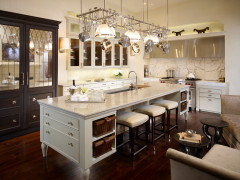
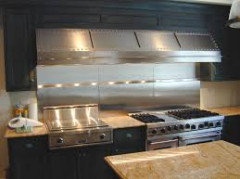
 Tarun Mistry thanked Shannon_WI
- 5 years ago
You may wish to review the OP's post. The OP has a 36-inch cooktop plus another burner unit.
That I missed.
You may wish to review numerous hood threads here to gain perspective about hood performance requirements.
That I have done, and I can't quite see the point. I've always had a range and hood of matching size, and it's never been a problem. Maybe I've always had really suck-y hoods (suck-y in a good way).
I do not like the look of those giant hoods ... looks commercial /out of place in a home.
- 5 years ago
Hood are notoriously non-sucky; they mostly depend on the rising effluent to reach the hood entry aperture by the plume's own upward momentum. When the cooking is generating meter per second plume velocities and the pan is centered on an edge burner, some expanding plume will miss the hood entry aperture and not be 'sucked' in. This varies somewhat between wall and island configurations, and whether side skirts or cabinets performing that function provide enough guidance to the plume.
 5 years ago
An ISLAND 60" hood will be a serious monster! I would look at a powerful 48" one, and/or rethink the location.
Tarun Mistry
Original Author5 years agoHi everyone
thank you for all of the thoughts and options thus far. Some updates and thoughts as to where I have got. Sorry this is a long post - i am hoping its helpful to others in future too.
I spent a ton of time reading a whole bunch of @kaseki and @opaones posts including the hood vent FAQ here https://www.houzz.com/discussions/5161173/hood-faq and this awesome read here https://bamasotan.us/range-exhaust-hood-faq/(which maybe one of you guys wrote - im not sure?). Thank you all by the way for being so helpful to everyone in general! :D
So - I realise I need to both come up with a good .ventilation approach and a MAU approach, so based on the above, this is what I am thinking and could use some help/critique.
Cooktop Selectionswe finalised on the 36" bluestar induction coupled with an 11" Gaggenau Gas Burner (18000 BTU). I got nuts deals on these so thats what i have, hopefully they'll look good together. In total I think thats about 48" width assuming a small 1" gap between the 2 units.
On the ventilation side, I am thinking;Bluestar 60" Manhattan Hood with a duct silencer and 1400cfm remote blower on the roof.
- This is the range hood: https://www.bluestarcooking.com/ventilation/designer-series/60-manhattan-hood/- This is the remote blower they sell, https://www.bluestarcooking.com/wp-content/uploads/2015/12/Blowers-HYEX-072021LR.pdf
1) I am wondering if I could keep the cooktop to vent gap at 36" safely as im mainly using an induction cooktop. I'd prefer my head height2) My duct run is about 25ft and there are 2x 90 degree turns. Will this pose a problem?
3) I went into a store and listened to a 2x fan vent-a-hood. The salesman said it wasnt that loud - it seemed pretty loud to me. Would my remote blower option be noticably quieter?
4) Should I simplify my life and just get a ventahood? Everything on here says DONT DO IT - but worth asking I suppose :D
5) The same sales man raised the point of grease build up in the duct work for the remote blower option. Is this really a concern, if so, assuming moderate use whats the lifetime of it in years before the house burns down :S :)
On the MAU sideMy house is pretty tight (new build), I will defiantely need a heated make up air system (i live in Canada). I was researching this for a while and was never really happy with the options on the market, but based on the hood vent faq I found this product by elecro industries (https://electromn.com/make-up-air-2/). For anyone else looking - I hope this helps=,
So thank you to whoever wrote the FAQ, this brand did not come up in any of my intense googlings - and frankly the product looks absolutely perfect. In canada pricing looks about less than $5K USD for this thing. Some questions to you all (if I should make a separate thread please let me know)
1) I assume this will make a bunch of noise when operating. Im thinking to put it in the basement in the furnace room, should I expect it to be noise pollutant?
2) Im not sure sure where to eject the air in the house. My hood vent is in the island and my house is open plan. I cannot eject the air behind the stove like some have done as im in an island. I don't think I want air blowing at our feet, im wondering what options I have
3) Also for noise - as 1200CFMs of air is being pushed into the living space, will this itself cause noise I should be aware of?
4) The installation guides shows different ways to bring the air into the house (see here https://electromn.com/wp-content/uploads/2021/05/EI914.pdf and go to page 8). Is shows one option as pumping that air directly into the house furnace. I had thought that this was not a good idea, but could use some advice on the appropriate course of action.
At the end of the day, I need to discuss with my GC and HVAC guy - but I want to be educated going in on the basis I doubt they have this level of knowledge!
Thanks again everyone!Tarun Mistry
Original Author5 years agosorry that should read $5K CAD for the make up air system (not USD)
 5 years agolast modified: 5 years ago
A few quick thoughts...
- The hood you've chosen has no containment area. If you do very much wok style cooking or pan frying then you might want to consider a better hood like from Accurex, Captiveaire or Hoodmart. More: https://www.houzz.com/discussions/5745986/commercial-range-hood-install
- MUA entering through a curtain system in a hood from Accurex is one of the better options. Toe kicks in the cabinets on each side of your range can work but it needs to be both sides and approx even so that the air is pulled up IN FRONT of your range and wok burner. Otherwise on the opposite side of your kitchen from your range so that the air is pulled across the kitchen and in to the hood. FWIW, we did ours in to the return duct on our furnace (with a lockout to the furnace blower and kitchen zone) which is not ideal but works well.
- The air from the MUA can cause some noise though the Electro units are fairly quiet. A silencer between the MUA and supply vents helps as will oversizing the ducts and supply vents downstream of the silencer.
Tarun Mistry thanked opaone- 5 years agolast modified: 5 years ago
"That I have done, and I can't quite see the point. I've always had a range and hood of matching size, and it's never been a problem. Maybe I've always had really suck-y hoods (suck-y in a good way)."
The PM, VOC's and Carcinogens from cooking are largely colorless and odorless. Just as smoking a cigarette doesn't (or didn't until it got a lot of publicity) seem to be harming you, same for the effluent from cooking. It slowly harms your body with the harm building up slowly over time until you develop cancer or COPD or something else.
How much is too much? That's rather impossible to answer. It depends on what you cook, what techniques, how often and how good of ventilation you have. And then layer on top of that the problem that we're still learning what causes harm and what does not.
It's all about your exposure over time - dosage.
Tarun Mistry
Original Author5 years agoThank you @opaone
I am worried about the size of the hood I am going to need on the basis my cooktop is in the island and not against a wall.
I'm trying to find a balance that should be awesome in most cases, not be an eye-sore and not block all the light in the kitchen.
There are not many pictures of people with island cooktops and large vents for me to look at. I am worried about lighting, specifically
I did look at Accurex, what would I have todo in order to take an island hood like theirs and use it? Do I need to fabricate a chimney around it?
Thanks- 5 years agolast modified: 5 years ago
Well, a modest number of questions deserves a modest number of answers, albeit not in order. :)
@opaone wrote the bamasotan treatise.
It is best if the MUA approaches the hood in a quasi laminar manner so as to not make the cooking plumes turbulent. There was a case here where toe-kick registers flowing MUA to strike an adjacent island caused turbulence and hence cause some of the plumes to miss the hood. I would feed from across the room or (as in my case) from down a connecting hallway. Toe-kick feeds at the island should point away from any other islands, peninsulas, or nearby walls. Striking the cook may be a bad idea. To keep MUA noise and pressure loss down, a lot of toe-kick register area will be needed. If feeding at a ceiling, then diffusers are better than registers. (See Hart and Cooley for clarification.)
Do not casually estimate the size of the cooking area without determining the exact cabinet layout and structural support for whatever material the countertop is and the support needs of cooking units. One inch gap would certainly not be adequate if the countertop is stone unless a very well analyzed steel structure (probably an I-beam) were used for in-between support. Stone needs support for human weight to not cause bending tension fracture. My two induction cooking units are 5 inches apart, for a total side-to-side distance of 58 inches.
I may have mentioned this somewhere before but you will want (for residential style hoods with low baffle assemblies and thus minimal reservoir volume below the baffles) 90 CFM per sq. ft. of hood entry area. With active MUA as you are planning the product of the area and 90 can be further multiplied by 1.5 to find an adequate blower. Or, take the maximum differential pressure error claimed by the MUA supplier, add the loss vs. CFM of the duct length plus the bends, and if you can get it the hood with baffles vs. CFM. Plot these vs. the fan curve and see if the intersection of the loss curve and fan curve exceeds the 90 x area value. (See image 1.) I think your intended 1400 CFM blower will be adequate.
36-inch base height for the hood should be fine if the hood is deep enough (front-to-back) for island operation, viz., as deep as the Wolf Pro Island hoods.
Use a Fantech silencer in your hood duct path. With a remote blower the noise at the cooking area should be modest. I move an actual 1000 CFM at full power through my hood and the noise is not too loud for normal conversation.
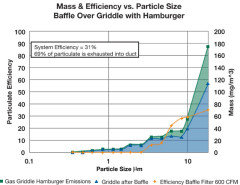
I am always dazzled with amazement when learning of the latest VaH claim. Both baffle (centrifugal) filters and (I would bet) VaH squirrel cage centrifugal blowers capture only much of the larger end of the grease particle size spectrum. (See image 2.) Condensation collection and impingement collection of intermediate sized particles in the ducting is likely to be similar, and for most residential uses, of low concern. By "low concern" I mean that the rate of grease build-up and the rate of rancidification of grease to varnish are similar, so dripping duct grease will be very unlikely.

- 5 years ago
Brief highjack — kaseki, may we see pics of your setup? Especially the induction wok burner? Getting ready to do a reno that — ideally — needs one.
I cannot help the OP much, other than to say I installed a VentAHood in a previous home and loved it. - 5 years ago
@MizLizzie About to move large stones into a garden area and will be tied up for a while (not to the stones). Shooting black appliances on black soapstone requires some setup and post processing, so please wait patiently (or however you like to wait). Also, the primary cook has to not be using the area.
Note that I don't know whether Cooktek still sells that particular wok hob, but it has worked well for a decade.
Tarun Mistry
Original Author5 years ago@kaseki and @opaone - thanks for taking the time to answer, it really is appreciated.
On the Make Up Air front, @opaone am I correct to understand that you push MUA directly into the furnace? If so - can you explain what was meant by "(with a lockout to the furnace blower and kitchen zone) which is not ideal but works well."
I don't understand what a "lockout" is and what you mean by a "kitchen zone".
However - from reading this, I would very much prefer to send air directly into the furnace and let it distribute thoughout the house. I had thought the air all needed to get to the kitchen area, however if that doesnt need to be the case then that is great.
Somewhere I had read that house ducting is only good for a few 100 CFM, and this type of approach would damage it and the blower in the furnace, but that does not seem to be the case?
Would appreciate your insight
Thank you- 5 years agolast modified: 5 years ago
Lockout just means that the furnace blower turns on when the MUA is on. Otherwise the furnace blower could block a lot of the MUA air. Most MUA's have a lockout function so this is just a wire from that to the fan controller on the furnace, thermostat or zone controller.
We have 6 HVAC zones in our house (e.g., 6 thermostats so each zone can be a somewhat different temp). The kitchen zone includes the kitchen, scullery, entry hall and mudroom. When the range hood MUA is on the kitchen zone damper is also opened to insure air flows to that zone (the incoming MUA air will also be conditioned (heated/cooled/humidified/dehumidified) if necessary - the MUA will only heat the air and that is only to 45°).
The furnace blower and ducting were sized for MUA+ERV loads. I believe the kitchen zone ducting needed to be about 20% larger than it otherwise would have.
If your house is one single zone then you likely only need to insure that your furnace blower CFM is greater than your MUA+ERV/HRV, connect a lockout and you s/b good to go.
Doing MUA in to the return vent like this is kind of sub-optimal and it can result in airflows coming from directions you don't want.
- 5 years ago
Getting all of that cooking off the island, and sticking soley with induction, would be the first steps to more efficient cooking, and a heck of a lot more budget friendly than the 8K of ventilation that's in your future.
- 5 years ago
With respect to depending on the furnace for MUA heating, it is important to ensure that it can supply the heat needed when replacing what may be 1000 CFM of air flow. This may be best addressed in new construction. Many houses only provide sufficient furnace capability to handle normal house replacement air (leakage) and loss of heat through the walls and windows.
Where the furnace is inadequate, perhaps putting MUA into a clean basement or mud room or other location where a supplemental heater can be installed is easiest. For attic type systems, an electric coil with upgraded house power circuits may be optimal. The biggest issue with MUA is dealing with existing architecture.
Here is my handy chart for heat needed as a function of air flow rate and difference between outside and desired inside temperature.

- 5 years ago
Here is a quick shot, only staged enough to see the cooktops in their entirety, with a bit of the dark end of the base curve pushed up a bit. I was able to get this with a mere Nikon CoolPix so a time draining setup wasn't needed.
Note that the actual color of the Cooktek induction wok surround is aluminum, and not golden as various room and hood lights vs camera curve made it seem.
Model number is MWDG-3500, 3500W (output), 240 Vac single phase, 31000 BTU equivalence (see the Induction Site for more on equivalence). I mounted the control into the soapstone. It is easy to stir with one hand and regulate "flame" with the other.
Further reading from my copy of the product spec: dimensions are 16.5L x 16.50W x 6.15H. The red blotch visible to the lower left is the power setting display.
I ordered mine from Select Appliance, San Francisco, CA, December 2007 and it was shipped to me from Cooktek. The same unit appears to be available here: https://www.culinarydepotinc.com/cooktek-605601-16-5-wok-range/?keyword=&msclkid=951587c5448318e61630e69f5f8cbc0a
My unit came with a fitted wok that rests on the metal rim and nestles into the bowl but does not touch it. A different configuration drop-in wok hob is also shown on Cooktek's web site, but I didn't attempt to determine power level.

- 5 years ago
Thanks, kaseki. Dang, that is NICE. Never seen one before. Perfect for my project, but perhaps out of budget. Thanks again for sharing.
- 5 years ago
Oh! That was what you wanted, @opaone. I recalled yesterday that you had asked for a photo too, but I couldn't remember the relevant thread's topic. I was going to send you a message, but in spite of bragging about their new messaging, Houzz has successfully hidden the method from me.
I have a 25mm lens for my 645z camera body that might be able to get the kitchen in one or two shots. Just keep in mind that unlike the situation in those just-built-kitchen photos rampant on the Kitchen Forum, my DW believes no horizontal surface area should be left unused. Expect some obscurative clutter; I don't have time to stage and unstage the whole area.
- 5 years ago
"my DW believes no horizontal surface area should be left unused. Expect some obscurative clutter; I don't have time to stage and unstage the whole area."
A well loved kitchen is a wonderful thing.
Nice camera. I've a couple of Mamiya 645's around here somewhere and even a digital back for one. I miss shooting medium and one of these days hope to get back to it.
Tarun Mistry
Original Author5 years ago@kaseki I must say im excited to see this too! I have been reading yout threads for a while and always wondered too!!! :D
@opaone thanks for the input on the multizone HVAC. I have some questions on this too, wondering if I need a separate thread - maybe not, lets see. I am also thinking the same but - just lika MUA, there is alot of confliting information as to how todo it.
Could you provide a little details about how you setup the zones. Is it a single furnace with dampers or multiple furnaces? Did you use a bypass or not?
I would preferably like 4 zones (basement, main level, bedroom level 1 and bedroom level 2). Each zone is approx the same size.
Regarding the MUA coming into the kitchen, on the assumption I pump this in directly and not via the exisitng vents, I have attached a screen shot of my layout. The kitchen is top left. Where would be good places to bring it out?
I was thinking (in red) at the base of the island on the sides - equally. That way it doesnt annoy anyones toes/feet while cooking and it going to be even on both sides?
Appreciate any insight.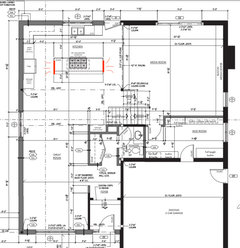
- 5 years ago
These two locations are better than from under the cooktop toward the sink, or from the sink area directed at the island, but better would be out the opposite side (perhaps below foot level if tall stools are used on that side). Otherwise, an even more remote location may be a better solution. These comments apply to MUA coming from below.
If the MUA is supplied from an attic, then a ceiling diffuser is better, with the blades oriented to direct the MUA away from the hood toward an open area or distant wall.
Practical MUA paths and conditioning are so entangled in the whole configuration of the house that it is very difficult to believe in even one's own suggestions without more data.
Here's a related insight. Assume some cooktop hood with baffles, roof blower and intermediate silencer. Then I expect you will hear mainly baffle hiss from the hood. If you emit MUA from a toe kick area that is smaller than the hood opening, then the noise of the MUA entering the room by passing the register blades may be louder than from leaving via the hood. So this MUA exit area needs to be fairly large. Also, the MUA blower needs a post blower silencer to remove its noise.
- 5 years ago
You need a good HVAC person to do zoning correctly as there are a lot of details to get right, especially with duct design. If they screw it up and start telling you things like 'well, that's at the end of a run' or 'it's impossible to get rooms even temps' then you've some serious problems that could have been avoided.
We have two HVAC systems each with furnace, AC, humidifier, dehumidifier and ERV. MUA's are all on one system. Each system has 3 zones using zone dampers and control is handled by a Honeywell/Residio zone controller and prestige IAQ redlink thermostats.
The Honeywell/Resideo zone controller and Redlink system has proven surprisingly antiquated, unreliable and problematic. Unfortunately the Lennox system was worse.
System 1: LL, Main North, 2nd North
System 2: Main South, 2nd South, Loft
Bypass is a quite general term so I'm not sure what you're referring to.
We were supposed to be able to run ventilation from our HA system (C4) but that's proven a failed promise from Resideo. The idea was to use CO2 sensors in bedrooms and a couple of other places to run ventilation when necessary. If I'd know better we'd have installed CERV or Zehnder ERVs.
Anytime possible we turn off all HVAC systems and open windows.
We had planed to install a Whole House Fan to use w/ open windows but the local code inspector had heart palpitations over that saying it would kill people.
Tarun Mistry
Original Author5 years agolast modified: 5 years agothanks guys, this is really helpful. I was under the impression I had to be very even with the air and have it close to the hood vent.
@kaseki I also have this option as shown, much larger vents again at toe level pushing into the room. Great point about matching the vent sizes to avoid noise! These will need to be pretty large then.
@opaone I will talk to my HVAC guy about a multi zone setup, I suspect without your level of knowledge, I wont be able to have the approproate conversation with my HVAC installer! Having said that - if multi zone is possible, it seem the best option is to dump into the kitchen zone assuming it is done correctly.
- 5 years ago
"it seem the best option is to dump into the kitchen zone assuming it is done correctly."
Likely, yes. Ideallly what you want is the fresh air to flow across the kitchen and in to the hood so that it takes as much effluent as possible with it.
- 5 years agolast modified: 5 years ago
I like your new scheme if the MUA is isolated from the furnace zones. I consider this less trouble, but there is a capital cost to adding an additional heater. If this path is pursued, it would be useful for the register or diffuser vanes to direct the air toward the hood island and not into the great room, to minimize drafts there.
You want the 1000 ft/min air velocity level of MUA at its blower to become a mere zephyr when the MUA reaches the hood area. If there is still turbulence, then rotate the registers/diffusers to aim into the great room. The returning air to the kitchen will be pretty smoothed out, I would expect.
Tarun Mistry
Original Author4 years agohey guys - just wanted to thank everyone on this thread thus far. We are now moving forward with this design including the elctro industries MUA.
Once im done i will post pics of the hood vent too, most likely still 4-5 months out. If subsequent folks do want to see and I forget to reply, please ask
Cheers!



chispa