Software
Houzz Logo Print
ned_b

Deteriorating Exterior Tile Stoop: Repair, Replace, or Scrape Clean?

4 years ago
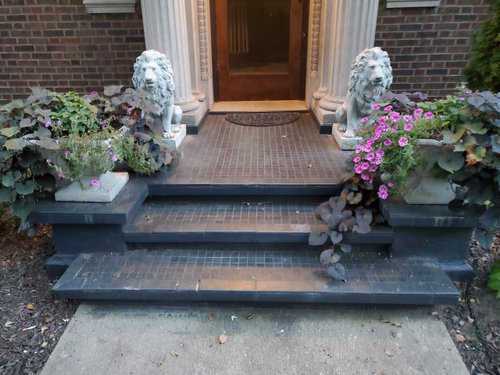
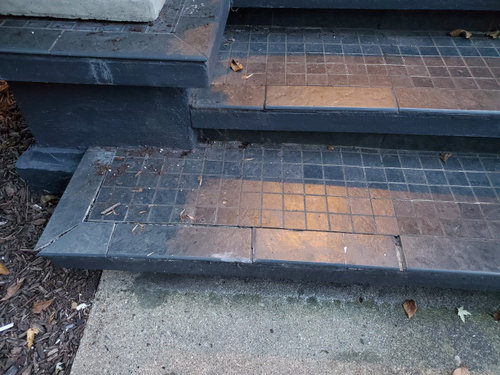
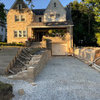
Our front stoop has had issues since we moved in 3 years ago. The original construction is concrete with decorative precast concrete cladding on the sides, and as far as I can tell the steps and landing were originally concrete poured with-in a steel edge angle. Somewhere around 15 years ago the previous owner tiled over all of the horizontal surfaces.


When we moved in the tile on the lowest riser was falling off and we just chipped what remained off. There were also a few small surface spalls on the faces of tiles, but that was about it. The second winter some large chucks of tile popped out and the grout around the edges of the border tile started to crack. I did some makeshift patches with epoxy, but last winter a few more sections of tile broke off, and it became clear that there was movement in the entire border. Now after summer and a few months of people walking up and down these steps while work was being done on our house and most of these tiles are loose. Lifting them up it seems like the setting bed has in many places just turned to dust. The rest of the field tile seems considerably more stable, but there is a decent amount of efflorescence(?) on the grout throughout.


So my first question, for anyone who can give some insight, is what caused this? Was it an improper installation, improper application? A lack of regular grout sealing or other maintenance issues? The painted/caulked edge where the tile meets the steel angle?


And my second question: what should we do now? My first inclination is to patch it back up and hope it lasts a few more years, but we may be past that point now. As much as this is not how I would have done the stoop, and the dark color is a pain for showing dirt, we have plenty of other pressing issues on our house to be spending money on right now and another winter is coming fast.


But if the answer is that the whole thing has to go, should we try tiling again, or scrape it all off clean and hope that the concrete beneath is in reasonable condition or can be restored/coated to look good and be durable.


I appreciate any thoughts.


Comments (5)

  • 4 years ago

    That must have been a beautiful entry before it was damaged but the steps are definitely not looking as if they're safe.


    Most step tiles are loss or most of all the tiles are loose -- Is that only on the steps but not the stoop that is damaged? IF the top level -- the stoop -- is in good shape and it is only the two steps that are damaged, then you could redo only the two steps in concrete -- no tile needed since you do have a concrete sidewalk.


    If, however, the tiles on the stoop are also loose, you should remove them all; and if so, would not replace them with other tile. Because the stoop floor is so close to the door threshold level, it may well be that you need to remove the entire stoop and steps and build anew. When you do, consider concrete but face the vertical front and sides with brick or stone and then outline your sidewalk with the same brick or stone.


    Before you proceed... now is the time to decide if you want a larger stoop or even a front porch.

  • 4 years ago
    last modified: 4 years ago

    as far as I can tell the steps and landing were originally concrete poured with-in a steel edge angle.

    I'm going to guess that the main reason for the failure is the steel angle...if I understand correctly. (Is the steel angle a reinforcement for the edge of the steps?) I'm thinking that the steel and concrete behave differently with changes in temperature and the dissimilarity caused the failure. And/or corrosion?

    Along with possible climate factors, moisture, etc...

    we have plenty of other pressing issues on our house to be spending money on right now and another winter is coming fast.

    I would be inclined to patch it back up and deal with it next spring.

  • 4 years ago

    ci_lantro, thanks for the thoughts. I had thought about the steel angle being a potential, which I think essentially serves to not only protect the edge of the steps and landing, but was their pour-stop and form when the concrete was poured. And this angle had gone long without paint and was very rusted before it received a new coat of paint last year. But at the corner where the tile has really started to pop the concrete below the tile and adjacent to the angle appears to be in good condition (see on the far left near the corner).


    Concrete and steel actually have the same expansion coefficient so they normally behave the same with temperature differences, which is why steel makes such a good reinforcement for concrete. But when steel corrodes, it expands in a different way that could effect adjacent concrete. That's when rust jacking for instance causes the brick and mortar above a window to crack. But so far that doesn't seem to be the issue here to me.


    Regarding a design change, I think we definitely aren't looking to make huge changes to the configuration. It would end up being pretty costly too since the stoop is clearly integrated with the foundation of our home. The columns and door surround sit atop it and the whole thing has stayed tight and attached and at the same level as the rest of the house for the last 95 years.


    Here's a zoomed out view though for reference:


    I was actually hoping instead of plain concrete that we would find red quarry tile like we have in the sunroom, and matching the red clay roof rather than plain concrete under the tile.

  • 4 years ago
    last modified: 4 years ago

    I love the step entrance. I googled "how long would concrete steps last" and the answer was 40/50/60 years. Find an expert exterior tiler...my suggestion is someone who does pool tiling. They know what tiles can withstand your winter temps.

    What outdoor steps tile flooring is the best?

    • Granite - one of the most durable materials for tile flooring. ...
    • Sandstone - tiles made of this material are far less resistant than granite. ...
    • Travertine - it is a naturally coarse material and the tiles made of it are anti-slippery.
  • 4 years ago
    last modified: 4 years ago

    That makes sense about concrete & steel being compatible, A Fox. Maybe the challenge is in finding a tiling adhesive product (mortar, thinset, etc.) that adheres to both concrete & steel? Suitable for wide temp changes, exterior use, moisture....? (Thinking out loud because I am certainly no expert.) The field tile appears to be in good repair & it is just the picture frame border tiles (where I presume there is steel) that is failing. Correct?

    Judianna has a good idea with consulting people who do pool tiling.