

How to Test Heat Pump Stage 2 Cooling?
I have a Carrier 50VR package heat pump and a Honeywell T6 Pro thermostat. The heat pump supports two-stage cooling and two-stage heating. The thermostat is configured for two-stage cooling. How do I check whether the heat pump is actually switching between stage 1 cooling and stage 2 cooling?
Comments (41)
 4 years ago
First thing to check is the wiring from thermostat to heatpump. Are all the wires there (Y1, Y2, W1, W2)? Other terminals/wires may be thermostat and heatpump specific, so check the manuals for each. Does the airflow increase when the thermostat call for second stage? This will only test for the blower, not the compressor.
wdccruise thanked sktn77a
wdccruise
Original Author4 years agoThanks for the reply.
The thermostat is wired correctly but I'm not sure the second-stage wire (Y2) from the thermostat is connected to the heat pump. I hoped to test whether the second stage worked before complaining to the installer. I don't see a way to know when the thermostat calls for stage 2 cooling; the thermostat control panel always shows, "Cool On" regardless of how low I set the desired temperature.
Related Professionals
Daytona Beach General Contractors · DeRidder General Contractors · Salisbury General Contractors · Grand Forks General Contractors · Brattleboro General Contractors · San Jose General Contractors · Pullman General Contractors · Alexandria Home Remodeling · Enfield Home Remodeling · Augusta Home Remodeling · Provo Home Remodeling · Anchorage Home Remodeling · Cape Girardeau Bathroom Remodelers · Manhattan Bathroom Remodelers · Palm Desert Bathroom Remodelers- 4 years ago
You should feel a noticeable increase in airflow after a couple of minutes if you drop the thermostat 5 degrees.
 PRO4 years ago
Is it two speed or two stage?
Two stage would have two physical compressors. If both compressors are running it's calling 2 stages.
If it's 2 speed (one compressor) you should have a call (signal) from y1 and y2. The board may also have an indicator on it.
It's possible to have 2 compressors and only 1 running in 2nd stage. That would be odd though for a package unit, usually 2 stage package units are 2 separate refrigeration circuits.- 4 years ago
The 50VR has a 2 stage, single, Copeland Utlratech scroll compressor. Don't know if that's good or bad (?)
 PRO4 years ago
"Two stage would have two physical compressors. If both compressors are running it's calling 2 stages."
Nope. Multi-stage compression is fairly common in commercial and industrial refrigeration systems. A single compressor can (and typically does) have multiple compression stages (e.g., pistons) where the output from each stage is passed to the next stage (e.g, next piston) where it is compressed again, and passed to the next stage until the desired compression is reached.
If you have an air compressor in your garage, it's most likely a two-stage piston-type compressor. It has a single motor and it's a single, two-stage compressor--it's not two compressors.
In residential HVAC, what most manufacturers refer to as a two-stage compressor is a single compressor that operates at either of two speeds depending on the capacity required. Typically, low speed is around 65% to 70% capacity and high speed is 100% capacity. Again, it's not two separate compressors and there aren't two separate motors. If you have an issue with the terms "two-stage" versus "two speed," you'll need to take that up with manufacturers of residential HVAC equipment since the use them interchangeably.wdccruise
Original Author4 years ago@Charles Ross Homes: "what most manufacturers refer to as a two-stage compressor is a single compressor that operates at either of two speeds depending on the capacity required."
Yes, this is the Carrier 50VR design.* In addition, the heat pump supports two blower speeds, one each for stage 1 and stage 2 cooling (and heating).
*As well as that of its many clones: Bryant 607E, ICP PHR5.
- PRO4 years agolast modified: 4 years ago
Unbelievable. You bet. It's clear to me that our storied HVAC replacement contractor doesn't know a halocarbon from a hazelnut, doesn't have a basic knowledge of building science or physics, and his most recent post suggests he doesn't know much about equipment either. Maybe a little less time beating up on others and a little time with his head in the books....or under the hood.
- PRO4 years agolast modified: 4 years ago
LOL.
If you have two (2 as in more than 1) physical compressors with two seperate refrigeration circuits within a package unit what "term" or "terms" would you use to differeniate it from a package unit that contains a single compressor with two speeds and a single refrigeration circuit?
A manufacturer can call it whatever it wants, primarily to "sell" you... I am telling and showing you the difference between various ways of doing something.
So tell me (since you think you know so much) How would you describe the difference Charles Ross?
What does "stage mean" vs. "speeds"? The answer ____________________________.
Yes, I know staging too.
What's the limit as to how many compressors a package unit can contain? (Look who I am asking? a builder LOL)
speeds vs stages --- I call it what it is, because there's a big difference in how it performs.
You tell me the difference since you think you know something... - PRO4 years agolast modified: 4 years ago
The frequent misinformation you spread on houzz.com does houzzers a terrible disservice. It's clear over many posts that you do not have the subject matter expertise you would like houzzers to think you have. When you're called on it, you deflect the criticism using your too-often exercised "LOL" or "ha, ha, ha" techniques and you bully the individual(s) holding you accountable to re-inflate your ego.
You're not engaged in new construction or design. You're a replacement contractor with a bug up his butt about builders and architects. You might be able to change out an outdoor unit faster than your can correctly spell "psychrometric," but that doesn't give you the broad HVAC knowledge base to help houzzers with the majority of problems for which they're seeking help. Indeed, the majority of your posts serve only to promote your political views, propagate your stereotypes, put down others and advertise the fact that you service the Katy, TX area. Houzzers will be well served to view your posts with a healthy dose of skepticism.
- 4 years agolast modified: 4 years ago
You are so right. The guy should be banned because of his Spamming... and his lack of knowledge about HVAC and aggressive dismissals of the simplest of queries or challenges to his frequently ridiculous statements about HVAC.
Half of his posts include spam - and even when reported seem to frequently remain.
Is there any person in this forum that does not know where this person conducts business?
wdccruise
Original Author4 years ago@Austin Air Companie: "If you have two (2 as in more than 1) physical compressors with two seperate refrigeration circuits within a package unit what "term" or "terms" would you use to differeniate it from a package unit that contains a single compressor with two speeds and a single refrigeration circuit?"
What are you going on about? The Carrier 50VR has one, two-stage compressor. I even provided a link to the Product Data document whose Physical Data table shows Compressors: "Scroll, Quantity = 1" and whose Features/Benefits section states, "Scroll Compressors have 2 stages of cooling/heating..."
- 4 years ago
Meanwhile, back on track, what happens to the airflow when the second stage kicks in?
- PRO4 years agolast modified: 4 years ago
What are you going on about? The Carrier 50VR has one, two-stage compressor. I even provided a link...
Yes, I know that... but the title of this post that you started reads what?
If you had a "real" 2 stage system and not a 2 speed system... you wouldn't be asking how do I tell if it's running in 2nd stage?
If manufacturer's spelled out "everything" of a specific model they make -- to make it sound worse? --- They don't do that. They wouldn't sell any if they did.
There is a difference. Those are the points I was making.
Meanwhile, back on track, what happens to the airflow when the second stage kicks in?
Uh, I believe the proper slur is "second speed".
I sold two compressor systems a little over a decade ago in direct competion with 2 speed compressors. The two compressor systems cost more.
So given this new found insight....
What does "stage mean" vs. "speeds"? The answer _______________?
You're not going to notice the difference from 1st "speed" to 2nd "speed" on a two speed compressor. What these try to do and mostly fail at? -- that said they are better than single speed but for the amount of money, you'd be better off going full variable and choosing Inverter.
Obviously a little late for you. But much of what I post isn't necessarily for the OP of the post. It's for some people who read these things weeks, months and sometimes years later. There's more to selecting a system than just looking at "trigger words and phrases" put out by manufacturer's.
I service the Katy, Texas area. - 4 years ago
How do I check whether the heat pump is actually switching between stage 1 cooling and stage 2 cooling?
Here is a video which goes into details have to verify a 2-stage compressor is operating properly:
How I Troubleshoot an Air Conditioner 2-Stage Compressor
Here is another video If you want to understand of how a 2-stage compressor works:
What's Inside a Two Stage Compressor?
The 2-stage reciprocating compressors typically have operating capacity stage splits of about 65%/100%, whereas the scroll compressor is typically 75%/100%.
- 4 years ago
"You're not going to notice the difference from 1st "speed" to 2nd "speed" on a two speed compressor."
Maybe, maybe not. But if the air handler is wired correctly, the blower speed should increase noticeably when the second stage is called for. This won't tell you if the condenser is wired correctly, but its the first step in diagnosis.
- 4 years ago
I notice a difference on my 2-stage compressors. The low stage runs so quietly you have to look at the thermostat to realize it is running. The low stage is used for cooling to dehumidify.
The compressors in my Carrier Infinity equipment have a single motor winding and run at one speed. In the low stage they run in one direction and use one piston, and in the high stage they run in the opposite direction and use two pistons.
I am not familiar with 2-speed compressors. Perhaps one of the HVAC pros can point to a product data sheet of equipment that contains an example of a 2-speed compressor.
wdccruise
Original Author4 years ago@mike_home: "I notice a difference on my 2-stage compressors. The low stage runs so quietly you have to look at the thermostat to realize it is running."
That's why I chose a package heat pump with a two-stage compressor. The heat pump sits on the roof above my bedroom so I wanted the unit to be as quiet as possible. I could hear vibration from the old heat pump through the ceiling.
- PRO4 years agolast modified: 4 years ago
Maybe, maybe not. But if the air handler is wired correctly, the blower speed should increase noticeably when the second stage is called for. This won't tell you if the condenser is wired correctly, but its the first step in diagnosis.
Everything nowadays comes with either ECM or variable speed blower, if ductwork is done properly even that is not likely or "easily" to be noticed. Time doesn't stand still in HVAC land.
Noise? it's subjective. If you look at sound DB charts for any modern (*recently made*) AC / heat pump there is very little difference in 1 speed AC / 2 stage *if you can find one, referring to split system ducted here* / 2 speed AC / heat pump.
The Inverter beats them all when it comes to noise, when running in low and even mid operating ranges (which is most of the time). The inverter also beats them in performance, energy savings as well as better dehumidification in the summer.
Here's a picture (below) of a two "stage" - 2 compressor AC. I doubt you could find one of these today, but that doesn't mean they don't exist. --- like some around here like to push that narrative for some reason... you know who you are. LOL.
click to enlarge if necessary.
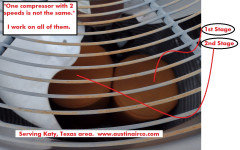
If this switched into 2nd stage... you'd know it. But time moves on in terms of split ducted systems.Package units on the other hand? They will continue to be what they are for a time longer. 2 speed compressors cut costs, but as we all know: you get what you pay for.
In terms of how many compressors could you have? How they operate? We haven't even discussed tandem compressor operation?
Unbelievable!?! --- right?
All this time has passed an Mr. Ross still can not answer this simple question:
What does "stage mean" vs. "speeds"? The answer _______________?
I service the Katy, Texas area.
Note: When I do maintenance service on a few two speed units I sold years ago when there wasn't much of anything better at that time, the only difference is a short swoosh sound when unloading the compressor from 2nd to 1st speed. If you don't know, not right up on the unit near the compressor it's not what I would say "noticeable". From 1st to 2nd speed, I don't recall any difference or noise or anything. - PRO4 years ago
You may have missed this from my earlier post, so I'll impose on houzzers and repeat it for you, Ray:
"If you have an issue with the terms "two-stage" versus "two speed," you'll need to take that up with manufacturers of residential HVAC equipment since the use them interchangeably." wdccruise
Original Author4 years ago@Austin Air Companie: "Maybe, maybe not. But if the air handler is wired correctly, the blower speed should increase noticeably when the second stage is called for. This won't tell you if the condenser is wired correctly, but its the first step in diagnosis."
This is just wrong. The stage and fan speed are independent. Normally the fan speed is configured by the installer to run faster during stage-2 operation but this isn't required. The 50VR even includes a jumper that forces the fan speed to remain at low speed during both stage-1 and stage-2 cooling while allowing the faster fan speed during stage-2 heating.
FYI: I looked at the specs sheets for many package heat pumps before selecting one. Those documents never used the term "two-speed compressor."
- 4 years agolast modified: 4 years ago
"Normally the fan speed is configured by the installer to run faster during stage-2 operation but this isn't required." Great recipe for an iced evaporator coil.
Oh, and a "two stage" compressor is the same as a "two speed" compressor. wdccruise
Original Author4 years ago@sktn77a: "Great recipe for an iced evaporator coil."
The Carrier 50VR heat pump (and its many clones) supports a constant fan speed (same speed in stage-1 and stage-2) to improve de-humidification when operating in stage-2. I presume that Carrier designed the heat pump to prevent damage when that feature is selected.
Feel free to call a two-stage compressor a two-speed compressor if you like.
- PRO4 years agolast modified: 4 years ago
@Austin Air Companie: "Maybe, maybe not. But if the air handler is wired correctly, the blower speed should increase noticeably when the second stage is called for. This won't tell you if the condenser is wired correctly, but its the first step in diagnosis."
This is just wrong. The stage and fan speed are independent. Normally the fan speed is configured by the installer to run faster during stage-2 operation but this isn't required. The 50VR even includes a jumper that forces the fan speed to remain at low speed during both stage-1 and stage-2 cooling while allowing the faster fan speed during stage-2 heating.
FYI: I looked at the specs sheets for many package heat pumps before selecting one. Those documents never used the term "two-speed compressor."
The top part that your referencing was "quoted" by sktn77a, I was responding to what he was saying. --- I know people like to put words in my mouth, but this is another level.
Fan speeds are completely different now with AFAIK every furnace / AH etc come with either ECM or variable speed blowers. Manufacturer's now have the ability to pre-program various algorithms into the board for various operating conditions. One such method can ramp the blower slowly to the point in which you won't notice it, like equipment of old where the ramping was much faster and as such much more noticeable.
Best not to go off so far into the weeds... lots of confusion among the realm of deciding what the difference is from "speed" to "stage".
If a compressor has 2 speeds... you call it a two 2 speed compressor. (I call it what it is)
If a unit has 2 compressors... it also has 2 speeds. But it's different than the unit that has a single compressor with 2 speeds. How different? Do you know? If you called the unit that has 2 compressors a 2 speed does that tell you really what you need to know to make an accurate comparison of the product you're marrying yourself to for at least a decade or two? (unless you sell the home / business / move etc.)
I asked you more than once to choose the terms yourself how anyone here would wish to describe this difference since you don't like the terms I've used? So why haven't you done this?
You go to the car dealer lot: two cars look nearly identical to one another?
The car manufacturer even named them the same except for the accessory package etc? The prices of the 2 cars that look the same are miles apart when it comes to price? why?
Look under the hood?
Essentially that is what I am doing here. I am opening the hood of your air conditioner and explaining the difference that you otherwise wouldn't have. Builders don't do that... thats why in that realm you have things that are called "Builder Grade".
I service the Katy, Texas area.
wdccruise
Original Author4 years ago@Austin Air Companie: "Fan speeds are completely different now with AFAIK every furnace / AH etc come with either ECM or variable speed blowers. Manufacturer's now have the ability to pre-program various algorithms into the board for various operating conditions."
The Carrier 50VR doesn't work like that.
@Austin Air Companie: "lots of confusion among the realm of deciding what the difference is from "speed" to 'stage'."
You are the only one confused.
@Austin Air Companie: "If you called the unit that has 2 compressors a 2 speed does that tell you really what you need to know to make an accurate comparison of the product you're marrying yourself to for at least a decade or two?"
You're babbling.
- PRO4 years ago
The Carrier 50VR doesn't work like that.
You know so much how something works that you had to start a thread asking how it works?
Makes complete sense now. - PRO4 years agolast modified: 4 years ago
A residential HVAC system is comprised of a variety of mechanical, electrical, and electronic components. I imagine they are designed by a team of individuals in various engineering disciplines. The mechanical engineers responsible for the design of the compressor won't necessarily know how to verify correct operation using the electronic controls any more than the electrical engineers would know the mechanical details of the compressor's internal working parts. So, it's perfectly reasonable for the OP to understand how the system works, but lack the ability to field verify some aspect of the system's operation at the controller. I believe that is their question. Answering it succinctly and correctly would help keep everyone "out of the weeds."
wdccruise
Original Author4 years agolast modified: 4 years ago@Charles Ross Homes: "it's perfectly reasonable for the OP to understand how the system works, but lack the ability to field verify some aspect of the system's operation"
Correct. I didn't ask how it works, just how to verify it's working as designed.
- 4 years agolast modified: 4 years ago
How do I check whether the heat pump is actually switching between stage 1 cooling and stage 2 cooling?
There are a few ways to determine if the compressor is switching stages on your unit The simplest is to determine if the indoor fan speed is Hi or low because the compressor uses the same low voltage signal from Y2 to switch between stages. If the wires from the P3 plug on the indoor fan board to the compressor are open or the compressor solenoid is shot the compressor will always be in low stage by default regardless of the indoor fan speed.
Because the compressor DOESN'T change speed between high and low you could not tell by listening like the indoor fan. To eliminate a bad wire you would check for 24VAC on the solenoid wires going directly to the compressor (Red and Black). If the solenoid wasn't working the compressor would still only be in the low stage with a Y2 signal. To actually verify the compressor is in the proper stage determined by the Y2 signal is to measure the amperage of the total system.
There is approximately a 500 watt difference between high and low stage operation with your unit. The performance data starting on page 11 will give the actual differences and is also dependent on out door air temperatures. Find your unit for both Low and high performance data (2 charts) to find total system KW demand. Take the total amperage and multiply by system voltage to find wattage for each stage and compare.
A little clarification is in order: In refrigeration 2 stage and 2 speed are not interchangeable and also does not apply to air compressors. A 2 stage bypasses part of the compression cycle of the refrigerant gas to reduce the electrical load, and a 2 speed unit will reduce motor speed with the addition of motor winding taps. A two stage air compressor or water pump uses the same motor to operate two separate and isolated compression units within the casing with the first feeding the second, and I've never seen it done in refrigeration.
There are plenty of two stage condensing units using two separate compressors but most are used in ultra low temperature freezers, and the two units use different refrigerants, very complicated so I won't explain. But I've seen but never worked on the units Ray talked about and don't know how they work. Did I miss the pile on ray day memo?
- 4 years ago
Because the compressor DOESN'T change speed between high and low you could not tell by listening like the indoor fan.
I am in agreement there are no 2-speed compressors found in residential HVAC equipment. But if someone can find an example, then please point to it.
The Trane XL20i condenser had two separate compressors. This allowed it to have an even 50%/100% split between low and high stages. It was an expensive piece of equipment and has been discontinued.
wdccruise
Original Author4 years agoInteresting wrinkle: The installer returned yesterday and told me that the Carrier 50VR switches between Stage-1 and Stage-2 by itself because its control board contains a learning algorithm that intelligently switches stages based on demand. I don't believe this because (a) the Sequence of Operation section of the Installation Instructions states, "High Stage: Thermostat closes R to G, R to Y1, R to Y2, and R to O" and (b) there is no mention of this magical switching in either the Installation Instructions or Product Data.*
My conclusion: the heat pump doesn't switching stages because the thermostat's Y2 terminal is not wired to the heat pump and the thermostat is set to Cooling Stages = 1.
*Unfortunately, Carrier does not appear to provide technical support to customers, only dealers, so I have no way to verify anything.
- PRO4 years ago
There is no "pile on Ray day memo." Rather, there is a simple standing request that his posts contribute something useful to solving an OP's problem. While houzz.com is a forum in which many posters ask for help, our storied HVAC contractor is not wont to provide any without showing up in person and being paid. His posts are self serving. I believe that qualifies them as spam.
With regard to multi-stage vs. multi-speed compressors, residential HVAC manufacturers use the terms interchangeably, which I would expect any residential HVAC contractor worth his gauge set to know. Raising the question didn't contribute to solving the problem, but rather, took houzzers "into the weeds"--a place Ray asserts he tries to keep everyone out of. - PRO4 years ago
With regard to multi-stage vs. multi-speed compressors, residential HVAC manufacturers use the terms interchangeably, which I would expect any residential HVAC contractor worth his gauge set to know. Raising the question didn't contribute to solving the problem, but rather, took houzzers "into the weeds"--a place Ray asserts he tries to keep everyone out of.
Yes, absolutely. So when I sell something that a "HVAC contractor worth his gauge set to know"?
Why does it cost more than something that looks on the surface to be just as good?
A manufacturer can call something whatever they want. You're often told to get 3 quotes or in some cases more? How is it you're going to make a decision and be happy with your decision when every single manufacturer with unbiased or controlled reviews ranks in the realm of 1.5 to 2 stars out of a scale of 5 stars.
I call it like I see it. A two speed compressor is a 2 speed compressor. 2 separate compressors whether half "stage" functionality or "incremental full stage addition".
If you have a 5 ton capacity package unit - design wise you could have (2) as in more than 1 compressor. Each could be 2.5 Tons of capacity with separate refrigerant circuits. In "stage 2" both compressors run to deliver 5 tons of cooling.
Why would you choose this? Do you know? Should I not have the "gauge set to know" If I don't know why would I say things I do in this thread? Please tell me. I'm litteraly dying to hear your excuse.
You could have a 2.5 ton compressor and a 5 Ton compressor in a sort of "tandem" set up in which in 1st STAGE the 2.5 ton compressor runs... upon entering 2nd STAGE the 2.5 ton shuts off the 5 ton compressor starts. In this form of operation both compressors use the same refrigeration circuit. (How do you suppose a manufacturer would describe this. The answer is why you need someone like me... this isn't DIY camp.)
--------------- Larger systems ----------------------------What lay out above is merely generic as to where things go further up. I am licensed to work on any equipment up to 25 tons in capacity. Use your imagination how a manufacturer could get to those sizes.
---------------------------------------------- HVAC design -------------------------When it comes to "design" -- whether it be residential, commercial, light industrial etc. Choosing a system and how it operates --- is a part of the system design process. So if you want to trust the manufacturers without getting further insight?
Or you could just settle as --- it's good enough for this neighborhood. -Builder Grade is all we need.... that's entirely your choice. Comfort means different things to different people. I'm in a unique position to throw at least a few shadows on that thought process.
UNBELIEVEABLE?!? --- yep, you betchya.
So again how would you describe it differently than I did> what terms would you use if you were trying to "sell" me something that was clearly better, but was going to cost more?
I offer cheaper solutions too. Comfort means different things to different people.
There's only 1 Ray Austin. I service the Katy, Texas area. - PRO4 years agolast modified: 4 years ago
To restate the OP's question:
"How do I check whether the heat pump is actually switching between stage 1 cooling and stage 2 cooling?"
The excursion into the two-stage vs. two-speed discussion, while fascinating, isn't particularly relevant to the OP's question, which you haven't answered in any way in this thread, despite using up air time, and of course, letting us know you service the Katy, TX area. I can't speak for everyone, but I'm glad there's only one Ray Austin. Perhaps you could start a new business selling Ray Austin branded merchandise. I know one customer in Katy, TX who'll buy a lot of any such branded stuff.
wdccruise
Original Author4 years agoWhat is wrong with @Austin Air Companie? Why does he keep typing this stuff, all of which is irrelevant to the simple question I posed about my new Carrier 50VR packaged heat pump?
@mike_home: "If my conclusion is correct, you will need to install a Y2 wire in order to engage the high stage."
Yup.
- PRO4 years ago
The excursion into the two-stage vs. two-speed discussion, while fascinating, isn't particularly relevant to the OP's question, which you haven't answered in any way in this thread, despite using up air time, and of course, letting us know you service the Katy, TX area.
Sure you're entitled to your opinion. You're a home builder, this isn't your realm. This is what I do for a living. --- expanation is there for those who want it.
If you don't want it? Why are you here? I ask this question myself everyday responding to your builder grade rhetoric.
Guess what I am also entitled to my opinion. An opinion based upon 27 years of doing HVAC for a living. If you like that, don't like that? I am fine with it, but it changes? NOTHING.
I service the Katy, Texas area.
[Contractual Obligations] --- I'm not under any currently. (lucky for you the reader searching for important HVAC information... consider your sources for such. -- I make reading between the lines so much FUN!) - 4 years ago
Maybe you need more than a Y2 wire. Below is the control operation and the thermostat wiring requirement to run your 50VR in dual stage. Just because you have a 2 stage thermostat doesn't mean it's wired up. There are other sources for information besides what you have. The 50VR---A, C manual is the same unit and where the following information came from. It also states how to wire up a 1 stage thermostat. Good luck,
Start and check the unit for proper control operation as follows:
2. Thermostat:
On a typical two stage thermostat, when the room temperature rises 1 or 2 degrees above the cooling control setting of the thermostat, the thermostat completes the circuit between thermostat terminal R and terminals Y1, and G. These completed circuits through the thermostat connect the contactor coil (C) (through unit wire Y1) and indoor fan board (through unit wire G) across the 24--v. secondary of transformer (TRAN).
On a typical two stage thermostat, when the room temperature is several degrees above the cooling control setting of the thermostat, the thermostat completes the circuit between
terminal R and terminals Y1, Y2 , and G.
3. If your unit contains accessory electric heat, place system switch or MODE control in HEAT position. Set control above room temperature. Observe that the indoor blower is
operating and warm air is flowing through the supply air vents inside your home. Observe that the heating cycle shuts down when the control setting is satisfied. If your unit does not contain accessory electric heat and you would like to obtain it, please contact your local dealer for more information.
4. When using an automatic changeover room thermostat place both SYSTEM or MODE control and FAN mode stitches in AUTO positions. Observe that unit operates in Cooling mode when temperature control is set to “call for Cooling” (below room temperature).Thermostat wiring (9 wire)
Color Connection
WHT (W2)VIO (W3)
YEL (Y1)
GRN (G)
RED (R)
BRN (C)
ORN (O)BLU (DH)
PINK (Y2)
.wdccruise thanked outpaientzero








mike_home