Software
Houzz Logo Print
gandtperry

Slab backsplash

4 years ago

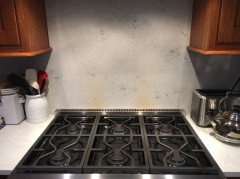
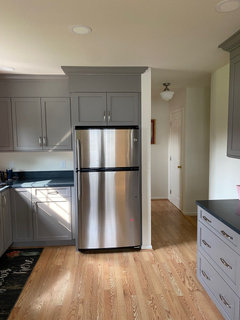
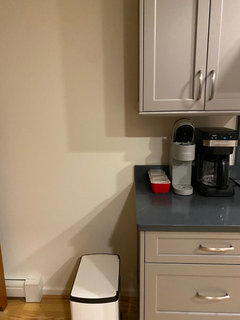
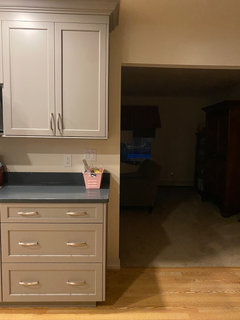
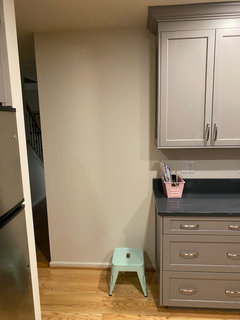
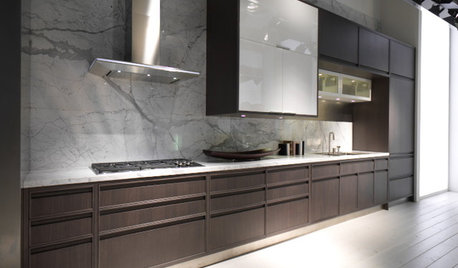
I want to do an 18” slab backsplash up to shelves on one side of my kitchen. The opposite wall has my cooktop and range hood and I will not have anything either side of the hood. Will an 18” backsplash look awkward as it won’t go up to the range hood (planning on 26” above counter for hood)? Should I do 18” and then up to hood, but I really like straight lines! What edge options are there for the top of the backsplash? Thank you!

Comments (26)

  • PRO
    4 years ago

    It will look like you mis measured if you don’t run it up to the hood- you will regret it.

  • 4 years ago

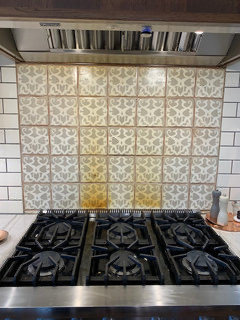
    And w will look scorched and burned.

  • PRO
    4 years ago

    If quartz is what you are using it can't go behind the range anyway and honestly I need to see the space and the choices for counter and backspalsh. Your hood will make you crazy at 26" why that height? I need pics

  • 4 years ago


    Sketch out your plan. It MIGHT look like you mismeasured but it might look fine. Will the backsplash be 18" all the way across both walls? It might work.


    I am sure you are putting enough space between the range and the wall that all the lectures about burnin' yer backsplash are unwarranted. :)

  • 4 years ago

    Yes it would run the length of both walls

  • 4 years ago

    “planning on 26” above counter for hood”

    The distance between the cooktop and the bottom of the hood should be between 30” and 36”. The 26” you mentioned is too low, and will give a cramped feeling.

  • 4 years ago

    This depends on the hood. Some Vent A Hoods for example, mount below 30" because they operate at a lower CFM, as do some other lower powered hoods.

  • 4 years ago


  • 4 years ago

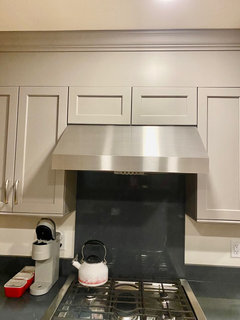
    When I had my kitchen renovated a few years ago; I chose Silestone quartz countertops with 4” backspash. I also had the Silestone quartz range backsplash extend from my Samsung gas range up to the hood. The Silestone counters and backsplash looks as good today as the day of installation. When I use the burners or oven, the Silestone backsplash never gets warm. My very experienced kitchen designer and experienced licensed carpenter have installed lots of quartz backsplashes behind ranges without any issues. I think if you want the quartz backsplash behind your range, it should extend to the hood; and make sure the specs of your range can accommodate a quartz backsplash.

  • 4 years ago
    last modified: 4 years ago

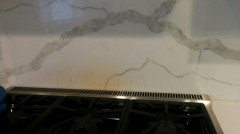
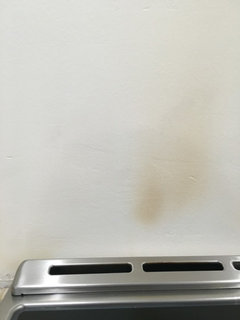
    The quartz specs are what prohibit its use behind a range. They tell you that they will not warrant it against heat damage. Which is why you need a backguard, which most pro range manufacturers also require, if people would read those specs too. People just don’t read.

    And a picture of a range is conspicuously missing…..

  • 4 years ago

    Part of the problem is that people always say on design forums how "terrible" ranges with backguards look because it "ruins the line" of the backsplash.

  • PRO
    4 years ago
    last modified: 4 years ago

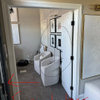
    Verbo has posted pictures of an installation failure, not a product failure. I can't stand it when a product is improperly installed, fails, and gets the blame when in fact the mistake was made by a designer in an air conditioned office.

    According to Thermador, the pictured range's manufacturer, there is to be 12" between a combustible wall and the rear of the range. And no, placing tile or stone on a combustible wall does not turn it into a noncombustable wall, at least according to the NFPA.

    Any surface, stone, tile, stainless steel, would all suffer heat marking installed that closely to the burners. Let's not single out engineered stone as somehow defective for showing identical characteristics.

    Page 6 please.

  • PRO
    4 years ago
    last modified: 4 years ago

    "But stone is naaaatuuurralll." Yes it is, but the plastic resin the slab processors suck into it to make it suitable for countertop use is not and can cook just like the pictured estone.

  • 4 years ago

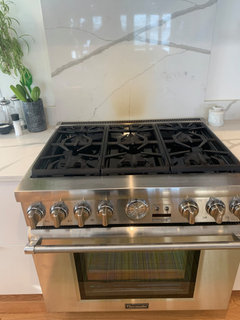
    Verbo: here are 2 more pictues of my kitchen: I love my quartz backsplash!!!!

  • 4 years ago
    last modified: 4 years ago

    It has subtle heat breakdown of the resin. Its just not nearly as obvious initially on dark colors as it is white.

  • 4 years ago

    Verbo: no breakdown of my backsplash: it is perfect!!

  • 4 years ago

    Joseph, please stop spreading misinformation. What you wrote is not true, and we've been around the block with this one already.


    The amount of resin that some slabs have on them is nowhere near equivalent to the resin matrix that makes up ~30% of manufactured quartz.


    Natural stone does not suffer the same type of heat damage that manufactured quartz does.


    As an industry pro, you have a responsibility to be accurate.

  • PRO
    4 years ago

    OP: the range install instructions dictate minimum hood height above range, usually 30"

  • 4 years ago

    Even porous tile or natural stone that has been sealed can have that penetrating sealer be negatively affected by the excess heat that scofflaws to the fire code create when not choosing the required backguard.


  • 4 years ago

    You guys are going into overdrive about gas ranges. . . .the OP said cooktop. Could be induction. Then that heat scorching doesn't happen.

  • 4 years ago

    As far as we know, they have induction with a rear riser and a 12" gap behind the cooktop.


    The question is about twin racing stripes vs slightly mismatched stripes. G&T, I think either can work, especially if it's a modern type of kitchen. I'd want the hood higher, though!

  • 4 years ago

    The posts here have been very helpful. I am amazed by how many professional designers show backsplashes behind a cooktop that are unsuitable for that use. BTW - a shout out to Joseph Corlett - I used Corian for my countertops and the kitchen is a dream (but still haven’t selected a backsplash for the cooking area).


  • PRO
    4 years ago
    last modified: 4 years ago

    "Joseph, please stop spreading misinformation. What you wrote is not true, and we've been around the block with this one already.

    The amount of resin that some slabs have on them is nowhere near equivalent to the resin matrix that makes up ~30% of manufactured quartz.

    Natural stone does not suffer the same type of heat damage that manufactured quartz does.

    As an industry pro, you have a responsibility to be accurate."

    Karin:

    If anyone has a responsibility to be accurate, it would be a shill paid by the natural stone industry. You know, like you. I am paid nothing for my participation here, I've spread no misinformation, and deeply resent your baseless accusation.

    I never said or implied that there is as much resin in natural stone as there is in engineered stone. I never said or implied that natural stone suffers as much heat damage as engineered stone. The hot pot marks in natural stone are nearly identical to the hot pot marks in engineered stone so your statement to the contrary is false. Yes, they are more rare, but you lab types need to get into the field more often. It is you, not I, spreading misinformation. Looks like they're getting their money's worth from you.

    The amount of resin in this case is irrelevant. The issue is heat damage from improperly installed appliances. Were this appliance installed properly, you could use bamboo grass mat wallcovering for a backsplash.

    Don't make me look up and post the myriad of natural stone failures at fireplaces, fire pits, and restaurant heat lamp damage, again all due to improper installations and detailing, not material composition. Natural stone is a fine building material, but its limitations must be acknowledged and accommodated. Let's work together to spread this information please.

  • 4 years ago

    Joseph, it's interesting that your first move to defend yourself is to call me a shill. Look at the tone of your own posts before you call other people names. If you want to be recognized for your factual contributions to this forum, then I'd encourage you to stick to the topic, rather than mischaracterizing other contributors.


    Nevertheless, you corrected yourself in your response, which is the right thing to do.


    Of course any material can be damaged by heat. No one is arguing the contrary.


    The amount of resin and the amount of damage are absolutely the point. It's useless to lump every material together because they can all be hypothetically damaged. The type of information that's helpful is to sort things by degrees. Which material is more likely to be damaged? How might damage occur? This stuff can be nuanced, as you know. Pros can help people sort through that. Your post did the opposite.


    And let me clarify my role is not to promote natural stone over other materials. That's simply not what I do, as is consistently evident in my posts. My advice here is always the same, and that's to help people learn about materials so they can make informed choices. Stone is not the perfect material - nothing is - so I want to help people understand the properties that matter for their situation, and I give them tools and tests to learn for themselves.


    That said, I am a frequent critic of the natural stone industry when they fail to educate themselves and they mislead consumers, That happens way too often and I am always willing to help consumers challenge the industry and sort out the misinformation. Note that I do this without promoting any material over any other, because I have no interest in selling anything -- other than science, of course!


    - -


    MTPO, sorry for hijacking your post! I'm glad you've gotten great advice and extra glad you are happy with the materials you've selected so far. Keep up the great work! :)

  • 4 years ago

    This discussion has used gas cooktops or ranges as the default for the discussion, but electric cooktops may have a minimum distance to a combustible vertical service as little as 2" behind the cooktop, which means the surface could be drywall, so it seems like Corian and manufactured quartz and such would also be unlikely to be damaged in those cases.