Software
Houzz Logo Print
zumtobel

Direct vent NG unit heater for basement

4 years ago
last modified: 4 years ago
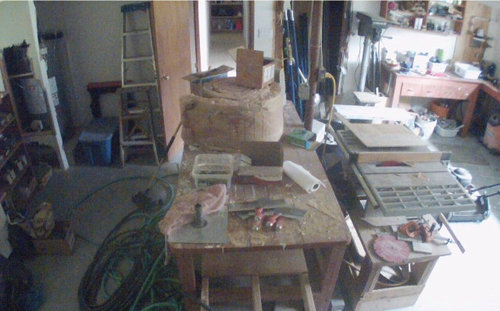
I have a home with a half finished unheated basement. It would take something with at least 50,000 BTUs to heat it. Yes, there are direct vent counterflow wall furnaces but none come ready to accept a Nest, Ecobee or similar WiFi stat. I'm aware that there are workarounds to make a smart thermostat work on the products by Empire, Cozy and Williams. But since my plan is to install a unit in the unfinished portion, appearance isn't a requirement. So why not go with a direct vent NG unit heater, one with an electronic ignition to work with a Nest? Much cheaper! Normally, a unit heater is for a higher ceiling than 8 feet. But in my case, since I would install it close to an exterior wall, the fact that there is no head clearance does not matter. It would be a small trade-off. What products can anyone suggest?


The attached is a view from the exterior wall where the unit heater would be installed. Note the door going into the finished basement. I would replace with a sliding barn door to allow more heat into the finished area.


Comments (10)

  • 4 years ago

    How is the house currently heated? What are the sizes of the finished and unfinished basement areas? Where are you located? Is the basement mostly below ground?

    I can't imagine needing 50,000 BTUs to heat a basement, but I suppose it is possible if it is mostly above ground with a walk out door. Another option is to install a 40,000 BTU furnace with duct work. You could have supply vents in the finished and unfinished areas. The furnace would need to be a high efficiency model so it could be vented through the side of the house. This would allow you to use any thermostat you wanted. This solution may be much more than you may want to spend but the whole basement would be comfortable on the coldest day of the year.

  • 4 years ago

    The house is currently heated upstairs with a 30 year old 40,000 BTU freestanding cast iron NG stove. I am replacing it with a Rinnai 38,400 BTU direct vent wall furnace. Since the Efel stove being replaced "fills the bill" insofar as providing adequate heat at 40,000 BTUs, then it stands to reason that the full basement below [unfinished and finished] requires at least the same BTUs. Even though I have been satisfied with the heating I have had upstairs, to have heat in either of the two bedrooms, I have to leave the door open. So if I left both doors open on the coldest nights in the winter, then the heat from the Efel would fall short. So based on this, for the basement, since I want to adequately heat all of both areas, I want an extra 10,000 BTUs. The house is 1,200 square feet on each level and is in the interior of British Columbia, Canada. As to the forced air furnace idea, for starters, if I went that route, high efficiency forced air furnaces are mandatory in B.C. So we're looking at $15,000.00 [furnace plus duct work]. Last but not least, I am only up there for a week or so every 6 weeks in the non-winter months. This helps to explain why whatever heating I decide upon for the basement has to be controlled with a Nest Learning stat so I have control from here where I live in Bellingham, WA.

  • 4 years ago

    I don't know the prices of a gas furnace installation in B.C., but $15,000 Canadian for a basic high efficiency furnace seems very high. If that is the going rate then I understand why you are looking for a lower cost solution.

    Instead of using a Nest , you could install a line voltage WIFI thermostat. The Mysa Smart Thermostat is one example. These thermostats are designed to control base board heating at 120 V or 240 V. You could wire it to control the line voltage to a natural gas wall furnace. You would have to investigate if cutting off the power to the wall furnace would cause any operation problem on start up. I think this would be a problem since gas furnaces have to be able to safely survive a power outage.

  • 4 years ago

    "Since the Efel stove being replaced "fills the bill" insofar as providing adequate heat at 40,000 BTUs, then it stands to reason that the full basement below [unfinished and finished] requires at least the same BTUs."


    Not necessarily. It depends on the heat loss of the basement (which should be lower if it is below ground).

  • 4 years ago

    True. The basement -- all of it -- is well insulated. And for the unit heater on the west wall to effectively disperse enough heat 40 feet down to the east wall and into a bedroom and bathroom on each side of the hall, it seems that 40,000 BTUs -- at the least -- is needed. But no question, to be sure, I should get a professional to do a heat loss calculation.

  • 4 years ago

    Just an observation: Apparently this Rinnai 204000045 Direct Vent Wall Thermostat Installation Kit lets you attach any thermostat (e.g., wifi) to a Rinnai Direct Vent Wall Furnace.

  • 4 years ago

    Well, mike_home, I can tell you this. Here in Bellingham, WA, it just so happens that we are replacing our forced air natural gas furnace. It is in a crawl space. A contractor quoted on two high efficiency Tranes: S9V2 @ $9,848.00 and XC95m @ $12,697.00. Taxes included. As to the thermostat, no, I won't settle for anything less than Nest.

  • 4 years ago

    Yes, wdccruise, I am aware of the fact that the Rinnai unit accepts a Nest Learning, Ecobee or any WiFi stat. But I was not aware that it required this kit for that. I will look into this and thank you very much.

  • 4 years ago

    wdccruise, I just realized something and verified it with Rinnai. The EX38CTWN, I just purchased does NOT require a kit for a Nest Learning stat to be used. The new models come with an electronic ignition -- unlike the older generation units which don't. So if someone has an older unit, they do need the kit.

  • 4 years ago

    I'm wrong! Even the newest Rinnai wall furnaces require the kit!