Software
Houzz Logo Print
yana_sparrow

Should I downsize a pot of a pruned schefflera?

4 years ago
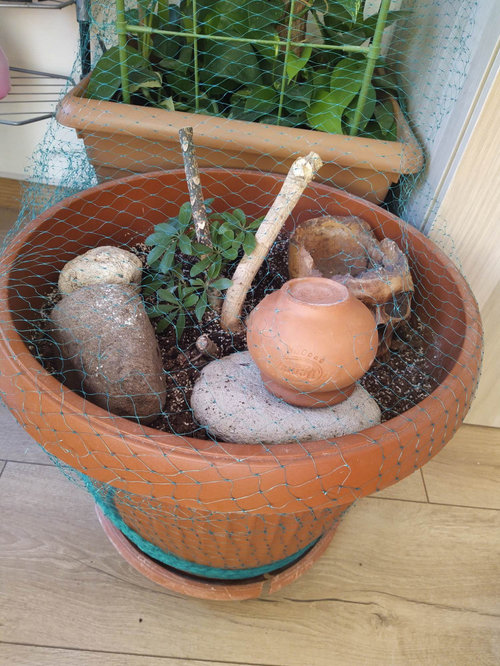
Hello :)

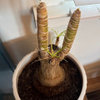
I was given a fairly large schefflera plant, that was attacked by scale. During its time with me, I got rid of the scale bugs (hopefully), but in the process the plant lost most of its leaves and I pruned it back to a few inches of the ground, because that is where I saw healthy new growth.

My question is, because of the severe pruning and loss of leaves, should I repot the plant into a smaller container or should I just leave it in its large one?

P.S. Please, don't mind the ugly protective measures I have taken to preserve it from my two cats :)


Comments (4)

  • 4 years ago

    i would expect.. that it has an intact root mass ... which has not been reduced.. so how would you jam it in a smaller pot ... besides.. that is a lot of extra stress .. and right now.. it probably doenst need any more stress ..


    with an intact root mass... you might be surprised now fast it can regrow.. in the proper season of course.. you might not see that in winter ...


    to figure it out.. i might pull it out of the pot. AND LOOK AT THE ROOTS ... and if they look fine.. then just shove it back in.. and let it do its own thing in its own time...


    lets not try to love it to death.. by repeatedly trying to fix it... its had a tough year.. so lets just water properly.. and give it time...


    if you find the roots rotted or what not.. lets us know ... take pix.. and we can work from there ...


    ken

  • 4 years ago

    Plants are economical organisms and are genetically programmed to make the best use of energy. The plant's chemical messengers keep Plant Central apprised of whether or not the ratio between roots:shoots is appropriate. If it is not, and because plants are shedding organisms, the plant will adjust the ratio to make best use of resources. If, for example, a plant receives a hard root pruning, the plant will shut down top growth until enough fine rootage grows to support new top growth; and/or, it will shed leaves/ branches enough that the roots are able to support at least the current volume of top growth. Should the top of the plant receive an extra-hard pruning, the most common response is heavy back-budding and shedding of existing roots beyond what is required to keep the top mass appropriately supplied with water/ nutrients.

    Other than some sense of knowing how much is too much (pruning roots or shoots) is too much, it isn't necessary that the grower does anything to interfere with this balancing act insofar as the root to shoot ratio is concerned; however, if the grower misjudges how far (s)he can go, there is risk that some wholesale shedding of top growth in the form of entire branches important to the plant's eye appeal might be lost; or, roots supporting one side of the tree might die back. So, while the idea that you need top growth to fuel new root growth, so you shouldn't prune the top when transplanting is a valid reasoning when it applies to plants which are being transplanted from pots, nursery cans, or balled/ burlapped specimens where the root:shoot ratio is already in balance, it falls apart when that ratio is notably unbalanced by heavy root or shoot pruning. IOW, the advice shouldn't be repeated as though it fits all transplanting applications. It doesn't.

    As long as you understand that watering intervals will be a critical consideration, half the battle is won. I suggest you use a "tell" to "tell" you when it's time to water, and water only when the tell comes out of the soil dry (for schefflera). More about using a "tell".

    Using a 'tell'

    Over-watering saps vitality and is one of the most common plant assassins, so learning to avoid it is worth the small effort. Plants make and store their own energy source – photosynthate - (sugar/glucose). Functioning roots need energy to drive their metabolic processes, and in order to get it, they use oxygen to burn (oxidize) their food. From this, we can see that terrestrial plants need plenty of air (oxygen) in the soil to drive root function. Many off-the-shelf soils hold too much water and not enough air to support the kind of root health most growers would like to see; and, a healthy root system is a prerequisite to a healthy plant.

    Watering in small sips leads to avoid over-watering leads to a residual build-up of dissolved solids (salts) in the soil from tapwater and fertilizer solutions, which limits a plant's ability to absorb water – so watering in sips simply moves us to the other horn of a dilemma. It creates another problem that requires resolution. Better, would be to simply adopt a soil that drains well enough to allow watering to beyond the saturation point, so we're flushing the soil of accumulating dissolved solids whenever we water; this, w/o the plant being forced to pay a tax in the form of reduced vitality, due to prolong periods of soil saturation. Sometimes, though, that's not a course we can immediately steer, which makes controlling how often we water a very important factor.

    In many cases, we can judge whether or not a planting needs watering by hefting the pot. This is especially true if the pot is made from light material, like plastic, but doesn't work (as) well when the pot is made from heavier material, like clay, or when the size/weight of the pot precludes grabbing it with one hand to judge its weight and gauge the need for water.

    Fingers stuck an inch or two into the soil work ok for shallow pots, but not for deep pots. Deep pots might have 3 or more inches of soil that feels totally dry, while the lower several inches of the soil is 100% saturated. Obviously, the lack of oxygen in the root zone situation can wreak havoc with root health and cause the loss of a very notable measure of your plant's potential. Inexpensive watering meters don't even measure moisture levels, they measure electrical conductivity. Clean the tip and insert it into a cup of distilled water and witness the fact it reads 'DRY'.

    One of the most reliable methods of checking a planting's need for water is using a 'tell'. You can use a bamboo skewer in a pinch, but a wooden dowel rod of about 5/16” (75-85mm) would work better. They usually come 48” (120cm) long and can usually be cut in half and serve as a pair. Sharpen all 4 ends in a pencil sharpener and slightly blunt the tip so it's about the diameter of the head on a straight pin. Push the wooden tell deep into the soil. Don't worry, it won't harm the root system. If the plant is quite root-bound, you might need to try several places until you find one where you can push it all the way to the pot's bottom. Leave it a few seconds, then withdraw it and inspect the tip for moisture. For most plantings, withhold water until the tell comes out dry or nearly so. If you see signs of wilting, adjust the interval between waterings so drought stress isn't a recurring issue.

    ******************************************************************************************

    Fertilizing is also a key component of your care regimen and is inextricably linked with your soil choice and watering habits. If you would like to have that discussion, let me know and I can offer some guidance.

    Al


  • 4 years ago

    Thank you for the thorough response! I will try to follow your advice as close as possible, I have some experience with plants, but I've never had such a case.

    As for "jamming the root ball into a smaller pot", I never meant to do that, I was rather thinking of pruning the roots and I wasn't sure if that is such a good idea, so won't be doing that, thanks to your responses :)

  • 4 years ago

    Pruning the roots is a very good idea and undeniably an essential part of the care regimen of any grower who wants to provide as much opportunity for his/her plants to realize as much of their genetic potential as possible. Fall through early spring is the least favorable period to do full repots of schefflera as their energy reserves are usually at their lowest during that time frame. Early spring, which most growers believe to be the best time to repot, is actually the worst. Primarily because your tree's energy reserves will usually be at their lowest after a long dark winter. The 2 weeks immediately before the summer solstice is generally the very best time to repot a very large (90%+) fraction of houseplant species. Planning a repot then, unless you live within 20* of the equator, would be a good plan.

    I have a series of images showing a full repot of a scheff, in case you're interested. I'd be happy to post them.

    Take care,

    Al

Sponsored
Mary Shipley Interiors
Average rating: 4.8 out of 5 stars34 Reviews
Columbus OH Premier Interior Designer 10x Best of Houzz