Software
Houzz Logo Print
hzdeleted_35844888

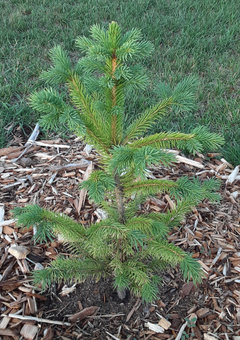
Picea Meyeri - Anyone with experience on these?

4 years ago

My questions come from conflicting information found when researching this plant and would like to hear from people who have actual experience or know someone that does.


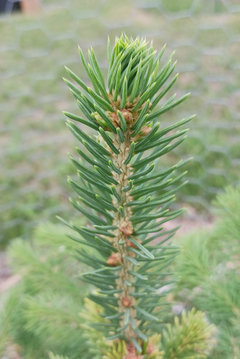
#1 Is the color of the needles actually bluegreen?

#2 Are the needles not prickly (rounded at the tips)?

#3 Can it really survive -50F during winter (z2)?

My source for the first 3 question came from here: https://www.exoticconifer.com/conifers I don't know if they are a reliable site or not.


The only dependable pictures I could find show something totally different with light green color and sharply tipped needles: https://plantdatabase.kpu.ca/plant/plantDetail/1234 (this link may or may not bring you directly to picea meyeri, so you may have enter it on a search in the database there).


None of my other sources use a common name of: 'Chinese blue spruce' that some of the retailers use.

https://www.conifers.org/pi/Picea_meyeri.php

The other source is not secure so I won't link it directly here but it's eFlora.org 'flora of China' (use at your own risk).


Can anyone throw some light on this confusion?


TIA.


Comments (63)

  • 4 years ago
    last modified: 4 years ago

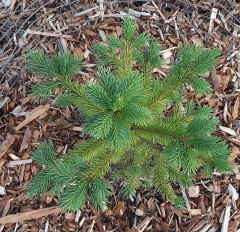
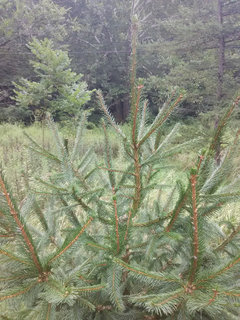
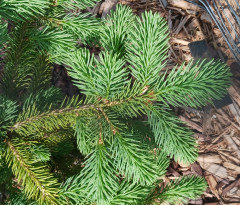
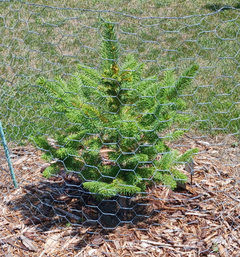
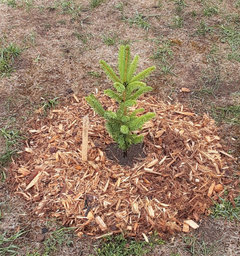
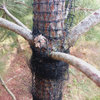
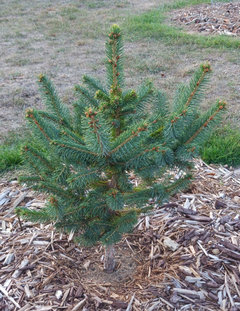
    I should comment that the example branch above was taken after some cold snaps and the tree was dormant, so that could account for the fact that the needles were a bit more 'yellow' than the earlier picture I had taken in early August at the time of purchase.

  • 4 years ago
    last modified: 4 years ago

    I'm having an 'AHA!' moment.

    Reading an article from NDSU on 'Forest Health' and found this on page 12 of the article https://www.ag.ndsu.edu/ndfs/documents/north-dakota-forest-health-highlights-2014.pdf

    'Meyer spruce is identified most easily by the cones (Figure 18A), although the mild pubescence on newer growth (Figure 18B) proved to be the most valuable characteristic for identification. Also, the growing form (Figure 18C) is somewhat useful for identification when paired with the other characteristics. Meyer spruce has been described as looking like (and feeling like, due to the sharper needles) a Colorado blue spruce but with the more upright growth form of a Black Hills spruce (as opposed to the more horizontal branch structure of the Colorado blue spruce).'

    I also sent an email to someone at the University to see if I can get a report on how well P. meyeri has been doing out in those growing conditions since they started them. I'll follow up there.

    Gosh this is fun! 8^)

  • 4 years ago

    Good work!

    tj

    User thanked tsugajunkie z5 SE WI ♱
  • 4 years ago
    last modified: 4 years ago

    Thanks tj.

    I now am convinced that I own a true P. meyeri.

    Pages 12 & 13 and part of 14 of the above article turned out to be the 'Mythbusters of Picea Meyeri'. :-))

    eta: And they are growing them in Rolette County N.D. which is a northernmost county in Zone 3.

  • 4 years ago

    Update: 11/22/21


    I received a short answer to my email from the NDSU forestry guy. Could be I'll get more information bc in the email the forester asked for a link to the Forestry Health article (linked above) which I then sent to him but haven't heard anything since.


    Email response from NDSU Forestry Dept:

    'Meyer spruce has been planted a lot in North Dakota, even as a windbreak tree. I haven’t really seen much hard data regarding Meyer spruce but instead have just heard anecdotal evidence.'.


    So that's it for now unless I hear more from him at a later date. :-)

  • 4 years ago

    Good researchin', Bill!

    User thanked UpperBayGardener (zone 7)
  • 4 years ago
    last modified: 4 years ago

    Thanks, david.

    I had no idea what a Meyer spruce was, just saw them sitting by the door when I was leaving Landsburgs nursery. Sign said $7.95 so thought I'd try one.

    I did perform a little root surgery before planting back in August.

    Kind of cool having a 'Blue spruce' growing in my yard knowing it's native to the mountains of North central China. You don't get that too often here in zone 3. :-)

  • 4 years ago
    last modified: 4 years ago

    eta: 7-5-22

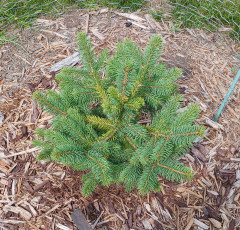
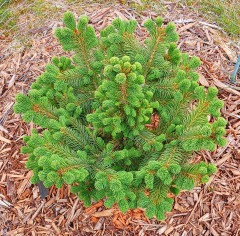
    The new growth on this tree does come out a nice blueish green. Old growth so far is much lighter than a CBS or Picea glauca, unless this changes with maturity.

    If eventually, enough new growth forms each season to envelop the old growth, it may end up being a nice-looking tree after all.


  • 4 years ago
    last modified: 4 years ago

    Looks like 1" or less of new growth on each branch tip for the season.

    Winter buds are ripe and nights are going down into the low 60's/high 50's. So we won't see a lot more out of this one.

    I've heard they are slow starters for the first couple of years. And mine did get some root surgery last Fall.

    I checked at Landsburg's a few weeks ago and apparently, they up potted some of this same stock and those had closer to 3" of new growth on all the stems, but the pots (maybe 3/4 gal.) were oozing thick with those little balls of blue fertilizer.

    I just didn't want to take a chance doing that, figuring to let the roots settle in this season. It seems like anytime I fertilize spruce trees (too much), I end up with really wild growth from every dormant bud on the plant and that can get pretty ugly.

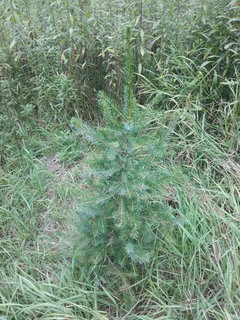
    So, bought & planted 8-4-2021 puts this one at a year of establishment complete. :-)

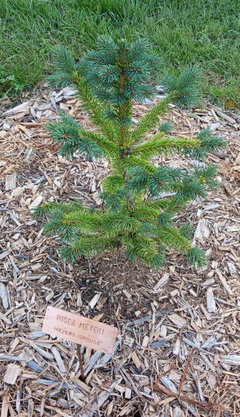
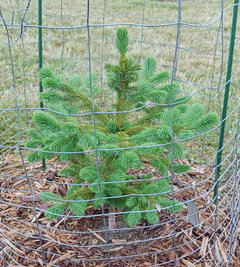
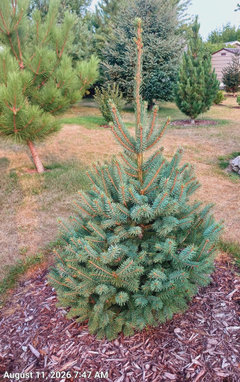
    Picea Meyeri:

    eta: The new growth stayed really blue. Looks like a different tree than the one that I bought. :?

  • 4 years ago
    last modified: 4 years ago

    That's interesting w/the markedly blue new growth. My Serbian spruce is very slow, tho in its final location for a few yrs, it's doing alittle better. Prb'ly the heavy clay doesn't help.

  • 4 years ago
    last modified: 4 years ago

    No telling what this one had gone through before I bought it.

    Once I removed the pot, I put the whole plant into a bucket of water only to find the roots had gotten so thick and woody, it was almost impossible to separate them or remove any soil.

    Finally, just took a WAG and cut a couple that appeared to be circling up and around.

    Time will tell if I did enough or too little. :^\

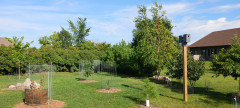
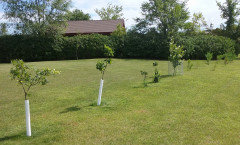
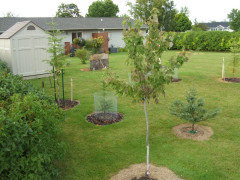
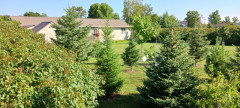
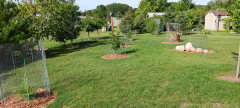
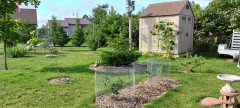
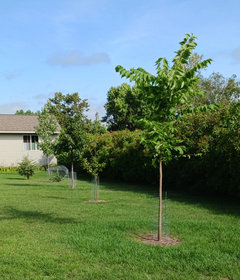
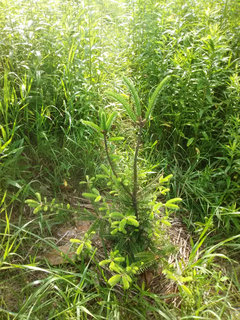
    I used this tree, along with several other smaller trees (not all in the picture) to create a second row of screening along the south end of the yard. It'll be getting all day, direct sun for many years to come, which should help with growth and color. But it's okay if it's on the slow side, I have enough full-sized trees around the perimeter of the yard already. :-)

    eta: added pic: P. meyeri center.


  • 4 years ago
    last modified: 4 years ago

    Little Serbian spruce, actually at least 12 yrs old, but in this spot just a couple years. Better growth this year.


    Norway spruce about 6 yrs old had its main leader killed by a stem borer last year, so tied up a side stem this spring and it has straigtened out & upward and looking good.


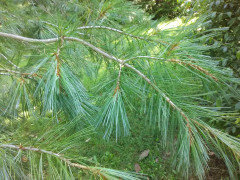
    Southwestern white pine branch. Very soft and flexible.


  • 4 years ago
    last modified: 4 years ago

    beng, Looks to be some acreage you're on to have that many large conifers and I know you have many deciduous trees to boot! :) How long have you been at it out there?

    I've thought of some of the Siberian versions of conifers that are out there, but I must have >25 full size pines, spruce, Tsuga and Thuja growing here now, not to mention many deciduous trees.

    My 0.2 acres is closing in on me but if the right plants come along, particularly smaller species, I could be tempted to add one or two somewhere. :)

    For now, I'm nearing the end of new starts for the yard. Of course, things can happen, and replacement may be needed.

    8^)

  • 4 years ago
    last modified: 4 years ago

    It's an acre of mostly stream-bordering bottomland (pretty much all grass when I moved here in 2004) with a neighbors' unattended weed-field adjacent where I also do some guerilla-planting like the Serbian spruce (neighbors don't care).

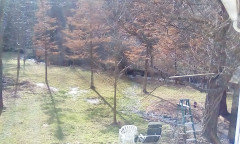
    South part of lot looking south during some autumn yard-flooding w/pond cypresses. Border stream can be seen behind trees.


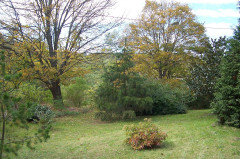
    Area north of house looking west. Sugar maples were the only trees when I moved in.


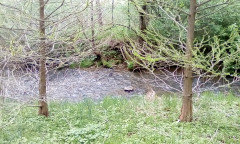
    My seed-grown baldcypresses along border stream in spring. There are now cypress knees all over that area.


    Yes, I'm done planting on yard proper (some work now removing/trimming things), tho still some guerilla planting in the adjacent weed-field. Had to cut down my 2-needle ponderosa pine as it was suffering badly from needlecast after 10 yrs. Had a Jeffery pine that grew well for the first few years, then declined very rapidly from needlecast.

  • 4 years ago

    Thanks beng!

    Very cool and interesting.

    I've always wanted a creek or stream on my place. Your looks like one that runs year-round so that's a plus imo.


    I moved here in 2012 and had an almost 'bare' yard after a previous storm removed most of the trees in the area. I didn't have a good (phone) camera and didn't do posting the time, so my pictures are few and far between until about 2016-2017. At the time, I wasn't into collecting and was looking to just populate the yard so went with native trees I could dig from land I owned out away from town. So that took up room that could've housed different species.


    But I'm glad that I what I did.

    Here's a picture from July of 2016. This was after these trees had been in a year, some two or 3.

    Left to right: Two northern pin oaks, two lilacs, Paper birch and about a dozen Pine trees.

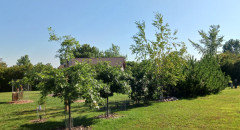
    Here's August 2022: (same trees and a few more.


    Here's another (Aug 2017), I was standing atop the electrical supply box.

    Aug 2022 Same spot different camera (the maple in the forefront above is long since gone)

    Random shots, this month:


    I'll still be looking for new additions, just have to be the right ones. :-)

  • 4 years ago

    Just a note: The yellow growth from last year is beginning to darken to more of blue/green similar to the new growth. The tips of the needles still are yellow so it's kind of a strange transition.


  • 3 years ago
    last modified: 3 years ago

    2-14-23

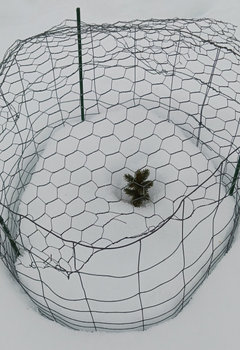
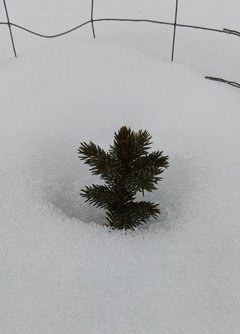
    With above average high temperatures almost all winter, I'm seeing the p.meyerii peeking out of the snow. This winter I didn't place any sunshade around it. From all the good info I got from NDSU, it didn't sound like it needed it. So, this will be the first real test, for mine anyways.


    :-)

  • 3 years ago
    last modified: 3 years ago

    4-29-2023:

    Quite satisfied. Went right through when the snow is melting, ground is frozen and sun angles are >45d, resulting in zero winter burn. We have a keeper. ;-)

  • 3 years ago

    I guess I lied (a little), when I said there was not any winter damage at all to my little tree.

    For some reason. the top couple of branch tiers, didn't sprout new growth buds. They just happen to be the branches sticking out of the snow in the picture a couple of posts above.

    The good news in, the main leader broke its top bud and is growing normally, so if it was winter related, you'd think the top bud would've frozen also. :-? So the tree is making the decisions on which branches it wants? As the tree grows, it should be inconsequential.

    :-)

  • 3 years ago
    last modified: 3 years ago

    Wow, almost a florescent green. Shoots look fir-like.

  • 3 years ago
    last modified: 3 years ago

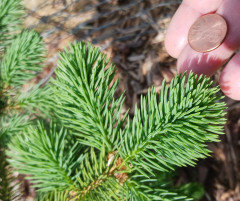
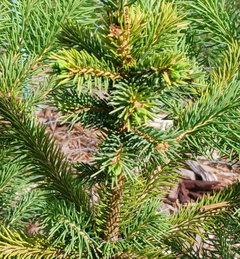
    Yes, the new growth color and length of needles has definitely improved.

    Here's picture (bright sun today) you can see original growth (left center & lower left) when first planted.

    Also, in the center is the one inch of growth from last season, a little improved from the earlier season. But yeah, this season has really taken off. We'll see how long new growth gets this season (it's already twice what it was last year).


    Another picture with a penny for size reference.

    Should be a nice-looking tree, someday. :-)


  • 3 years ago

    7-3-23

    For some reason, unbeknown to me, those short branches that didn't break bud this spring, decided to put out a little new growth, during all the near 90's and 90's we've had most days this last month. So, at least I know they weren't dead.

    Even some of what I thought were 'winter buds' near the top, have put out a few new growth needles lately.

    Worst of it is, now is normally the time we start getting our hot summer weather. :^?


    About 3" total for terminal leader growth so far. I've heard these are slow starters, so I'll have to assume things are looking good.

    :-)

  • 3 years ago

    A bit early for lammas growth, but maybe…

    tj

  • 3 years ago

    Been so hot since beginning of May, we're going to have 2 summer growing seasons right in a row. I even see new growth coming on some of my pines.

    But there's still plenty of time and as long as everything hardens off when it's supposed to this Fall, we'll be fine.

    :-)

  • 3 years ago

    'A bit early for lammas growth, but maybe… '


    According to this article, early July is not unheard of.

    https://www.currywoodsconservationtrust.com/peter-s-blog/lammas-growth

  • 3 years ago

    Has anyone noticed heavy cone drop by white pines (P. strobus)? I've got two fairly large/cone-bearing trees around the house and the drop has been unusually heavy. It's been warm-hot and dry, but certainly not the worst we've had.

  • 3 years ago

    You really should start a new thread about this maackia, don't you think?

  • 3 years ago

    Lammas growth, P. Meyeri 7-5-2023:


  • 3 years ago

    7-21-2023:

    The original yellowed branches are disappearing in the sea of blue green. :-)


  • 2 years ago
    last modified: 2 years ago

    9-21-2023:

    End of season update.

    I recently visited the nursery where I purchased this, and it appears there were still P. m. in same size pots as I bought mine, and they were just as old as mine. Possibly from the same batch? Mine was root bound bad enough two years ago when purchased. Still $7.95 ea. but I passed. ;-)

    P. Meyeri does appear to be a slow starter. The funny part is some of those at the nursery had 3 times as much new growth as mine did this year. I'll have to assume they were under a heavy fertilizer regime, but I can't say that for sure.

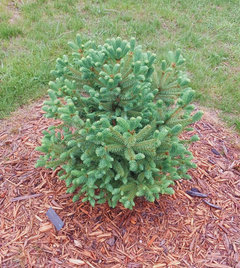
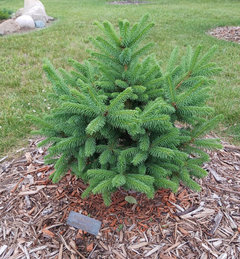
    Picea Meyeri:

    20"+ tall with 4"+ new growth on many of the branches (The shorter branches near the top that didn't grow much this season, have now set plump winter buds). :-)
    Very stable in the ground (no rocking and I can find the root flare at proper height).


  • 2 years ago
    last modified: 2 years ago

    Very dark blue-green and dense. Should be a fine spruce. I have a Serbian spruce, and it has excellent foliage, but it simply refuses to grow much more than a couple inches a year. Close by, in similar soil, my Manchurian fir can put out near 2 ft sprouts (usually after late freeze damage).

  • 2 years ago
    last modified: 2 years ago

    Abies holophylla is listed to need good drainage but then Picea omorika says the same.

    That is strange, considering you have a heavy clay soil?

    But you know how to grow trees so tell us what's the answer? lol

    I never need to worry about good drainage. It's good to a fault.

    Next season, I plan to give the Picea Meyeri a little more attention where nutrients are concerned although, sporting a larger root mass, it may not be necessary.

    Substantial rain predicted here this weekend. Ya right.

  • 2 years ago

    You're right, it isn't well-drained, but that doesn't seem to bother the fir. Japanese larch there is now 40 ft tall, but larches are prb'ly not bothered by heavy clay. Seed-grown honeylocust is growing fast there, but again, not bothered (it's a bottomland tree in nature).

  • 2 years ago

    5-21-2024:

    After an open, snowless winter, this one is looking better. Breaking buds out of everywhere. Even the short, underdeveloped branches from last year that barely grew.

    Picea Meyeri:


  • 2 years ago
    last modified: 2 years ago

    6-18-2024:

    Things are looking up with this tree.

    I'm still not sure why there was the stunted growth on some of the top branches the last couple of years.

    I could've been a combination of the extremely knotted, pot bound roots and the accompanying root surgery at planting time, plus its first year in the ground, coming through first winter with those exposed branches above the snow subjecting it to sun damage, idk. I guess I'll just have to be glad it's still alive and growing.

    You can't just find another tree like this anywhere for $7.95. ;-)

    These trees are supposed to be slow starters the first two years with noticeable increase in growth on the third year, from what I understand.

    It's possible it's a little behind because of those impediments.

    It has markedly improved in appearance and the way it's growing. It may not 'take off' this year but it is close and I'm optimistic it will continue to move toward normalcy, even though it may be next season.

    We'll know more by end of season and it's quite possible it will stretch out considerably by then.
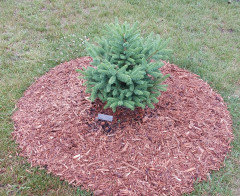
    Picea Meyeri:


    :-)

    ps: I expanded the mulch ring on this one today.


  • 2 years ago
    last modified: 2 years ago

    Looks good. I had posted a pic of a little but handsome Serbian spruce that hardly grows, and one of our mid west/Great Lakes posters mentioned that it might do better. Right on cue, it's grown this season like I'd hoped.


    My last-chance attempt at firs of bare-root Canaan firs have all sprouted -- here's one.


  • 2 years ago

    I'll have to keep those in mind in case I have a failure.

    Or see one for cheap. ;^)

  • last year
    last modified: last year

    5-21-2025:

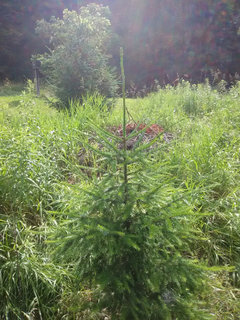
    Planted from a small, rootbound, band pot in August of 2021, I understood that P. meyeri generally have a 3-year period before they start to grow at a normal rate.

    But mine not only took it's time and grew slowly but the bottom half of the tree always grew faster and more overall than the top half. The top was always slower to start too and behind the bottom half all season.

    Now this season will be the 4th full season in the ground, it's showing good growth on the whole tree, in fact, maybe even more at the top than the bottom. I'm hoping this is its year to flourish. :-)


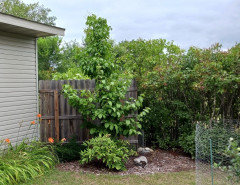
    Just for reference. Picture taken 8-4-2021. :^))


  • last year

    Good job. Most conifers are agonizingly slow as small plants...it is what it is.

  • last year
    last modified: last year

    8-18-2025:

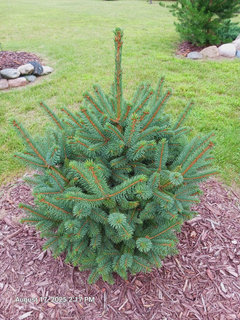
    Season update: 35" tall.

    eta: Rock solid in the ground so the roots must be good.

  • last year

    Nice blue-green color -- 1000x better than the garish blues some commercial conifers have.

  • last year

    Yeah, it's quite a 'Looker'.

    My camera doesn't do it justice in color or form.

    Beautiful tree!

  • 5 months ago
    last modified: 5 months ago

    4-1-2026:

    JFWIW:

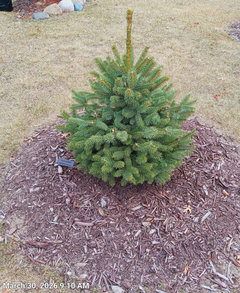
    I've normally not pruned spruce trees to any extent but with this one, getting a slow start and growing slower at the top, lagging behind the rest of the tree, I thought I'd keep the multiple leaders, forming (see last picture above) at the middle, upper portion of the tree in check, at least for this season.

    I can see what the new growth looks like later this season and do more if needed but better to keep pruning to a minimum, you can always do more later.

    This tree is serving in a windbreak/screening capacity so developing into a full, wide tree is okay with me, I just didn't want it to become a multiple leader tree yet, at this size.

    I took some pointers from this site:

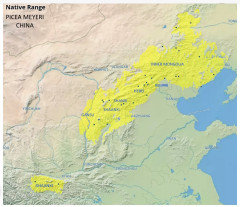
    edit: to add. Only native range map I was able to find.


    This tree has proven to be the bullet-proof, rock-solid z3 tree, described by the UND associate, earlier in this thread.

  • 24 days ago

    8-16-2026:

    After spring pruning of extra leaders, it was then I noticed the dead sprouts, explained HERE.

    But even though I ended up with a few 'Branch Cavities', the Meyer Spruce, overall, came out great.

    Main leader gained 19" to bring it up to 53" total height.

    Just over 5 years in the ground, from a little 'potband' and growing normally.

    ;-)

  • 23 days ago
    Glad it is still doing well for you!

  • 23 days ago
    Thanks! UBG.

    It's hard to get a grip on the trunk but it appears rock solid.


    I've always heard, that if I had bought a larger tree to begin with, it may have taken longer for a larger tree to re-establish its cut roots, making it take a few years to start growing normally again.

    Which would give the smaller tree a chance to grow as big as the larger tree, before the larger tree has a chance to grow normally.


    In your opinion, is that a true statement?


  • 23 days ago
    last modified: 23 days ago
    I think it depends on the tree. Alas for conifers, I truly believe you are better buying bigger 1) if you can - a lot of rare stuff isn't available bigger at any price and 2) if you know it was grown correctly with no circling roots, which is a HUGE if. Because they are just so darn slow until they are about 6' tall.

    I can compare the firs I got as 5' footers to those that were liner sized. And "there's no comparison"! You have seen pics of my now medium sized A. firmas - both around 35'. If those had been liners in 2010, I am sure they would just be getting to 20' now, at best. BUT REMEMBER (or maybe u didn't see those posts LOL) I had to very, very extensively work with the roots of them, and detangle them. I even dug extra trenches to contain the unfurled roots. If I hadn't , I could be in a worse place. because they could have pancaked and fallen in a storm or whatnot. So like so many things in life, it involves tradeoffs and being prepared. (And those were much easier than if they'd been B&B'd, because they were in somthing like a big air pot. I could see that they were circling without doing a lot of close inspection.)

    It's different with most angiosperms that grow faster when young, I think for some of those you can really make a case "size doesn't matter as much as you think it does", especially, since again, you might get something plopped from a container into a B&B production field and grown with circling roots. In that case you are better buying small, because you can at least assess the root system and fix it while you can. Do you remember the story of the Fagus 'Rotundifolia' I drove all the way to upstate NY to buy? It was about 5.5', could barely get it into my sedan for the drive back. HUGE B&B rootball. Super heavy. Had to scooch it out of my drunk into the FEL and drive it to the place to plant it. But it died after about 10 years. when I dug it up, the poor root system was basically a big bowling bowl with a few sad little feeders trying to come out. It was hopelessly doomed to die the day I bought it, probably, because it had moved from liner to container to field without its roots ever being untangled.

    OF COURSE, there are exceptions to conifers = slow, like my crazy 'Ogon' that went from a 24" grafted whip to 50+' since 2010.

  • 23 days ago
    Thanks david!

    I always appreciate hearing about your plant adventures and your wisdom learned from actually doing these types of things.


    I agree there's a lot of variables when conditions and types of the trees we buy come into play.


    And I realize that this particular P. meyeri was unqualified for this question because it was terribly root 'skeletinized' and it had to grow roots just to catch up, not to mention what my newby root surgery may have done to it. 🫤


    Thanks again!

  • 23 days ago
    That's a nice blue-green -- similar to your white spruce. Another blue-green alternative that could and should take the place of the cursed CO blue spruce, at least in humid-summer climes.