Software
Houzz Logo Print
upperbaygardener

very optimistically early damage report

4 years ago
last modified: 4 years ago

We had 8.8F, and a long spell below 10F, a few weeks ago, and more recently 7.7F a few nights ago. For all my winters in the past 16 years, that's pretty average, although I would say It's infrequent to go below 10F without the benefit of snow cover which was the case both of these times. (well maybe 1.5 inches for the 7.7F, but that would barely count it seems. Based on the fact York Co PA was warmer that night, it probably just made me colder than I would have been w/o snow cover...some places on the eastern shore of MD went < 0F because of their heavy snow cover in the latest nor'easter)

My studies of winter climatology shows if we haven't been super cold by end of January, it's very unlikely there will be a turn for the worse. But it can happen, there was a mid Feb. freeze at some point in the 90s IIRC, after a mild winter. Knock on wood! The start of the last week of February is when I truly feel out of the woods, so, jumping the gun just a bit.

Anyhow...

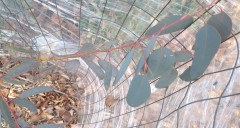
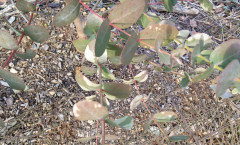
Most exciting is that a Eucalyptus delegatensis I collected myself from the last I found before the switchover to snow gums above 4400' or so appears almost totally undamaged. Granted, I did give it a little wind screen, and it has protection from the dreaded winter morning sun. But this is one that Ian Barclay, about as close to an expert on the PNW hardiness of gum trees as you are likely to find, said 'hadn't been very hardy at all' in the PNW. Well, 7.7F is cold for the PNW. So, that's encouraging. I notice on both this E. and E. neglecta, its the very oldest foliage that burns. The apparently new growth, even very tiny leaves at the branchlet tips, is totally intact.

Less promising is Cinnamomum porrectum AKA C. parthenxylon. Sold thusly by Cistus: https://plantlust.com/plants/27895/cinnamomum-porrectum/

Dave Parks of Camellia Forest dryly commented "that was the one that wasn't hardy for us". So, perhaps a lost cause, although TBH it doesn't look as bad as a C. wilsonii that was totally killed by a milder winter a few years ago. It defoliated, but not as quickly. Here's a discussion of these exotic trees I contributed to on another forum: https://growingontheedge.net/viewtopic.php?p=124558

The good news is a huge Cinnamomum japonicum in East Texas at SFASU survived -4F/-20C in the TX mega freeze. So it gives me hope for that species, although I may not have the same clone as they do. If you look at the overall mildness of their winters, -4F is potentially more destructive down there because Asian BLEs may not be in complete dormancy. (although, also, potentially less for other reasons)

Phormium 'Lake Te Anu'. One of the only single-digit freezes it's had without snow cover. Looking pretty good with just a bit of outer leaf burning. This is a green selection from what was thought to be a cold part of NZ, although a horticulturalist I met at Christchurch Botanical Garden dismissed the notion that Lake Te Anu was especially cold. I also have another clone i collected in Ophir, the coldest town in NZ by some estimates. That one is bronzy and now that I've divided it, I will by trying it in the garden, too.

A few other interesting items:

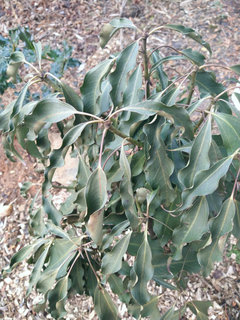
Metapanax davidii...slight boiled cabbage look, but I think it's ok.

Rhodoleia henryi 'Scarlet Bells' - looks OK!

Eurya 'Moutiers' - just fine

Trachycarpus planted in a SW facing alcove- just fine

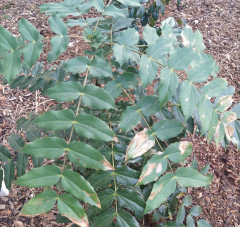
"Zone 8" Mahonia hybrid with gigantic leaves, bred at Bloedel and sold by Far Reaches - OK so far. Has 100% protection from winter morning sun tho. UPDATE: just took closer look at this...maybe about 5-8% burning of the least hardened foliage...so the 'zone 8' classifications of these was probably reasonable. I can't remember what the species were but the make up suggested it would be more tender than the typical M. x medias discussed next. UPDATE pt 2 - found it: https://www.farreachesfarm.com/Mahonia-duclouxiana-x-M-japonica-p/p4537.htm

Mahonia 'Arthur Menzies' - small planted last spring - just fine

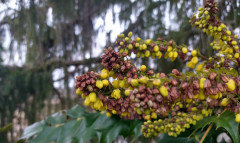
Mahonia 'Buckland' - just fine of course, huge plant now pushing 8', flower buds not killed yet apparently

Erica terminalis 'Thelma Woolner' - bravely planted in late fall, but doing just fine. This is the hardiest 'tree heath' but I have found almost all Ericas to be somewhat temperamental. (and that includes a girl with that name I used to know har har har) I have a whole emerging theory about the 'trick' to growing fine rooted Ericacaeae in my climate, but I'll go into it another time.

Erythrina flabelliformis - to the extant you can tell, still ok. (tip of "bulb" pectinate and looking like it did at end of growing season)

Camellias: all established ones just fine of course...

new planted 'Robiraki' hanging in there

same for a C. cuspidata

alas, a 'Peacock' (Kujaku) Camellia looks very unhappy. Maybe that clone just isn't very hardy. Hoping it recovers in spring.

lastly:

Magnolia skinneriana - extra hardy clone from somewhere - fine, just a bit of singeing on the most sun exposed leaves. If it doesn't deep freeze again, I suspect it will bloom just fine

Magnolia dianica or whatever they are calling it these days - same, it seems to be be hardy to about 5F

Magnolia 'Frosty Pale Purple' (M. figo var. skinneriana x figo var. crassipes) - almost 100%, leaves have a slight boiled cabbage look but I am sure it's nothing to worry about

Comments (23)

  • 4 years ago
    last modified: 4 years ago

    I'm not familiar with any of these trees, but it looks like most are OK for you. Good news.


    We're supposed to get our coldest of the year in the next couple of days. -15 or so. Hope this is the coldest of the cold, but you never know.

    UpperBayGardener (zone 7) thanked L Clark (zone 4 WY)
  • 4 years ago
    last modified: 4 years ago

    -6F coldest morning here, -13F on same day in a nearby WV valley. Not uncommon. As I was looking at site records, the same day in 1984 and 1985 were both extraordinarily cold. Site records can be found here:

    http://w2.weather.gov/climate/

    PS davidrt, it's my experience that right after a heavy snow, most of the moisture in the local air is precipitated out, so radiative cooling overnite is maximized.

    PPS davidrt, check out the Hagerstown station's Feb records -- it CAN get really cold in Feb.

    https://www.i4weather.net/feb-hl.txt

    UpperBayGardener (zone 7) thanked bengz6westmd
  • 4 years ago
    last modified: 4 years ago

    btw thanks for the links, since SERCC's climate links went defunct I didn't know where to find that.

    Yeah beng, the fact Hagerstown's record low is -20F makes it all the more shocking that Emporia, Virginia's is -24F!!!!! Granted it was in one of the really cold winters of the 1890s, but still.

    https://en.wikipedia.org/wiki/Emporia,_Virginia#Climate

    https://www.weather.gov/wrh/Climate?wfo=akq

    EDIT: oops apparently Hagerstown is actually -27F in 1912. Still -24F is an impressively low for the city that is far to the south and at much lower elevation...I think that part of interior SE VA and NE NC is kind of like the pine barrens of NJ, flat and sandy. Hence the radiational cooling is maximized. As recently as 3-4 winters ago there were temps of -5F or lower in the area N & W of the Albemarle Sound in NC.

  • 4 years ago
    last modified: 4 years ago

    It's a shame the data is not as navigable as it once was at SERCC.

    That cold spell actually shows up in Emporia, VA as -3F in 2018. It really seems you have to be careful with where you site a garden in the coastal plain if you want to grow borderline plants. A lot of places in the interior of the Delmarva Peninsula have been < -5F in the past 5 years if not more recently. OTOH I would be able to piece together from looking at wunderground, etc. that hillside locations in Cecil County, within 5 miles of coastal water, have not. (i.e., areas like mine) Because of better cold air drainage.

    Anyhow back to the matter at hand, 10 day forecast gets us to mid-Feb without a major cold outbreak, and then the climate prediction center isn't forecasting anything ominous, so fingers crossed that we've had all the single digits we are going to have this year!

    (I should explain I was thinking of that town in SE VA because I had to spend a night there last month)

  • 4 years ago
    last modified: 4 years ago

    And worth saying we can't skew our expectations with extremely rare record lows: at the end of the day many standard issue cultivars of Camellia would obviously be way more growable in Emporia than Hagerstown. Still, I couldn't believe that figure of -24F when I saw it at wikipedia but I verified it another way. That's very, very cold for a 7b location!

  • 4 years ago

    I really have nothing to add.......temperatures such as listed here simply do not occur in my area and they are difficult for me to even contemplate :-) Minus anything is just unheard of!!

    But I just wanted to say that I am impressed with david's selection of unusual/rare and possibly zone pushing plants (many of which I have never heard of either).

    My plantable real estate is limited so few rarities but a fair amount of zone pushing, mostly in containers! We had an extended Arctic blast beginning Boxing Day (a week of freezing or below freezing temps) and it dipped into the low 20's here so waiting to see who didn't survive. I have my suspicions 😑 But nothing significant and all are easily replaceable.

    UpperBayGardener (zone 7) thanked gardengal48 (PNW Z8/9)
  • 4 years ago
    last modified: 4 years ago

    Ah yes, 1996 we tied our all time low of -26F. Came close again in 2019 when we hit -24F and had three nights in a row of -20s. I was amazed my Taxus baccata ’Standishii’ never missed a beat.

    tj

  • 4 years ago

    David, I'm not saying this is your situation, but I jumped the gun following the winter of 2019 when I posted that some of my marginal trees (Stewartia pseudocamellia, Acer maximowiczianum, Corylus fargesii, etc.) seemed to have escaped with minimal or no damage. It wasn't until mid - late May that I realized how wrong I was. While they seemed to leaf out normally, there was extensive tissue damage and major branching vectors were lost.


    This winter has been cold, but not extremely so. The lowest temp we've had so far is -24F, which is typical. My concern is always trees & shrubs that were planted the previous season. One that I'm keeping my eye on is Pinus densiflora 'Golden Ghost'. Fingers crossed.

    UpperBayGardener (zone 7) thanked maackia
  • 4 years ago

    Maackia - you raise a very good point, and I commend you for raising it!


  • 4 years ago
    last modified: 4 years ago

    There's a small sign near the top (above 4500 ft) of Spruce Knob, WV along the Cass Railroad excursion track that the logging camp there "unofficially" but prb'ly reliably recorded -46F in Jan of the 1930s (I can't recall the exact date).

    In 1994, the Jan cold wave produced -15F to -22F along the New River in Giles Co, Va. Driving along the river to work, I saw in amazement a prb'ly 500 ft tall and 15 ft wide "fog-spout" in the center of the partly frozen river, rotating visibly and connected to a heavy ice-fog cloud above.

    UpperBayGardener (zone 7) thanked bengz6westmd
  • 4 years ago
    last modified: 4 years ago

    A picture is worth, well, something! Maybe not 1000 words in this case.

    maackia I found a thread from spring 2019 where in fact underestimated damage on a couple plants. In that case, I was looking at a plant with a lot of blasted leaves, seeing a bit of green on the stems, and assuming that meant it was still alive. Lesson learnt, it doesn't, in particular if it is a BLE. But if I have under-estimated again, I will certain update this thread.

    Here is the tiny "woollybutt" tree LOL. Great common name.


    Here is what the damage on the non-wind protected E. neglecta looks like.


    But most of it is ok.

    For my Nerium in 2019, for example, practically ALL the foliage was dehydrated in that manner.

    Likewise here is the Mahonia duclouxiana hybrid. Hard to tell but these leaves are huge compared to a bog standard M. X media. Sure there could be some hidden stem damage and things could still go south, but generally, I read this as a plant that survived 7.7F.


    Lastly the 'slight boiled cabbage look' on Metapanax davidii.


    I think it's probably ok.

    I think there is some fingerprint grime on my smartphone lens so I just realized these all have a slightly washed out look.

    One more pretty unsurprising finding: https://www.farreachesfarm.com/Clethra-pringlei-x-alnifolia-p/p6400.htm has dead brown/black leaves, but the stems are green underneath.

  • 4 years ago
    last modified: 4 years ago

    Back to my discussion of the surprising coldness of interior SE VA and NE NC, here's the stump of a dead Trachycarpus I spotted at the hotel I stayed at in Emporia. Almost surely died in the subzero F event in 2018.


  • 4 years ago

    davidrt and beng, your region's record lows really are surprising, since some are colder than the lowest recorded temps of most of the cities here in southern Michigan. Detroit's official all time low is -21 (although there was an unofficial reading of -24 in the late 1800's), Ann Arbor -22, Flint -25. But our longer winters with more persistent cold (and sometimes deeply frozen soil), frequent late freezes in spring, generally cooler less humid summers, and shorter overall growing season, mean that Zone 6 in southeast Michigan is definitely harsher than zone 6 in western MD or VA. But we accept the challenge here ;) And it's not quite as bad here as it is for those WI guys.

    davidrt, that Metapanax doesn't look very happy ("slight boiled cabbage look" is a good description). Also, do you think the Cinnamomum species will be susceptible to Laurel Wilt disease?

    UpperBayGardener (zone 7) thanked arbordave (SE MI)
  • 4 years ago
    last modified: 4 years ago

    do you think the Cinnamomum species will be susceptible to Laurel Wilt disease?

    No, because I think the operating assumption about Laurel Wilt, as with so many deadly plant diseases, is that it comes from Asia and that Asian species are at least mostly immune. But we will see. In the immediate future, cold winters are probably going to be more of a concern ;-)

    Completely agree about the record lows! It's one thing for Hagerstown, but particularly shocking for a town at 160 ft of elevation in SE VA! It's fascinating to think of climates it terms of risk of extreme "edge cases". The most extreme extremes! Like, the wetter, zone 10a parts of SE Australia seemed ridiculously Edenic when I visited, but, that explained why it shocked me to my [horticultural, at least!] core to realize the incredibly lush, exotic-filled Mt. Tomah Botanic Garden that I discussed here had a harrowing, narrow escape from incineration just a few years after my visit. Teams of fire fighters worked to spare it from the recent Aussie fires. This in a climate that usually has PLENTY of rain, year round: https://en.wikipedia.org/wiki/Blackheath,_New_South_Wales#Geography_and_climate

    and certainly during summer. And as far as I've been able to piece together, that can potentially happen almost anywhere in the highland subtropical parts of AU, with maybe the exception of some of Tasmania. It's just the nature of the beast. (Is any Eden safe these days? It also shocked me that Villa Taranto in Italy was visited by a tornado that killed the gigantic Fagus 'Purpurea Tricolor' I'd seen a few years earlier.)

    So, if I lived as far south as Emporia, just 1.5 h drive from very palmy Virginia Beach (where I also have some relatives) I would think "surely I can grow Trachycarpus!" Especially given what I would see as the trade offs vs. where I live now, like being too hot for rhododendrons. But, obviously not in a place that went below 0F so recently! Anyhow my cousin who I saw around Christmas said she wants to try a palm in her garden. She might luck out because she's a little west of Emporia in a place where there seem to have low hills and she might have better cold air drainage, but I didn't really get a sense of it because I only visited her house after dark.

    Full disclosure I am trying the last Trachy I will ever try in that SW alcove of my house, but if it doesn't make it, it doesn't make it. And I'm never going to heroics to save it. It's pretty low on my list of plants to worry about, because for one thing they are so common just a hop skip and jump south of where I live, in the grand scheme of things, which VA Beach is. Just the other end of the Bay!

  • 4 years ago
    last modified: 4 years ago

    davidrt, in Patrick Michael's "Virginia Weather Advisory", he mentioned a late 1700s blizzard in Norfolk, VA that dumped 40 inches of snow there accompanied w/60 mph winds & drifts up to 10 ft high.

  • 4 years ago
    last modified: 4 years ago

    Yeah I definitely don't "miss" the winters of olden times. The 1890s were a crazy cold period. Florida's state record low of -2F, and the Atlantic frozen all the way down to Virginia Beach. Positively mind-boggling! I think 1978 was also really bad too, that killed hundreds of camellias at the National Arboretum. Possibly exacerbated by a drought leading into the winter. As bad as the polar vortex winters were, they still weren't as bad in the mid-Atlantic as 1994.

  • 4 years ago
    last modified: 4 years ago

    Almost everything still tracking as reported above, except Camellia cuspidata is actually looking pretty bad. Hope it and the peacock camellia can pull thru, we'll see. The two Eucalyptus that were not wind protected but recognized as being hardier, are looking a bit more stressed but will surely survive. It's a testament to how dangerous the wind is around here...the upper bay seems to create a windy microclimate in gardens around it. Some of the tender magnolias are showing a little more leaf burn than they did immediately after the freezes, but they will be fine.

    Here's a very interesting (to me) picture of Mahonia 'Buckland' from 3 days ago. It looks like about half of the about-to-open flower buds were killed by 7.7F a month or so ago, but half of them weren't.


  • 4 years ago

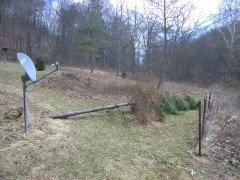
    Unfortunately a brief but powerful snow-squall brought down one of my longleaf pines, but it had been leaning badly & it was just a matter of time. Chronic girdled roots at the base was the culprit. My other longleaf pine is fine fortunately,


    UpperBayGardener (zone 7) thanked bengz6westmd
  • 4 years ago
    last modified: 4 years ago

    Too bad! You are certainly a horticultural pioneer for having those out there...I am only aware of a handful in the DC to NJ corridor. (and even down in SE Virginia you don't see many of them) The one at Udel has never looked very good, and I'm sure Longwood doesn't even have one. The best looking is just a picture that was posted here years ago of one in a (sandy soil, probably) part of New Jersey. A collector south of Trenton had a pretty good one 10 years ago but who knows what all the snow and ice since then did to it.

    My supposed Pinus hwangshanensis revealed itself to have tightly circling/knotted roots - it was in a difficult spot where it would have been hard to completely dig up to correct as I have done with my Euro beech cultivars. So I said to myself, 'f--- it, I'm just going to slice the knot with a chainsaw and see what happens'. I'll post a pic later. If it survives, it survives, if it doesn't - oh well. Can't have hurt any worse than what the existing situation was, in my humble opinion. It is rare but wasn't something I sought out for its rarity, I just spotted it at McLean nursery for a very reasonable price for something so rare (definitely no more than $20!) and said, heck yeah, I'll buy that.

  • 4 years ago
    last modified: 4 years ago

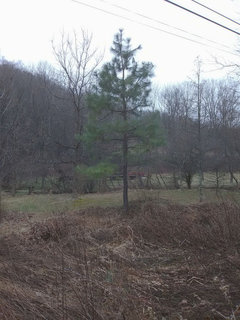
    Tho I didn't slice w/a chainsaw, I did (after digging off the soil covering the root-crowns) slice radially out from the trunks of both longleafs w/a heavy duty hand-saw after I realized how badly girdled they were when they were about 4-5 years old (~2009). Apparently was only successful w/the one. I also had to do the same thing with my Japanese larch the same year & age and was apparently successful w/it. You can see it in the pic behind the green part of the fallen longleaf. The pine behind just left of center is a loblolly pine.

    PS The Lovett Pinetum was growing longleafs in southwest Missouri -- after growing well for some years, they got shredded by an ice storm.

    https://lovettpinetum.org/horticulture/pines-for-southwest-missouri/

    https://lovettpinetum.org/

    https://lovettpinetum.arboretumexplorer.org/

    UpperBayGardener (zone 7) thanked bengz6westmd
  • 4 years ago
    last modified: 4 years ago

    Maybe OT, but perhaps not because supposedly this is zone challenged -- pond pine has a similar range as longleaf. But never seen any issue w/cold or even wet snow. Here it grows in heavy clay that occasionally has standing water, but it thrives. Bought from Forestfarm as a long, lanky stem that had to be supported at first, but firm now after 12 yrs in the ground. Perhaps my best-formed pine.


    UpperBayGardener (zone 7) thanked bengz6westmd
  • 4 years ago

    I appreciate the discussions of impacts on exotic vegetation from extreme winter cold. Gardening here in the Pacific Northwest (formerly Zone 7 but supposedly now Zone 8) we last saw widespread low single digit weather at low elevations in December 1989. Since then temps have generally only strayed into the teens and then for only a few nights. In the past decade we might see a few nights below freezing and then no freezes after February. Our experience with Southern Hemisphere plants is that they often will survive very low overnight temps if it warms up above freezing during the day so they can rehydrate. What tends to do them in is dry, dessicating freezing winds with daytime temps staying below freezing. When that happens lots of broadleaf evergreens will experience tissue damage. Some eucalyptus are able to recover by sprouting anew from epicormic buds on the trunk. And some with lignotubers may have the entire top killed but may push out root shoots. In those cases, cut out the old trunk and select the most vigrorous spout and you may get a new tree in no time. Hopefully that will be the case with some of yours.