

Does Simonton DaylightMax Look Green?
Hi experts, I learned that low e coating will make windows look green which bothers me. I'm now struggling between ProSolar (I assume it is Low E2) vs ProSolar Sun (I assume it is Low E). Their stats are as follows:
ProSolar: VT 0.58, SHGC 0.32, U-Factor: 0.28
ProSolar Sun: VT 0.65, SHGC 0.54, U-Factor: 0.29
Detailed sheets: https://www.simonton.com/wp-content/uploads/2015/09/DaylightMax-Single-Slider-Thermal-Testing-Data.pdf
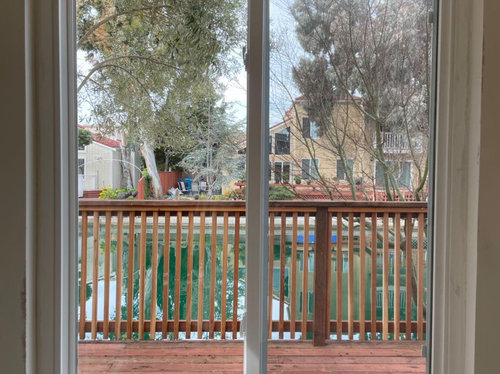
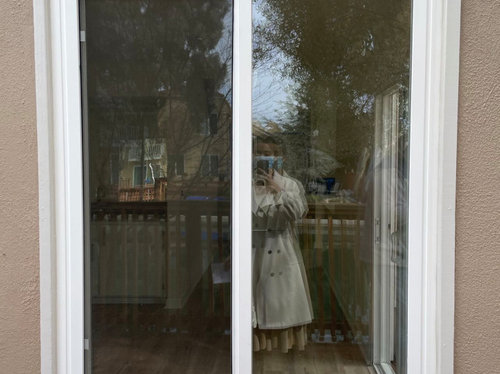
I assume the bigger VT is, the clearer the glass would be?? I'm OK with the glass looking a bit grey, just don't want obvious green. I don't mind green tint in general, but I'm adding ONE window right next to my existing window which looks as follows. Basically, I'm trying my best to match the look. FYI I live in the Bay Area CA, right next to the river.
Anybody has experience with Simonton DaylightMax? Really appreciate your insights!!
interior:
exterior:
Comments (12)
Wenjun Wang
Original Author4 years agoThanks @oberon476, the information is super useful!! So basically you are suggesting ProSolarSun may NOT be energy-efficient and let through a lot of sunlight and ProSolar doesn't have much color-tint concern so maybe a good option?
I'm choosing SuperSpacer system and wondering if ProSolarSun would make it a waste as letting thorugh a lot of sunlight?Related Professionals
Miami General Contractors · North Adams General Contractors · Alexandria General Contractors · Twin Falls General Contractors · Amherstburg General Contractors · Springfield Home Remodeling · Niles Home Remodeling · Platteville Home Remodeling · Dodge City Home Remodeling · Portland Home Remodeling · Everett Home Remodeling · Belleville Interior Designers & Decorators · California Interior Designers & Decorators · Greenfield Interior Designers & Decorators · Boise Interior Designers & Decorators 4 years agolast modified: 4 years ago
So basically you are suggesting ProSolarSun may NOT be energy-efficient and let through a lot of sunlight
Not precisely, what I am saying is that the coating used in the ProSolarSun allows more visible light and more solar heat gain versus other coatings because that's what it was designed to do. For people in heating climates who are designing for passive solar, then this is the ideal coating for that application. But for someone in the southland, not so much.
The single silver coating used in ProSolarSun U-factor is not quite as good as U-factor on the dual and triple layer coatings, but in a well designed application the very slight U-factor loss can be more than offset by the gains in free solar heat. And even in homes not technically designed for passive heat gain, some people simply like to feel solar heat in the winter, and no doubt it does feel good even though it might result in a slight energy loss when compared with the multiple layer coatings.
Most of the performance numbers listed for ProSolar are very indicative of a dual-silver-layer coating, but a few had me scratching my head....despite that I still believe that the ProSolar uses a dual-silver-layer coating, and as mentioned previously Cardinal and Guardian each have two coatings that fall within that spectrum and have similar performance properties - U-factor, SHGC, VT, etc.
IMO I think that the dual-layer coatings are generally going to be the best choice for most anyone who lives in a moderate heating/cooling environment, and except for more extreme or specific heating or cooling applications where the single or triple-layer coatings might be the better option, I think dual-coatings can be used almost anywhere.
Without going in depth, there are even quad-layer coatings and both dual and triple layer with different shading options than the ones that I believe are used in ProSolar, but I only mention them in passing in case you hear something about them and not to discuss here.
To clarify in case you have never heard this, glass-only (plus coating) visible transmittance and solar heat gain performance values are not going to be the same as whole window performance numbers.
Because VT and SHGC are computed in windows using the entire assembly, not just the glass, it's entirely possible to have identical glass packages in two different windows that have markedly different VT and SHGC even when the glass specification is identical. Frame/sash, using grids, will affect the final VT and SHGC whole window values.
This is something to keep in mind since Simonton is considered to have a relatively bulky frame and so those values for Simonton will be lower (VT and SHGC higher is better, U-factor lower is better) when compared to a company with the same glass package but a thinner frame.
I'm choosing SuperSpacer system and wondering if ProSolarSun would make it a waste as letting thorugh a lot of sunlight?
Apples to bushel basket comparison. SuperSpacer (or any spacer) is responsible for keeping the glass lites apart and maintaining an airtight seal between them. Spacers also allow conductive heat gain or loss where they bond to the glass. Some are better at blocking conduction, some are worse, but whatever coating you choose doesn't affect the effectiveness of the spacer. Both coating and spacer have their own job to do.
Wenjun Wang thanked oberon476Wenjun Wang
Original Author4 years agoThx a ton @oberon476 for detailed info!! From this sheet, https://www.simonton.com/wp-content/uploads/2015/09/DaylightMax-Single-Slider-Thermal-Testing-Data.pdf seems ProSolar vs ProSolar Sun has almost same U-Factor. I'm not considering ProSolar Shade or 4 coats low e as I'm pretty concerned about green-look. And I assume the higher E is 1->2->3->4 the more obvious the color-tint would be.
- 4 years agolast modified: 4 years ago
Again not precisely, the 4 layer are darker but with a more neutral gray color and lower VT and lower SHGC
Wenjun Wang
Original Author4 years agolast modified: 4 years agoDecided to go with ProSolar Sun as
- Derisk of obvious color tint
- As @oberon476 described like the feeling of natural sun heat and sunlight. Really wanna house to look bright
- The house feels a bit cold during winter
As in the post ProSolar Sun vs ProSolar differs mainly in SHGC and VT, higher VT means higher SHGCWenjun Wang
Original Author4 years agoResponse from customer service in case someone else also interested in ProSolar via ProSolar Sun:
“ProSolar and ProSolar shade have the same number of coats of lowE. Its just about where the lowE is placed. The ProSolar has 2 coats of lowE that are on top of each other on 1 inside surface. The ProSolar Sun will have 1 layer on each piece of glass on the inside surfaces. So both will have 2 coats of lowE.
I've been asking around and it sounds like if there is any difference it won't be much. Unforuntaly we do not have a side by side of these 2 products because they are both 2 coats and usually the proSolar Sun is only used in a few places in the north for energystar requirements.
The ProSolar Shade would be much darker with 3 coats of lowE.”
- 4 years agolast modified: 4 years ago
Window glass is labeled from the outside in as surfaces 1-4, with surface 1 being the surface you can touch outside your home, and surface 4 being the surface you touch inside your home. Surface 2 is the inside the airspace surface of the outer lite and surface 3 is the inside the airspace surface of the inner lite. I hope that makes sense because I am going to refer to it later.
“ProSolar and ProSolar shade have the same number of coats of lowE. Its just about where the lowE is placed.
I am going to assume that shade in the above was a typo and should have been sun.
The ProSolar Sun will have 1 layer on each piece of glass on the inside surfaces.
Typically single silver-layer high solar heat gain coatings (ProSolarSun) are placed on glass surface 3 which increases the amount of solar heat gain that passes through the glass into the home because that coating is normally used in high solar gain applications. The idea of coating on two glass surfaces is wrong unless they are talking about a surface 4 coating, but the performance values that you posted don't appear to indicate that happening.
The ProSolar has 2 coats of lowE that are on top of each other on 1 inside surface.
As I mentioned in previous posts, ProSolar appears to use a dual-silver-layer coating and not two coatings. Calling it two coatings is a pretty common misconception that many folks in the window industry claim, but it's wrong.
Multi (2, 3, 4) silver-layer coatings should always be used on glass surface 2 (versus 3 for single-silver), although some window companies will put multi-silver coatings on surface 3 for various reasons, generally NOT because of energy performance.
So both will have 2 coats of lowE. Nope, they don't.
I've been asking around...asking who?
....proSolar Sun is only used in a few places in the north for energystar requirements.
As I mentioned previously, ProSolarSun, using a single-silver LowE coating is intended for high solar heat gain applications, typically in the north but in the US Energy Star is not concise when it comes to wanting solar heat gain through windows. The coating used in the Sun product is more common in the far north but it can be used successfully in more moderate climates if the home is designed to use it correctly.
The ProSolar Shade would be much darker with 3 coats of lowE.”
Single silver coatings have glass-only visible transmission (3mm glass in a dual pane IG configuration) of about 80%. Dual silver without tinting have VT ratings about 70-72%. Triple silver-layer coatings (ProSolarShade) have VT rating in the 66% range, so saying much darker is questionable. What triple layers have is a slight green tint that some people find objectionable. The tint is there intentionally and it is related to glass performance.
Bottom line, whoever you talked with in customer service needs a serious refresher on what LowE coatings are and in how they work. Pretty much everything you were told ranged from questionable to flat out wrong.....
You are in the Bay area per your first post. You can certainly use ProSolarSun in your environment, BUT it's only a good idea if whomever is in charge of windows understands how windows with this coating have to be used to get maximum performance.
Wenjun Wang thanked oberon476 Wenjun Wang
Original Author4 years agoThanks so so much @oberon476!! I guess the customer service guys just don't quite understand their business.....
I asked them about ProSolar vs ProSolar sun before posting here and then they got back to me saying they have the same amount of coating. After checking stats and learning from you, I follow up with them to confirm if they have the same amount of coating and that was the answer I got... so I think since I already decide to go with ProSolar Sun then maybe not bothering keep asking.
Thanks again as I learnt a lot indeed, it would also help me in my future window projects!! <3- 4 years ago
Yeah, someone at their end dropped the ball on that one.
You're welcome and more than happy to help out as can here as you move along.
 PRO4 years ago
You couldn't have tapped into a bigger brain and more accurate source of information than Oberon.
You lucked out. We are fortunate to have him as a part of the forums.- 10 days ago
OP are you pleased with your ProSolar Sun windows? i am curious what to go with. i live in the PNW area and surrounded by tall trees. will be repainting the interiors white and want to make sure no weird tint is reflecting in the walls. I read some people with white interiors were seeing green or purple tints in the room due to the windows. debating between prosolar and prosolar sun too.





oberon476