Software
Houzz Logo Print
lonejack2

How low will the markets go?

4 years ago
last modified: 4 years ago

The stock averages are tanking again today. What are your guesses on how low the S&P, DOW, and Nasdaq will go before they hit bottom.

I moved my 401K out of a S&P index fund into a money market fund back in late December and am trying to time the bottom to get back in. Still trying to be patient but I'm getting antsy!

Comments (37)

  • 4 years ago

    If someone suggests they have an answer to your question, don't believe them. All markets have recurring price peaks and valleys over time, not always for rational reasons. Other than people appearing on TV shows or in podcasts, few seriously try to predict directional changes.

  • 4 years ago

    Ah the market is a temperamental being. You just gotta do what you gotta do when you feel comfortable. I've gotten it really right, and I've gotten it really wrong. that whole "not always for rational reasons" thing elmer brings up. Yep.

  • 4 years ago
    last modified: 4 years ago

    I am not asking for expert analysis here and wouldn't take anything given as anything more than the 'guesses' that I requested.

    So far I have received two guesses of 'no idea'.


    ETA: Working from home, I usually have CNBC market coverage on in the background when I am not in an online meeting. The consensus at the end of the year was that the bubble was about to pop and I acted on that and it was proven right. So far there is no consensus on where the bottom may be.

  • 4 years ago

    CNBC was one of a few sources I had in mind about when I mentioned "people appearing on TV"


    But for the blip at the beginning of the pandemic, markets have been on an upward trend for the last 10+ years. No one predicted that nor how long it would last (it's been longer than most). When any prices are on an upward trend, especially long ones, "the consensus" will continue to predict an end or "a correction". That's been heard for years now, ultimately, they're bound to be right. The current dip is because of world politics that no one predicted.

  • 4 years ago

    https://money.cnn.com/data/fear-and-greed/?utm_source=optzlynewmarketribbon


    Loved this what's driving the market thing. Cute.


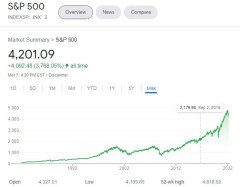
    Looks like it's going to keep plummeting, and if you look at the "max" version of the NASDAQ, for instance, there's room to go down, plenty.

    LoneJack Zn 6a, KC thanked rob333 (zone 7b)
  • 4 years ago
    last modified: 4 years ago

    I wouldn't say that the market has been on a upward trend for 10 years. The S&P in 2018 was negative for the year. I have no interest in spinning my investment wheels for an entire year knowing that the market will eventually go up at some point.

    I have a yacht to buy!

  • 4 years ago
    last modified: 4 years ago

    Upward trend since 2009.

    Those who were scared and sold out in 2018, with only a small dip experienced, lost a lot of money. Click image to enlarge.


  • 4 years ago

    With a rampaging war mongering putin on the loose and several Fed interest rate hikes coming up this year I just hope it stabilizes. We may need to "pop" several balloons before the bottom, including the inflated real estate market which is nutz. A 20% correction is getting close which is supposed to be the norm to correct an overly hot market, it may already be there from the highs?

    LoneJack Zn 6a, KC thanked vgkg Z-7 Va
  • 4 years ago

    My opinion....it's a good time to short. Unless Putin loses his hold on Ukraine...it will continue to go lower. The market hates uncertainty. It hates bad news. It/the market, hates inflation. JMHO

  • 4 years ago

    Have you done so? How much stock have you sold short?

  • 4 years ago

    My guess is that it will take about six month before it makes a recovery, but what do I know?

    This is just a guess, and so do not attempt to take it for any more than that.

    When I got out of the stock market, I invested in real estate, and that has been good for me, but you have to buy in the right location at the right time.

    However, in 2019 I bought a house in Cathedral City with the intention of renting it as AirBnB, but less than a month after we closed, the city banned all new VRBOs, and then a few months after that, refused to renew existing VRBOs. This was an extremely popular market for vacation rentals (and vacation houses), and its popularity may have been part of the problem.

    Anyway, we made some adjustments and now use the Cathedral City house as our own vacation house, and for the past two years, that house and the one in Los Angeles have been vacant about half the time, since we have been spending alter months in each house.

    Since we cannot rent the house for less than 31 days at a time, we have decided to renovate it to our own tastes without consideration for what renters would want. We also do not have to worry about damage from renters.

  • 4 years ago
    last modified: 4 years ago

    No one can predict a true market bottom, but relatively the DJ so far this year has the worst performance in the red compared to the entire year of 2018 and 2015. That may make some people wanting to get back into the equities, unless everything turns South and races for the bottom should WW3 happen. From an article in my investment firm’s publication, to buffer the market fluctuations during retirement, it may be a good idea to set aside cash or cash equivalents of 3 years or more.

  • 4 years ago
    last modified: 4 years ago

    I'm not sure what having 3 years of cash equivalents does for you, unless you're saying that buffers the need to sell stock market investments. If there is a sustained downturn, you might want to sell anyway to limit losses or protect gains.

    The advantage of having a diversified portfolio is that among the different choices underlying values usually don't move in the same direction at the same time or to the same extent. Splitting your money between stocks and debt, and between foreign and domestic, in whatever ratios you find are advised, will do that. I'm not sure what you consider to be cash equivalents but for those with much money in bank deposits and the like have been losing money every year recently because of low interest rates.

  • 4 years ago
    last modified: 4 years ago

    unless you're saying that buffers the need to sell stock market investments.

    Yes. And I was glad I stayed the course during the dot.com crash. For cash/cash equivalents I meant cash, CD, money market, precious metals (for some other parts of the world). Not much earning in interests but that would still be better than nothing.

  • 4 years ago

    CDs and precious metals are no more liquid than stocks and bonds and some types can be less so. The problem with holding cash is how much you lose in returns and inflation over time compared to alternatives.

  • 4 years ago

    With CD, it’s the money waiting to be spent but at least you earn some interest when it matures. So instant liquidation is not the goal. For time like this, precious metals are hot, but not stock and bonds, though cash is still king.

  • 4 years ago

    As of tonight, 1:30AM, Bloomberg shows the Dow futures down $403. Interestingly, Gold is down also.

    Until the oil problems, Ukraine and Russia subside, I fear a dangerous market ahead.


  • 4 years ago
    last modified: 4 years ago

    "Have you done so? How much stock have you sold short?"

    If a person was trading stock in a 401k or IRA, you can NOT short. That is true. But...you can buy stock in a mutual fund that shorts.

    Our real estate market is also nutz. :0) But there's nothing for sale in the lower, working class home market. Nothing seems to be shaking loose with the foreclosures they predicted. Apartments are going up everywhere. New home builds appreciate 20% before closings...and only expensive homes are being built. The low interest rates are still making payments affordable. If they raise rates, that might slow it all down....

  • 4 years ago

    Nicole, there's no requirement to own stock in order to have market short positions. Call a broker, tell them you want to short Amazon. It's a margin transaction and margin account requirements need to be met. The brokerage firm "borrows" certificates, then sells the shares as per your order. Your derriere is in the wind for stock movements from that point until you "buy" shares to

    "cover the short". If Amazon drops after your short, you buy the shares at a lower price and keep the profit. If it goes up (you guessed wrong), you need to put up the money (short sales price plus spread upward) to cover it.


    Another way to short a stock is to buy a put option. Your financial risk is limited but options are of fixed lifetimes.


    Neither way requires an investor to hold shares outside of retirement funds, as you have described is the case for you. Nor are the retirement balances involved.

  • 4 years ago
    last modified: 4 years ago

    @Elmer J Fudd....I am well aware of margin trading, options trading...I sent you a PM...are you OK?


    I personally feel shorting in a down market like now....IS a good move. JMO

  • 4 years ago
    last modified: 4 years ago

    Sorry nicole, my apology. I don't check for messages regularly but I have read what you sent.


    I'm a pedestrian investor, I keep things vanilla.

    A relative is a stock broker who at one time was very gung ho about buying and selling covered and naked puts and calls. I gave him some money to manage for me for a while. He did fine overall, his approach was conservative, but it always was that the timing was such that his conservative tactics, while locking in returns, seemed to limit my gains. It wasn't for me.

    I went to the Ron Popeil School of Investing - set it and forget it. Mutual funds in a diversified pattern, I look at what's there not more often than every 6 months.

  • 4 years ago

    May I just add a word in favor of diversification? To the OP, no way all your retirement funds should be in US stock market funds, not unless you are very young. The older you get, the more you should balance out the funds you own into a variety of funds: stocks, foreign markets, RE, bonds, short-term, long term, and a certain amount in cash.

    LoneJack Zn 6a, KC thanked sushipup2
  • 4 years ago
    last modified: 4 years ago

    sushipup, you may know of what's called "target date" funds. These are funds that buy other funds - nothing special there - but each fund has a target date, typically spaced out every 5 years in a fund family, intended to represent when the funds will be needed in retirement.

    To illustrate, someone who's 40 years old today and expecting to retire in their mid-60s would buy a 2040, 2045 or 2050 target date fund. As the target date approaches, the underlying investments are changed to become less risky and more oriented to producing income and protection of capital. For the investor, there's no need to rebalance their portfolio as time passes, the fund does it for you. Target funds are not only for those with a long term horizon. If you expect to retire in 5 years, a target fund with a date 5 or 10 years out will have a portfolio balance in keeping with what experts recommend should be held.

    LoneJack Zn 6a, KC thanked Elmer J Fudd
  • 4 years ago
    last modified: 4 years ago

    I find the target dated funds too conservative for my liking but I've been in and out of them a few times over the years often choosing one that is targeted to 5-10 years beyond my planned retirement year.. The expense ratios are also much higher compared to passive funds tied to indexes like the S&P or Nasdaq.

    Thought for a bit that yesterday might have been the bottom but today's gains were wiped out rather quickly. What a rollercoaster its been for the last couple months.

  • 4 years ago
    last modified: 4 years ago

    lonejack, I just took a look at several of Vanguard's target retirement funds and they have no fees to purchase and expense ratios of .08%. That's very low, close to nothing, and only slightly more than index funds, which of course need "administration" (to handle purchase and sales transactions) but only enough "management" to keep the portfolios in the same relative balances as the index that's tracked.

    I agree that they do tend to be conservative. Most advisers suggest that a diversified portfolio should include both some amount of higher risk speculative investments as well as nest egg funds that should not be subject to great risks, with the speculative portion diminishing as one gets older. Speculative portfolio portions, for those that have such and many don't, are typically not the moneys that people put into mutual funds.

    LoneJack Zn 6a, KC thanked Elmer J Fudd
  • 4 years ago
    last modified: 4 years ago

    Elmer - Yes, I would consider an expense ratio of .08% to be very low for a target date fund. I just looked at several of Fidelity's target date funds and the expense ratios all ranged from 0.38% to 0.5%. In comparison their S&P index fund expense ratio is 0.015%.

  • 4 years ago

    My HSA is in a Vanguard fund and the ERs do seem lower overall but their S&P index is about double Fidelity's, but still very low at 0.04%.

    Well after swinging wildly from 1.75% up to 1.02% down the S&P ended up down 0.73%.

  • 4 years ago
    last modified: 4 years ago

    .04% will blow off the table if you breathe on it lightly. As close to nothing as you can get.

  • 4 years ago

    The stock markets can go to zero, but how low can they go before moving back up? It's been a while since my trading days but checking a few charts and indicators I'd say 30K on the Dow before a bounce, then much lower and closer to zero than the previous high.


    Margin Debt has nearly doubled since the 2020 covid sell off and Margin Debt started to unwind around Nov 2021 which coincides with the markets topping, and with the margin debt still unwinding 30K would of been my target as a normal retrace. This pull back had nothing to do with the Ukrainian war and seen well in advance with money flow indicators suggesting money was flowing out of equities since mid 2021 as a leading indicator.

    But a few black swans have changed the playing field. If I was playing today I would of flipped my positions late 2021 with a target price of 30K on the Dow as a safe bet but not now. Now I don't care because the Dow is going to 23K, then 18K, 12.5K and may a stop at 7K.

    I wish I was dreaming and knew nothing but 33 trillion dollars in stock market value is about to evaporate.


  • 4 years ago

    Well, they are back up with a vengance today!! I hope it remains that way.

  • 4 years ago
    last modified: 4 years ago

    As long as there are "Help Wanted" signs in just about every business's window we see then things should proceed as normal......barring a nuke war.

  • 4 years ago

    Hope was the most dangerous emotion people exhibited in my trading days. Emotion is what moves the stock market. a very reliable trading tool and has been analyzed for 120 years. Chart patterns, Fibonacci patterns, trends lines also aid in trading based on human psychology.

    I'd like to say "sure it's going back up" but it would be a lie. The pattern in play has a 83% success rate of a calculated drop, Fibonacci retrace levels and trend lines are highly effective with long term charts (which I'm looking at now) and they all converge at 30,000 range on the Dow and 90% confident. A testing of the pattern may take it back to the 34,000 range and where I would without hesitation short the market through a inverse index ETF If I was still playing the stock market casino game. But from 30K I'm also confident it's going lower because there just isn't the fear or panic indicating a bottom, only hope.

  • 4 years ago

    The overall trend is still down and is consistent with the current fear factor from the VIX or the Fear And Greed index. It remains to be seen when the trend begins to level and heads back up when the fear subsides. Looking back 2 years ago around this month, the DJ hit bottom quickly at below 20,000 because of the great fear at the height of Covid. Now it’s fear of Putin’s threat of nuclear war which the market movers react in advance.

  • 4 years ago

    "A testing of the pattern may take it back to the 34,000 range and where I would without hesitation short the market through a inverse index ETF If I was still playing the stock market casino game."

    Today 10:30 am ET with the Dow testing 34K is where I would take my inverse position with a tight stop. Not a given but does have an 83% odds it will move to 30K

    Putin had little to do with a market correction, it started in late November and if the 1st quarter GDP shows none or a negative growth rate 30k is just a weak support level and will go much lower.

  • 4 years ago

    Very interesting Kevin! I'm not sure Elmer agrees with you though.

    The DOW did inch over 34K for a few minutes this morning and has since dropped about 400 points. It seems like about one day a week lately there is a flurry of buying by people sitting in cash but the trend still seems to be down.

  • 4 years ago

    I've never seen a market happy over a rate increase?! But I'll take the upward trend.