Software
Houzz Logo Print
publickman

Air gap needed for Whirlpool dishwasher?

4 years ago
last modified: 4 years ago

We've had this Whirlpool dishwasher for about a year now in our house in Cathedral City, and we have been having problems with it not draining properly. We do not have an air gap, as the previous dishwasher did not have one, but it drained properly.

With the Whirlpool, I have to check the filters and drain after washing dishes every time, and there is pretty much always water in the drain, up to the bottom of the dishwasher. If there has been any food at all on the dishes, it is even worse, and water drains onto the kitchen floor.

The dishwasher has a button that I can press after the washing is complete that will start the drain cycle only, and this only lasts for a few minutes. This helps. The entire cycle generally takes about four hours, which seems like a long time.

We are getting new cabinets, sink, and faucet in our kitchen renovation. Should I order a Hansgrohe air gap to match the faucet, or does it really matter? Some reviews say that the Hansgrohe air gap does not work with thicker countertops, but mine have not been ordered yet (have specified quartz), and neither have the cabinets. The cabinet supplier is supposed to meet with me next week to measure for the cabinets, and he will also be supplying the countertops. Do all air gaps have the same hole diameter requirements? Will the air gap help with the drainage from the dishwasher?

I am getting the Hansgrohe Metris faucet in Optic Steel (already ordered), but I wonder if I need to order the same brand of air gap, since Hansgrohe costs twice as much as the others. Should I hold off on ordering an air gap until I speak with the cabinet/countertop supplier?

Comments (11)

  • 4 years ago

    From the Owner's Manual (see step 45 on page 24):

    DRAIN REQUIREMENTS

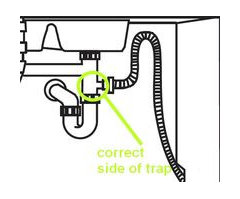
    ■ Make sure to connect drain hose to waste tee or disposer inlet above drain trap in house plumbing and 20" (50.8 cm) minimum above the floor. It is recommended that the drain
    hose either be looped up and securely fastened to the underside of the counter or be connected to an air gap.
    ■ Make sure to use an air gap if the drain hose is connected to house plumbing lower than 20" (50.8 cm) above subfloor or floor.


    As quoted above, you do not need an air gap if you loop the drain hose up to the underside of the counter. If the dishwasher is not draining, the first thing to check is that the hose is not clogged or kinked. Does the dishwasher drain into a garbage disposal? Check that the plug was removed where the hose attaches to the disposal. More ideas.

    Lars thanked wdccruise
  • 4 years ago
    last modified: 4 years ago

    I'm in my house in Los Angeles at the moment, and so I won't be able to check the hoses under the sink until I get back to Cathedral City next week, at the earliest. I don't know what I will be able to see until I get there.

    It would be very nice not to need an air gap, but it would be even nicer not to have to worry about the dishwasher draining onto the kitchen floor.

    I am pretty sure that the DW there does drain into a garbage disposal, but I cannot be sure from here.

    I do have very hard water, and so that might be part of the problem, but I do use rinse-aid and Cascade Platinum in Cathedral City. I use a non-scented DW pod for my dishwasher in L.A. because Cascade Platinum leave a horrible scent on the dishes, but this does not happen in Cathedral City.

  • 4 years ago
    last modified: 4 years ago

    Lars, you might have to get an air gap to meet code when you remodel whether you need it or not. (Some cities in CA still require it. Mine won't budge.)

    And the caps from different air gap makers are mostly interchangeable so if the HG one doesn't work, you can probably just put its cap on a cheap air gap.

    Lars thanked Fori
  • PRO
    4 years ago

    Put your air gap where you want a soap dispenser, then elimate it after inspection. There are millions of perfectly-draining dishwashers across the country without air gaps. Except California apparently where the state knows what's best for everyone.

  • 4 years ago

    Washington too. :(

  • 4 years ago

    I would rather have an air gap than a soap dispenser - I have one in L.A. and it stopped working, as it gets clogged.

    I will go ahead and have an air gap installed, although I have not yet decided whether I want to get an inexpensive one. I think I might as well spend the extra $20-25 to get one that exactly matches the finish of the faucet, although I do not really think that it is worth the extra cost, although that is rather minimal.

    I have no problem with requirements for air gaps - I just wish that I already had one.

  • 4 years ago

    The lack of air gap probably isn't the problem though.


    I had a ton of leakage problems with a KA dishwasher I had installed a few years ago. Pretty sure it was a Whirlpool. The first of a series of irregular, unpredictable, and undiagnosable leaks was caused by the float valve. It wasn't malfunctioning, but it wasn't screwed in tightly enough. (It went downhill from there.)


    Anyway, is it still under warranty? I'd get someone to look at it. Even if it's off warranty.

    Lars thanked Fori
  • 4 years ago

    What I mean about water flowing onto the floor is that during the cycle, water leaks out and makes a puddle on the floor in front of the DW. When I unload the dishwasher, I notice there there is standing water (a small amount) at the bottom, and so I remove the filters and clean them. When this first started happening, I noticed a very small amount of food debris on the filters, and so I cleaned them and ran the drain cycle again, which removed most, but not all, of the water under the main filter at the bottom.

    Once I started making sure that the dishes were reasonably clean before I loaded the DW, I have not had a problem with the puddles, but I still run the drain cycle at the end of each washing.

    The DW says that it is okay to leave small amounts of food on the dishes, but I have not found this to be the case.

    I don't completely wash the dishes before loading them, but I do scrub them to remove almost all of the food or whatever might be left on them.

    I have a Bosch DW in L.A., and I have no problems with it, except that I have to use fragrance free DW pods because otherwise it leaves unpleasant scents on the dishes which interferes with the taste of the food. I use Method Dishwasher Packs, and this gets the dishes as clean as Cascade does and does not leave the nauseating scent that Cascade does. I can use Cascade in the Whirlpool, and it will not leave the scent. If I use Cascade in the Bosch, I have to run an additional rinse cycle at the end, but it is just easier to use Method instead.

  • 4 years ago

    "... I notice there there is standing water (a small amount) at the bottom, and so I remove the filters and clean them."

    "... and ran the drain cycle again, which removed most, but not all, of the water under the main filter at the bottom."

    It's normal for some water to remain in the machine's tub sump area under the filter screens. All dishwashers do that, the pump cannot push 100% of the water up/out the drain hose. It shouldn't be enough water to see in the tub at normal view without removing the screens.

    Have you removed the toe kick and checked for water in the drip/overflow tray, which obviously there shouldn't be any. The machine is sensitive to proper leveling to avoid water leaking out of the tub at the engineered overflow drip channels which drain into that tray beneath. The detection float in the tray should 1) prevent the machine from filling and 2) possibly turn on the drain pump in event of an overflow.

    Lars thanked dadoes
  • 4 years ago

    The dishwasher is going to get removed, temporarily, when we replace the cabinets later this month, and so I should be able to check at that time. I don't think I can remove the toe kick at this time, but I will check next week when I go back to meet with the cabinet supplier.