Software
Houzz Logo Print
melissaaipapa

Garden tales: roses, bits and pieces

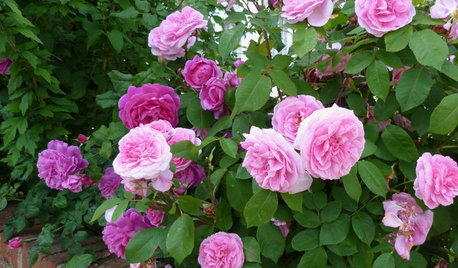
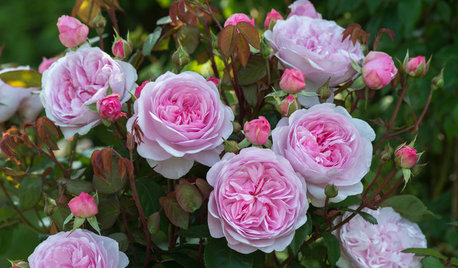
A year or two ago I found myself with one remaining plant of 'Rose-Marie Viaud', a Multiflora rambler that I had gotten several plantlets of from cuttings. I had lost all the rest: this rose needs an acid soil, or at least one not actively alkaline, rare on our property. In a desperate venture I settled it under the branches of the fir/spruce, a Christmas tree planted there by our predecessors, that grows at the edge of the Small Orto, pruning an opening in the branches to give the rose a modicum of light, and hoping for the best. The rose is still there, alive, growing I believe, and it has nicely green leaves, not chlorotic. So far, so good. 'Rose-Marie Viaud' is scentless, but it has sweet little pompon flowers that start mauve-pink and turn lavender, looking then quite a lot like a Parma violet.

It's growing in a line of roses edging the Small Orto. Starting from the back there's a large 'Brenda Colvin' scrambling up a dead black locust, the fir/spruce, and another scraggly black locust; then comes little 'Rose-Marie Viaud'; after that comes a line of suckers stretching out from a thicket of 'Maiden's Blush'. This last was planted back in 2004, I think; after several years in the ground it began to sucker out in all directions. My goal is to have a wall of it along the edge of the Small Orto, while I pull, cut, and dig the suckers that stretch out in other directions. Since 'Maiden's Blush' is pale pink, and 'Brenda Colvin' apple blossom pink and white, I also wanted the mauve and lavender of RMV for color variety. I'll see how this works out.

My Multiflora ramblers are few, our conditions not suiting them. But I have 'Goldfinch' growing in the hedge at the top of the Shade garden, where at one point I dumped a great mound of organic matter, and I think that helped. 'Blush Rambler' holds out somehow on the Allée in the densest gray clay; and a rose that may be 'Tausendschoen'--it arrived without a name--is growing out of the middle of an eleagnus and spreading into the Leyland cypress on one side of it, while trying to climb into the oak on the other. I'm still trying to convince various Pemberton Hybrid Musks to grow for me, and trying to convince myself to cut down 'Summer Wine' and be done with it: it's unhappy where it is, and the color is too strong for my taste. Or perhaps just a merciful hard pruning.

I have deliberately destroyed very few garden roses in my life, but I'm also thinking of just cutting down the mystery rambler down by the first drainage ditch. It's unhappy, and there seems to be no way to make it happy: it sunburns, in spite of the shrubs growing around it; it's a martyr to cane girdler; it always looks yellow and wretched. Away with it! (Maybe.) I have a little start of 'Alberic Barbier' coming along, where a cane tip-rooted: that would do very well for that pergola. I'll have to think about it.

Comments (16)

  • 4 years ago

    All so interesting to contemplate, Melissa. I too rarely toss a rose. I recently did toss a second Souv d' un Ami Tea. I thought it was winter killed and dug it up and it still had a live crown and root. It was such a weakling though I replaced it with Gene Boerner.

    I have had another Souv d' un Ami that got sunburned and it's large cane died. It still limps along. There is no doubt some plants do not like the conditions we offer. OTOH, I have a third Jesse Hildreth doing great when the first two petered out. If a plant can make it through the early years they seem to gain strength.

  • 4 years ago

    Melissa - I love hearing about all your plans and accomplishments in your garden.

    My soil is quite alkaline here, but I have two plants of Veilchenblau that are doing very well for me. One was planted in 2001 and the other in 2003 and they thrill me every time I look at them - which is just about all the time! The reason I bring this up is that Rose-Marie Viaud is a seedling of Veilchenblau. Seeing this, I purchased one from Rogue Valley Roses in March of 2019. She is still rather small but has two canes that are about 3 feet plus and are getting to be long enough to tie up onto her trellis. This will be her third year so she will leap up onto her trellis this year, right? Anyway, since Veilchenblau, a Hybrid Multiflora, does well here, I assumed that Rose-Marie Viaud would also. And then since one Hybrid Multiflora has done well for me, why not all of them? Using this logic, I have ordered some others to try this year. We shall see... I might add some amendments such as Alfalfa Meal and Cottonseed Meal to help with the alkalinity.

    This was a rather long way of saying that, in my humble opinion, Rose-Marie Viaud may do fine for you in your alkaline soil. Keep us posted on her progress!


  • 4 years ago

    Sheila, good luck with your projects. I have somewhere I list of all the roses I've lost, and it's a long one. I still want to be able to grow Teas somewhere other than right around the house.

    I've been meaning to ask you whether you grow phlomis? This is a plant of great virtues, and particularly so for gardeners in Mediterranean-type climates who have a lot of land and poorish conditions. Which may not be you, but I thought I'd ask.

    BirdsLoveRoses, don't forget I've already lost several plants of RMV: this is a last ditch effort. It may not be just soil ph; there are also soil structure and water patterns to take into account. I'm glad you can grow Multifloras, but I have a long history of difficulty with this class, and, when it comes to ramblers and climbers, prefer to concentrate on Wichurianas, Ayrshires, and, by the house at least, Teas and Noisettes

    I hope you like RMV: it's a charming rose, and not like any other I know. Mine appears to be sending out a new cane! Thrilling!

  • 4 years ago

    I love Phlomis, Melissa. There is even a hardy pink one I grew in Alaska. Here I have Russeliana, fruticosa, and one other variety. They are wonderful and no trouble like euphorbia seeding.

  • 4 years ago

    Very good, Sheila: just thought I'd check, as I couldn't recall you mentioning phlomis, and it seemed to have your name on it. I have three species, none of which I know the names of, and all are long-lived, well-behaved monsters for me, extremely useful in the garden...better able than lavender to hold their own against the grass; more shapely than rosemary, which flops about. Mine do seed a bit, but I consider this a virtue. Do you have the yellow-foliaged one? What's the hardy pink one's name, do you know? I don't have a phlomis with pink flowers: is it a perennial shrub like the others?


  • 4 years ago
    last modified: 4 years ago

    @Melissa Northern Italy zone 8

    I love your posts because reading them is like sitting down with a good book…but the author is someone in my conversational circle. I have been reading a book by a gardener who moved into an antique residence in France and lovingly rennovated the garden. Your posts are even more engaging.

    Rose-M Vaud is a gorgeous thing! I hope she sticks around for you this time. It was clever of you to site her within the vicinity of a Xmas tree. May the forest floor of acidic shed needles do its job well! 🤞🤞🤞 Please keep us posted on RMV’s progress. I’d love to hear!

    I (think) I have decided to move along my adored Veilchenblau due to its size and my garden constraints. The question is not ”How many angels can dance on the head of a pin?” but “How many can dance in my tiny urban rose beds?” I am keeping the angelic and deeply purple Multiflora, Violette, and will soon discover her tolerance, or intolerance, for hard pruning. For whack I must.

    I hear your pain in disposing of roses. I have also tossed very few in my lifetime. Lately I have given away more than I care to mention so that I can preserve some rarities. Rehoming feels good once I have coped with the loss. Is your mystery rose worth rehoming? I recently let a couple of Dr. Hueys croak. But even that was oddly hard. I am hopeless. :-)

    Your rose pergolas sound exquisite!

    Carol

    Melissa Northern Italy zone 8 thanked portlandmysteryrose
  • 4 years ago

    Carol, you sound like me.

    Melissa, Tuberosa is the pink phlomis and the others here are yellow. The fruticosa is huge.

    Melissa Northern Italy zone 8 thanked Sheila z8a Rogue Valley OR
  • 4 years ago

    Sheila, mine are all huge. I think the yellow-foliaged one is called P. chrysophylla, and my other two biggies are, I believe, P. fruticosa and P. russeliana. I have another I was given which is possibly more compact, and may even have P. tuberosa running around somewhere...I'm not sure. Wonderful plants, in any case, making substantial shrubs where very little else will grow.

    Carol, our ramshackle pergolas are anything but exquisite, but the roses they support are glorious. I'm glad you like my writing. Good luck with your project of keeping some Multiflora purple in your garden and yet still having some space! I am certainly keeping my eye on RMV, hoping that the conifer needle project works. If it does, I might experiment with other purple ramblers, though Heaven knows where they'd go. Well, speculate, speculate. I design bits of the garden in my head incessantly, though the plans I was coming up with yesterday, as I worked out in the old section of the big garden, will have to wait for their implementation until 2023 at the earliest, possibly the following year. This fall I want to plant down in the upper part of the woods. And DH is eighty-seven now. Time will tell.

  • 4 years ago

    As usual, I can relate to your garden stuff, Melissa! even though I am not so kindly about not getting rid of roses as you seem to be.

    I have what I think are RMViaud and Violette, but am not sure-though they've been in my garden for years,I don't remember them ever blooming-probably awful soil. I have Seven Sisters, which is also in a BAD spot, but I'm trying to improve it; it's hanging in there, though not flourishing. But mayybe the Multiflora "blood"has something to do with their issues. However, my Veilchenblau is doing splendidly. It's at the bottom of a steep little "scarpata",growing against my water tanks,so I think a lot of organic matter winds up down there.

    Ah, garden plans for the future! so many, and when-if ever-will I realize them? Also quite a few roses that I think I want to sp,for various reasons. The fact is that I want to be able to focus more on companion planting, filling up areas that every year wind up as an impenetrable weed jungle,so I won't have to spend so much time and energy every year on clearing the ground and mulching.

    Maybe I should take a look at phlomis; the purple one looks ok. It doesn't exactly knock my socks off, but if it'll grow in problem spots,well, it sounds like I should look into it...

  • 4 years ago

    Melissa - I forgot to ask what is a "Small Orto"?

    And I don't think any of us could call ourselves gardeners without multiple plans for the future!

  • 4 years ago

    Bart, I have a suspicion that you're not considering other phlomis because of their yellow flowers: am I right?

    Phlomis are wonderful shrubs for gardeners who have poor heavy soil, periods of drought, and loads of sun. They have handsome foliage, silvery and dark green, are large enough to make a statement and suppress weeds and grass, and they need little maintenance, perhaps an annual pruning. They never look bad any time of year. However, they may not suit your gardening style. I love rosemary, which can get very large and lush, but it needs adequate drainage and can be messily floppy; it's best planted on top of a low terrace that ensures drainage and down which it can tumble. Salvia greggii is handsome and gets big; it has more delicate foliage than phlomis, and it can be damaged by frost, but it's an extremely tough plant for Mediterranean conditions. Another favorite of mine is shrub (or tree) germander, Teucrium fruticans. This is another drought tolerant subshrub that gets large: it has the most silvery foliage of any plant I know, and likes the same conditions as these other plants, tolerating heavy soil as phlomis does. I never get around to pruning mine like I ought to. Mine has never seeded.

    My apologies if you already know all this. I'm listing the ground covers that have worked for me and that are low maintenance. I wish I could see your garden and get an idea of your vision for it. "Companion planting" can be all sorts of things, but if choking out weeds is a high priority for you, then Mediterranean subshrubs are a good way to go. I can't think of many, if any, other smallish plants with year-round foliage or woody structure that can take full sun and compete with weeds. There are shade lovers, but they're a different kettle of fish. Have you, by the way, let areas of the beds go and allowed native spring annuals to frolic about? If you combine these with bulbs and herbaceous perennials--peonies come to mind--you might get some pleasant, if informal, plantings. These kinds of plantings can be gently nudged along, and take a few years to develop. Also, I've never found a way to have all the garden look good all the time. Right now I'm dealing with the annual grass, now mature and flopped over after two days of light but steady rain. It's a mess. But the grass is still better than no grass.

    Oh...there are also the named varieties of caryopteris (I don't recommend the species, which gets untidy and isn't pretty enough to compensate its shortcomings). There are also herbaceous perennials, which might be useful, but I think I've written enough. I have a suspicion I've said much of this before....well, patience....there it is.


    BirdsLoveRoses, the Small Orto is an area we have close to the house given over to propagating beds and surrounded by ornamental plantings, the whole forming a sub-garden within the garden. This is our name for this garden. Italian has two words for "garden": there's "giardino", meaning an ornamental garden; and "orto", derived from Latin "hortus", meaning a vegetable patch, with an implication of simple geometrical order and tidy rows of vegetables and herbs, with possibly some flowers for cutting. The Small Orto started life as an attempt at a vegetable garden, at which it failed spectacularly, but I converted it into beds for propagating plants, digging out the bedrock (it was a parking area under the previous owners) with a pick, bringing in compost and sand, and, later, laying out beds outlined in heavy pavers. It has maintained this structure since. We plants tomatoes and, usually, parsley there every year, and otherwise grow plants on there. Ornamental plants keep coming in and not leaving again, though, which is a problem, though one of the better kind.

  • 4 years ago

    Thank you, Melissa. Your Small Orto sounds as wonderful as your Large Giardino!

  • 4 years ago

    My own favourites are ceanothus and cercis,but both of these are very big plants, aside from ceanothus repens. Also, neither of them spread or self-reproduce automatically, so they are a bit spendy. I feel unsure about ceanothus repens, get the vague idea that there may be several types of this plant in circulation,since descriptions of its' height at maturity seem to vary amongst different nurseries. Sooner or later I want to order from Priola and try their c.repens, which they say only gets to a max height of 50cms https://vivaipriola.it/gli-arbusti/ceanothus-thyrsiflorus-var-repens -that would work as a groundcover! But, yes, I do want to suppress weeds ,and purple or pink phlomis might be worth a try (I really don't like the yellow) Salvia greggi looks like it'd be nice, too. Teucrium doesn't appeal to me very much. The real problem is getting myself organized so I can start focusing on this groundcovering project: for now I'm still trying to re-gain the "territory" that I lost in the past years due to the badger invasion and my health problems.

    I am also trying to cultivate a few areas as real garden beds; I have floribunda-type roses planted in these,and eventually-IF the floribundas ever seem to get to a point that I think they can accept my garden's conditions-would like to companion-plant these small spots with stuff like ground-covering veronicas, campanulas ,and creeping phlox. In the background areas of these spots I have a few delphiniums -they seem to like my garden -and other of the spectacular perennials that bloom early enough so that they don't require watering in summer.

    As always, the main thing that slows me down is the water limitations-every year the number of plants that I can put out is determined by the question of "how many can I water during the summer?" . Even many xeriscaping-type plants need to be watered for their first year...

  • 4 years ago

    Hmmmm. I went out and checked the rough dimensions of my C. thyrsiflorus repens. It's a mature plant, perhaps 15-17 years old, in a site that really suits it, behind a low terrace with decent soil, good drainage, and in full sun. It does stay fairly low, but it's about 3m x 2m for width and depth, not a plant of modest dimensions, according to my ideas. I don't know how it takes pruning. I believe it can be propagated from cuttings: I tried one year, got a bunch of rooted slips, planted them to grow on in the propagating beds and went on vacation, and DH didn't water them so they all died. But they did root. You haven't said anything about rosemary, which however is not the best for really dank heavy clay. I have a prostrate one in a raised bed by the house, and it creeps quite amazingly. Any holes in its growth are filled in by the equally creeping, aesthetically complementary pepper thyme, Thymus longicaulis.

    I get you about the watering, and am in fact rather amazed that you've succeeded in making a garden without having any water at the site: that's an impressive feat. I have, not only water, but also a waterer, DH, which puts me at the acme of luxury.

    We just got rain, too, probably well over an inch, alleviating somewhat the drought that's been going on since last summer. Life is rich.

  • 4 years ago

    How did you root the ceanothus cuttings, Melissa? I've read that they are difficult to propagate,but I would LOVE to be able to do so!

    I'm very fond of rosemary; I have several planted around the perimeter of the garden area to help repel animals. The prostrat rosemary is more beautiful-this, too, I should learn to propagate,since I'd like a lot more of it.