Software
Houzz Logo Print
lmecheverri

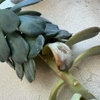
best planter for jade plant

4 years ago
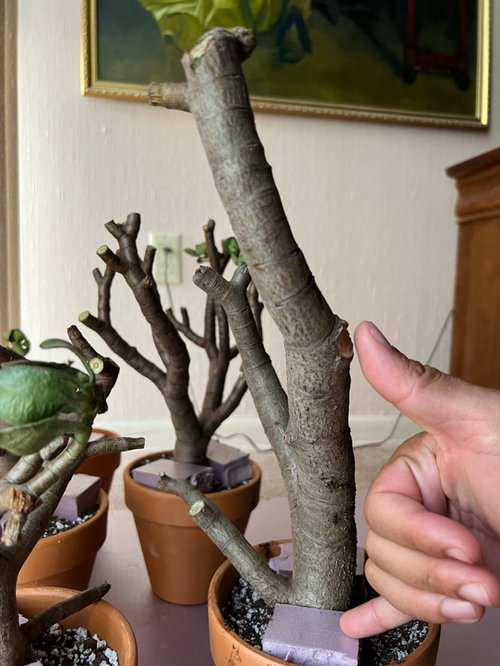
What’s the best planter for a good size jade tree branch? I know drain hole is key.
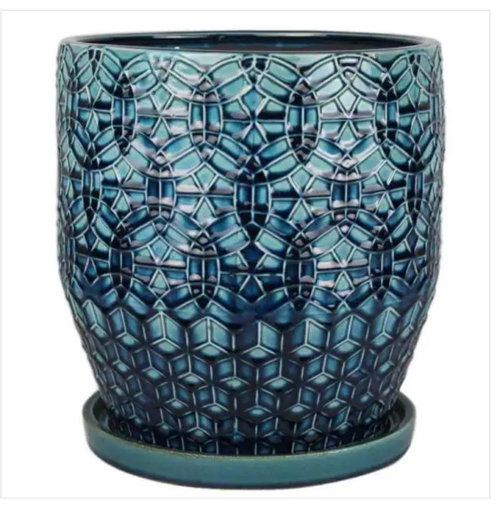
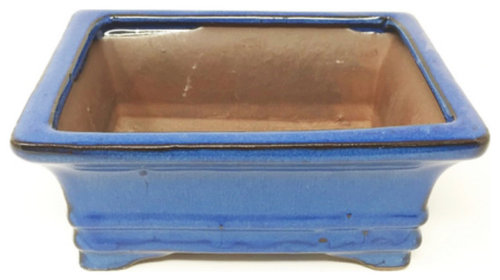
What about height and width? Like shall I go with a tall one like the one on the pic like 10” tall or a low 5” bonsai type one is ok?

Comments (6)

  • 4 years ago

    An appropriately sized clay pot, like you are showing, would get my vote. I'm assuming your branches don't have roots yet or have tiny roots. My experience is that rooting works best in a pot that breathes.

  • 4 years ago
    last modified: 4 years ago

    From the grower's perspective, unless the grower is entirely focused on what's best for the plant, it doesn't matter what you use - use whatever pleases you. The view from the plant's perspective is much narrower.

    Clay pot, pond basket, or a plastic colander would be the top 3, from the plant's perspective. A wooden box would be great, too. They all allow increased gas exchange and allow the grow medium to dry down faster ..... perhaps not something that goes in the grower's 'plus column', but definitely belongs in the plant's.

    Shallow pots demand highly aerated soils. If you are using a medium that supports 3" of perched water (perched water is water that remains in the pot, filling all air porosity for a consistent height from the pot's bottom), the medium used in your bonsai pot would be 100% saturated after a thorough watering.

    Watering in small sips to avoid over-watering brings with it its own drawbacks; namely, it ensures all salts/ dissolved solids in fertilizer solutions and tapwater remain in the pot and accumulate to the point where the plant's ability to take up water is severely limited or destroyed; and, it can very quickly skew the ratio of nutrients in the grow medium, each to the others, so badly that antagonistic deficiencies develop. Example - too much magnesium can cause a deficiency of calcium and too much P can cause deficiencies of calcium, potassium, iron, copper, and zinc.


    Pond Basket ^^^

    Al

  • 4 years ago

    Many ppl never get proper mix...so using deep pot could be a problem. As Al said, shallow pot could be problem for others...I would go with 2nd pot; 5" is plenty deep IMO. I often use 4" 'bulb' pots & they work perfectly. This is 10x4" - quite stable for bigger plant.


  • 4 years ago

    This is just my opinion. My experience with those pots with the attached saucer is they are lovely, but they seem to present problems with drainage. I have better experience with plain terra cotta pots. The bonsai planter is nice too and those have good drainage but I think it's difficult to get the plant to anchor in there when its roots are developing. Just my 2 cents.

  • 4 years ago

    PM - it's not just your opinion. Many growers with a good understanding of what it takes to consistently keep root systems healthy will opt either for a pot which allows generous gas exchange through the walls of the container, or they adopt grow media porous enough to allow gas exchange by way of diffusion from the top of the soil column to the bottom of the pot. The primary bias against pots with impermeable walls, including bonsai pots, is when used in combination with media that support excess water, gas diffusion essentially stops at the top of the excess (perched) water table. Gasses diffuse approximately 10,000 times faster in air than in water, leaving the fraction of the grow medium which is completely saturated little more than an anaerobic swamp that produces the same gasses as swamps, among them are CO2, methane, and hydrogen sulfide, all of which displace oxygen essential to root function/ health.

    Any pots with smooth sides, like glass/ plastic/ high-fired clay (porcelain), provide less anchorage than low-fired clay, unless they are shaped with a rim/ top opening that is smaller than the maximum diameter of the pot. IOW, a plant can become lodged almost inextricably in a pot with an 8" maximum diameter and a 6" top opening. These pot often must be broken in order to extract the plant at repotting time. Even dead woody plants in these pots are very difficult to remove w/o breaking the pot.

    Some inexpensive bonsai pots have drainage holes located higher than the lowest point on the pot. It might be surprising to learn that many bonsai growers will not plant valuable plants in pots which do not drain completely. That the holes in bonsai pots are often several and their size large for the pot size, have nothing to do with drainage insofar as how completely the soil drains. A pot with a 1/8" hole would drain as completely as a a pot with 4 - 3/4" holes, it might take a couple of minutes longer, but the net result would be the same.

    Finally, something true of every grow medium that supports perched water is, when the medium is at container capacity (holding all the water it can, the ht of the perched water table will be the same in any container, regardless of its height or shape. This image (already posted) illustrates that principle in pots of various hts ......

    The pot on the left looks like about 80-90% of the soil column is free of perched water; while, using the same grow medium, less than 1/3 of the soil holds enough air to allow roots growing in that fraction of the medium to grow normally. This is why it is soo important to use well-aerated, fast-draining media in shallow pots.

    The containers below illustrate the shape of the pot doesn't affect the ht of the perched water table.


    Notice how simply tipping the pot (fig B) eliminated much of the water the planting is capable of holding. Use this when it's raining or immediately after a thorough watering. In fig C we see the shape of the container can significantly affect the VOLUME of perched water a planting can hold, but not the maximum ht of the perched water table. Fig D shows how using an over-turned as ballast inside of the main pot can significantly and passively reduce how much water a planting can hold.

    Al

  • 4 years ago

    ...and it's easy to temporary support plant, until the roots anchor it. It could be rocks or by tieying up...either could be easily removed when not needed any more.

    ...crude tying, but it worked well while needed: