Software
Houzz Logo Print
bluemonday2001

Tree or Shrub for under Pine Trees

I would like to plant a tree or shrub to cover the area where my neighbor parks his cars. There is a row of Pine trees that are about 50 to 60 feet tall. At ground level the coverage is not that much. It would be nice to plant a small tree or shrub that will fill in the area so I don't see the cars as much. Thanks.


Comments (33)

  • 4 years ago

    We need some sort of Zone or location information.

    Most of us put it in our user name so we don't have to keep typing it, but it really is essential information when choosing plants.

  • 4 years ago

    would you care if they dont appear to be pine trees??? .. if you might.. give us some pix of the needles etc.. and perhaps we can ID it for you.. if not here.. in the name that plant forum ...


    planting anything very close to those ancient trees will be hard to care for.. because the huge old trees will steal all available moisture.. it can be done.. but it isnt going to be a plant and forget thing..


    big city name.. and we can suggest some plants... and perhaps a pic from ground level.. and some idea of how much space there is between the house and the trunks.. the further you can plant from the trunks.. the better off you will be ...


    ken

  • 4 years ago

    Pacific Northwest Zone 8a.


    If I change my user name is that what I use to log in with? Seems it would be a bit long to long in with such a long user name and with spaces.


    Yes, the pine tree will provide shade and soak up the water. I don't mind watering though and it rains a lot here. I would like a shrub that would provide some privacy so I don't see the cars. It doesn't have to be an evergreen. I could plant hydrangea but not sure if that will be rugged enough to come back each year. I have a Japanese maple tree nearby that has done ok. But doesn't cover from the ground to about 6 to 10 feet or so. I could try emerald green but not sure it would survive that close to the pine tree.


    I'll take some additional photos (or find some) of the pine tree to identify it better. Thanks

  • 4 years ago

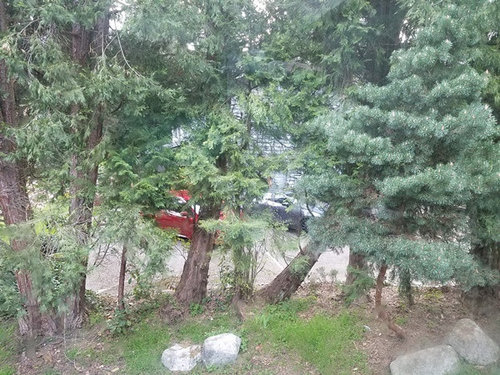
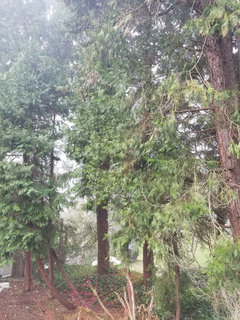
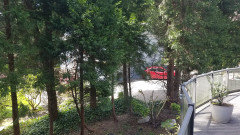
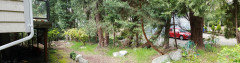
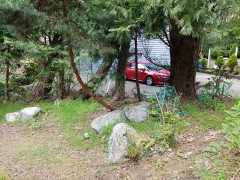
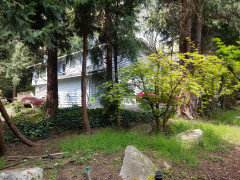
    Here are some photos I had on my computer.\


    One is at ground level. The rest are various views.


  • 4 years ago

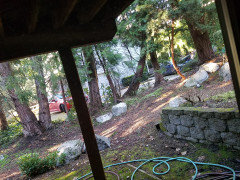
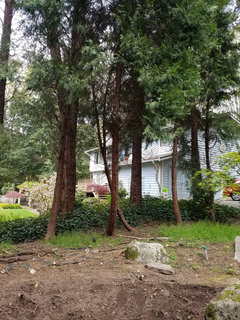
    Found a few more photos. not much space in the ground level photo. I would need to plant something right next to the pine tree. On the left side in the photo below the scrub would sit underneath the first row of pine trees. I could remove those as they are not that big. Maybe 15-20 feet and a thin trunk. The chopped up japanese maple survived. It was twice as big (maybe 10 feet) and didn't do much for privacy. I could plant hydrangea around that tree and it might give some ground cover privacy. Though it would be nice to have something more scrub like.


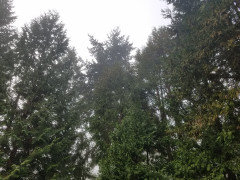
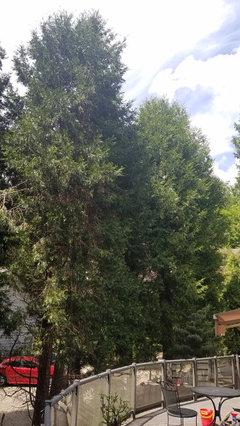
    This view gives the height of the trees. The deck is the 2nd floor. Attaches to kitchen and master bedroom. And no entry to the deck from outside.


    not much space. basically would like to plant something just in front of the tree. and in between if possible. The green scrub in the middle of the picture provides good privacy when it if full of leaves. Not sure what it is, but may not be wide enough. It basically a lot of shoots sticking up.


  • 4 years ago

    Found an article that mentioned emerald arborvitae, American holly, hicks yew, rhododendron and Prague viburnum. The rhododendron I have in my front yard. They are very popular here. I can plant a few on the left side and see what happens. The american holly looks interesting. It has nice density if it would grow next to the pine tree. Hicks yew looks a bit thin but could work in some areas. I don't know if they sell that locally. Praque viburnum looks a little messy but might work. Would any of these be good candidates? Thanks.

  • 4 years ago

    Aucuba is shade tolerant as is Viburnum tinus. Both are evergreen. The Aucuba has brightly variegated leaves and the Viburnum flowers in

    Winter/early Spring.

  • 4 years ago

    I do see a pine in there but most of your big evergreens are Doug firs and western red cedars, PNW natives. They have a lot further ranging root system and suck up a lot more soil moisture so they are more difficult to plant in proximity, especially something larger growing. If you examine local greenbelts and wooded areas, most of the understory you will see are low growing, surface rooted plants - ferns, Oregon grape, salal, huckleberries, etc.

    This is pretty common issue through many of the more rural areas of the PNW and is a condition requiring plants tolerant to dry shade. Evergreen shrubs that would grow well under these conditions and are easily found in PNW nurseries are the aucuba floral mentioned, boxleaved honeysuckle (Lonicera nitida), tall sweetbox (Sarcococca confusa or ruscifolia), the taller mahonia hybrids, Elaeagnus pungens or x ebbingei, Japanese holly, Fatsia japonica, false holly (Osmanthus heterophyllus), evergreen huckleberry (Vaccinium ovatum), and Viburnum davidii. No rhododendrons, no American holly, no Emerald Greens, no Prague viburnum, no Viburnum tinus........they will not appreciate those conditions and will struggle to survive. The Hicks yew will work but has very slow growth under those conditions.

    The issue is being able to plant anything of size very close to the base of the trees. The soil will be hard, dry and very full of roots and you cannot raise the soil level so digging a planting of hole of size large enough to fit a 2G or 5G shrub is going to be very difficult. Typically the suggestion is to plant small sizes - 1G containers or smaller - but that is going to take a lot more time to generate a shrub of size that will address the screening needs any time soon. It is not clear from the photos how much plantable space you have extending from that tree line but the further you get from the base of the trees, the larger the shrub you can start with.

    Watering the first few years will be critical. We may get rain frequently in the PNW but we don't get much in total and almost none in the summer months :-) And those big trees will deflect any rain water so not something you can rely on.

  • 4 years ago

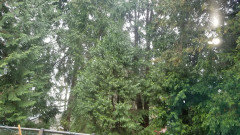
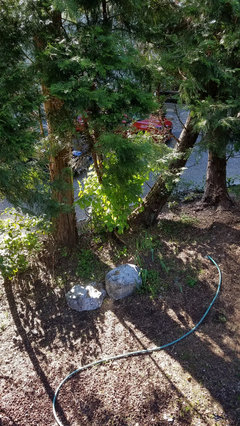
    OK. A few more pictures from today. I'll read through the post tonight and check those suggested shrubs. Thanks


    There is space in front of the row of trees. I can dig into the ground and plant at least 2

    feet deep.


    There is sun that hits most of the area for about 4 hours. and watering is not a problem. My kids play with water often.


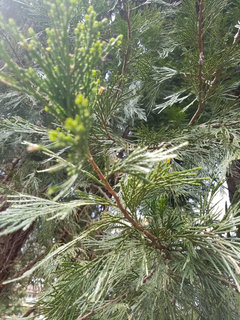
    leaves of tall trees


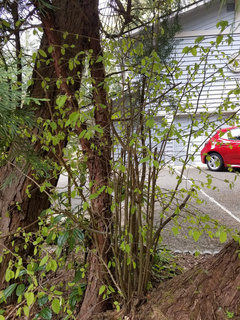
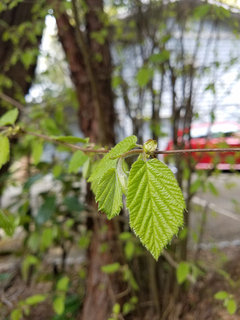
    This shrub thickens and provides good coverage but would like something more hearty.


    leaf of shrub


    This is just left of the area above. The japanese maple has no problem growing. I cut the height in half. I could plant another maple with shrubs underneath if needed. There is a fair amount of sun for about 3 hours in the morning. And some light in the late afternoon. West is straight back behind the line of trees in all the photos.


    There are two rows of trees in this area. The back trees have a thick trunk. The 5 or so in the front I can cut down once a shrub starts to establish itself. I would need about 6 feet or so before I decide to cut down the front trees. I could plant at the same level of the front trees.


  • 4 years ago

    What do the others think of Diervilla ”Kodiak Orange”? Listened to a gardening podcast (Let’s argue about plants, I think) and this was mentioned as a good plant under trees.

  • 4 years ago

    I’m pretty sure V tinus would grow there if a Japanese Maple can.

  • 4 years ago

    The Aucuba Japonica is nice. A bit show growing so it may take 10 years to get to 6 feet. The Japanese Holly is also a slow growing scrub though could reach 10 feet. I have something like a cherry laural on the side of my house that is growing nice (though it could be 10 years of growth). That would be nice if it can survive under the trees. The Diervilla ”Kodiak Orange" seems it will grow anywhere. I might put one near the Japanese maple to provide coverage under the canopy.


    I'll take a look at the others. Some look to be 5 feet and under. Might mostly depend on what I see at the store. Does mail order work or is it better just to stop by a local store?


    Thanks


  • 4 years ago

    Living in the PNW, one rarely ever needs to resort to mail order - this area abounds with excellent retail nurseries that will carry all manner of appropriate plants. And they will be a larger size and for a lot less $$ than if ordering online, plus no shipping charge :-)

    Please do not use English/cherry laurel. It is a borderline invasive species here and is on the WA state Noxious Weed Monitor listing, as it has naturalized widely through area parks, forests and green belts.

  • 4 years ago

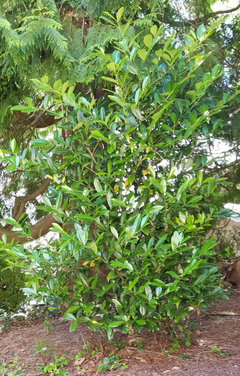
    This is the shrub. It was here when I bought the house. It looks like a laurel


  • 4 years ago

    It is. You are not obligated to remove it but I'd discourage planting more. Laurel hedges abound here and the berries are favored by the birds, which then spread them all over, hence all the seedlings popping up in natural areas. Same with English holly, although that is even more of an invasive threat.

  • 4 years ago

    Where is the property line? Is it in front of the big trees toward the neighbors house? Would you consider a cute wire grid fence with vines growing on it? Or look at golden ninebark , Spireas

  • 4 years ago

    Spicebush and pagoda dogwood can both grow in rather deep shade/competition.

  • 4 years ago
    last modified: 4 years ago

    The location is clearly stated in the OP's screen name - PNW zone 8. A rather specific growing situation that does not always suit just any plants grown in what looks to be a similar situation. And there is only one pine tree showing in those photos - all the rest are PNW native conifers, which grow huge and are very difficult to underplant.

    If you have to have a big city name, you can pick from Vancouver BC, Seattle or Portland, OR. The conditions will be the same for any of them.

    Azaleas flourish in this climate perfectly well....just not under large growing conifers :-)

  • 4 years ago

    Property line is between the first set of trees and the second set of trees (much bigger trees). Scrubs will be ok as it will look more natural. Not many fences in the area.


    The closest big city is Seattle. Zone 8a.


    Dogwood might be in the wrong zone.


    I'll stop by the store in a week or so to see what they have.


  • 4 years ago
    last modified: 4 years ago

    Gardengal, The location was not there when I first saw this post three days ago. I will delete the first post. Sorry to bother you.

  • 4 years ago

    Sherry, the location was disclosed early on, which is why I directed my comments specifically to this locale.

  • 4 years ago

    I have burning bushes in from of my arborvitae. They tolerate dry conditions and fill in gaps very nicely.

  • 4 years ago
    last modified: 4 years ago

    NOT WHEN I READ THE POST TO START WITH! Please read my comment above.

  • 4 years ago

    Euonymus alatus, winged euonymus or burning bush, is not a listed invasive species here.....yet. But it can self seed with abandon if happy and is not a plant I would promote simply because of its highly invasive nature just about everywhere else. And unless it receives regular deep watering during our long and dry summers, it looks terrible, is prone to spider mites and will fail to develop the fall color that is the ONLY justifiable reason for growing.

  • 4 years ago

    My other suggestion is blueberry bushes. It pairs nicely with pine trees because both like acidic soil. Beautiful bush in summer and fall, just like burning bush but not invasive. And if you can keep the birds away you could have some delicious fruit.

  • 4 years ago

    I saw that burning bush was invasive. The blueberry bush sounds interesting. I have a few blueberry bush or tree. Two are in the side yard and 1 is on my deck. I may try to put the potted blueberry near the tree and see what happens this year. The other two seems to be grown in a bit, but I assume transplanting them might be possible.


  • 4 years ago

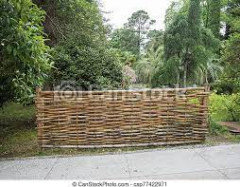
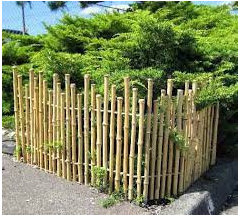
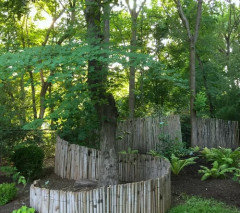
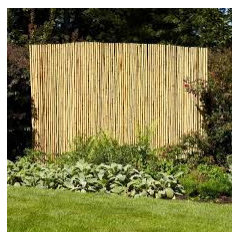
    I can't figure out what you said about the property line, but if it were me, I'd rig up a natural looking fence/screen behind the trees as far as you can do it. Doesn't have to be longer than whatever you need it to be to screen that area. Bamboo or reed fencing looks pretty natural, and can kind of disappear, esp when shaded under large trees.


  • 4 years ago

    The bamboo or reed fence is interesting. How does it say up? With the rain and wind, I would think it might fall down often.


  • 4 years ago

    Around my house in Maryland, forsythia seem to do OK under pine trees. They bloom best in full sun, but will grow fine in shade. they grow and fill in quickly. They're deciduous, but they produce a dense thicket of stems, so they kind of block in the winter too.


    Rhodos do great in West Virginia forests under conifers. Heavy shade and rocky acidic soil.


    The fence idea would work, but it seems kind of rude to me. Putting a plant in would likely be construed as you liking the plant. Putting up a fence in one area sends the message that you want your neighbors to stay away from you. Just something to consider.

  • 4 years ago

    Patrick there are a number of ways to attach the rolled fencing so it stays up. The easiest is fence posts. One of my friends did an informal bamboo rolled fence and painted the fence posts black so they kind of disappeared in the shade of her trees. If you don't want to do wood fence posts you can use metal ones and paint them to disappear. Those rolled fences don't last forever; the bamboo longer than the reed or twig ones. They could easily be damaged by falling limbs, but are very inexpensive and easy to replace if needed.

    I don't think a small, unobtrusive fence, intertwined with the trees is in any way rude to the neighbors. They might appreciate the privacy, too, or likely wouldn't even notice it.

  • 4 years ago

    The forsythia looks nice. I was looking for something yellow for my front yard area. I will probably cut down the front trees that are much smaller which will let more light in. Since I have a Japanese maple tree that grows nicely next to the conifers, I think the scrubs suggested should work. I think the watering in the summer will be important. Otherwise there is more than enough water during other parts of the year. I may plant a few varieties and see which can survive.


    The neighbor doesn't mind if I install a fence, but I will try the scrubs first as it is more natural looking.

  • 4 years ago

    Look at Mahonia, tall (and short) Oregon grape for wonderful yellow flowers, beautiful evergreen foliage and good screening potential in the area near the conifer trees. It's a PNW native plant so should do well in your yard.