Software
Houzz Logo Print
daniel_dine

Advice on front yard edible garden

4 years ago
last modified: 4 years ago
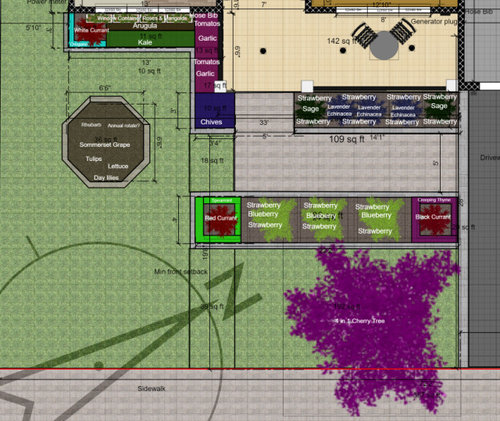
We're in the process of building a house and I'm starting to think about the small front yard. I like vegetable gardening but won't have the space for a big garden and the front yard is where the sun will be. So my plan is to create a front yard garden thats 80% edible and 80% perennial. I'm in zone 5 and it does get cold over the winters and the growing season is a bit short so having perennials is helpful.

My goal is to create something that looks reasonably nice, but that is still edible. Don't know if its readable but I've mocked up a layout below.


Ignore the colors of various things in the picture -- its just to keep things separate.


Would love any advice, critiques, or stories from people who have done something similar.

Comments (13)

  • 4 years ago

    80% edible and 80% perennials??

    Daniel Dine thanked callirhoe123
  • 4 years ago

    Check the soil and water requirements of your various choices before deciding on placement. Lean soil/minimal water plants like sage and lavender are not going to be happy in the same situations preferred by strawberries, which an want enriched soil and plenty of water.

    Also blueberries need a very acidic soil that may not be appropriate for their very near companions.

    Daniel Dine thanked gardengal48 (PNW Z8/9)
  • PRO
    4 years ago

    What edibles do you already like to eat? Consider that first. looks like you have a lot of the perennial berries planned. Garlic and tomatoes. Do you want/need peppers or other alliums like onions, chives, shallots, ramps? You have some greens planned. Want to expand into some of the Asian ones? Some of them can be fairly perennial or multiplying. Some of the cresses can be perennial or multiplying/self sowing. Many herbs are perennials. Sage, thyme, tarragon, oregano... mints- grow those in containers. Loveage- tastes like celery and grows into a big bushy celery looking plant. Sunchokes, cardoons, and the artichoke family are usually perennial.

    I'm not seeing beans, cucumbers, or squash planned. So I'll not offer suggestions for that. I assume they fall into the 20% annuals you might not want.

    I'd recommend you plan in a bit more flowers- for the pollenators and attractive. I tend to annuals there. Worth it to me for the annual percentage. Zinnias, marigolds, calendula, nasturtiums, sweet peas, firecracker vine. Instead of buying the ornamental sweet potato vines, get regular ones and trellis up the leaves- they are pretty and edible.

    And a lovely ornamental in my gardens is bronze fennel. It can be a bit of a challenge to keep it in check sometimes, but the pollenators love it. And I harvest seeds for the kitchen sometimes. The greens are edible, but I'm very not fond of fennel greens. I planted one years ago and that spot always comes back.

    Daniel Dine thanked beesneeds
  • 4 years ago

    Mixing edibles and ornamentals is great but has to be done with a view to each plant’s needs and character, as GG says. Temporary food crops in with perennials could present problems. The cultivations needed for the vegetables could disturb the perennials. Also vigorous spreaders like day lilies will fight something like lettuce.


    Take note too of the orientation and the height of crops. Your blueberries, for example, as well as needing acid soil, would keep the sun off half your strawberries. In the morning the cherry would shade them too. Your Arugula will be shaded by the currant and the kale. Three feet is too narrow to accommodate lavender etc all in one bed. And that’s a heck of a lot of space devoted to chives. And, just to warn you, black currants smell very strongly. If you like cat pee odour, by all means plant alongside your sitting area.

    Daniel Dine thanked floral_uk z.8/9 SW UK
  • 4 years ago

    If you're building a home in an HOA community I'd check with them first if not already. I have a front yard garden too but it's across the street from 4 acres of woods so no one cares. Hope too that your contractor doesn't shave off all of the good topsoil and covers the clay bed with a roll out ready made lawn carpet. Otherwise grow whatever you like to eat and blend in lots of flowers for pollinators and prettiness.

    Daniel Dine thanked vgkg Z-7 Va
  • 4 years ago

    You can grow what you like, but you should try to visualize and plan how it will grow and look all year long from season to season. Some plants will grow in early to mid Spring, some grow in the heat of Summer, some plants will fade/ die by September while others will still be going strong until full Winter. Some plants may provide Winter visual interest. Some areas will be left undisturbed, while others will be planted new annually. Succession planting and interplanting ideas. Planting bulbs in the more undisturbed areas can provide early visual Spring interest.


    Daniel Dine thanked robert567
  • 4 years ago

    How important is appearance? I would think high, it would be for me in front of my house. Blueberry bushes look great but as mentioned require acidic soil. I would rank blueberries #1 for edible & appearance. dwarf fruit trees are also a great idea. Green onions. Asparagus is has an interesting look in summer. Noone guesses what it is when they see it in my garden.


    I did a lot of research years ago to grow as many perennial fruits/veggies as possible.


    Some things are not perianal but can come back every year if you let 1 plant flower. Dill, arugula, carrots etc. True you will have extra plants to pull but not much worse then pulling weeds (which I do a lot). Only let ONE flower.


    Rainbow chard looks pretty. Sunflowers.

    Daniel Dine thanked Donald V Zone 6 north Ohio
  • 4 years ago

    Something like this maybe. Just the front corners have flowering shrub.

    Daniel Dine thanked bearbev
  • 4 years ago

    I would be tucking things like argula, kale and chives into corners rather than dedicating entire beds to them. Someone already commented on the size of the chive bed. If you like tomatoes, then dedicate a bit more space to them and tuck the chives and such in front of them.


    Around here, garlic is planted in the fall (October-ish) and sits all winter looking like not much is happening. Sometimes the winters will be really mild and there will be a bit of green growth. Usually it's pulled up in July or so, depending on the variety (I only grow hardneck). I typically plop some bush bean seeds in the bed once I've pulled/amended.


    Note that tomatoes and garlic growing spots should be rotated each year.


    I tend to tuck in a lot of random bits of plants that are edible but pretty. I especially like red veined sorrel (aka bloody dock). Arugula and mustards self seed. I have a lot of white and purple borage that pops up here and there. If you don't mind eating flowers, things like calendula and some voilas are edible and pretty. Bees love them.

    Daniel Dine thanked missb_remodeling
  • 4 years ago

    If you are the mix-edibles-in-with-the-flowers type, I have had success with chives and various herbs and I am looking to try rhubarb, because I think the leaves are fantastically decorative. Good luck with your project!

  • 4 years ago

    One consideration for front yard edible gardens is neighborhood pets. Depending on your lot and the surrounding area, you might need to figure out ways to discourage cats and dogs from using your beds as a toilet -- it's a big issue in my neighborhood. E-coli is a real risk.


  • PRO
    4 years ago

    You can have peas and tomatoes in the same spot in the same year. Succession planting. Peas like it in the spring, and tend to not so much into summer. Tomatoes like the later spring into fall. Pick an early variety of pea and when you plant them out, leave a space for where the tomatoes will go in. Don't need anything big, just the spot where the planting hole will be. You just want to remember the spot and not have peas there. As the peas finish up the tomato will take off.

    And oh, I didn't suggest tomato rotation, that was missb :) I don't usually rotate my tomatoes much. Sometimes there can be benefit to doing so depending on the garden and how one gardens. My one container tomato gets it's soil rotated out with other container soils. My processing tomatoes are big vines and grow in the same spot for a few years before I change it up. Grow something different like dwarves and want to use a different bed for that and use the big fence for a different big vine that year.

    Perennial garlic. Not so awesome of an idea for eating garlic. I grow a bunch of garlic, reset the garlic bed every fall with fresh cloves and harvest every summer some scapes and heads of garlic. I also grow a mother patch of garlic. Perennial style. Great for keeping up a patch of seed clove garlic, small scapes and some greens. But harvesting for heads big enough for eating isn't so great. You will get some- that first clove will make a head. If you leave that head in it will start to create more cloves... smaller ones. Part of my use specific for my mother bed is to keep breaking it up in the fall and let it reset too- then I often have a lot of tiny heads of garlic for pickling whole. We like them around the size of large marbles. The rest get scattered back into the mother to grow out next year.

    Green onions you can cluster plant or multi-sow. Check out Charles Dowding on Youtube for excellent advice on that. Some kinds of more standard onions can be multisown and grown as multiplying or AKA perennial or perpetual onion. There are also walking onions :) If you take half of that chives square and dedicate it to green onions, standards.. and even some ramps because those grow wild and are pretty and tasty.

Sponsored
Peabody Landscape Group
Average rating: 3.5 out of 5 stars8 Reviews
Columbus' Reliable Landscape Design & Contracting