

Question solved "MY SOIL IS TERRIBLE"
Ok, so we just moved to a new house out in the woods. The garden is in the perfect spot, so much sun and it's beautiful. However the spot we tilled didn't even have much grass before it was tilled. That's how bad it is. The soil is so sandy and clay filled that 3 inches down there is a clear line where it switches to just sand. I did holes near my roses to water them and they take 15 minutes for 6 inches of water to seep into the soil. (I always did a water hole about 4 inches from my roses to fertilize into and put water into to help them actually get water.) If I just water the ground, it rejects water. It won't penetrate past a centimeter. I added miracle gro to the soil to try to help, and some compost, but that didn't do much. I'm hoping my mulch will biodegrade into better soil, but that will take forever. Can I just dump fertilizer all over the ground to fix it or will that not work. I was thinking it would help get some microbes and roots to get into the clay and begin to help amend it. It's just so sand that nothing but dahlias are going to do well. If I just continuously fertilized, would that hold my plants over until I can lay manure? I think they could last for a little while, and I know that soil will get better if I lay groundcovers and mulch with leaves in the fall.
Comments (68)
 4 years ago
John D:
"If it's on fairly level ground the old stuff in nearest the barn."
How do you know?Just curious.
Related Professionals
Brunswick Landscape Architects & Landscape Designers · Logan Landscape Architects & Landscape Designers · Sheboygan Landscape Contractors · Mansfield Decks, Patios & Outdoor Enclosures · Potsdam Landscape Architects & Landscape Designers · Phoenix Landscape Architects & Landscape Designers · Florence Landscape Contractors · Columbia Stone, Pavers & Concrete · Moline Stone, Pavers & Concrete · Ithaca Stone, Pavers & Concrete · Saint George Landscape Architects & Landscape Designers · Edmonton Landscape Architects & Landscape Designers · Phoenix Landscape Contractors · Ogden Landscape Contractors · Hot Springs Home Builders 4 years ago
You can also call your town office and see if your town has a composting facility---preferably loosely managed---like mine does. I have lots of choices here---finished compost; rough, unfinished compost; chipped leaves, some mixed with grass clippings; hay, pine needles, straw, etc. This is what your garden needs, and lots of it.
To start so young, you must have gardening in your blood. Building your soil is key. I hope you have great success in your new plot.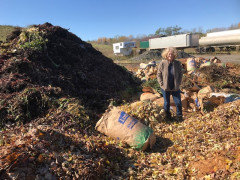 GardeningTeenager thanked annpat
- 4 years ago
Darth - They get the manure in the barn and push a wheel barrow out and dump it. As time goes by the end of the pile keeps getting farther away.
- 4 years ago
Lots of helpful advice above. Another suggestion, hard to locate but worth the effort and one of your adult family members could get lucky. A visit to local beer breweries asking for beer mash for your garden is worth a try. I have used it for years to improve poor soil problems when available. Breweries usually promise their mash annually to area farmers. That is why it is difficult to find. I use it as a top dressing, lightly raked into the soil surface just before planting.
GardeningTeenager thanked nandina GardeningTeenager
Original Author4 years agothank you so much! I can try that, I think I can get manure or clippings from there, I also want to take grass clippings to get nutrients and mix them in, we have a huge yard.
I would try that, and I trust you, but I just don't really know if there is any place like that near where I am, I am going to start with manure for now!
 4 years ago
Read up on composting - even when you are tilling amendments into soil, it is a good idea to use a mix of "greens" and "browns". Greens = fresh grass clippings, fresh leaves like from tree trimming, manure, tea bags, coffee grounds, vegetable scraps. Browns = dry leaves, straw, paper, cardboard, chipped wood, sawdust.
Neighbors are often a good source for many of these. You can call tree trimming companies to ask about getting some chipped wood - many will be happy to bring you some, since then they don't have to pay to dump it.
- 4 years ago
!!!!!!! !!!
10 hours ago
Let me just add that the suggestion to till the area is not a great idea
10 hours ago
Gardengal always has excellent advice.
It does seem like tilling should help, if there is soil that is too clayey on top and too sandy underneath.
mad_gallica (z5 Eastern NY)
There are places I've been dumping leaves for 20 years, and the only soil change underneath has been in the top inch - if I'm lucky. Look up double digging, while I try to figure out what the cat wants.10 hours ago
The way you described your soil, I wouldn't worry about micro organisms right now. I think you need to homogenize it by tilling to something that will drain properly and hold nutrients.
GardeningTeenager thanked rifis (zone 6b-7a NJ) - 4 years ago
I think everyone saw these posts. Did you have a specific point?
There are different ways to garden, and if you ask 4 of us you will likely get at least 5 slightly different answers. GardeningTeenager
Original Author4 years agoI just need to know different ways to fix soil, that was the only point, I am going to try out which ways I think are best.
- 4 years agolast modified: 4 years ago
I was talking to rifis about the post just above, sorry.
I think you have a good approach though. - 4 years ago
One thing I would say about tilling: around here we are in general agreement that tilling is not the solution to everything and that there is a lot going on in soil that tilling will disrupt if done every year. However, it is a good way to 1) mix soil and 2) incorporate compost, both of which you seem to be in need of. I started with terrible clay 30 years ago and did quite a bit of tilling over the years. But I tapered off as the soil improved and I learned about fungal filaments and worms and soil particle aggregation. Now I hardly do it at all, but I don't need to.
Since you have undisturbed, unamended, clay on top of sand, it seems good to either dig or till in compost initially. - 4 years agolast modified: 4 years ago
I am a very experienced, uneducated, gardener. All of my gardening advice is based on nothing fatual, pure bias, combined with anything my favorite gardening author, Thalassa Cruso, ever wrote in the early 70s. I agree with tox's post above to the letter. We all mostly agree that tilling is destructive to soil structure and soil biology, but...it's hard to deny it's a fast way to incorporate amendments, flip up rocks for removal, etc. My soil is so full of rocks and construction gravel here at my mother's former camp where I now live that I was forced in the early 2000s to start my new gardens without tilling because one pass would render the tiller blades useless.
I've always been a dedicated mulcher, but I amped it up in the new wasteland. I was discourged to see my thick mulches disappear so greatly in volume annually, but, despite that, I was seeing improvement in my soil and an explosion in the worm population.
So here's my new theory. I give the yard copious amounts of compost or any organic matter that breaks down in a timely fashion, applied as mulch, and the worms and other organisms draw those nutrients down, adding, all along their tunnels and routes, their mineral rich fecal castings. I supply the food; they do the labor.
- 4 years ago
It's my opinion that there three major reasons you would need to consider as to what you need for your new gardens soil,.
1. How soon do you want to plant. If you want to plant this year and it's already spring you need an instant solution as to how to get your soil in a condition to grow this years crops.
2. What kind of soil do you have to start with. I know of a spot where the top soil is 3 feet deep; rich black topsoil. And I saw them excavating for a hamburger stand and there was a foot of rich black topsoil. I would say that you could grow nice crops with a little mulch on top. But we see on this thread some of the other possibilities. Not everyone should be making the same decisions as the person with the 3 feet of topsoil. And I'm sure glad I don't have the rocks and stones that some here have.
3. What you want to grow. It's said that beans don't need the same requirements that corn might need.
Myself I have perhaps a half inch of sod and clay under that. I put in two stands of corn one year. On one; I mowed the grass and punched holes with a long rod and dropped and knocked the seed in the holes. The other I dug up and amended. The plot with the amended soil grew plants almost double the height of the other. The amended plot had filled out cobs the other had half the corn kernels.
I amend my soil using either free horse manure or mushroom compost I spread an 18" wide row of compost 2 inches deep and dig that in, with the sod, using a spade. Then spread the next 18" so that I'm not standing in it. When I finish the plot I start again with an inch and dig in the opposite direction. East/West instead of North/South. This breaks up the clay clumps and sod better and mixes the compost more evenly. But if need be I'd be happy with one pass and it's my opinion that any organic matter you add will greatly improve your crops. I've used peat and sand, and kitchen scraps, and I've also dug in huge unchopped oak leafs. I knew someone who mulched with grass clippings from all over the neighborhood. Six inches deep. What happened was that the microbes in the soil ate the clippings in a very short time period and left nothing at all. - 4 years ago
I like to mulch the gardens in the early summer with a mixture of leaves (if I have any left from last fall) or wood shavings, and grass clippings, mixed together on a tarp. I only use my own clippings for that because they aren't composted first and I don't want anyone's herbicide-treated clippings going right into the garden. The leaves or shavings help fluff the grass clippings and prevent matting, and also make a balanced green-brown mix and food for both fungi and bacteria. It works very well to suppress weeds and keep water in the ground in the hot summers, and is almost gone by fall so I know the soil is being fed. I pretty much only dig these beds for tree roots every 2-3 years, and that's normally only a trench along 1 -2 sides.
It took a long time to get to this point. - 4 years ago
I can certainly see the logic of tilling once seriously when moving into a new place with problematic soil and not much plant life. "Once and done", hopefully - and then you can not till again and let the soil organisms grow. (Keep mulching and top-dressing regularly though)
If you're going to be wanting a lot of organic matter (and you will), wood chips in many places are going to be the most economical (even free). Supplement with whatever else you can get cheap and in bulk. Get some and piile it up and use it as you can, if it gets a chance to age, all the better. The lignin in wood is also going to be more persistent in the soil (compared to softer organics like greens), and to some degree aggregate with the clay bits and give tilth.
The one thing is fresh wood chips may (temporarily) tie up nitrogen in the soil if dug in. I think it's somewhat overstated, but it is a real thing; some manure or richer amendment mixed in there will help. Actually whatever else you can mix in there for your tilling, more variety is better. May not get best results from growing the first year (esp if tilled in during the same season).
You may want to sow ground cover, green manure or cover crops the first year anyway to get some life in the soil, and you garden in subsequent years. Note, wood chips that've aged a while will be much less likely to have any nitrogen-fixing issues.
But overall if you're adding in organic matter and not expecting perfection right away, it'll improve over time. Have fun.
 4 years agolast modified: 4 years ago
@GardeningTeenager I am very confused by the original post. Is there any way to show us photos of the three-inch layer of clay on top of the clear line where the sand begins? Can someone suggest how three inches of clay ends up on top of a sandy loam soil? I am guessing that she might be living in a flood plain (maybe without realizing it), and there is a once-in-100 event that deposits a huge amount of silt and clay onto the base of sandy loam.
Regardless of how it got there, I am also confused by how you describe water pooling above the clay layer. Three inches of clay is nothing. It would absorb the water and that should then very rapidly drain down to the sandy loam.
Given your very unusual soil arrangement, the obvious question I would ask is why doesn't she just till the sandy loam and clay layers together? You would end up with a much more porous clay loam or loam soil. That well-drained soil could then be mulched with compost or wood chips for long-term soil improvement. As gardengal correctly points out, you normally need to dump many trucks worth of sand to significantly amend clay soil. But you are lucky because there are dump trucks of sand already below your feet. You just need to access it directly by blending it with the thin clay layer.
What would not make sense to me is using a mulch on poorly drained clay soil, when there are only three inches of it, and sitting below it is a pile of sand. Why bother to "improve" the clay soil when this is just a superficial layer and your plant roots live in the sand, not the clay?!!
- 4 years agolast modified: 4 years ago
As a follow-up regarding flood plains: I once considered a move to Reno Nevada to a neighborhood of really nice homes, which at the time were quite cheap by California standards. I could not help but notice a network of streams around the area, and viewed from a satellite I realized it was a flood plain. I researched the historical record and found an event in the late 1800s where the entire neighborhood became a three-foot-deep torrential flash flood that wiped everything clean. The County was apparently more interested in collecting property taxes on megamansions than in public safety and there were no warnings about this risk anywhere. But if you went to the County website, buried there were various engineer reports that made it very clear that the area had no business building homes the way they had been built.
If I discovered a three-inch layer of clay soil on top of a deep layer of sand, I would be doing some research to see if you understand the worst-case 100-year event for the location you live.
 4 years ago
Since roses were specifically mentioned in the first post, and this was cross-posted in the Rose forum, I've assumed the bed is intended for roses, or roses and mixed perennials. Definitely not a vegetable bed, or anything else where annual tilling is going to be possible. This is a do it once - do it right situation.
The issue I've found with tillers is that they just plain do not go deep enough to do the job if they are used in the normal way. I've been in situations where the tiller is used to loosen a layer of soil, a mob of people jump it and shovel the loose soil out, and the process is repeated until the bed is 10-12 inches deep. In this situation, I'd expect the tiller to get through the clay, but barely.
As to how this situation was created, this is what the State of Vermont has to say on the subject.
GardeningTeenager thanked mad_gallica (z5 Eastern NY)GardeningTeenager
Original Author4 years agolast modified: 4 years agoI will post a picture tomorrow. The house was built in the 1780's and the land around it was farmland. I also have no idea how it is that way, it's just that there is such a small layer of topsoil and then all sand under it. The woods around the house have great soil! They were farmland, but were allowed to turn back to forest. I almost feel as if maybe the soil was stripped from the farming before.
- 4 years ago
GardeningTeenager I have 3 thoughts: 1 - Is that it might be silt, instead of clay. Looks like clay, but finer. (Try the making it into a wet clay snake, silt will crumble, clay usually stays together or breaks at weak points) 2 - If the sand is in a specific place, someone could have added a layer of sand then topsoil on top. We have that is one garden, with no idea why someone would do that, but they did. It is taking 3 years to get the soil to retain anything, so a tilling might have actually helped. 3- We can grow amazing potatoes in that layer above the sand (even in the sand). If we leave some potatoes in, it adds organic retentive matter, unless the voles eat them. (Diakon radish will also help, if planted in late summer.)
Epic Gardener (youtube) decided to till some of his beds 1 time and found that mixing the soil up 1 time was worth the cost of killing most of the soil life.
By the way ours was orchard land surrounded by woods, but on a hill, we have glacial tilth and therefore silty, sandy, rocky soil that drains well, but only after it sits for about and hour in most places.
GardeningTeenager
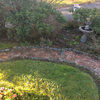
Original Author4 years agoHere’s the plot of land. The soil just turns to clay or silt.
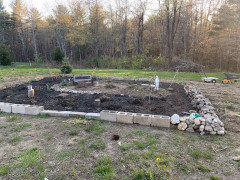
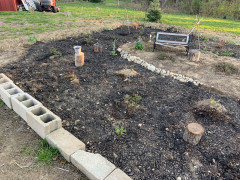
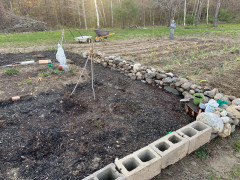
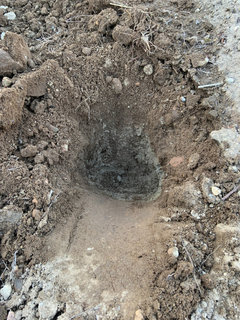
 4 years agolast modified: 4 years ago
I think there's a lot of potential there for a great garden.
- 4 years ago
My advise is to try other perennials to go with your roses. You can start from seed to make it very affordable, maybe find a seed mix of perennial flowers that's suited for your area, or even better, native to you. Those mixes can be found in a local nursery or online. Anyways, the point of them is that they should grow well for you there, giving you several benefits: 1. they will cover the ground, so your bare soil isn't as exposed to the elements. 2. They will form good root systems that stay in place permanently and hold the soil to slow any erosion, and the roots will also push down and break up the soil. 3. The roots of the plants will encourage soil life to grow in your garden, which is fantastic. 4. I bet they'll look great. And they'll also look great to other insects that will help keep pest populations down on your roses. 5. You cut down the dead topgrowth in spring and compost it to put back into your garden. With that plot of land you could have a great composting system.
- 4 years ago
@GardeningTeenager It looks like maybe six to nine inches from the clay loam down to the sand? Actually, that clay layer looks much more loamy and organic than I expected from your description.
I would say 15 minutes to drain water at the surface is okay. Why do you perceive that to be a problem?
Other than roses, what kind of plants do you want to grow? Are they shallow rooted?
GardeningTeenager
Original Author4 years agoHere’s the plot of land it’s more like 4 inches, that picture is deceiving. I have 21 rose bushes and a bunch of perennials like clematis. It’s just not working because the water runs off rather than get absorbed because it’s on a hill. It’s hard to explain but the soil just won’t accept the water. My old garden at the other house would readily accept loads of water and my plants thrived. This soil just can’t seem to let water sink in. It stays near the surface while my roses and flower seedlings need it to go deeper so when it gets dey there will be a little water for them to use deeper down.
- 4 years agolast modified: 4 years ago
Hmm, I hope someone chimes in who knows more about it but I think some people have found success making their soil less hydrophobic by using baby shampoo. I garden on quite a slope, tight planting with deep rooted plants, mulching and some terracing is what I do to combat it. Hills are a challenge but it's definitely possible to fix this situation.
GardeningTeenager
Original Author4 years agoThat’s exactly what I would call it!!!! It just rejects water.
I hope I’m not bothering people on these forums, I know I ask so many questions, I’m just trying to figure out what’s best and what to do.
GardeningTeenager
Original Author4 years agoThank you so much for saying that. Sometimes I feel really annoying because I comment on everything. What can I say, I love it all!!
- 4 years ago
@GardeningTeenager I would rent a motorized tilling machine and try it out on a small sample of ground, tilling down about 12 inches. Then test if the rotated earth absorbs water better. I think if you combine the underlying sand with the clay loam, you should end up with a nice loam soil.
- 4 years ago
In my experience, working the soil is really important. I can't help but think that the people who are against tilling soil are ones that have good soil to start with. My soil is by nature SO poor-there is no "soil life", lol! I am only starting to have earthworms, for example, in areas that I have worked and re-worked, adding lots of different amendments. Expanded clay in pellets really seems to be helping enormously in aereating the soil, and helping with moisture retention. I wonder if adding this might help in this situation...
- 4 years ago
You're quite the worker, I see, and that will be a lovely rose garden. I'd be starting a compost pile and finding out where the municipal compost facility is, and I'd be amending my soil from the ground up, over time with mulches.
I'm torn about the tilling. In the 70s, I would have soaked a ton of peat moss in wheelbarrows with water, mixing with a spade as if I were mixing concrete, until the peat was thorougly saturated and I'd have tilled it in the bed if I could locate a tiller. I no longer use peat (except in my potting soil) and I no longer till; I fork over my beds at most.Gardengal has a following here, because she knows her stuff. She pointed out, in her post above, that mostly, it takes time to improve soil, unless you truck it in. She doesn't recommend that, and I, personally, am very opposed to supporting topsoil harvesting and sale. The only way I know to deal with water issues in a garden is with organic matter.
These forums are for conversations and you started one that Soil, Compost and Mulchers are always interested in.
- 4 years ago
After looking at your pictures. Cover the ground with anything organic you can find. Leaves, compost, manure, whatever. The more, the better. Then I would get a shovel and start mixing the sand, clay and organic matter. Looks like you have a lot of rocks. So get rid of the big ones as you dig. The clay will likely form clumpy balls surrounded by sand/compost, but that's a lot better than a solid surface of water resistant clay. The roots will find the clumpy clay balls and grow into them over time. You could til instead, but I think you may issues with the rocks. Maybe til after you get rid of the big rocks.
- 4 years ago
"The clay will likely form clumpy balls surrounded by sand/compost"-kidhorn2 is exactly right! and, again IME, that is not great, and this is where the expanded clay seems to help.
 4 years ago
I just wanted to jump in and say how much I enjoyed reading this thread. I love reading about gardening, thinking about turning over soil with a fork and you guys actually hand digging knee deep holes! I love looking at gardens, in person, on line, in books. I just do not enjoy gardening. It is my deepest regret.
(I have two horses and spend a lot of time on pasture care. We compost and turn our manure/shavings pile (for pasture spreading in the fall) so we don't have the oldest poop closest to the barn, but I think that rule would hold for any boarding stables that are still mucking and dumping.)
Your garden space is a thing of amazement to me, @GardeningTeenager and I wish you the best of luck. I'll keep vicariously gardening and maybe in my next life, I'll get the gene.GardeningTeenager
Original Author4 years agoThank you so much for all your complements! I just texted try my best. Right now I’m working on turning the soil over and mixing in organic matter. I can totally do composting! I might also just rake grass clippings and add them to the garden!
Barncatz, you could totally do a simple green if you really wanted! The people on these forums could walk you through making a low maintenance garden that you could enjoy looking at, but not be consumed in. It’s about finding the balance. There’s plenty of roses and perrenials that need almost no care, like knock out roses!
- 4 years ago
@GardeningTeenager I add a lot of grass clippings to the garden and my compost bin too, it's a good free mulch that breaks down easily by the next season. If you do compost bins/piles your garden is going to be banging in just a few seasons, you've got the perfect site for it and I truly believe it will help your soil a lot. So excited for you!
GardeningTeenager
Original Author4 years agoI’m excited too!!! Everyone in my family thought I was crazy for asking for grass clippings! Now I know I’m not crazy and It will work!
 4 years ago
Look up a broadfork, Teen. This is a large fork you step on to enhance drainage of soil. I think it could really help you. You might have to find a helper to step on it for you if you are too lightweight. My husband helps me.
- 4 years ago
For the hydrophobic top layer of soil where water just runs off: cover with organic matter, pretty much of any kind (wood chips and shredded leaves are my go-to). And keep it covered!
Almost always with hydrophobic soil, it's a top layer or crust that is the problem, when it dries out it stops absorbing water and rejects it. Yes, that top layer actually 'likes' water until it dries out. Keeping it covered with organic matter (leaves, chips) will retain some water down there and keep it moist enough to stop it from becoming hydrophobic. On top of that, I think over the medium term the organic stuff and microbes will mix/aggregate this so you stop having that layer, but I can't say for sure with all soil.
Note, this works way longer than you would think from eyeballing it - if you have even a half-inch of mulch, stick your finger in and discover it's usually at least a little bit moist. But yes, of course, in really dry and arid conditions, it does EVENTUALLY dry out. Even when completely dry, though, that layer of mulch will absorb water before letting it run off and moisten the soil below again, i.e. it's a pretty effective fix and you don't usually need to run around watering just to avoid the hydrophobic soil.
Personally I think green manure cheapo seeds are nice too. But keeping the soil covered with some organic mulch will go a long way to making sure this hydrophobic soil layer becomes a non-problem.
- 4 years ago
I find that wood chips are great for keeping weed seeds from germinating. Problem is it also keeps the seeds you want to grow from germinating.
 4 years agolast modified: 4 years ago
I don't want to hijack this thread and if there's a better place to post this, I'll move it and I apologize for posting here. It's difficult for me to navigate houzz for information.
As I'm digging a new garden bed at the moment (just taking a break from the heat to hydrate and rest) I have a question that's related except I have the opposite problem. My garden "soil" is sand and silt. And just now watching it drain (over 15-20 minutes) makes me realize how much like cement the silt gets when it gets wet. I'm planting blackberries and grapes. I am planning to add horse manure (composted) and other organic material to amend it. But I'm worried about whether the silt/sand will smother the roots. Do any of you have advice on how to help make it less cement-like? My cactuses love the soil as is but I expect other plants might not.
 4 years agolast modified: 4 years ago
@L K, if the cacti are happy in this soil then I doubt it is quite as cement-like as you think. 15-20 minutes is considered rather fast afa drainage is concerned and I'd suspect the cement-like surface is a result of the soil drying rapidly and crusting over so it becomes temporarily hydrophobic.
Adding organic matter will help, as it does for just about any soil condition, even good ones :-) It will help to aerate and lighten the soil as well retain soil moisture. There is really no concern about roots being smothered......many gardeners grow successfully under very similar soil conditions.
Have you ever done a soil texture analysis? It's a very simple home test that could provide some helpful insight into exactly what you are dealing with. Although my advice to add organic matter would still not change regardless of results :-)
ETA: sorry, I forgot to include a link to the soil texture test, aka "mason jar test". There are dozens online, but this one is very simple to follow and explains how to interpret the soil texture triangle. https://hgic.clemson.edu/factsheet/soil-texture-analysis-the-jar-test/- 4 years ago
I'm not sure what's meant by 'smothering the roots.' I think the main condition that would 'smother' roots is too much water retention, drowning them really - which won't be a problem in fast-draining sandy soil.
I think.
- 4 years agolast modified: 4 years ago
@armoured & @gardengal48 (PNW Z8/9), thanks for the input.
I should have said drowning, yes. Forgive my poor choice of words.
I know from other plantings that if I put a metal post in, that silt cements it in so that it's immovable. I could put my full weight against my fence posts and they're fine.
If you say that 15-20 mins is fast, I'll trust you. That certainly makes me feel better.
I just finished digging down a bit deeper than I'm putting the plants in and didn't find any caliche--which was a shock because it's everywhere else. Then tomorrow I'm going to add the horse manure and other organic material, mix it in with the native sand, and plant higher, like in a mound. That way, in case the monsoons ever do actually happen, the water is retained lower and away from the roots. The plants' roots can go find the water if they want/need it.
As for the soil texture analysis, I just looked that up and I might just do one. It does look simple.
Thank you both!
 4 years ago
Oh boy, after reading this I am heading out to empty the yard waste bin of the grass clippings and get them into some trouble areas.
Thanks for the advice. Not sure why I never thought about using grass clippings








Mischievous Magpie (CO 5b)