

Recommendations for struggling rhododendron
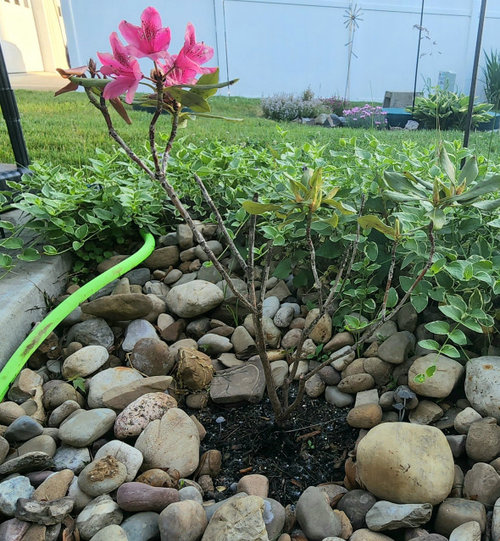
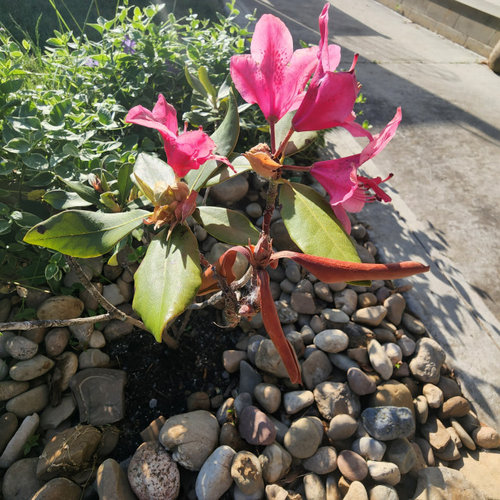
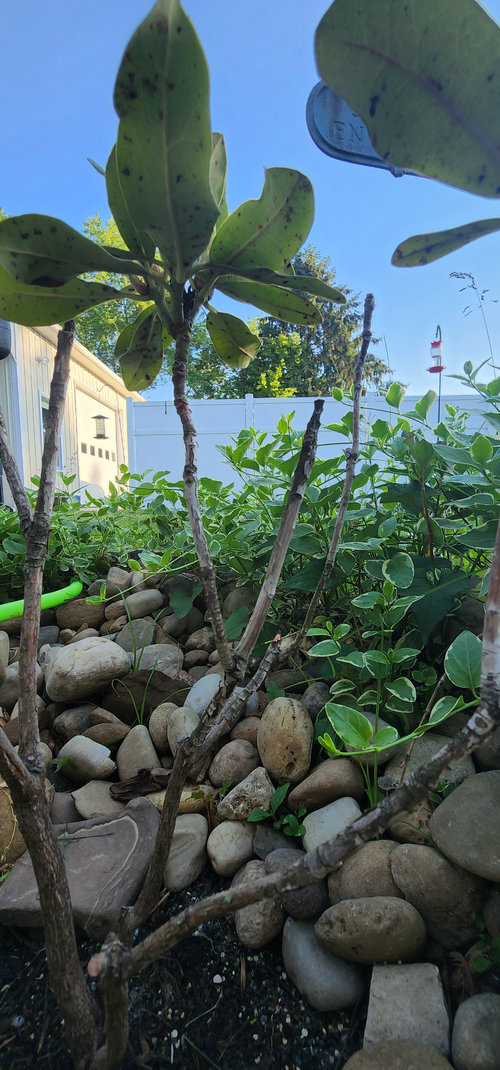
I have a nearly 10 year old rhododendron that really hasn't grown at all. For about 7 years it was in a poor, location where it didn't get a lot of sunlight and a few branches got broken off over the years. I moved almost 3 years ago and now have it in an ideal location, although until recently it was in poor clay soil at both locations. After seeing pictures of a sister plant that was given at the same time and how big theirs got I realized how poorly mine was doing. It's in good soil now with rhododendron fertilizer, I thoroughly checked the roots after digging it up & untangled them as best I could since the bigger ones were circling around the rootball. There weren't a lot of white feeder roots, most were woody and an orange-reddish color which I read can indicate Phytophthora root rot, but I don't know that this is the case as this plant has been surviving like this just fine and has no other indications other than it just isn't growing. The root root seems like it kills them pretty quick, so I don't think that's the problem. I get a few lovely clusters of flowers every year, this year one leaf cluster & buds didn't make it and turned a burnt orange color, may be a diseased section.
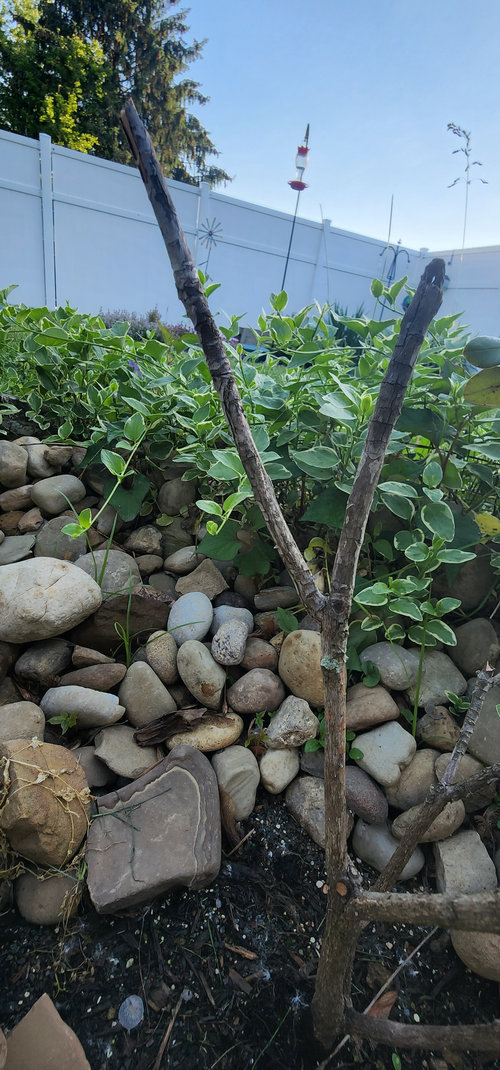
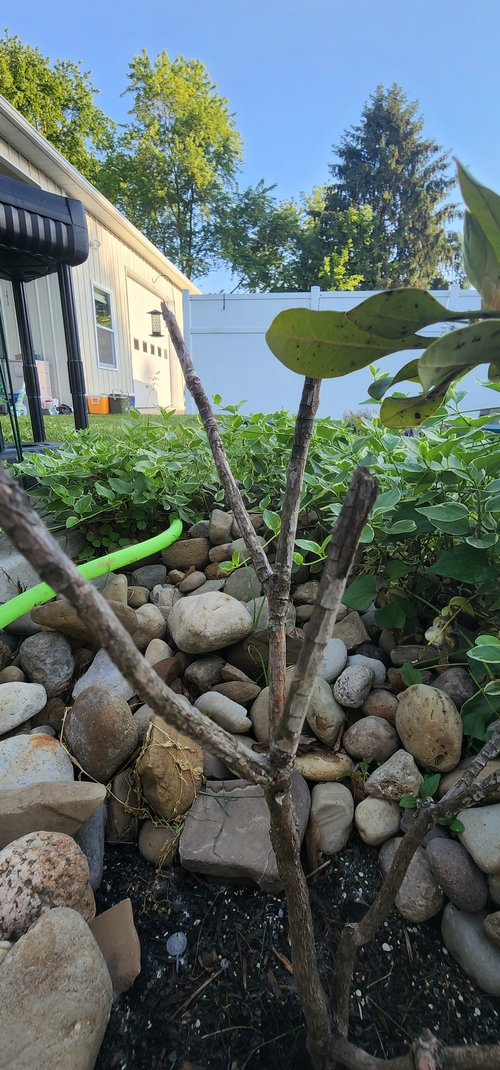
I'd like to prune back the dead wood & try to coax some new growth out of it in the hopes it will get new branches & grow bigger. Can anyone familiar with rhododendrons give me some recommendations on what to do? I read a little about pruning: do it in winter when dormant and look for the little pinkish dots of latent buds and prune above one. The only latent buds I see are on the less woody part, right below where the leaves are. I'm not seeing any on the branches that appear to be dead, or below the leaf areas.
I've attached some photos of the plant in full, and close ups of the branches & leaves. On the leaves you'll see black spots which I've searched and the only thing I can find is some varieties just get black spots on the underside of the leaves and it's nothing to worry about. Everything else is about brown spots and rust spots, which aren't present here. Not sure if the black spots being no big deal is true, or if it's some kind of fungus. It doesn't seem to harm anything, and I think it's always been there. Is there any hope for this little guy?
Comments (30)
 4 years ago
You need to say where you are, roughly, but I can tell u the rocks are generally not a good idea for mulching.
 4 years ago
dead is dead.. remove those parts.. and otherwise... just leave it alone .. and go light with the fert ..
in my MI... these things just dont grow fast and there is little you can do to speed it up ...
big city name will help us.. help you ..
also explain the clay deal.. is your yard horrible clay.. and you just amended the planting hole???
kenRelated Professionals
San Francisco Landscape Architects & Landscape Designers · Anniston Landscape Contractors · Traverse City Landscape Contractors · Jackson Home Builders · Vicksburg Landscape Architects & Landscape Designers · Jamestown Landscape Contractors · Cheyenne Landscape Contractors · Evanston Landscape Contractors · Shreveport Home Builders · Sarasota Landscape Architects & Landscape Designers · Vineland Landscape Architects & Landscape Designers · Rochester Landscape Contractors · Birmingham Home Additions · Pensacola Home Additions · Auburn Home Additions 4 years agolast modified: 4 years ago
^^^ Especially not with rhododendrons!! (This is in response to david's comment, not ken's!)
If it had phytophthora, it would be dead, so you can remove that possibility. It is quite possible that it was planted too deeply and that could certainly account for poor vigor and dieback of various branches.
Also, a hard pruning of rhodies can be done at any time other than in the middle of winter....right after flowering is ideal. There are latent buds present all up and down the stems of any rhododendrons, quite invisible until stimulated into growth by pruning. Cut back hard any stems that have no leaves showing - they might well be dead and no longer able to sprout new growth, in which case, removal won't hurt and can prevent other issues from arising. If not dead, then they should generate some basal sprouts.
I'd leave the single stem with leaves and flower intact for now to give the poor thing something to work with to stay alive.
- 4 years ago
Rhodos don't need much sun. The biggest healthiest ones I've seen grow under dense pine trees. They seem to like acidic soil high in organic matter.
- 4 years ago
Rhododendron grown in full, all day sun.
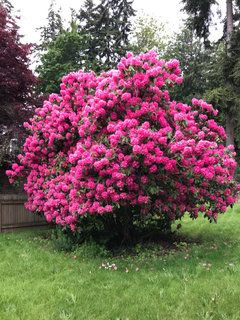
Approximate size is 25' x 25', give or take a few :-))
The point being that many rhododendrons are very tolerant of sun if all other conditions are met.
- 4 years agolast modified: 4 years ago
Yeah rhodies are definitely not plants for dense shade. They will survive it but not thrive it in. I'm finding mine have flowered much better after branches have been removed from their overstory. When you see pics of most them in most of their native haunts, they are at least partly if not entirely open to the sun.
Here is the most dendron of Rhodos, so to speak, Rhododendron arboreum: https://www.vivaanadventure.com/rhododendron-national-flower-of-nepal/
An exception would be the big-leaf species which grow in deeper shade, but those are beyond the reach of most North American horticulturalists.
- 4 years agolast modified: 4 years ago
Go visit wild forested areas of West Virginia. Loaded with extremely healthy dense rhodo thickets. They can certainly thrive without a lot of sun.
https://wvexplorer.com/2018/05/01/rhododendrons-usher-in-summer-in-the-west-virginia-mountains/"Rhododendron of both kinds prefers to live in the shady forest understory and thrives in deep, well-drained acidic soils that are high in organic content."
 4 years agolast modified: 4 years ago
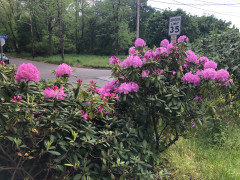
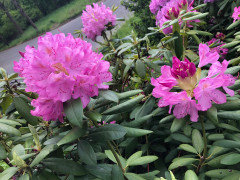
These are now past peak, especially after the recent Eastern heat. They used to be heavily shaded by maple trees that have since died out. I think they started doing better after the demise of the maples, as both maples and rhododendrons are shallow rooted. These seem to do well with the increased sun and they do get full, unobstructed, southern exposure, BUT, my summers (NJ/Zone 7a/b), are normally VERY HUMID, HOT, and rather WET with a high water table. In a more arid climate, I would expect that somewhat more shading would be appreciated.
- 4 years agolast modified: 4 years ago
Even in the Appalachian Mountains, I've been surprised over the years to see many pictures of at least R. catawbiense thriving in full sun. R. maximum, the species with slightly bigger leaves although hardly big compared to the various Asian big leaf species, does seem to frequent shadier spots.
https://www.mastgeneralstore.com/info/chasing-the-catawba-rhododendron-in-the-blue-ridge-mountains
Not meaning to prolong the "argument" unnecessarily, but in my 16+ years of collecting them seriously...since a very fateful drive to Rarefind in 2006...this has been one of my biggest 'revelations' about Rhododendrons. That they really do better, at least as mature plants, with a good amount of sun. When I removed a branch from a gigantic maple that shades one of my main rhodie beds, everything started budding up better. Granted, I'm in a 'extra-murky' microclimate by the standards of the non-mountaineous US east coast. Being at the northern tip of the Bay with warm water to the west and south of me, means that summers are even more likely to be humid here albeit even so slightly cooled on some days. This is the furthest south point on the low elevation east coast where you will see a lot of classic ironclad rhodies in full sun, and it is no doubt due to this quirk of the microclimate. I keep meaning to drive around a place like Kent Island in May to see if it works down there, haven't had time yet. But there has to be a turning point, there always is. You hardly see any elepidote rhodies in say, Virginia Beach, VA, whether in shade or not. It's just too damn hot down there. Likewise, they are the northernmost point on the east coast where there are "ancient" Trachycarpus palms that survived 1994.
Also noteworthy that the local wild Kalmias do best in full sun...they are the most floriferous, although they will grow in dense shade, too. Alas, they are really getting overrun by horrible invasive Asian Celastrus vines. If I were a naive young fool I'd try to organize the local hayseeds into clearing that stuff out, but the most pragmatic approach involves judicious use of herbicides and that would never fly with the small percentage of people who would give a damn. You just can't win sometimes!
Last thought...soil and water table do make a difference. Rarefind grows their plants under a canopy of Jersey pine barren pines that is actually pretty dense in some spots. Although they have an irrigation system, they might need that overstory protection because the soil can dry out so quickly otherwise. Here, with my more moisture retentive clay loam, I have plants like Rhododendron decorum 'Gable's Hardy White' (probably actually a hybrid, but still) in almost full sun. I think a related factor is that rhodies are just plain more 'sensitive' 'fussy' 'prone to rotting' or whatever that a lot of plants, and DO NOT like hot, wet roots. In the warmer parts of the US east coast...south of say coastal CT, it might be easier to get a rhodie established in a spot that would actually have a little too much shade for optimal flowering. Established meaning...not dying in its first few years. So this allowed a horticultural myth to arise that they require moderate to dense shade, when in fact they just happen to survive it more easily for inexperienced planters. My so-called decorum might have struggled to survive if I moved it to its current spot when it had the sun exposure it does now. It was shadier back then due to a huge crappy maple that later split in a storm. But since it has grown into a 6'X6' monster, it can to some degree shade its own roots and keep them cool. The reward is that because of the sun and heavy budding, it is so covered in blooms you can barely see the leaves in the spring.
 4 years ago
@Jurassic Park, i appreciated your commenfs on varous topics — and the ones you posted about cold hard palms were very informative. You give me hope! i would love to pick your brian if you could email me at Rizbollo1@gmail.com, i would appreciate it.
- 4 years ago
I don't care what anyone posts. I've seen with my own eyes that rhodos can do very well in shade. Many different varieties. Do they have to grow in shade to thrive? No. But, I never said that.
- 4 years ago
You keep making a straw man argument. I never said they didn't do well with sun. But you keep correcting me that they do. Growing well in shade is not the same as not growing well in sun.
And how come somehow West Virginia is not a good representative of rhodos. Even though Rhodos are their state flower. But, I've seen you post many times that being in the PNW makes you an expert on certain plants because they grow there. Even when the plants also grow outside the PNW. Seems very hypocritical to me. - 4 years agolast modified: 4 years ago
And how come somehow West Virginia is not a good representative of rhodos. Even though Rhodos are their state flower.
You do realize that "state" flowers (birds, mottos, songs, etc.) are just tourism/marketing-related designations of particularly emblematic plants, and not some sort of indication of the relative abundance/diversity of a species, right?
Perhaps WV isn't a "good representative" of Rhododendrons, because, as GG mentioned, only 2 species are native there, out of ~1,000 species in the genus?
Julie Adair
Original Author4 years agoWell that sure sparked a discussion. I came back after a few days to a little advice and a lot of bickering 😂. In all seriousness though, @UpperBayGardener (zone 7) @gardengal48 (PNW Z8/9) and @ken_adrian Adrian MI cold Z5 I'm in zone 6, Ohio near Cleveland. Most of my yard & garden areas are clay heavy. After reading a bit about Rhododendron and realizing it isn't good in heavy clay soil, nor planted deep, I carefully dug it up, untangled the root ball, amended the hole I dug with good, acidic well-draining soil and replanted it with the root ball higher this time. I've got no idea what variety it is, but it's mostly in Sun all day, been almost ten years since I've had it and I don't think it's grown a bit. Back when I got it I knew nothing about gardening and just threw it in a clay heavy corner of the garden that didn't get much sun. Not sure if it can come back from 7+ years of that. Glad to know at least it doesn't have root rot.
I will try pruning back the dead branches now that it's done flowering, hopefully this will spark growth on some of the latent buds. I can't bring myself to only leave the one branch though, I'm going to leave the smaller branches that have life too. I didn't realize about the rocks, they were there when I moved in. They've been a right PITA, I have to shovel out a few wheelbarrows full anytime I want to plant something new. But I kept them from around the hole the rhododendron is in. I don't want to completely remove them from this area, as they are helping to keep the vine growing nearby in check. That vine was rooting inside the rhodie rootball when I dug it up, so I removed it all from the rootball and made sure to clear the surrounding ground area of the vines, and put an underground wall in to prevent the roots from heading towards the rhodie again. I did fertilize lightly since it was about to bloom at the time. Thanks to everyone for their advice. Hopefully I'll come back next year with a redemption story!
- 4 years agolast modified: 4 years ago
I really want this thread to die - nothing against any of the participants - but 'amending a hole' is not a good idea. What you could have done would be to top dress an entire _bed_ with some kind of compost (but NOT pure composted manure - most are way too high in nitrogen) , and then plant the rhododendron(s) on top of that. Almost on top. The top quarter of the root mass above the level of the bed, and then mound up a bit. And with their roots properly unknotted or gently splayed out. Then lightly mulch the area with something like shredded pine bark or chipped wood.
- 4 years ago
I’m also a little worried about the ’underground wall’. If it keeps the Vinca roots out it will also restrict the Rhododendron roots from spreading. And if it’s impermeable it could affect drainage. Once the Rhododendron is growing well a bit of Vinca root shouldn’t bother it.
Julie Adair
Original Author4 years ago@floral_uk z.8/9 SW UK The wall is a good foot away from the root ball, placed right in front of the vines, and temporary. It wouldn't affect drainage as it's vertical, going 1/4 way round the plant and maybe 6" deep. Its just a couple pieces of step flashing to prevent the vine roots from penetrating the root ball again, there was as much of them as the rhododendron roots. Once (fingers crossed) it grows a bit I'll remove the wall.
@UpperBayGardener (zone 7)d I didn't want to only do compost on the top like I typically do, as I've read that don't do well in clay, and this area was 100% clay. It's already looking better, although I'm sure it will never be what it could've been had I taken the time to learn about it from the start.
It's been trimmed now and looking better. Fingers crossed it will branch out at some point. Anyhoo, I'll leave this discussion up as there is one helpful comment that could be of future benefit to someone else with a struggling rhododendron.- 4 years ago
"Neither Rhodies nor Azaelas {sic} thrive in 6+ hours of direct sun."
Well that is patently NOT true!! It will depend the particular species/hybrid or cultivar and the location. Several previous posters have clearly stated how their rhodies and/or azaleas thrive perfectly well in full, all day sun. That is also supported by the American Rhododendron Society and the Rhododendron Species Foundation.
Alpine rhodies and deciduous azaleas actually prefer as much sun as can be managed!
- 4 years ago
Rhododendrons and azaleas for sun: http://rhodyman.net/rhodynsh.php
And that is only one source. There are many others.
btw, not all rhododendrons or azaleas are shade plants in their native environments. Many that are some of the most commonly grown are hybrids so they don't have a native environment! And even a fair number of species rhodies are native to alpine regions where there is little to no shade.
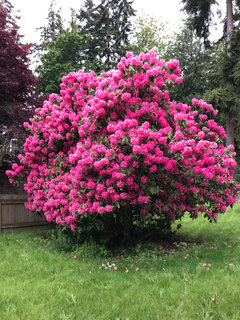
30+ year old rhody in full sun
Reality!!
- 4 years ago
"Anyone can post a link. That doesn’t vouch for accuracy though. Try again."
You seem to think it does. Why would you post a link otherwise??
The pattern of pathetic, inaccurate, irritating and borderline rude responses continue. The troll is out of his cave again. - 4 years agolast modified: 4 years ago
It is quite obvious to an impartial (ahem) observer that many rhododendrons are plants of largely sunny, open settings, ALBEIT almost always in mountainous or cool summer areas. Whether it's our Catawba rhododendron on the balds of NC or the 'laligurans' of the Himalayas. These species can therefore become more manageable to grow in the shade, especially in hot climates where yes, their foliage can burn. Plants WANT light. It's their "food". Other than plants aggressively adapted to deep shade like Fatsia, it's safe to say most plants, rhododendron included, want as much light as they can tolerate given the conditions. - 4 years agolast modified: 4 years ago
Even in a place with sun as hot as Florida, this page notes that the native haunts of the Florida Pinxter azalea are "dappled sunlight to partial shade"
https://plants.ces.ncsu.edu/plants/rhododendron-canescens/
also
https://gnps.org/plant/piedmont-azalea-rhododendron-canescens-2/
"To make one of these beauties happy in your garden, aim to duplicate its natural growing conditions. Select a location with enough sun to encourage blooms, but with protection from the hot, glaring afternoon sun."
- 4 years ago
My azaleas are doing just fine in full sun in northern Virginia.
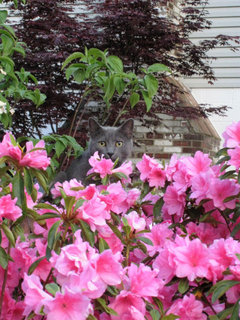
I don't even water these. Actually Adrian Higgins, the former garden editor at the Washington Post, recommended azaleas as a tough full sun/part shade shrub for the DC area. Apologies to those who have seen this photo before, it's one of my favorites.
- 4 years ago
“7 year old Azalea in shade
Reality!”
Yikes: what a sad, scruffy little Azalea! It sure hasnt been happy for 7 years. You might want to consider moving it to a sunnier spot, or at least post the pic to the Azaleas/Rhodos or Garden Clinic forums to get some advice from the experts on getting it thriving again.
- 4 years ago
Nice, now a personal attack on me for relating my own experiences growing azaleas in northern Virginia. Why does the HOUZZ moderator allow these attacks to continue?
- 4 years agolast modified: 4 years ago
Why are some participants determined to be so argumentative and obnoxious? You do not have to post here. If you're that upset, let me encourage you to move on to something that is more enjoyable and let this go. 😎 Relax.
- 4 years agolast modified: 4 years ago
Glad you’re not offended! Looking forward to seeing more pics of your garden! We all have so much to learn! 😊
- 10 months agolast modified: 10 months ago
This thread has been in the back of my mind for ages because this is actually a really interesting question.
Let's ask the dreaded AI:
Are rhododendrons considered shrubs for shade?
Yes, rhododendrons are considered shrubs for shade, but they thrive in partial or filtered shade, not deep shade.
I am coming up on the 20th anniversary of the fateful trip to Rarefind in Spring 2006 that gave me the rhododendron bug. For anyone who visited Rarefind at that time, the dense New Jersey pine barrens forest canopy would certainly have seemed close to deep shade. And yet the plants were in absolutely riotous bloom! (I hope to scrounge up some videos I took there when I bought my first HD camcorder, in spring of 2008, and post them online.) But I wasn't lying when I said, in the decades since then, I really have noticed that you want to give rhodies as much sun as they can manage, because mine seem to bud up more if they get more sun. So what's going on!?
I think the answer is...well, that there's actually a lot of nuance in the answer to this question! Rhododendrons have an overall reputation of being persnickety, difficult plants. (of course I'm talking standard elepidotes hybrids RN) The one professional landscaper I once knew in the DC area said he wouldn't plant them even if customers asked. Obviously things are different milder climates like the PNW, or acidic soil parts of England. But I actually think once rhodies have the basic things that make them happy - and very importantly, are fully established in good soil - they are actually more adoptable w/respect to light levels, than many people would know. And probably more than various other BLEs!
Here's a R. maximum x R. calophytum hybrid that was crossed in North Carolina by Frank Furman; so presumably using a fairly heat tolerant strains of both. It occurred to me recently, this monster is in almost full sun!
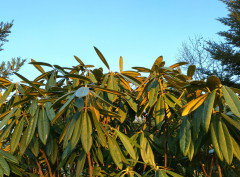
Look at how well budded it is. This is not even a variety or grex that rhodie experts would recommend for full sun...far from it...yet there it is, thriving after two summers that had droughty periods. (Not watered during those periods btw) What I will say is that, I think if I'd done all the tree clearing I've done in the past 20 years, and THEN planted all of these rare rhodies cultivars, it would have been a total disaster. Instead what happen was I started building this garden, at first in a very impromptu way, and then had to remove more and more junk trees, either because they were junk trees, or (more often) because storms started taking their branches out. So this rhododendron and various others got to develop with slowly increasing light levels, are now so big and expansive that they are creating their own soil-level microclimate or microbiome underneath, that allow their roots to stay cool. I suspect, but cannot prove, that this wouldn't work as well on the sandy soils of Rarefind in NJ, or in the gardens of the fabled rhodie hybridizers on Long Island who I visited in 2013. But on my cooler, deeper, loamy soil, it does. This would also explain why I have to fertilize much less than my general understanding of how much they were fertilizing. The plant in this picture has not been fertilized more than 3-4 times, and very lightly, to get it to this massive (by east coast standards...) 8' x 8' size.So BLUF: the amount of sun that's optimal for rhododendrons is a complex interplay of factors: the way the plants have been grown and established, the local microclimate and typical atmospheric humidity level, and soil conditions. Just what I think of course, but food for thought I hope! I remind you, look at the links I posted above, or just google "rhododendrons in mountain habitats". You will see a whole bunch of them growing with no shade canopy!
Picture in Sikkim of the parent of various yellow hybrids: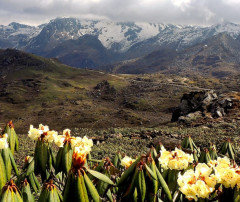
Fair use crop from:  10 months agolast modified: 10 months ago
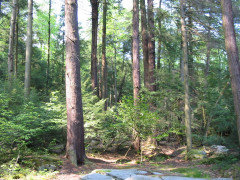
Yeah, you don't see rhododendrens in the deep shade of evergreen forests. Swallow Falls park in western MD -- no rhodos.





Julie AdairOriginal Author