Software
Houzz Logo Print
bananastand

The surprising downside of #NoMowMay

4 years ago

I just read this article and learned a ton about dandelions and native bees- I thought you fellow land stewards would appreciate reading it also! Here's a quote:


"While we need to loosen the grip of the lawn on our collective landscape imaginings, here’s what the little research done to date on dandelions tells us. Dandelion has allelopathic pollen, a scientific term that basically means the pollen of dandelions can reduce reproductive success in native wildflowers, disrupting the native plant communities it invades. Another study showed that queen bumblebees (some of the early emerging wild bees that pro-dandelion campaigns say dandelions help) resorted to eating their own eggs when fed a diet of protein-deficient dandelion pollen."

Comments (19)

  • 4 years ago

    bananastand, I know you meant well and are just sharing information so I hope you don't take my

    comments personally. But more and more unvetted information makes it's way into the mainstream media like gardenweb. I hope we might be more discerning as we become more skilled in our advocation

    The longer I live and the more I learn about gardening the more skeptical I've become about articles like this. What are the writer’s sources, Is this the conclusion of a controlled study/experiment conducted by specialists knowlegable about the field? how much information and how many studies over what period of time are the conclusions based on?

    i did not read to the end of the article or look at the bibliography or citations. Is there a

    bibliography or citations?

    No mow and 'natural lawns are right up there with mulching controversies that feature non factual assertions piled as high as the corn on the 4th of July or more relevantly, a mulch volcano.


  • 4 years ago
    last modified: 4 years ago

    So there is a book that probably references articles in peer-reviewed science publications. Then the article linked above provides its own "spin" on this complicated topic by selecting what information from the book they want to highlight. Note that the article is from "Rewilding" magazine so anything less than digging up all the lawns in favour of native plants is unlikely to be admired. Then @bananastand provides their own spin on the article by offering a selected quote and a quite negative thread title. So we're quite a few steps away from the raw science.

    My "spin" on the article, and the parts I would like to quote, are different.

    "one of the benefits of #NoMowMay is that it undermines the conventional lawn aesthetic and, in doing so, helps to normalize acceptance of “messy-looking” habitats that support pollinators (dead leaves and dead plant stalks, for example). Another benefit of the campaign is that not running the lawn mower will reduce noise and air pollution." and "Not mowing in May (and beyond) is good."

  • 4 years ago

    I mostly agree with the linked article, but it goes to unsupportable extremes to make its point.


    Feeding queen bees exclusively with dandelion pollen is a highly unnatural situation that doesn't occur in nature, so any detrimental effects seem unlikely in the real world. Not all lawns are monocultures maintained with heavy use of fertilizer and pesticide - many, like mine contain wild violets, clover etc., are not fertiized or herbicided, and do furnish food for pollinators in addition to what my garden provides. The blanket dismissal of non-native plants is problematic as well - some of the most-loved and probably nutritious sources of food for bees and hummingbirds in my garden come from non-native Salvias and other "introduced" species.

  • 4 years ago

    About the authors: Sheila Colla is an assistant professor in the Faculty of Environmental Studies at York University in Toronto, ON. Lorraine Johnson is the author of numerous books on growing native plants, gardening for pollinators, restoring habitat, and producing food in cities, she's not a scientist. Heather Holm is a biologist, pollinator conservationist, and award-winning author who has written a few books about native plant-pollinator interactions, native bees, and native wasps.


    The example of the queen bumblebee resorting to eating it's own eggs when fed strictly dandelion pollen, while not a real world situation, does demonstrate the pollen's lack of nutrition.


    I don't see it as a black and white situation, there's no way we're getting rid of dandelions or turning everything back into native plant habitats, but I personally prefer to use native plants and try to reintroduce these wildflowers to my yard and surroundings, where they have for the most part been eliminated due to varying factors. I just think it would be nice if when I pulled a weed the soil seed bank would give me something native and beneficial to specialist insects instead of more noxious weeds.

    Here's a nice writeup about pollen specialist bees and bees in general https://jarrodfowler.com/specialist_bees.html 


    Dandelion pollen does indeed seem to contain chemical defenses that harm bees "During our bioassays, we observed that micro-colonies of generalist bumblebee (Bombus terrestris L.) feeding on Taraxacum pollen (Asteraceae) reduced their pollen collection and offspring production." https://www.ncbi.nlm.nih.gov/pmc/articles/PMC7290674/

  • 4 years ago
    last modified: 4 years ago

    Makes one wonder what other kind plants have toxic pollen. Plants have all kinds of chemical defenses.

  • 4 years ago

    I don't see what NoMowMay has to do with dandelions. I have dandelions in my lawn, in my gardens in sun, in my partial shadevgardens and in my dry, deep shade gardens. If I got rid of my lawn (not happening), I'd still have a lot of dandelions.


    A friend did the whole no mow thing and ended up with a jungle of non-native invasives as a result.

  • 4 years ago

    Unfortunately all of you are ignoring the wildly prolific invasive species that take over spaces intended for native species. I am a former state park ranger and have been a farmer most of my life. If I did not mow and spray both my “lawn” area and my pastures, stilt grass would take over within one year. And the war on kudzu vine is simply lost. It’s killing all the trees. I do my best to keep it off my property but again, chemicals are absolutely vital to keeping it at bay. How many acres are you all managing?

  • 4 years ago

    I manage four acres at home and with my clients you can add in another thirty. Some of the invasives I deal with are multiflora rose, bittersweet, privet, ivy and burning bush to name just a few. Dandelions are the least of my concerns. Chemical use is a last resort rarely used. It certainly isn't vital.

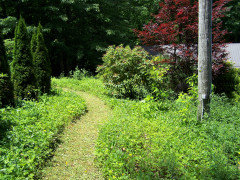
    Why have a lawn at all when a path will do?


  • 4 years ago

    Livestock can’t eat a path,

  • 4 years ago
    last modified: 4 years ago

    Livestock are not really relevant to a discussion of No Mow May and suburban lawns. Hay season however is late May into June here so pastures are pretty much in line with No Mow May.

  • 4 years ago
    last modified: 4 years ago

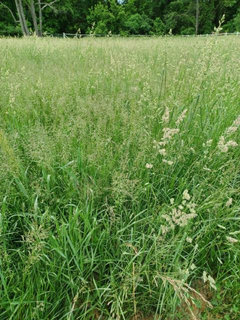
    I'm on a little over 3 acres. Last year I convinced DH to leave about an acre of the pasture unmowed after the last horse died. He left a path to the back gate so it's easily navigable if we want to go back there out onto the trails. I love it! Last year the grass was maybe about knee height but this year kabam! it really filled in, probably from the seed that set last year. Sure there's some weeds out there but mostly it's turned into a lush boob-height carpet of grasses. Not sure exactly what grasses -- I still have to get out there to identify. I'm kinda disappointed I don't see any of the native perennials I scatter planted (e.g. helianthus, cup plant, milkweed, etc) but I'm kinda hoping I just can't see them amongst the green, but if they're still there I'll notice the blooms.

    Anyway, I like how it looks, and I enjoyed seeing insects I'd never seen before last summer, and I've noticed different birds have moved onto the property, too. What's that saying -- plant it and they will come? We lament the loss of prairies and the associated diversity, yet we're resistant to convert areas of property into that sort of habitat (prairie, meadow -- I don't know the difference on a technical level, I call what I've got a meadow).

    Plus, with the price of gas as it is, it's expensive to keep it all mowed. DH and I were just talking about that yesterday. He calculated that in the spring with the current price of gas, it costs about $20 a week to keep 2 acres mowed with the mower he has. So, we're thinking of leaving about another 1/2 acre unmowed so that only half of our property would be mowed, in the front and up around the house. Plus, time is money, but more importanly it's a non-renewable resource, we're only alloted so much of it in this life and not one minute more -- mowing sucks up a couple hours a week of time for this chore, and I put the sound of power machinery into the noise pollution category. All that to say -- not mowing saves resources and cuts down on both air and noise pollution.

    My family and I were talking about this no-mow May movement last week -- they think it's dumb, but they live in suburbia, the land of shorn lawns and keeping up appearances. Unfortunately, I haven't educated myself enough on the benefits to pollinators in terms of both pollinating and nesting, to have much of a rebuttal against their argument that it doesn't really have much benefit for the pollinators. So I'd definitely like to learn more, and I'm hoping when they come over they'll see what I've done and it'll change their viewpoint (but not likely...sigh...)


  • 4 years ago

    my spin on the article is why would a plant evolve in a way that its pollen is detrimental to a pollinator? Here is a quote from that NIH article.


    Regardless of floral specialization, bees display numerous adaptations to discriminate among plant species and to enhance floral resource foraging which can compromise the reproductive success of plants. For instance, bees can remove 95.5% of the pollen produced by flowers of Campanula rapunculus (Campanulaceae) and some solitary species require the entire content of more than 30 flowers, even more than 1000 flowers, to feed a single larva. In response to excessive pollen harvesting, flowering plants have drawn up complex defense mechanisms and adaptations. In fact, flowers have evolved several morphological traits that can be viewed as adaptations preventing excessive pollen harvesting by bees, such as heteranthery, nototribic flowers (i.e., dorsal anthers hidden in the upper lip of the flower, such as in Lamiaceae), keel flowers (i.e., ventral anthers hidden in a boat-shaped keel formed by the fusion of the two lower petals of the flower, such as in Fabaceae), floral tubes, poricidal anthers and progressive pollen release.


    It's a jungle out there!


  • 4 years ago

    A hayfield is not the same as a pasture. Hay is a crop, and hay fields are routinely fertilized and sprayed for weeds since no one will buy hay that has weeds in it. Pasture is usually also sprayed because livestock will selectively graze and leave plants that are not as palatable which are usually….wait for it….weeds. Horses will keep the grass down, but then the weeds are left alone to thrive so you have to mow the weeds so they don’t go to seed. Horses like dandelions, we don’t mind them. Buttercups are poisonous to horses (although unpalatable) but sheep and goats will eat them. Goats are famous for eating weeds, but there are some weeds they won’t eat so I will be mowing the goat pen tomorrow since the weeds are getting tall.

  • 4 years ago
    last modified: 4 years ago

    what puzzles me is that she seroiusly suggests to stop mowing altogether (or did I get this wrong?) as prairie and (European) meadows do not occur naturally but are managed, either burned, grazed or - in case of the meadows- cut/ mowed at least twice per season.


    grassland untended ends up as woodland in the long run, blackberries and other nasties pop up when you quit mowing.


    and there is a technical difference between mowing lawn and cutting grass, as the remaining stalks are way longer after "hay making", at least for traditional, European hay and more plants / herbs survive

  • 4 years ago

    I believe she is suggesting creating a pollinator garden that will never be mowed, instead of letting the lawn grow out. At least that's what Heather Holm has advocated for in interviews when asked about No Mow May.


    I hope if someone has acreage they want to turn into pollinator and wildlife habitat, the NRCS or their cooperative extension would be go to resources.

  • 4 years ago

    " .... why would a plant evolve in a way that its pollen is detrimental to a pollinator?"

    Bear in mind that Dandelions did not evolve in N America.

  • PRO
    4 years ago
    last modified: 4 years ago

    I have 25 acres, I mow between 2-4 acres of it. Some areas are regular lawn, some get mowed as mulch patches, some get left alone till the area is done blooming with whatever is in it, some areas are just too wet to mow till June or even later, some are just trails cut out back.

    In the regular yard areas I mow around swaths of creeping charlie in one area, wild strawberries in others, let the yellow salsify and chickory bloom, encourage the wild chives to spread, the pools of violets and lilly of the valley to keep eating up the grass, the little whites and yellows flowers and the bigger ones to go to seed before cutting down. I do have to keep much of the front mowed open- both because a lot of the main gardens and orchard are there and also because out here if a front gets too overgrown it often means empty house and that leads to folks coming up my driveway to see if they can get away with things.

    The old stableyard is my now gardenyard. I've let it grow out for a few years, letting the roots do a lot of the deep work after it had decades of compacting and eating down to bare dirt. I started last year and now this year really mowing in the gardenyard in mulch mows to clear the area and start replenishing the surface.. Need to clear areas to build in garden structures like raised beds, compost bed, and doing things like coppice racking and the wood pile for shredding wood mulch.

    I don't get a lot of dandelions in my lawns. Conditions are not right for them out there really. Where they do grow I treasure them and harvest them and the pollenators love them. I know why they grow where they do. The higher acid and compacting under the trio of pines, the compacting or lack of other competition under a couple maples. Now that the gardenyard is in it's mowing phase, most of the bigger tapping weeds are being kept down. So I'm introducing dandelion seed in areas there to start deep rooting- dandelions are exellent for bringing up calcium and breaking soil. Dandelions can be a good indicator plant and a useful one as well as a baneful weed depending on how one treats it.

    Though some natives can be fairly exclusive, most bees do better if not fed monoculture diets. A lot of urban and suburban areas can have a surprising variety of offerings. Lots of people tending different non-lawn things. It's part of why honeybee keeping has become more popular in some urban areas, the food is there for them. Also in addition to that is addressing the issue of our use of insecticides. It does not help any to not mow or grow flowers and then treat the area for icky bugs with products that can also hurt the good ones.

  • 4 years ago

    Looking at an issue so complicated through the singular lens of dandelions is like taking a still shot randomly from a movie, looking at it, and saying you know what the movie was about.