Software
Houzz Logo Print
nejohnson

Japanese Knotweed

4 years ago
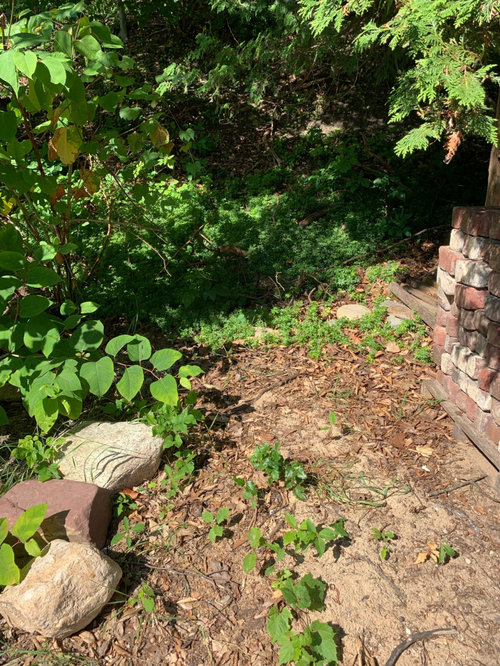
Has anyone successfully eradicated Japanese Knotweed? We had a decades-old intentionally planted specimen (that I did not recognize for what it was) that was disturbed by foundation work and cut down by tree trimmers. (It immediately took off for the new foundation and is spreading up a wooded hill of wildflowers.)

We treated with Clearcast last fall and it doesn’t look any bigger this year so that’s something. The extension advice suggest Clearcast reapplication in September. Any other suggestions between now and then?

Comments (17)

  • 4 years ago
    last modified: 4 years ago

    I had success with lots of digging and pulling. You'll probably never get rid of it completely, but if you keep the top growth to a minimum the roots will eventually be exhausted. 10 years after I started I still get the occasional small sprout, but I'm vigilant about pulling them out.

  • 4 years ago
    last modified: 4 years ago

    Is this really so hard to control? I know in the UK it's considered the plutonium of weeds, and there is an entire industry for dealing with it. But the product you mention appears to be a US one. Is widespread incorrect usage of herbicides common on both sides of the pond? Any plant I've tried to kill, I was able to carefully research the best way to do so, and I've managed. The 2 that are really hard for me are Smilax and Ivy (Hedera) but if you get them in the right way at the right time, even they will succumb.

    What happens if you cut the stems at the start of a dry stretch of weather, and stick the ends in a bucket of highly concentrated glyphosate? That works with smilax vines, particularly done in early fall. The even more powerful imazapyr would surely kill them, but could damage nearby trees.

  • 4 years ago

    Is this really so hard to control?

    Indeed it is. I've gotten rid of ivy in just a couple of years. Knotweed is relentless.

    The stems of knotweed are hollow, so you can cut them and drip full-strength glyphosate into them. This slows the plant down a bit, but doesn't kill it entirely. The root systems are enormous, and the least little piece left in the ground can resprout.

  • 4 years ago

    I'll second Bookwoman's comments. Asian (not just Japanese) knotweeds are a huge invasive issue in the PNW and eradication is a long and ongoing process. Mowing or cutting back knotweeds only stimulates root development and much like English ivy, any piece of root remaining alive can generate an entire new colony. $$ spent on eradication at county or state level approximate those devoted to ivy removal. It is a long and expensive process.

    Invasive knotweeds.

  • 4 years ago

    If I were to cut the big bush down to, say, 6” stems and then pour glyphosate or Clearcast/imazypyr (recommended due to water/groundwater proximity?) down the stems? Is the problem with mowing that the pieces are strewn about or that cutting stems stimulates new root activity?

  • 4 years ago
    last modified: 4 years ago

    Well I'm glad this is one weed I don't have to worry about!

    The distantly related Persicaria perfoliata is a minor problem, but is easily controlled although it needs extra surfactant because the leaves are HIGHLY water repellent. Perhaps more so than Smilax.

  • 4 years ago

    I've googled knotweed to death recently. After reading many, many articles, I'm taking an approach that seemed to be repeated by specialists and county extensions who recognize that treatment at different stages of growth is important to success. Cut the plants to about 3" in early June. Six weeks later in August treat with systemic herbicide, glyphosate preferred. The idea is that the first cutting will produce a smaller plant to treat six weeks later. By August, the leaf tissue is sending back carbohydrates to the root system for winter survival. Glyphosate at this time will be optimal to significantly affect the roots as it will be more readily drawn down to the rhizomes. There are other options that suggest injecting glyphosate between the first and second lower nodes (late in the season for downward transport to the root system). The area I'm treating is not vast, but I don't plan to spend time injecting this year. I may do it in the future based on my year one results.


    Googling this Penn State page brings up a pdf that has some good information and their findings "Managing Japanese Knotweed and Giant Knotweed on Roadsides". Can't get a direct link.

  • 4 years ago

    I’m sorry, but I refuse to use these toxic chemicals for the sake of a pretty yard/ garden . Our planet is so sick already. I had a LOT of Japanese Knotweed. I used strong (at least 30%) vinegar only, and have almost eradicated it completely, with pulling and vinegar. Just keep after it! And no I’m not some young tree hugger, I’m a really old lady grandma that’s got her priorities in order.

  • 4 years ago

    Thank you for your comments! The Penn State reference was new information — I will be cutting this week and reapplying the Clearcast at the end of summer. https://extension.psu.edu/japanese-knotweed
    momdotcom41 — vinegar is the common name for acetic acid and at 30% strength, you are using a strong foliage burn chemical which is labeled as ‘harmful to aquatic life’ and ‘avoid release to the environment’ — https://labs.allinahealth.org/Image/ViewDocument?uid=a13d3d2b-b3ef-4d03-b76e-67ff800b3f04. At that strength, it can also cause severe skin burns and eye damage — please be careful. Just because a chemical sounds like something you can buy at the grocery, doesn’t mean it is safe!
    Clearcast (imazapyr) is a systemic herbicide that moves throughout the plant tissue and prevents plants from producing a necessary enzyme, acetolactate synthase which is not found in animals. It breaks down in water by light and in soil by microbes. It is practically non-toxic (the EPA’s lowest toxicity category) to fish, invertebrates, birds and mammals. https://dnr.wi.gov/lakes/plants/factsheets/ImazapyrFactsheet.pdf. I assume that was why it was recommended by our local invasive species network. We live in an area with multiple springs on a spring fed lake that opens into one of the Great Lakes. No “vinegar” here!

  • 4 years ago

    My mistake: Clearcast is Imazamox not imazapyr. Great safety profile for aquatic environments though.
    https://sepro.com/aquatics/clearcast

  • 4 years ago

    https://youtu.be/b6IKfdAhzMM Very interesting webinar on the topic!

  • 4 years ago

    To add to davidrt28's statement, not everyone who uses chemical controls is doing so for merely a 'pretty garden'. Some of us are trying to manage neglected landscapes overrun with invasive plants. I'm attempting to restore a more natural habitat. Our property was neglected for decades by the previous owner and is being taken over by bittersweet, garlic mustard and a palette of non-native prolific plant material including Japanese Knotweed. Japanese barberry, autumn olive, poison ivy, and winged euonymus are on my hit list, too. Chinese wisteria is rambling all along the roadside. I can only hope that during my stewardship I can reduce the spread of this blight on approx 2 1/2 acres of wooded land. Not everything can be reasonably removed mechanically. These plants displace natives and disrupt the ecosystem, altering the food chain.


    Chemicals have a bad rep most often due to misuse and overuse. It's really unfortunate, as responsible homeowners can properly tend the land with the aid of herbicides if they educate themselves. It's a bit too easy to buy whatever seems ok on a store shelf and spritz away. It's very important to know what you're trying to control, the most effective means or product to use, and the best time to attempt removal. Of course, safety is paramount.


  • 4 years ago

    “It's very important to know what you're trying to control, the most effective means or product to use, and the best time to attempt removal.”


    I agree with you, TBL. On this website we see people saying ’what’s wrong with my plant? I sprayed it with ’x’ but it’s not getting better!’ They have no idea what the problem is, but they grab a chemical and start spraying away.

  • 4 years ago
    last modified: 4 years ago

    N Johnson, I watched the webinar and went on to watch another hosted by the same group. I'm thankful that these dedicated people of science are trying to solve problems methodically and carefully. Their $55k annual cost to experiment on the knotweed is disheartening. I can't imagine the resources needed to fully eradicate this beast and protect that waterway.

    I feel it's my duty to control this menace before it takes over. As it goes unchecked along roadsides and rivers, the spread may become as problematic here as it is in England. One only needs to Google Japanese knotweed in the UK and mortgages to learn that lenders there may refuse a mortgage if the property has knotweed. It's that bad.

    The other video I watched was about glyphosate. It has been demonized partly due to misinformation and partly due to misuse. Issues include studies that were questionably designed and interpreted. Disputes about its impact abound, but many experts still deem it safe when used properly. Bashing it also fails to recognize that it replaced more toxic chemicals.

    Sadly, our 'information age' has also become a disinformation age in every aspect of society - beyond science and habitat restoration. Far too many people make life choices that allow them to claim they're too busy to learn all sides of an issue. It's easier to read a news headline or a social media post and take a stance, regardless of facts; bona fide assimilated facts, not sensational partial information. Critical thinking has gone down the drain and people believe what they want to believe and are often closed minded and polarized in their thinking. It's easy and simple, and it makes people comfortably self assured. It's very destructive IMO. Nothing is simple or black and white. Life is complex, and dumbing down every issue du jour to an extreme sound bite does nothing to educate and inform the public.

    End Rant!