Software
Houzz Logo Print
petalique

Drinking well water filter? Suggestions

4 years ago
last modified: 4 years ago

We have a drilled well (I believe the builder said about 400 + feet deep, but the submersible pump does not go that deep.

We have always had clear, odorless and abundant water that tastes delicious. Our submerged Gould pump and PVC pipe were about 33 years old. A few years ago, I told DH that we were not getting enough water pressure to operate the oscillating garden pulse sprayer. He tends to be rushed and sometimes ignore me. The Well-xtrol was reading about 25, instead of 50 to 60 psi.

This spring, something else got my DH’s attention, and we decided to replace the pump. He tested the kitchen tap water first, and except for some elevated items, like arsenic, all seemed fine

The old well PVC pipe was broken, cracked across, perhaps (guesstimate 130 to 145 ft down, close to where the pump was placed, so that’s likely (maybe?) why the Well-Xtrol pressure was low (?).

The pump folks replaced the Gould 2 gal/min pump with a 10 gal/min pump and replaced the old fractured white PCV pipe with new black flexible polyethylene pipe. They added some tablets to disinfect the well and instructed us to flush it (on an intermittent schedule) until no more than about 1/16th of a teaspoon of sediment appeared in the 5 gallon white pail. This took a few days (during the day) and that water was straw colored for those days.

Afterward, it was clean, hardly any grit and we hooked it up the the house (we have a private SSD/Septic tank which is maintained).

The water tasted/smelled a bit stinky from the outgasing of the polyethylene pipe, and is better now, but I want the super clear, delicious well water we had, and so, I am wondering if we should get a ?whole house filter?

The pump guys are busy with pumps and pretty much don’t get involved in any water treatments like filtering.

Next post to coninue this thread and I’m hoping forum members can offer suggestions (what filter, if any)

Comments (9)

  • 4 years ago
    last modified: 4 years ago

    Part II

    Meanwhile, I am picky, so am drinking botted water.

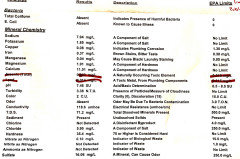
    Here is a report before the new well pump and polyethylene pipe as described above.

    I think it look pretty good, but I don’t know how to interpret some of the findings.


    Are those turbidity and total dissolved solids levels good or okay? We have no problems with minerals or hard water.

    And is the pH okay?

    There is some elevated arsenic, but can we just leave it? No children reside here.

    Will the bit of taste from the poly piping go away, and when? or should we get a filter?

    The report did not specify how much and what sort of sediment. I wish they had.

    The lab is apparently not EPA certified. It’s the one the well pump company uses and DH did not run it by me that he was going to spend lots of money on a comprehenive test *for things like solvents — we live in quasi boondocks. Nothing detected for that solvent, chemical part of the water test.

    I hope some of you can give me some feedback. Thanks.

  • 4 years ago
    last modified: 4 years ago

    Thanks, Jake.

    For some reason the lab marked through them with ped marker. (huh?). When I expand the report, I can make out the values.


    Arsenic = 0.063 (the report says EPA Limit is 0.010 mg/L

    Lead = 0.014 (the reports list EPA Limit as 0.015 mg/L)


    The house was built around 1984. Last year we replaced the 2nd floor bath sink.

    When I get drinking or cooking water, I let the water run for a few minutes. That might help with the lead, but not the arsenic. Just two seniors living here.

    So, there are different types of arenic?

    A neighbor 4 houses up (odd one, so we no longer interact) got an under kitchen sink reverse osmosis filter just for drinking water because, back then, she had a young one.

    In reading just a little about RO filters, it looks like, yes, low volume, but (something like) for every gallon of filtered water, you waste something like 2 gallons of water. That would go into our septic tank. We have an abundance of water from the well.

    We’ve lived here for about 35 years, so I guess we’ve consumed a bit of lead and arsenic.

  • 4 years ago
    last modified: 4 years ago

    "We’ve lived here for about 35 years, so I guess we’ve consumed a bit of lead and arsenic."

    Yeah, that's the thing about wells... most people don't test them regularly.

    The cheap, easy and least wasteful potential fix is the KDF55/carbon filter under the sink. If it works, (test again) you are good to go. I have one of these in my basement and it's plumbed to the kitchen cold water and the ice maker. I can filter 3 gallons per minute and the water tastes great. I replace the filter every 2 years.

    If it doesn't work, reverse osmosis is an option - or bring in the someone who knows about arsenic mitigation.

    I'm not an alarmist - but I'm not sure you are giving enough weight to arsenic and lead mitigation.

    petalique thanked Jake The Wonderdog
  • 4 years ago

    I appreciate your feedback, Jake. There isn’t much room under the sink. An senior bachelor house carpenter designed and built the house. Well built, pretty, but he knew zip about kitchens, cooking, etc... For example, the fridge alcove is small, so good thing no family of four lives here.

    The kitchen floor is part continuous wide pine, and I don’t want any leaks (although that could happen with DW). Cramped quarters under sink.


    The well pump folks suggested we could just get a whole house carbon filter, and we’d likely have to change the filter cartridge every 6 mos to a year. That seems simple, and, I know, there is no need to filter anything but cooking and drinking water — not shower, outside hoses and so on.


    Maybe my DH can figure out how to hookup a kitchen sink or kitchen, down bathroom and upstairs bathroom cold water a carbon filter in the cellar. Or just the Kitchen sink, but put the filter system in the cellar, close to sink? We’ve got tools and solder, but I guess we want to go with NO solder because of lead? And avoid copper?


    He won’t hook up the ice maker in our fridge because he doesn’t trust the plastic not to leak onto the wood floor. I told him that Ask This Old House showed how to hook it up with metal pipe and fittings. He still isn’t interested in doing it. I’m not sure he’s ever done plumbing fixures, but he replaced the upstairs faucet set (only when the pipes burst —it was a junky set). There’s always YouTube.


    Do you just have a carbon cold water filter under your sink? Does it eat up a lot of space?


    When I look at some of the filter systems, they look like they have three cartridge housings and sometimes a tank of some sort.


    We would like to address the arsenic as it appears to be high-ish.


    I don’t want to consume lead (I drink a lot of water), but at mid 70’s maybe it’s too late 🥵

    I swear I grew up gnawing on Pb paint window sills in the 50’s. Not gnawing, but I think I put the indoor painted sill in my mouth while looking out the window or relaxing. Then, there was Pb fuel and cigarette smoke.


    I’m getting tired of drinking water from gallon P spring plastic jugs, so I hope I can get at least a carbon filter system in place soon. DH already has a long Honey Do list and I have to keep jump starting the poor guy. Maybe I can figure out plumbing, except not very strong and arthritic arms. We do have one of those pipe cutter for 3/4” or 1” cupper pipe. If I turn the valve, shut the H2O pipe, them cannot complete the task, someone else will have to step in ;-( That’s too passive aggressive, though.


    Maybe we can learn on Ytube. So we should use brass pipes? And instead od soldering, there are other types of connectors?


    Thanks, again, Jake. I do not perceive you as an alarmist.

  • 4 years ago

    That carbon filter you suggested must have to go into a system, right? It isn’t a straight in-line filter, is it? An the exterior/housing is blue and opaque, so how could I tell when it needs replacing? Clearly, I am lacking some info for a complete picture.

  • 4 years ago
    last modified: 4 years ago

    So, your arsenic is not "high-ish" as you suggested. It's more than 6 times the EPA limit.

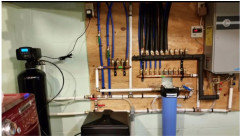
    The filter that I suggest you try is a cartridge that goes in a standard cartridge holder (such as this Pentek Big Blue).

    This setup would give you 3 gallons per minute service rate- which is slightly more than a standard kitchen faucet (2.5 gpm). So it doesn't slow down your cold water like a smaller filter would.

    You would replace it every 2 years. The carbon is good for 95,000 gal of water - but I'd still replace it every 2 years. Besides carbon It alsocontains KDF55 which is what would have the potential to reduce your arsenic and lead.

    I installed mine in my basement and ran the line to my regular kitchen faucet in PEX pipe. I would suggest that you use PEX to connect your filtered water to your sink also.

    Below is a photo of my setup. This all looks more complicated than what you would have because it's all of my plumbing in one spot. The blue thing at the bottom of the photo is the filter.

    Note that you would need the mounting bracket and two ball valves also so you can close off the water when you replace the filter.

    Again, test your water again after installing and see if it's really doing what you need it to do.

    Also, I would replace your kitchen and bathroom faucets. Until recently, brass (faucets) contained lead.


    petalique thanked Jake The Wonderdog
  • 4 years ago

    Thanks again, Jake. So > 6 time EPA limit isn’t ”highish?” then it’s ’high?’


    Thanks for sharing the photo of your filtering set-up and offering suggestions. ????I think at a minimum we should to that KDF55 sort of filter. i will also find out more about arsenic and mitigation.


    I just remembered — about 4 to 5 years ago we replaced the kitchen faucel. i will try to look at what make and model.


    Is the blue tubing the PEX?

  • 4 years ago

    if you replaced the kitchen faucet 4-5 years ago it meets the current standard for lead.


    The blue and the white (and the red) tubing is PEX. It's a very standard type of plumbing that is easy to install.

    petalique thanked Jake The Wonderdog