Software
Houzz Logo Print
kmyagel

Under Cabinet Range Hood Design Problem

4 years ago
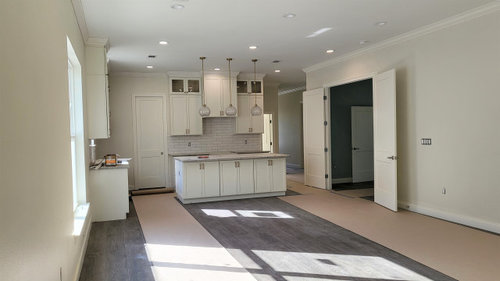
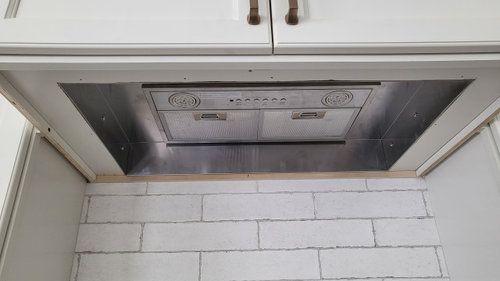
I am building a house and the range hood has been installed into a 42" high x 24" deep cabinet. The issue is that the because of the height of the cabinet and the way that the range hood is inset into the cabinet with the controls in the middle, the controls are out of reach by about 8-10".


The cabinet is currently installed 38" above the range. The range hood is then inset another 4" into the bottom of the cabinet. The builder has recommended the following solutions to try to address the issue:


Solution 1 - Switch out the one 42"x24" cabinet with two cabinets (one 18x24" Cabinet and one 36x24" cabinet). Distance between cabinet and top of range would be reduced to 26". The problem with this solution, is that I have the Samsung 6.0 cu. ft. Flex Duo™ Front Control Slide-in Gas Range Model #NX60T8751SS/AA which requires that any wood cabinet be at minimum 30" above the range.


Solution 2 - Switch out the range hood to a different model which has a remote. This is the model that the builder is recommending. https://www.geappliances.com/appliance/20-Custom-Hood-Insert-w-Dimmable-LED-Lighting-UVC7300SLSS. My concern with this solution is that I would only be able to operate the vent hood using the remote and the distance between the range hood and the range is 42" which I'm thinking would not be close enough to be effective.


Solution 3 - Find a vent hood that would fit under the cabinet that is 24" deep and 36" wide with the controls at the front so that I could reach them. The vent is ducted but has no "make up air" so I have to stay under 400CFM according to building codes. New building codes require what is called “make-up air” to be installed when a kitchen ventilation hood exceeds 400 CFM (cubic feet of air per minute). I probably should have opted for "make up air" and a vent hood over 400CFM but it's too late to change that now.


I'm looking for a under-cabinet vent hood that is 24" deep by 36" wide that is under 400CFM. Does anyone know of a vent hood that would work?


Comments (6)

  • 4 years ago
    last modified: 4 years ago

    You e got a bigger problem. No wood should be visible in that pic. It should all be stainless. Your liner is not big enough. Who is designing and specifying this? Because if your range is powerful enough even consumer grade, youre going to need that more powerful hood, and the MUA that goes with it.

    ky17 KY thanked User
  • 4 years ago

    It looks like replacing cabinets would be a last resort. Vent-A-Hood has a 9" tall hood that can be ordered with a 300 CFM blower. The hood is only 21" deep front to back so if you need it 24" you could pull the hood out to the depth you need and have a metal filler made to fill the space between the hood and the back wall. The hood is the CWEH9-142 here is the link to their web site. https://ventahood.com/index.php/support/specifications?id=361&view=article&model=CWEH9-142

    ky17 KY thanked regbob
  • 4 years ago

    Why not cabinets 18” and 30” or 12” and 36” to get you to 32” above the range? Can you reach the controls at that height?

    ky17 KY thanked Kim T.
  • 4 years ago

    No air leaves the kitchen that isn't replaced by some form of MUA, whether deliberate or house leakage. While code may draw a threshold at 400 CFM (rated), the actual CFM achieved without deliberate MUA is likely to be down in the 200 CFM region.

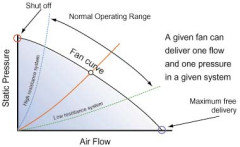
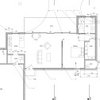
    For capture of cooking plumes driven by hot oil cooking (stir frying and searing), with plume velocities potentially over a meter per second, the specific flow rate should be upwards of 90 CFM per sq. ft. of hood entry aperture (the entire area) for common residential hoods. And this is actual CFM, provided by a blower that has been selected after accounting for pressure losses in the cooktop to outdoors back to cooktop loop. These include baffle, duct, and MUA pressure losses vs. the blower's "fan curve." See sketch.


    If you don't have any other combustion appliances, or have them but they have their own MUA and are thus not affected by kitchen air pressure, you may be able to size "passive" MUA (no blower) vs. candidate hood system blowers such that you can achieve the desired flow rate calculated from multiplying the hood entry aperture by 90 CFM/sq. ft. At a minimum passive MUA will have a filter pressure loss, a possible heater filter loss, some (maybe small) duct and diffuser pressure loss.

    With affected combustion appliances and without means to provide them MUA, then MUA for the hood system will require balanced pressure in the house and this will require that the MUA system have a blower.

    In general, determine requirements first and choose components second.

    ky17 KY thanked kaseki
  • 4 years ago

    Thanks for everyone's input. The builder is going to give me a quote for installing the MUA system and changing the vent to one that meets the requirements of my gas range. I think it's probably what needs to be done to resolve the issue.