Software
Houzz Logo Print
melissaaipapa

(OT) The Horror (construction)

We're having foundation work done on our house. It was necessary: the house is three stories of thick-walled masonry, and it was slumping because of an inadequate foundation, not to mention that it sits too close to a steep, deep drop. We finally decided to get the work done, found the money, and are currently living with the devastation. I can handle the loss of two thirds of the wisteria: the trunk is still there and it will grow back, though probably not in time to protect us from the summer sun. I can take the replacement of half of our brick terrace with a concrete pad. What is currently upsetting me is the leaky flood of thin concrete from yesterday, a result, apparently, of problems with the machinery that caused the concrete to spread over part of the brick terrace that remains, and down into the beds. My hardy cyclamen? My scillas? My hellebores?

What gets me about this is the unquestioned assumption, apparently by everybody concerned except me, that plants don't matter. It captures in a nutshell the attitude of much of the world that, where plants meet concrete, the plants must cede. They're not worth taking trouble over. Not worth protecting. Not worth saving. Not worth understanding. Even DH doesn't get it.

I was in Piacenza yesterday running frustrating errands in the heat and returned mid-afternoon hot, thirsty, hungry, and dead tired. I never even looked out the front door where all this is happening, so I didn't know about it until casual remarks by DH brought me out to the terrace. It's hot now, sticky, droughty, dusty as h*ll with the construction work, and never did we need plants more. I don't know what it will take to bring a majority of mankind to recognize that we need plants if we want to live.

All right, that's the end of my complaint.

Comments (15)

  • 4 years ago

    I'm so sorry! Thankfully, many plants are determined to survive and will often resurrect despite what horrors are committed on them. I hope they all happily surprise you and the newly straightened house with the beautiful new patio will be spectacular in all the joyous new growth!

  • 4 years ago

    Not for a while, Kim, but thanks. It all looks quite grim now, with the road denuded of its thriving cover of grass, most of the wisteria gone, the brick terrace torn up, dirt, cobbles, cement, dust, construction debris everywhere. It's dry, and there's no rain in the two week forecast. No point in cleaning up the house. A mountain of wisteria branches on the second terrace which I'm slowly carrying down to the garden and distributing. Also our first floor bathroom is completely gutted in preparation for being rebuilt, and we've taken out the "Tempietto", the wooden pentagonal pergola in the yard, prior to put up a new modular structure in rebar, which I designed and which I hope to goodness works. The sky is almost white with haze and pollution. Oh, yuck, all of it.

    However, as you optimistically point out, we can look forward reasonably confidently to an overall improvement in the situation. In time. In time.

  • 4 years ago

    OMG,Melissa,I am SO sorry!!! Bad enough to have to go through all the upset and mess and stress of construction work,but with this totally disgusting weather on top of it all...What the frack can I say? except concord with Kim about the resiliance of plants.Once, a guy ran over an Ornement des Bosquets rose of my with a back-hoe. It DID indeed survive and eventually came back completely.

    One hopeful thing: I think that at least the scillas and cyclamen are probably going dorment or close to that (about hellebores I can't say; I only have the wild ones out at my place),so after the worst is over of the construction,if you can find the courage and strength in this heat,clearing off the debris might well be enough to save them;they are bulbous plants so damaged top-growth may not be fatal.

  • 4 years ago

    Some problems you have to shrug off when there is little to nothing you can do about them. Many plantings will rebound and survive, much to our surprise.

  • 4 years ago

    I really feel for you too, Melissa. Those poor damaging workers do not enjoy the love of plants like we all do. I tried to put surveyor tape on choice plants before tree removers came and have generally used Jackie's approach to protect the plants.

    I agree with all that the roses and plants will come back, but it will take a year or more for things to look back to normal. So sad.

  • 4 years ago

    I am so sorry. My husband cut down my mock oranges while I was at work. He said they were dead. I told him, you idiot, it was winter and they were dormant. they never came back. I finally put metal green edging around all the beds (which I hate) and told him to stay out of them. He still does not always respect my flowers.

  • 4 years ago

    Melissa,

    Can you create a nozzle for a hose that can gently inject water under the concrete skim on the soil?

    Several years ago I watched a show on TV about the desert north of the Himalayas. It seldom rains there. People grow food there in a (to me) desperately strange way.

    They plant a plant in soil, and then move rounded pebbles all over the surface so any moisture down there will NOT evaporate. To get water into the soil they set up a network of very thin cord (maybe fishing line) and all the lines catch overnight dew which runs down the cord into the soil, under the stones.

    They are still alive, in a desert so it must work.

    I doubt it was inspired by the mist forests near the Pacific (where it never rains but almost mists every night and the big leaves (think Monstera shapes) collect water overnight and drip it to the soil. But moisture under a layer of anything is better than nothing.

  • 4 years ago
    last modified: 4 years ago

    Ugh. I am sending my empathy. The respect for plants—this world has so much to learn! Nurturing plants and refraining from indiscriminately damaging or removing plants is literally essential to our social-emotional and physical survival. Their value is priceless: the human toil and hours of life spent tending and raising them, the history embodied in the plants, the sheer beauty of them, their healing properties, the biodiversity they create, the insects and animals they host and the carbon sink they provide and the methane they don’t release unless broken down. In the face of global warming, the reckoning which is ensnaring all of us, the most vulnerable more than others, the need for the appreciation for plants is at a criticall point. Centuries of negligence and planetary abuse must stop now. In every biome. In every human cultivated space.

    With that said and clearly, Kim, Bart and Sheila are 100% right. Plants are surprisingly resilient. The roots want to regrow. The bulbs want to sprout. They are evolutionary miracles and very determined life forms. I am continuously amazed by their buoyancy in the face of seeming annihilation. Dr. Huey is a great testament to roots with a will to live and thrive seemingly beyond all possibilitiy! I know that the last thing you need is a microcosm of human insensitivity and wanton destruction right outside your door and smack in the middle of your hard won garden and greenspace, but I can hear between the lines of your shock and mourning the practical gardener-steward recovering, picking up the threads and gathering energy to assess and weave the cloth again—with changes and with acceptance of what cannot be changed.

    Please update us as you grieve and recover and move on in your grounded, undaunted Melissa way. We are nothing on this forum if not green and plant conscious. Although your wonderful DH initially missed the importance, he is likely grasping the extent of the physical damage now as well seeing the connections to a larger philosophical and practical human illness. I am sending you both understanding and shared courage. Take some deep breaths, make a cup of the brew that meets your mood and let us know your thoughts, hopes and conclusions as you survey the scene and search for signs of life and possibilities in the aftermath. This too shall pass. Carol

    PS @stillanntn6b We posted near simultaneously. What interesting and useful facts you know about horticulture! You are always here on the forum when there is a need, generously jumping in and offering advice that is both practical and educational.

  • 4 years ago
    last modified: 4 years ago

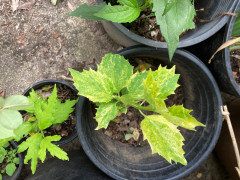
    @Sherry8aNorthAL I just wanted to share this little mock orange miracle. Last fall, I accidentally cut down a young, nurtured from a band, 4-foot-tall mock orange buried deep in a bed. After I whacked it with loppers, it was nothing but a 4 inch stump. But ever the hopeful gardener, I kept it moist, potted it up in late November and left it in my rain saturated driveway nursery. It continued to appear to be nothing but a dead stump all winter and way into spring. But I just glanced into the pot a few days ago, and this is what I saw—a fresh set of variegated Philadelphus ‘Innocence’ leaves!

    I applaud your edging and your clear communication! For gardeners, plant and soil boundaries are as important as interpersonal boundaries. Carol


  • 4 years ago

    @Melissa Northern Italy zone 8

    I hope that you are surviving the ongoing construction and unwanted effects without screaming into the sunset and that the results are shaping up to be a solid structural success. Thinking if you and sending fortifying thoughts! Carol

  • 4 years ago

    Oh no, Melissa!

    That sounds awful (and like a severe hazard regarding your home!). I'm afraid I agree that no one values plants at all and it's very upsetting. I hope your lovelies did a way to survive and return. Plants are indomitable in the end. Best wishes and stay cool!

    Steven

  • 4 years ago

    I am so sorry Melissa! It has to be a guy and non plant person thing. I'm surprised your DH doesn't get it, I know he has helped you alot. I pray they come back great for you. I totally understand. I wish I could find the words, but I am not good with them. Thinking of you, and hoping for the best.


  • 4 years ago

    To Kim, bart, Jackie, Sheila, Sherry, Ann, Carol, Steve, Alana:

    Dear Forum Friends,

    Thank you all so much for the sympathy and help you've all offered since I first began this thread. I haven't been on the forum for a while as I had no good news about the construction/plants and not much at all to say about roses, which is of course what this forum is all about.

    My current update is that things are tentatively and slowly improving. The heavy work is mostly done, I think done fairly well; DH and I have been re-laying the terrace in front of the house, old bricks in sand. Let me say, though, that the builder threw out all our old bricks that had formed the part of the terrace they tore up, saying it wasn't worth the labor of gathering them; THEN sold us more old bricks informing us that they were expensive: one euro/brick, then rising to 1.40 euro/brick. If I had known that, I would have been out gathering the bricks before they got shoved down the hill with the rest of the construction debris!! Similar for garden soil: they shoved it down the hill, then, when I needed more soil to fill the beds by the terrace, said they'd bring some. Where is the reduce/reuse/recycle? Does no one but a select few gardeners understand what it takes to create soil, and how our lives depend on it? We've been working on ours for twenty years. I did manage to recuperate enough garden soil, a bucketful at a time, to fill the beds, along with compost from our heap (a few bricks, too). I think these attitudes about destroy/throw away/consume more are pretty common, and are ruining the earth.

    DH and I have been slowly laying the bricks in sand in the early morning when the sun is blocked by what's left of the wisteria. That's an enjoyable task. I've scraped together enough soil and compost to fill the bed in front of the terrace, a morale-builder as it means I'm fighting back against waste, and can now replant the cyclamen and (I think they are) scilla bulbs that were disturbed by the works.

    Order and respect for plants are returning to our home. Next up will be the pergola, for which we need to source the metal parts, and then the long task of training the wisteria, as well as 'Jaune Desprez'. I want to expand the area the latter occupies in the alley in our summer battle against the sun; and create a new section of alley pergola roof further back and try to train the wisteria past 'Jaune Desprez' and onto that. Wisteria seems to be an infinitely extendable plant.

    A few of the warm climate roses have a moderate summer re-bloom, not that it's much to look at with our current heat and drought, but the roses are so spirited and courageous. 'Crépuscule', 'Mme. Alfred Carrière', and 'Mme. Antoine Mari', which is covered in flowers in spite of having had part of its roots cut away during the digging. Rosa moschata is flowering now, fresh, cool, and fragrant. I'm hopeful we've passed nadir.

    P.S. What you all said I valued, but somehow Steve's saying how upsetting it is that people don't value plants particularly struck me, perhaps because this sad reality has been staring me in the face for the last couple of weeks. We forumers are lucky to have others here who do care about plants. I'm also lucky to have my siblings, particularly my older sister, a horticulturalist and lifelong gardener, who UNDERSTANDS (and will listen to endless plant talk).

  • 4 years ago

    So glad to hear that you were able to save some of your soil and use it again - I was not surprised that they thought the solution was to sell you more, and undoubtedly not as good, soil. It sounds as if it will be not long before that area you are working on is better than ever. Can't wait to see pictures!


    Re the bricks, we had a fire in our 1905 chimney over 20 years ago. The insurance paid for building a new brick chimney from scratch. We could not use the old bricks, because many of them had been damaged by the fire. The insurance company paid for all new ones from a local 100+ year old rock quarry with a brick kiln which made bricks in several different colors. However, I did notice something funny. As the workers were taking down the old chimney, I noticed a young man throwing the old bricks into a dumpster. Immediately, his boss yelled at him to go and retrieve those, and to put the rest into the back of one of their trucks: "don't know those are VALUABLE?", he said. Later I talked to him and he said they could not be used for chimneys, but would be great for paving, and he had customers with old houses who would love to pay for them. So, the market seems to be working to save and re-use some things, at least.


    Jackie