Software
Houzz Logo Print
webuser_66864937

A Conifer at Leu Gardens that surprised me

4 years ago
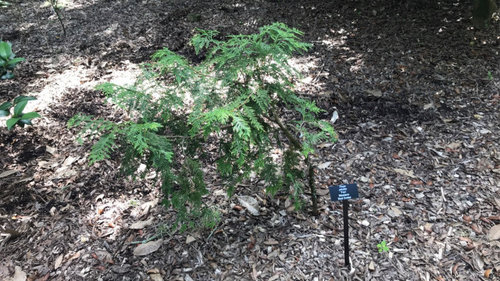
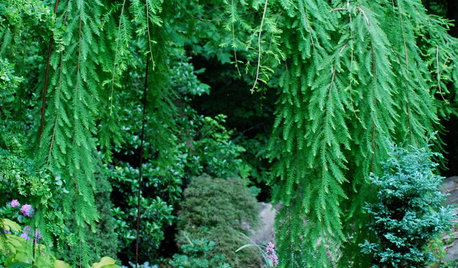
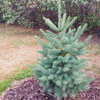
This fourth of July I went to Harry P Leu gardens in Orlando Florida, I’ll have a post later about all the intresting plants I saw there. Anyway here is the conifer I was very suprised to see a seemingly healthy Thuja plicata. Now with everything I have seen on this species it shouldn’t really be able to grow here in florida. Is anybody here familiar with the ’fan’ cuiltivar, is it more heat tolerant than the straight species? Is it a hybrid or prehaps misidentified? Anyhow its quite intresting.


Comments (35)

  • 4 years ago

    I also havent ruled out that it was planted recently and they are expermenting with it.

  • 4 years ago
    last modified: 4 years ago

    Well, it's also "not seemingly" (LOL) relatively young. It's definitely newly planted. The right combination of root rot organisms may not have "found" it yet to use as as substrate.

    Grows in Leu Gardens and looks 20 years old? Green light for planting in central Florida. Looks 2 years old? Yellow light. Generally speaking though, I'd skip ANY plant native to the western USA, because the climate is just so different. No doubt a few grow anyhow because there are exceptions to most rules. I wonder if x Chiranthofremontia lenzii would grow in Florida lol. I found one of the Fremontias surprisingly able to survive my climate, if planted in the dry soil under the eaves of my house. But the polar vortex winters were too much for it.

  • 4 years ago

    I thought it may have been a dwarf culitivar as im unfamilar with the species.

  • 4 years ago

    I based it not surviving at all on this old thread: https://www.houzz.com/discussions/1623697/western-red-cedar

  • 4 years ago
    last modified: 4 years ago

    It doesn't look very dwarf-like to me in a species that does not have a big selection of dwarf cultivars. And I can't imagine any dwarfs being better suited to a FL climate than the standard species would be.

    This is a tree that in its natural environment can grow massively large. Here in cultivated garden settings, 80-100 feet is not uncommon. In the wild, they can be double that height. It can certainly handle humidity - the largest specimens are rainforest dwellers - but not heat AND humidity! It is native to areas that rarely exceed 80F in summer and are seasonally quite dry.

    Palms And Pines thanked gardengal48 (PNW Z8/9)
  • 4 years ago

    ^^^ And this relates to the discussion how exactly??

  • 4 years ago
    last modified: 4 years ago

    I woundnt say firma is prevelant to be honest, they can be found certainly but cunnighamia (china-fir) is the go to ”northern” looking conifer in northern florida. The abies firma at leu may very well do ok I just dont think it looks that great. I think if they truly thrived you would find them everywhere. Another fir I think is worth a shot around here is abies guatemalensis, but its almost impossible to get seeds for it. I will probaly make a new disscussion for the firs later on.

  • 4 years ago

    But back to thuja, I wonder if thuja plicatas sister species thuja occidentalis would have a chance around here. If you look at daves garden you can see lots of people claiming to grow it in florida, but its clear they have mistaken it for playtcladus.

  • 4 years ago

    You might have better luck with Thuja standishii. Native to Japan and its monsoonal climate, it is also more accustomed to high summer humidity.

  • 4 years ago

    ^^^ I'd check your sources. As usual, they are not accurate.

  • 4 years ago

    "The climate of Japan is cold in the north (where snow and ice dominate in winter), temperate in the central regions, and almost tropical on the small southern islands. The rains are abundant almost everywhere, and between summer and autumn the country is hit by torrential rains and typhoons.
    The climate of Japan is influenced by the monsoon circulation: in winter it's affected by cold currents from the north-west, and
    in summer by wet and humid currents of tropical origin."

  • 4 years ago

    "Another feature you encountered throughout Japan is the "monsoonal" climate; that is, the annual cycle of wet and dry seasons. Specifically, Japan generally features wet summers and dry winters. The prominence of the monsoonal cycle varies by region, as you became intimately aware from your ever soaked hiking boots."

    "Honshu, Shikoku, and Kyūshū have an extra-tropical climate"

    "Tokyo, on the main Honshu island, has a humid subtropical climate characterised by warm and wet summers and mild winters."

    "Japan’s climate is generally a rainy country with high humidity. Central Japan, in its elevated position, has hot, humid summers and moderate to short winters with some areas having very heavy snow, and southwestern Japan has long, hot, humid summers and mild winters. The climate from June to September is marked by hot, wet weather brought by tropical airflows from the Pacific Ocean and Southeast Asia. These airflows are full of moisture and deposit substantial amounts of rain when they reach land. There is a marked rainy season, beginning in early June and continuing for about a month. It is followed by hot, sticky weather."

    "Most of Japan is in the Northern Temperate Zone of the earth and has a humid monsoon climate, with southeasterly winds blowing from the Pacific Ocean during the summer and northwesterly winds blowing from the Eurasian continent in the winter."


    No echoes. I can't think of anything you have stated on these forums during your very short tenure here that is worth repeating. I guess now in addition to all your other areas of "expertise" you are a qualified meteorologist as well........

  • 4 years ago

    I don't believe one can compare the growing conditions of almost any part of Florida with "...many areas up the east coast..." Take a look at growing degree days, as a starter. Then reference maximum soil temperatures and duration. Finally, consider winter dormancy period requirements. Plants that require a cold winter for their life cycle won't find it at the Magic Kingdom.


    I suspect that there would be millions of thriving Thuja plicata all over the north half of Florida, were it that well suited to grow there - simply because it is so easy to propagate.

  • 4 years ago

    Sorry for the disjointedness :-) It appears our hit and run deleting poster has struck again. Up to his usual trolling behavior - posts some wild inaccuracies to get things going then deletes all his posts! Makes for very choppy and often confused reading.

  • 4 years ago

    You should have no problem with thuja plicata in Central Florida, it has no Winter dormancy requirements and is one of our top performing conifers in Hawaii. Try finding the cultivar green giant which is a hybrid and has more disease resistance. I don’t know how heat tolerant it is but I saw big ones in Canton GA.

  • 4 years ago

    I did see a a photo somewhere of some green giants growing well in the fl panhandle so you may be on to something.

  • 4 years ago

    Quite close views of foliage sprays both top and bottom needed to tell if species assignment correct for the 'Fan' arborvitae shown on this thread. Otherwise some past confusion has been produced by the existence and commercial circulation of the unfortunately named Thuja occidentalis 'Plicata'. But I don't think the 'Fan' is a renaming of that one as it looks different in the picture taken at Leu.

  • 4 years ago

    I have three varieties of Thuja Occidentalis in Central Florida. I have 'Tater Tot', 'Anna's Magic Ball', and a green and silver variegated variety that I don't recall the name of. 'Anna's Magic Ball' and the variegated variety are thriving so far, but I have only had them since Spring. 'Tater Tot' has been rotting in the summer rains (and that is with special well-drained conditions created). I tried Abies Firma. Some plants will linger-on staying alive but looking like death warmed over. Abies Firma is such a plant. Thuja 'Green Giant' is sold everywhere here (but Alberta Spruce is also sold here). I doubt 'Green Giant' will grow south of North Florida. The big question is, "Why does the Florida nursery industry follow the planting schedule (with many of the same varieties of plants) as the Northeast?"


    Another question--"Why isn't there more research on plants that can grow in the Florida climate?" In the mean time, we must guess, plant, and hope?"


  • 4 years ago
    last modified: 4 years ago

    Tim Patz if you happen to be talking about an amended planting hole for the 'Tater Tot' that might actually be functioning as a collection point for water (a sump) rather than protecting it from prevailing wetness of the summer climate there.

    Problems with Planting Trees – The Garden Professors™

  • 4 years ago

    As far as why isnt there more research on what can grow here done, I have no idea, unfortunately for a state with so many potential planting opportunity’s there seems to be very little interest from the masses which is a shame.


    I find that in most planting guides there is a big bias towards a northern climate. This is definitely true of conifers, I always here “well who would want to grow those in florida anyway?” Well guess what we have 11 native conifers not including sub species which is pretty impressive when you remember just how flat our state is. I also here ”well aren’t conifers mostly native to a cold climate.” which isnt really true at all. Unfortunately there is a ignorant attitude from lots of people that say if a conifer doesnt have a conical shape like a spruce or fir its not worth growing , which I think is absolutely not true. With that being said I actually think we here in FL have the potential to grow the most conifer species on the east coast, and thats not even including species that could be zone pushed and grow to some extent (While hating the climate).(such as the thuja species mentioned in this thread)

  • 4 years ago

    With growing plants in Florida, I don't mean just conifers, I mean any plants.

    As far as amending conditions for 'Tater Tot', I mean amending the soil so it drains quickly and supports beneficial bacteria. As it is, I have sandy soil. Sump conditions are very rare (During hurricanes???).

  • 4 years ago

    I know but I said its especially true of them. Regardless it true either way, it most likley comes down to laziness, every identical house they put in has the same stuff planted usually a queen or date palm shoved in the ground. This isnt exclusive to florida, as many years ago when in the midwest every new house was planted with a freemans maple, nothing out right wrong with any of these but when every house has one it just stupid and nothing looks unique anymore.

  • 4 years ago

    Years ago I came across the UFL plant guide, unfortunately ive learned that it is one of the absolute worst guide out there. Going exclusively by grow zone: example coast redwood here with the range map you see here you would think there is going to be tall healthy redwoods in palm beach. https://edis.ifas.ufl.edu/publication/ST589


    To UFLs credit though they have update the pages somewhat as they used to say anything not native to FL was ”notnative to north america” which made no sense.

  • 2 years ago

    Thuja plicata is definitely tougher than people think. Lovett Pinetum has a location in East Texas that normally exceeds 94 degrees in the summer with lots of humidity! They say that their specimens do just fine, they just grow slightly slower.

  • 2 years ago

    I'd hardly consider the above a resounding recommendation for Thuja plicata anywhere in the southeast. According to their website and collections map, they have one tree - planted out in the open in a field - and it's struggling.

  • 2 years ago

    I have seen many people in the Carolinas planting these and then surviving just fine. In my area, it can get somewhat hot during the summer and they do just fine here in OH

  • 2 years ago

    It is not so much the heat that may be the limiting factor but a lack of a consistently moist root run. In their native range, these are rain forest trees or where there is a nearby water source.

    In their fact sheet on this plant, NCSU states this: "Western redcedar will suffer in hot, humid climates but may be able to grow in the North Carolina mountains. This species grows in full sun, partial shade, or dappled sunlight and prefers consistently moist, well-drained soil high in organic matter and an acidic to neutral pH. It does not tolerate drought or dry winds."

    And that last issue is even becoming a concern here in their native habitat. Increasing incidents of what's known as cedar dieback have been documented throughout Washington, Oregon and southern BC and officially attributed to climate change - a series of hotter and much drier summers.

    If it is struggling here - and it is - it hasn't got much hope in hotter and drier parts of the country. Any growing in OH should be regarded as very temporary visitors.


  • 2 years ago

    I’ve seen them live for a while just fine. It’s the drought that will kill them, not humidity and heat. Here, droughts are barely a problem as we get plentiful rainfall yearround

  • 2 years ago

    Tell me Henry, what sort of horticultural background do you have to support these pronouncements? How long have you been growing Thuja plicata in OH? Got any photos to share? What does "for a while" mean with a tree that has the potential for a lifespan of 1000 years?

    Ever heard of the concept of "right plant, right place"?

  • 2 years ago

    There are 80+ year old Thuja plicata at places such as Spring Grove Cemetery and elsewhere in Ohio. They do so well here that cultivas such as ’Spring Grove’ and I believe ’Steeplechase’ were selected here.

  • 2 years ago

    A quiv search of Holden Arboretum’s collection database shows several accesions going back to the 1950s. And I’m sure the only thing that would cause thwm harm there would be the occasional 4’ snowfalls from extreme Lake Effect events. The summers there are likely cooler and less extreme than say Portland. Definitely more rainfall and less days above 90 F.

  • 2 years ago

    Here's another source for Henry Green Splendor from Klyn Nursery. 'Atrovirens' was the old standby for many years. Now 'Spring Grove', 'Northern Spy', 'Whipcord' and a weeper called 'Holly Turner' are all available in easten US.

  • 2 years ago

    By the way the original purpose of this post was at the astonishment of it being tried at all, obviously I don't think its going to grow into a massive tree, but perhaps seeing how long it does survive in a radically different environment would be useful for accessing climate change. The thing is most even botanical gardens here don't typically really try things from radically different climates unless perhaps its from a tropical climate. As far as it surviving in ohio I'm not surprised at all actually, lots of PNW conifers do rather ok in that area of the country, obviously not optimal but well enough to produce mature specimens.

  • 2 years ago
    last modified: 2 years ago

    Most, especially one, of my Green Giant Arbs are aspiring to be Thuja plicatas w/big trunks and tall heights.