Software
Houzz Logo Print
susan9santabarbara

Odd situation with a rose cutting

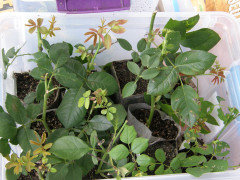
I've successfully rooted many scores of cuttings over the past 20+ years, but I have a situation that I've never encountered. I made a handful of cuttings about a month ago, plunked them into a cup of water, meaning to strike them in the next day or two. Life intervened. The leaves fell off a week or two ago, but I left them in the cup b/c they still looked good. Turns out, one has callused quite nicely... picture in the next post. So now I'm wondering about how to proceed. Options: leave it in the water longer; place it in my usual rooting mix of half potting soil/half perlite; do the same but dip it in rooting hormone first. I have Hormex #3, #8, and #16. Leaving it in the water seems dangerous, but suddenly putting it into rooting medium seems like it might shock it too much.

Comments (22)

  • 4 years ago

    That looks awesome!

    Can you split the baby and put it in soupy wet medium letting it slowly evaporate?

    Carla in Sac

    susan9santabarbara thanked sautesmom Sacramento
  • 4 years ago

    Thanks much Carla. That was actually one of the options I had considered... but I wasn't sure if it was crazy. Maybe in a band pot with a saucer at first as the water evaporates? Would you even bother with the rooting hormone? I've always figured that the hormone was primarily to get them to callus, which has already been achieved :-D

  • 4 years ago

    I would definitely dip rooting hormone-- I've had calluses just never go anywhere before.

    And the gradually drying up water is how I get tomato cuttings to root!

    Carla

    susan9santabarbara thanked sautesmom Sacramento
  • 4 years ago
    last modified: 4 years ago

    If you return it to water and then wait until you see a root form, even just one, and when that root is 1 inch long, pot up in a slurry of an otherwise good potting mix and let it dry down to normal moist potting mix before watering.

    Keep it in bright shade, no direct sunlight until leaves form. When leaves start forming, then 1/4 strength liquid feed it once a week. Then graduate into full sun in increasing increments.

    That's what I would do. Of course, I've had my share of cutting fails as well as successes.

    Moses

    susan9santabarbara thanked Moses, Pitt PA, cold W & warm/humid S z6
  • 4 years ago

    I would pot it up. Don't bother with rooting hormone. What you've done, I've been doing all year. Soak cuttings in water until they callous and then pot them up. Has worked really well for me. It will start growing roots into the dirt pretty soon. Probably roots will be there in 2 weeks or less. You can soak them longer until roots form if you want to try that, but I don't think you'll gain anything doing that.

    susan9santabarbara thanked charles kidder
  • 4 years ago

    I've never rooted them in water, but root them in sand. From what I hear, roots formed in water are extra fragile. I'm guessing that the stage it's in now with the callous is an ideal time to pot up as there are no fragile roots that could be damaged. I pot up calloused cuttings out of sand fairly often and label them, " NR", meaning " no root". Quite often they do form roots and make a plant.


    What kind of potting soil are you all using for your newly rooted cuttings? I use Miracle Grow Moisture Control potting soil with the food in it. Most of my cuttings do fine in that though I lose some. I have heard that you CAN NOT use potting soil with the food in it but it mostly works for me. Just curious what others use.

    susan9santabarbara thanked erasmus_gw
  • 4 years ago

    This is what I've done this with great success. I put the cuttings in water for about a month. Changing the water about 2x a week. Once a lot of callus has formed, I pot them up, Doesn't really matter what I pot them in. Just make sure the soil drains well. I think the reason this has worked for me is I don't have to cover the leaves. As long as the cutting is in water, the stem survives fine. Along with the leaves. When I put directly in dirt, I have to cover the leaves with plastic to keep from drying out and many of the leaves will end up getting black spot or some other fungus and fall off. Rooting works much better with leaves than without. When I plant after callus has formed, I frequently don't cover them at all. They seem to do better with a callus than without and after soaking in water, they're so hydrated, then can take a little dry hot weather. Not only that, I can put the cuttings in a little direct sun when in water. Doesn't seem to hurt them and likely helps.


    A misting system, might work better with direct dirt sowing, but I don't have one and am not going to invest in one. This is a hobby. Not a career.

    susan9santabarbara thanked charles kidder
  • 4 years ago

    Thanks for the replies! I'm chuckling over the varieties of answers :-D

    Kidhorn: That's really interesting that you use this method commonly to root roses. I noticed today that another one of the 4 has developed callus... and interestingly, not one with a heel, which is my preferred type of cutting. I think I'm gonna try this water method with a few more of my extremely hard-to-root rare roses. LOL, "this is a hobby, not a career"

    Erasmus: When I root roses, I use half Edna's Best potting soil (my regular brand) and half perlite. I'm not a fan of the MG soil with the moisture granules. And yes, I've always heard that zero fertilizer is better with cuttings. Ballpark, what would you say your % of success in getting your callused NR cuttings to take?

    Moses: So you think it's better to wait until an actual root forms before trying the slurry method?

    Carla: I've rooted tomatoes and other things like fucshias in pure water and had no trouble potting them up with their fine roots, so maybe the concern about the fate of the fine roots is not so much of a concern?

    Thanks again ever so much for your helpful comments!

  • 4 years ago

    I will try rooting in water for some hard to root ones. Gertrude Jekyll is always hard to root for me. Many mosses are hard to root. Here are some of my plants rooted in sand and potted up into Miracle Grow Moisture Control potting soil with the food in it:


    susan9santabarbara thanked erasmus_gw
  • 4 years ago
    last modified: 4 years ago

    Gertrude Jekyll absolutely HATES excess water, same with its parent, Comte de Chambord. I got 8 cuttings of Gertrude Jekyll this year and rooted in a Grow-bag (inside plastic bin) for 2 months. One rooting sprouted new leaves, and I was dumb to put some water below since the weather is so hot at 97 F, it instantly dropped its leaves and stem turned black.

    Another Getrude rooting stays green for 2 months, but one leaf got blackspot. That's the only rooting that has blackspot among the 20+ varieties that I'm rooting.

    The only time I succeeded in rooting its parent Comte was INDOOR through the winter with very dry air, plus soil high in calcium for its many prickles. Below are successful rootings after 2 months, that's when ALL original leaves stay green and none turn yellow. The minute any leaves on a rooting turn yellow, it's a goner.


    susan9santabarbara thanked strawchicago z5
  • 4 years ago
    last modified: 4 years ago

    I am interested in learning about rooting and callusing. Is callusing a good sign, a must stage to rooting? I remember reading someone mention that they have cuttings with a lot of callus but ended up not growing roots.

    I tried air-layering a couple costco roses and found it really easy to get them to callus. After a couple weeks all of them got callus. In additional 2-3 weeks about half would grow roots. For the ones that did not grow roots I still cut them and potted up. I am wondering whether I will have a better chance this way than rooting a cutting directly in the pot, which is almost a 100% failure for me anyways

    susan9santabarbara thanked forever_a_newbie_VA8
  • 4 years ago

    Erasmus, me too on being intrigued by this weird rooting in water scenario, and I am going to try some more of my rarities that I've had trouble rooting. I do find it interesting that the place these cuttings in water are sitting is on a table on my patio that gets a couple of hours of very dappled sun in the afternoon (they're in a red cup inside of another container for stability). I do remember that pic from when you posted it awhile ago. And BTW, I meant to mention yesterday that I have great respect for whatever your method is, considering what you do :-D

    Straw, I generally agree that when you lose the leaves, the cutting is a goner and the stem turns black, but that's what's so weird about these cuttings in water... not the case. I usually root my roses outside in the shade, but my all-time most successful rate was in December maybe 15-18 years ago. I did dozens and I put each in a band inside of 2.5 gallon ziploc bags on counter of my laundry room in front of a west-facing window. Re-blow up the bag every day or two. Being December, the sun was too low in the sky to really shine in, but the light was bright. I got >90% success rate :-D

    Forever, I haven't tried air-layering yet, but it's been on my "try" list for a few years for my really hard-to-root rarities. Sounds like you've had good success with it. Although my understanding of air-layering is doing it on a plant in the ground. Callusing is a must before they actually root. I tend to leave mine in their pots and don't check for callus, because I think that disrupts them too much, and a couple of my trading partners agree. But based on some comments, YMMV! I think you should start a new thread on making cuttings... your questions are great. There are tons of great resources out there too!


  • 4 years ago

    The leaves of one of the cut flowers from my garden roses still looked fresh after the petals dropped, so I left it in the water to see what would happen. After a few more weeks a callous began to form. two months later, the callous was a tiny bit bigger but no roots. I tried adding a tiny bit of hydroponic fertilizer and there was no change after a few more weeks. My cuttings usually root within 6 weeks and it was more than twice this length of time. Curious, I put it in my usual rooting medium of perlite. It immediately put out roots and began to grow new leaves. My conclusion from this was that rooting is much faster in a medium than in pure water. My guess is that it is the lack of light to the calloused areas that stimulates root growing.

    susan9santabarbara thanked noseometer...(7A, SZ10, Albuquerque)
  • 4 years ago

    Interesting thought, about the lack of light helping them root. I would really like to hear from people in academia or the professional rose business about factors that influence rooting. I have some that are consistently hard to root and it seems others do too. I'd really like to know why that happens. I know some people have a certain experience with a plant and they conclude that their experience is universal but I think before something is claimed as universal it needs a test involving significant numbers of tests.


    Sometimes a particular rose will be hard to root one year and easy the next. Or that can even happen within the same year. Sometimes an entire batch of cuttings will all fail and then a second batch of cuttings will mostly make it. I have no idea why. It could be temperature, too much rain, or the state of hydration of the parent plant, for example. I just know to try again.


    One professional rose grower I know uses Bonide Root and Grow on unrooted cuttings.

    I have not bought any yet but might. I have long suspected that the powdered rooting hormone I use washes off and a hormone solution could help in cuttings that are balking.

    I heard from him that the Antique Rose Emporium uses a manure tea to spray cuttings. Could be that a dose of food keeps up their vigor.


    I also heard from a former owner of a rose nursery that they never used rooting hormone.

    susan9santabarbara thanked erasmus_gw
  • 4 years ago

    The " burrito method" is also intrigueing. I have tried it , only once , I admit. The cuttings calloused very nicely but rotted. No idea why. Callousing alone was not enough for it to go on to make a plant. I don't know why a cutting in water would not also rot. I do plan to put some in water and see what happens.

    susan9santabarbara thanked erasmus_gw
  • 4 years ago
    last modified: 4 years ago

    Susan: Agree with what you wrote: "I do find it interesting that the place these cuttings in water are sitting is on a table on my patio that gets a couple of hours of very dappled sun in the afternoon."

    Years ago a friend in CA sent me a stem of Oklahoma rose to sniff. I put that spent bloom in a white solid vase of alkaline tap water (pH 9), then I left that outside. It rained lots (pH of rain here is 4.5) .. after 1 month, long whitish roots grew from Oklahoma in that vase in partial shade (few hrs. of weak sun nested in a narrow crack between a patio box and the house).

    Fast forward to this year, I bought Oklahoma (grafted on Dr.Huey) cheap for $5 from Menards. It's a water-hog, needs constant water and partial shade.

    Below is the white vase (with handle) that I put Oklahoma bloom in, Goodwill store sells a bunch of these beer mug for 50 cents, they are light weight & nice for cut-blooms.


    susan9santabarbara thanked strawchicago z5
  • 4 years ago

    It is true that roots dont like light. I wrap my glasses with tinfoil when trying to root in water.

    susan9santabarbara thanked Vaporvac Z6-OhioRiverValley
  • 4 years ago

    Noseometer, what a great story! I've read for decades about folks who "accidentally" rooted cut roses in water, but could never pull it off, and I've tried. This is why this situation surprises me so much. Given that you put it in perlite, did you keep it extra wet, or just damp?

    Erasmus, I have the same experience with some being really tough to root. One of my rarest, and most beloved, roses is Westminster Pink, which I have made 25-30 cuttings of in the past 2 years, with only one success. It's an extremely healthy and vigorous plant. I finally sent budwood to Steve at Wisc Roses summer 2021 and he sent me 4 plants in November 2021. This rose I'm writing about is Pink Intuition, which is equally healthy and vigorous. I always figured it would be easy to root, but when I started trying last fall for a trading partner, I've had 3 fails. The interesting thing is that both of these roses were originally budded onto multiflora, are extremely vigorous and keep leaves well, and I've had them both for ~20 years. Gonna try Westminster Pink next with the water thing, since their vigor is similar. I read a great article about the burrito method by Kim Rupert a year or so ago, but I decided it might be more than I was willing to do. And yes on the variation in results that surprise you from try to try... I finally got a Sun Goddess to root a couple of months ago, after many tries.

    Straw, wow on your OK cutting from CA that rooted! I used to bring rose cuttings home from rose road trips to No. Calif in the 2000s, and I kept them in plastic bags in a cooler. So I know they can survive the trip via mail or car for a couple of days.

    Vapor, I know they don't like light, but I kind of wonder about how much light my stems are getting in those conditions... maybe more than optimal? Maybe it was slightly more than we think is optimal? No clue.

    I'm gonna try to strike these tomorrow. I noticed today that the callus is getting bigger on both.


  • 4 years ago
    last modified: 4 years ago

    Susan, I kept the perlite extra wet in my usual way of putting the pot into a cache pot and putting water up to the bottom.

    I’ve tried the burrito method several times and although I got the cuttings to callous, they never formed roots and died.

    susan9santabarbara thanked noseometer...(7A, SZ10, Albuquerque)
  • 4 years ago

    Yeah, Susan, it is really weird how an extra healthy, vigorous plant can be hard to root. It makes no sense.

    susan9santabarbara thanked erasmus_gw
  • 4 years ago

    About blocking rhe light to the roots, we also put a black cloth or alumnium wrap around the air-layered pod. So it makes sense to also cover the glass when rooting in water

    susan9santabarbara thanked forever_a_newbie_VA8