Software
Houzz Logo Print
irida_medina

Fiddle leaf fig leaves are browning

3 years ago
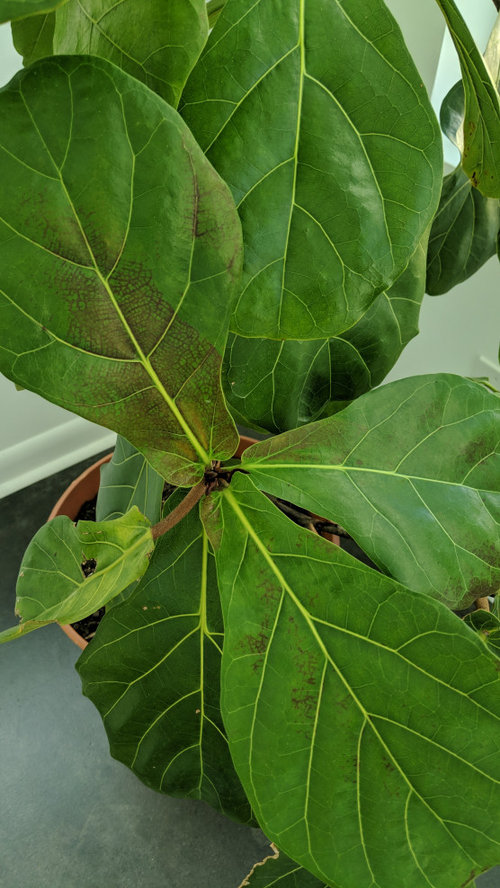
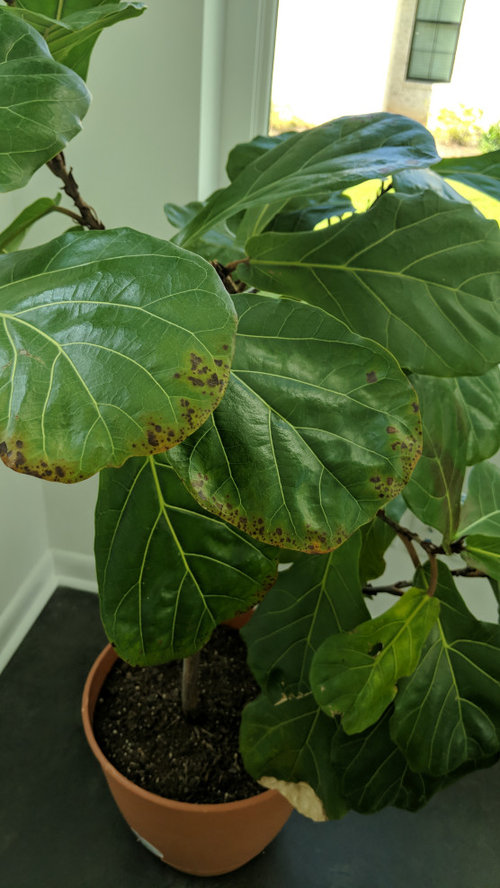
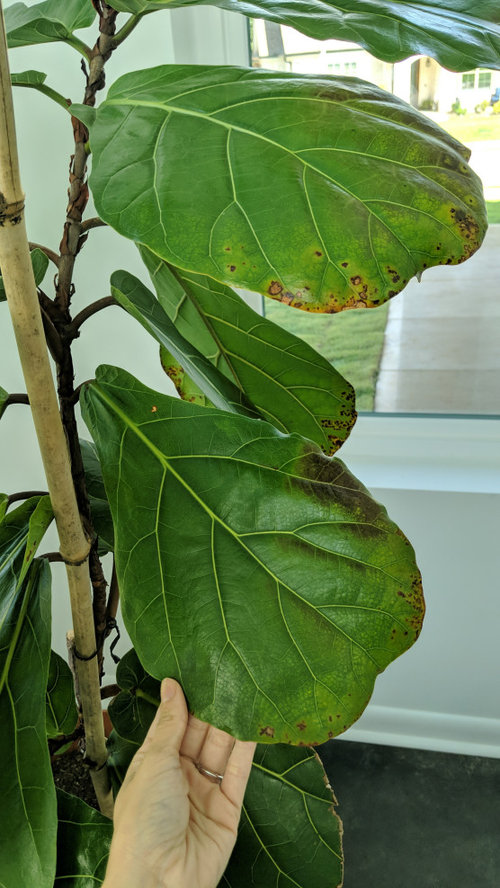
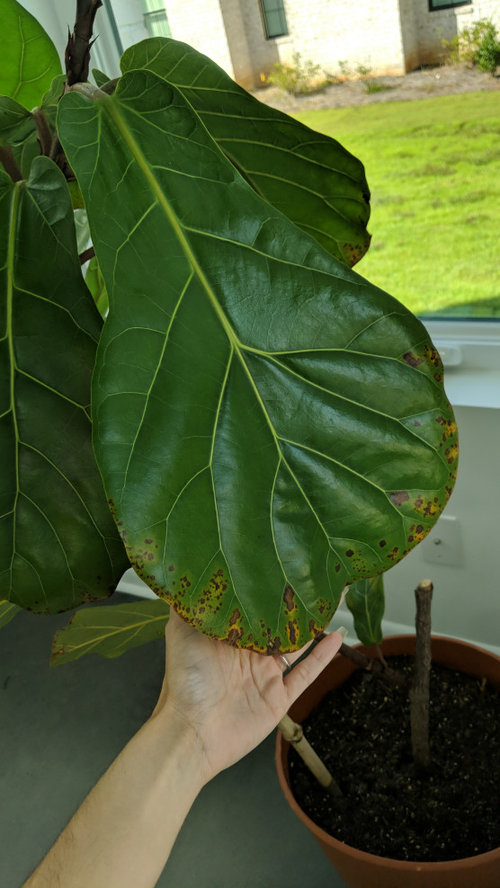
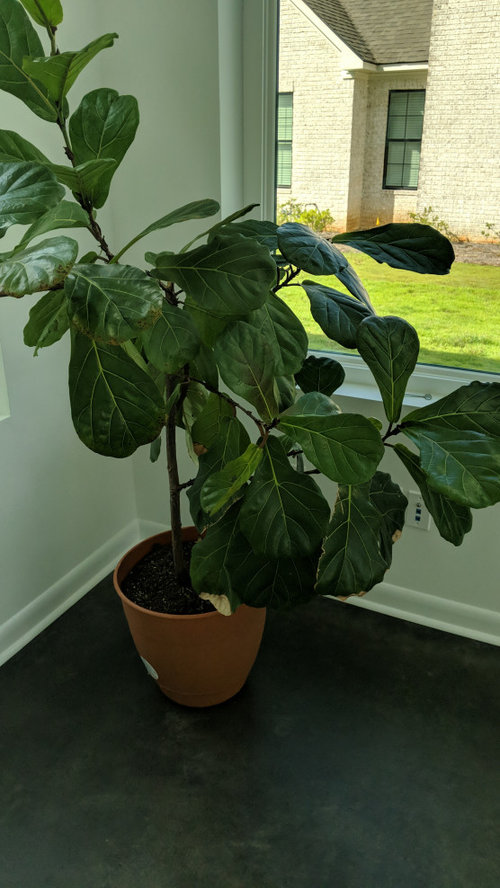
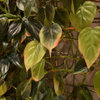
Hi, community! I received a couple of plants from my mom in law, but I'm afraid they're not too healthy. They have some brown patches and yellow/brown dots and I'm unsure about how to treat them. I'd appreciate your help!
Thanks!!

Comments (3)

  • 3 years ago

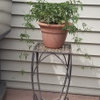
    You don't provide much in the way of what your care regimen is like. I did noticed your plant is in a pot with an attached collection saucer or reservoir. When you water, do you water in small sips or do you take the plant to the sink and water slowly until the entire soil mass is saturated, then allow the pot to drain before tipping the water in the saucer out into the sink? How do you determine when it's time to water? Have you fertilized? What product? What are the NPK %s of the fertilizer? Based only on the images, and with no other input, I'd guess the plant is being chronically over-watered. Some of the damage on the leaves looks as though it could be attributed to sunburn (photo-oxidation). Has it been in direct sun, even for intervals as short as a half hour?

    The plant needs pruning, but it would be best to wait until next June, if you live in the Northern Hemisphere. Ask if you're interested in knowing how/when to prune. Where you live should be noted if you're after more specific advice because geography affects timing of things like repotting, hard pruning, and pinching.

    Once I see a reply to the questions, we can dig deeper and put together a plan you can follow from year to year. Plants have natural rhythms that include a period of high vitality and robust growth (late spring through fall) and a period of waning vitality and significant diminishment of growth rate(late fall thru mid-spring. The greater the distance you live from the equator, the more pronounced the highs and lows are, unless you grow under powerful lights.

    Al

    Irida Medina thanked tapla (mid-Michigan, USDA z5b-6a)
  • 3 years ago
    last modified: 3 years ago

    Hi, Al!

    Thank you so much for your answer. I don't have a regimen yet because I just got them last Sunday. I thought about them being overwatered too because I know she watered them directly in the pot and it wasn't small sips. I have only watered them once today and it was about 2 cups of water for each, because the first two inches of soil were dry. I haven't fertilized them. They are next to a window, but they haven't been in direct sun. Could that be getting them?

    I live in Alabama, US.

    Thank you so much again!

  • 3 years ago

    Some warning flags: The first is: If a pot is 10" deep and the top 2 inches feels dry to touch, the bottom 6" of the soil can still be 100% saturated with water; so, using the 'dry to the second knuckle' test is pretty much a recipe for over-watering if the planting is in a pot deeper than about 5". What's important is the moisture level deep in the pot/ at the pot bottom. I'll leave some information below, about 'using a 'tell' to 'tell' you when it's time to water. It is much more accurate than the finger method or using a 'water meter', an unreliable gadget that measures electrical conductivity in the soil solution, which is largely a function of the level of salts in the soil.

    The second is: Watering in small sips causes all the dissolved solids in tapwater and fertilizer solutions to build up in the soil. As the level of salts increases, it becomes increasingly difficult for water to move across cell membranes. If the level becomes too high, water can actually be pulled OUT of cells (plasmolysis) in the same way curing salts pulls moisture from the cells that make up bacon/ sausage/ ham. Water when the tell comes out of the soil nearly dry after being inserted all the way to the bottom of the pot, making sure you wet the entire soil column and at least 20% of the water applied exits the pot. This watering method limits the accumulation of salts in the soil, carrying any build-up of salts out of the drain hole.

    I would detach the collection saucer (or melt a couple of holes in it) from the pot and use a separate collection saucer. There should be some sort of mechanism in place that raises the pot above any water that collects in the saucer.

    This denies a pathway by which any salts exiting through the drain hole could make way back into the pot.

    Indirect sun won't cause sunburn except in cases where the plant has been growing in a near dark location.

    If you intend to start flushing the soil as you water you can start fertilizing about every 5th time you water from now until late May, then change to every 3rd or 4th time. until mid-Sep. I strongly encourage you to use Foliage-Pro 9-3-6. Do not buy one of the fertilizers on the market, said to be especially for FLFs. There are several scammers selling fertilizers almost unbelievably low in nutrients. some of them cost almost 200X what foliage pro costs on a per application basis. Foliage-Pro provides a complete array of nutrients and serves as a complete nutritional supplementation program from a single source.

    There are several other good reasons to use it too, in case you're interested ......?

    The threads below provide good info that will keep you out of trouble if you implement the advice.

    Overview of good Growing Practices

    Long Term Care of Ficus in Containers

    Questions?

    Using a 'tell'

    Over-watering saps vitality and is one of the most common plant assassins, so learning to avoid it is worth the small effort. Plants make and store their own energy source – photosynthate - (sugar/glucose). Functioning roots need energy to drive their metabolic processes, and in order to get it, they use oxygen to burn (oxidize) their food. From this, we can see that terrestrial plants need plenty of air (oxygen) in the soil to drive root function. Many off-the-shelf soils hold too much water and not enough air to support the kind of root health most growers would like to see; and, a healthy root system is a prerequisite to a healthy plant.

    Watering in small sips leads to avoid over-watering leads to a residual build-up of dissolved solids (salts) in the soil from tapwater and fertilizer solutions, which limits a plant's ability to absorb water – so watering in sips simply moves us to the other horn of a dilemma. It creates another problem that requires resolution. Better, would be to simply adopt a soil that drains well enough to allow watering to beyond the saturation point, so we're flushing the soil of accumulating dissolved solids whenever we water; this, w/o the plant being forced to pay a tax in the form of reduced vitality, due to prolong periods of soil saturation. Sometimes, though, that's not a course we can immediately steer, which makes controlling how often we water a very important factor.

    In many cases, we can judge whether or not a planting needs watering by hefting the pot. This is especially true if the pot is made from light material, like plastic, but doesn't work (as) well when the pot is made from heavier material, like clay, or when the size/weight of the pot precludes grabbing it with one hand to judge its weight and gauge the need for water.

    Fingers stuck an inch or two into the soil work ok for shallow pots, but not for deep pots. Deep pots might have 3 or more inches of soil that feels totally dry, while the lower several inches of the soil is 100% saturated. Obviously, the lack of oxygen in the root zone situation can wreak havoc with root health and cause the loss of a very notable measure of your plant's potential. Inexpensive watering meters don't even measure moisture levels, they measure electrical conductivity. Clean the tip and insert it into a cup of distilled water and witness the fact it reads 'DRY'.

    One of the most reliable methods of checking a planting's need for water is using a 'tell'. You can use a bamboo skewer in a pinch, but a wooden dowel rod of about 5/16” (75-85mm) would work better. They usually come 48” (120cm) long and can usually be cut in half and serve as a pair. Sharpen all 4 ends in a pencil sharpener and slightly blunt the tip so it's about the diameter of the head on a straight pin. Push the wooden tell deep into the soil. Don't worry, it won't harm the root system. If the plant is quite root-bound, you might need to try several places until you find one where you can push it all the way to the pot's bottom. Leave it a few seconds, then withdraw it and inspect the tip for moisture. For most plantings, withhold water until the tell comes out dry or nearly so. If you see signs of wilting, adjust the interval between waterings so drought stress isn't a recurring issue.

    Al