Software
Houzz Logo Print
rvezirian

Help with schip laurel irrigation question please!

3 years ago
last modified: 3 years ago

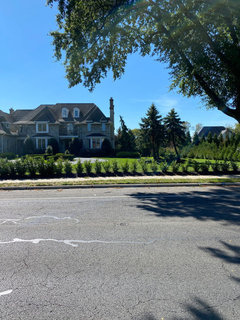
Hi, I planted (100) 2 gallon schip laurels in July 2021 across the front of my property in order to shield my house from the road.

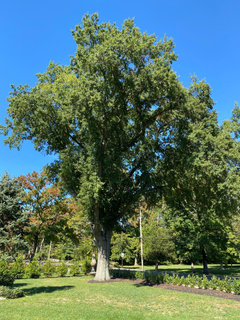
1/3 of them were planted under the drip line of a massive walnut tree. 2/3 have no other plantings competing for sunlight or moisture.

Since I didn't want to disturb the roots of the walnut tree, rather than dig holes to plant them, I sat the plants on the surface (see photo) and then built a topsoil/peat moss mixture to make their new home. They were spaced 24" apart since I want a dense screen.

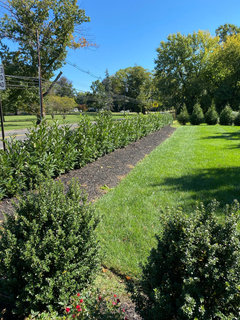
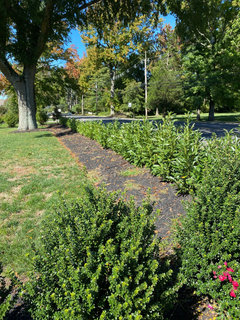
As you can see in the photo, the plants under the walnut tree are struggling to grow while the rest of the plants are thriving and have added 2-3ft of top growth in a little over a year. So, a year later and there is a dramatic difference between the plants on the right side of the property as compared to the left side. It's very noticeable and doesn't look great. I'd like to see if I can get them to grow at a reasonably similar rate, if possible.

I suspect the problem I'm having is that the walnut tree is sucking up all the water and these plants aren't growing because I'm not able to get enough water to them.

As far as irrigation, I have a drip line which I run quite a lot. I also try to run the irrigation zone for the grass under the tree in the hopes that it might help satisfy it's need for water but we have Khylinga grass problems in this area so I have to be careful not to run it too much.

I'm wondering if anyone out there would have any ideas as to how I might be able to address this? I would greatly appreciate any input.


Comments (15)

  • 3 years ago

    you didnt post the pic you alluded to ...


    and where are you.. big city name ...


    and 'quite a lot' really doesnt explain to us how you are watering .... nor when..etc ...


    ken

    rvezirian thanked ken_adrian Adrian MI cold Z5
  • 3 years ago

    Lacking photos or any additional information, laceyvail makes a good point. English or cherry laurels are sensitive to juglone toxicity.

    rvezirian thanked gardengal48 (PNW Z8/9)
  • 3 years ago
    last modified: 3 years ago

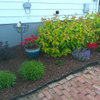
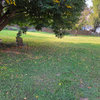
    I posted photos showing the way they looked prior to planting in July 2021 as well as photos of the schips under the Oak tree and those planted away from the Oak tree. In the last photo you can see how the schips outside the drip line of the Oak have normal growth.


    My location is Zone 7a Philadelphia area.


    Regarding irrigation, admittedly, since I was having no problems with the schips on the right side of the house, I just recently came to think the problem was moisture as opposed to sunlight. Recently, I am watering until I get a moist reading on my meter. The method is drip line.


    I had no idea juglone and very much appreciate the info, although I can't find any resource that is saying PRUNUS laurocerasus 'Schipkaensis' are affected. A different variety from cherry or English. But given the info you guys have offered, I'm definitely concerned I'm not going to have any good solution to this.


    A question for laceyvail, I thought I was doing a good thing by adding peatmoss. Not so?

  • 3 years ago

    Schip laurel is just a named cultivar of English or cherry laurel and there is no reason to believe - or documentation to support - that 'Schipkaensis' is any less sensitive to juglone than any other named form.

    Re: the adding of peat moss. It has long been documented that amending planting holes, especially of trees and shrubs, can be detrimental to their establishment. And depending on soil type, can also seriously affect water percolation and drainage. It is also increasing soil acidity and probably unnecessarily, given your location. Plant only in your indigenous soil - whatever gets dug out is all that is used to backfill. Any needed amendments can be used as a top dressing or mulch.

    rvezirian thanked gardengal48 (PNW Z8/9)
  • 3 years ago

    Thank you. As you can see from the first photo and as I described, I didn't dig a hole for these plantings because I didn't want to disturb the roots of the Walnut tree. That said, your comments are noted.


    I'm assuming there is no remedy for this issue other than removal of the Walnut tree?


    Do you happen to know if steeds holly are affected by juglone? I may have to transplant these schips to a different location.


    Thank you to all for the replies.

  • 3 years ago

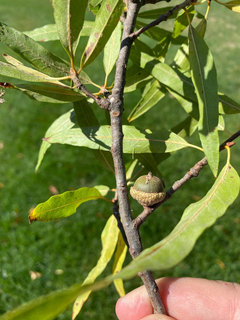
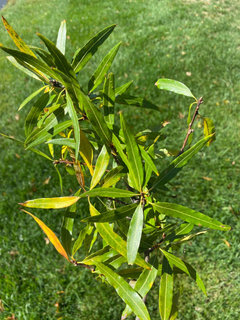
    Turns out this tree is not a Walnut tree after all but rather an Oak tree. The long narrow leaves fooled me.

  • 3 years ago
    last modified: 3 years ago

    as to the oak/walnut.. show us the leaves.. let us confirm your new discovery ...


    and check out this post... maybe you can find some other variable that needs to be addressed ..


    https://sites.google.com/site/tnarboretum/Home/planting-a-tree-or-shrub


    ken

  • 3 years ago

    please tell us you did NOT put down landscape fabric above or below you mounds ...


    ken

  • 3 years ago

    No, i did not put any landscape fabric down.

  • 3 years ago

    Here is a close-up of the leaves, and you can even see the acorn. Pretty sure this is an oak tree. If true, then I might not have as big a problem as I feared.

  • 3 years ago

    Ah, interesting. My first thought at that photo was, that's not an oak! But then I saw the acorn and was confused. Never heard of a willow oak. Have a cheesy commercial theme running through my head now - it's an oak! It's a willow! Wait!! It's both!!


    :)

    Dee

  • 3 years ago

    Glad you have identified the tree, but I would add that even if it were a walnut, I would never consider removing a tree rather than the shrubs. Trees support so many species. This is from Johnson's Nursery (don't know where it is-just came up on a search):

    Wildlife Value:

    The Black Walnut produces a large crop of nuts on average once every 2-3 years. The nuts feed many birds such as turkey and nuthatches. The most notable consumer of the nut is the Eastern Fox Squirrel, 10% of their diet alone can be entirely Black Walnuts. In turn, animals like the Eastern Fox squirrel are a food source for larger predatory animals such as the Red Fox, Red-shouldered Hawk, and Black Bears.

    The Walnut caterpillar specializes in the Black Walnut and relatives such as Butternut. This means the leaves of these trees are the only food source these caterpillars can eat. The leaves on both trees also provide food for over 100 other species of moths and butterflies including Luna Moths and Banded Hairstreaks. Since caterpillars are an important food source for birds, such as the Tufted Titmouse, not all caterpillars will see life as an adult butterfly or moth.


    Oaks have even more diverse, greater wildlife value.

  • 3 years ago

    @cyn427 (z. 7, N. VA) we all have our own courses to chart and the reasons we do what we do. But thanks for your input.