Software
Houzz Logo Print
alym876

How to winterize young maple?

3 years ago

Hi all I have 2 young armstrong gold maple trees in my yard and am looking for advice for how to keep them safe during the winter in zone 7. I have read that tree wrap can prevent winter scald but should I purchase those protective bags to put over the top and cover the branches as well? The trees are currently about 5 feet tall but very narrow. Any advice would be appreciated.

Comments (11)

  • 3 years ago

    Bump


  • 3 years ago
    last modified: 3 years ago

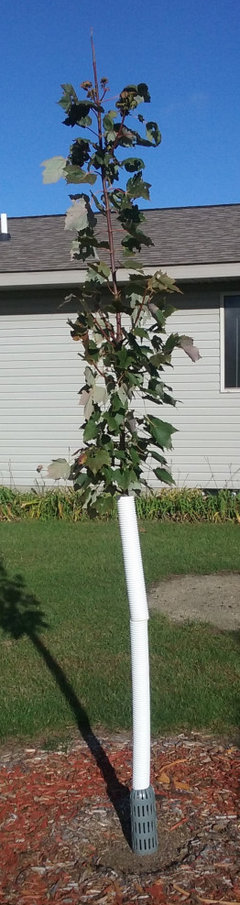
    I'm in a lot colder zone than you alym876 and all I ever do is put a tree tube on my maples.

    The reason for tubes up here is primarily to prevent sun scald. This happens in cold country, late winter when daytime sun awakens the phloem layer, then plunging nighttime temperatures re-freezes and kills the phloem. Generally, this appears on the bottom foot or two of the trunks, as a long wound, later in the season.

    I don't know if this can happen in zone 7.

    As GG mentioned, cold hardiness of the tree will not be a problem for you in your zone 7.

    The only other problem we have here, that is most likely the same where you are, is the aforementioned varmints. During hard winters rabbits and mice/voles will chew on the thin, sweet bark of maples and fruit trees, when other food gets scarce, late in the winter season.

    The tree tubes protect from varmints but with our ground freeze winters, the voles tend not to tunnel below the surface and chew on roots. From what I understand, in areas, where ground stays thawed, voles can tunnel into the root area and do damage, but I've had no personal experience in that way.

    Tree tubes will also ward off 'Buck' deer from rubbing their antlers on the trunk, late summer and Fall. Depending on your location deer may or may not be a problem.

    In winter, we can get a lot of snow accumulation and rabbits will chew on parts of the tree above the tubes, once the snow gets deep enough to support them and they can reach higher than the tube. But I don't know how much snow you get there. ;-)

    Below is one of my red maples, ~6ft. tall at the time. No, we never get snow deeper than the tubes. I ventilate the bottom of my tubes bc I put them on early Fall, while temperatures are still warm, and the venting prevents moisture accumulating inside the tubes.


    ETA: Rabbits and certain rodents have teeth that continually grow, and they have to gnaw on woody plants to keep them wore down. This can happen any time of year. Because of this, I keep tree tubes on my smaller trees year-round.

    :-)

    alym876 thanked BillMN-z4a
  • 3 years ago

    never cover the canopy of a tree ...


    wind will rip the tree apart... and if that doesnt happen ... trapped heat will make it go in and out of dormancy all winter long.. and that will be worse than just about anything ma nature can do to it..


    you are on the verge of killing them with too much love.. look around while you drive.. there are trees EVERYWHERE.. and ma nature takes care of just about all of them.. with little or no help from us ...


    just about the only thing you need to be worried about.. would be surface vermin.. like rabbit or voles.. etc.. i presume bill addressed that ...


    and since you wont have snow cover or ground freeze.. go out there once a month.. and make sure there is moisture in the soil.. not wet.. just not bone dry.. odds are you will NOT need to water.. but it never hurts to check..


    we dont care about surface moisture.. we want some moisture at root level ... so dig a 2 or 3 inch hole with a tablespoon and find out ...


    err on the side of not watering.. since there is no real heat to pull moisture form the soil.. so it probably wont be an issue..


    just dont swamp it out with too much water. ...


    review the link below.. and if you did anything really wrong.. lets fix it now ...


    ken


    https://sites.google.com/site/tnarboretum/Home/planting-a-tree-or-shrub

    alym876 thanked ken_adrian Adrian MI cold Z5
  • 3 years ago

    Thank you all for your feedback. I actually had no idea rabbits chewed trees but that may have solved a mystery about one of my other trees that had 2 holes in it about rabbit level so I will be sure to put something there to protect them.


    I guess I was just overly concerned because I had a beautiful maple growing and I assumed with regular watering nature would take over but it died during its 2nd year in the ground so I wanted to make extra sure that doesn't happen to these new trees!

  • 3 years ago

    Depending where you live you may want to water before winter, specifically if your area is low on water for the year. Young trees often need water the first few years. Even established trees will need water in a drought.

    Good luck!

  • 3 years ago

    Not sure where you are located, but because of drought in my area, I need to water my young trees (including maples) before they are established through the winter or they will die. My local nursery recommended deep watering in the summer 2-3x / week and in the winter on holidays (about monthly: Halloween, Thanksgiving, Christmas, Valentines Day, etc). If you can do a slow drip hose for 15-20min, great. If it's too cold, fill a 5 gallon bucket of water from an inside sink and slow pour it around the drip ring of the tree. If your area is receiving a lot of snow, you might be ok without winter watering, but we aren't getting enough snow to keep our trees watered during the winter until their roots have been established (2+ years).

  • 3 years ago

    And I'll add: smaller trees don't have the capacity to store great amounts of water. So even if they've been in the ground for the requisite 3 years, and are considered 'established', they may still suffer damage to the root system, if allowed to get too dry.


    This is not always apparent or recognizable to the average gardener, but Ime: Trees come out of dormancy in a more robust fashion when the ground is not left to go completely dry. :-)


    Each person will have to determine how often to water, depending on soil type, rain/snow, temps, etc.

    alym876 thanked BillMN-z4a
  • 3 years ago

    That's good to know, Bill! I think I lost some established shrubs about a year back due to the ground being too dry over winter as well. In the past I think we used to get enough snow over winter to sustain things, but now it's a little iffy.

    alym876 thanked pricklypearcactus
  • 3 years ago

    I wonder if that is what happened to my poor maple then I wrongly assumed it was good to go since it had done so well its first year so I wasn't nearly as good about the watering. Prickly pear I like the watering on holidays rule thats s good way to remember to check on them! We used to get more snow too but the weather these days is so crazy you never know

  • 3 years ago
    last modified: 3 years ago

    Yes, that's been the trouble here too.

    In the past, there's been dry spells and trees and shrubs have endured quite well. Mostly because there has still been enough sub soil moisture to help supplementary water be effective.

    What's we've seen lately is, we've had 2-3 years in a row without good soaking rains.

    Therefore, in the first year of drought, you don't see a lot of difference and regular surface watering is sufficient to keep up with the plant's requirements.

    The second year of drought, subsoil moisture is more depleted, so it takes more water to do what you could call 'deep watering', i.e. getting water down to where there's moist soil below the top soil, plus the area that you water dries out faster because that area, is surrounded by dry soil, causing the water you put down to spread out and evaporate faster, than if it were surrounded by moister soil. These lower humidity's don't help anything either.

    This condition continues to worsen each year that the drought continues. And make it more difficult to keep up especially with the wide-ranging root systems these plants want to develop.

    Now, I'm talking specifically about porous, sandy loams with a subsoil consisting mostly of sand. This may also be true, in varying degrees, to other types of soils, I'd be almost certain it is.

Sponsored
Wannemacher Interiors
Average rating: 5 out of 5 stars26 Reviews
Customized Award-Winning Interior Design Solutions in Franklin Cnty OH