Software
Houzz Logo Print
webuser_163408741

Difficult Radon situation - advice needed

3 years ago

We built a new house in April 2022. We had it tested for radon and the radon was exceptionally high. There was a radon pipe installed. The radon contractor we hired, tried using a fan to reduce the radon, but it barely worked.


We are trying to figure out what other issues may be at play. We think that the radon pipe installed may not be working at all. (Disclaimer, the pipe is 3" but the radon contractor said it really should be 4" for the size of my house.) The radon contractor did say that even though the pipe is smaller, there should be some decent reduction.


The radon contractor said he has done over 5,000 houses and he has always been able to get the radon down. However, this one is stumping him to some degree at this point.


We are wondering if the pipe is working at all. Is that possible?


Has anyone else had this sort of problem?


Thanks,


Elizabeth

Comments (25)

  • 3 years ago

    4,500 (a ranch with a finished basement and bonus room above the garage). There are no radon codes in Wisconsin. This is why this is a bit of an issue.


  • PRO
    3 years ago

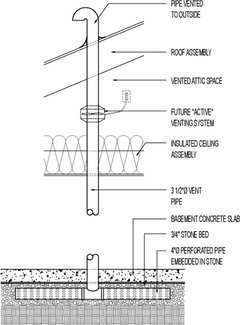
    Elizabeth, most likely the pipe is undersized, not sure what the fan size is, how the pipe was installed, and what is under the slab because many factors could cause failure to remove gasses at full capacity, maybe opening up the slab around the pipe and make sure the pipe is not clogged, and installed properly, etc and if everything seems fine maybe adding a larger fan could give better readings

    The existing installation under the slab should look something like this


    That said, the worst-case scenario may be adding another 4" pipe at a different location, properly installed with the right capacity fan will bring the numbers to a safe level.


    Good luck

  • PRO
    3 years ago

    Hi, Elizabeth,

    Sorry for your experience. There are a variety of approaches to deal with radon in a home. It's pretty common in areas with radon for newly constructed homes with basements to have perforated pipes installed under the slab which are connected to a continuously operated vent fan. That's an active soil depressurization approach. Depending on the size of the slab and the concentration of radon, a home may need a network of perforated pipes. If your current system isn't performing, a more powerful fan might do the trick. I certainly would try that before excavating any portions of the slab to install additional piping.

    Another way to deal with radon in a basement is to reduce its concentration by bringing in an adequate supply of fresh air and exhausting stale air to ventilate the space. A heat-recovery ventilator or an energy-recovery ventilator would be good options if you go this route. Your radon mitigation contractor should collaborate with your HVAC contractor to select the right size unit and integrate it into the overall HVAC strategy for your home.

    Elizabeth thanked Charles Ross Homes
  • 3 years ago

    What is important at this point is not the size of the pipe. If a 3" stack pipe with an in-line fan is not changing your radon readings, then a 4" certainly will not move the needle much (what it will affect is the size of fan to get the pressures you desire). You size a fan based on your pressure readings, which is based on pipe size, length, and sf, so that all should have been done properly with the initial installation. What seems to be missing is "communication" - that is, the allowance of accumulated radon gas far away from the pipe stack to be able to be pulled to the stack underneath the slab. A radon contractor with 5K houses under their belt should have approached the job as if a passive system was never installed, by testing for communication around the basement. Start there, then you can get into the proper pit, number of points, pipe/fan size, and method of testing for radon to make sure you are not getting bad readings. And, a radon contractor should be responsible for reducing the radon level on their dime, which their contract should say as much with a guarantee to get it below 4pCi/L.

    Elizabeth thanked 3onthetree
  • PRO
    3 years ago

    I got the impression the radon contractor was not involved in the design or installation of the under-slab perforated pipe, but rather, was called in after the fact. The point at which they became involved would affect the extent of their responsibility. Perhaps the OP will clarify that.

    Elizabeth thanked Charles Ross Homes
  • 3 years ago

    Tim, the Initial installation I was referring to was the hired radon guy's first visit, not the passive pipe (underslab pipes or not) sticking out of the slab from construction. The radon guy cannot assume he is getting the communication he needs from all areas of the basement just because a pipe was already sticking out of the floor. He is responsible for his work, which is getting the level below 4pCi/L. Similar to a window guy called in to fix leaking flashing around a window. He didn't install the window, but he is guaranteeing he can fix the leak.

    Elizabeth thanked 3onthetree
  • PRO
    3 years ago

    I agree the mitigation contractor should have verified the existing conditions and they should know how to upsize a fan. That said, if they inherited the sub-slab work there's probably a disclaimer in their agreement limiting their extent of responsibility. They can probably remove the fan, refund the OP's deposit, and go home. That, of course, doesn't really benefit the OP who still has a problem to remedy.

    Elizabeth thanked Charles Ross Homes
  • 3 years ago

    Underslab piping would be a wonderful bonus, and is a good indication that there is a vapor retarder and maybe even stone which makes the job easier. No one would be disclaiming their work on some piping that he doesn't even have to use. So the first thing any radon contractor would do is drill some holes and perform either a pressure or smoke test. If this guy didn't he needs to. Whether any existing pipe or pipes help his cause or not, he still is being hired to get the pCi/L down.

    Elizabeth thanked 3onthetree
  • PRO
    3 years ago

    To be fair, we don't know what the contract scope of work is, and what, if any, performance criteria are associated with that scope of work. It could be that the contract scope of work is limited to installing a particular radon vent fan connected to the existing sub-surface piping without any performance guarantee. The other variable which affects the radon concentration is the ventilation rate of the space which could be outside the scope and/or control of the radon mitigation contractor. Coordination between the HVAC and mitigation contractors may be required to get the concentration lower than the acceptable limit.

    Elizabeth thanked Charles Ross Homes
  • 3 years ago

    The radon contractor was brought in after the home was finished. He is inheriting someone's work.

  • PRO
    3 years ago

    Elizabeth, jus have him check everything and have him make it work if not call a more capable company and they will figure out what needs to be done to bring the level down. I had to install about a dozen of radon systems over the years and they always got to the safe level.
    Good luck.

    Elizabeth thanked GN Builders L.L.C
  • PRO
    3 years ago

    Greg,

    Maybe you'd consider making a "field trip" to Wisconsin!

    Elizabeth thanked Charles Ross Homes
  • PRO
    3 years ago

    Charles,

    Are you picking up the tab?

    Elizabeth thanked GN Builders L.L.C
  • PRO
    3 years ago

    I'll sport you a pound of cheddar!

    Elizabeth thanked Charles Ross Homes
  • PRO
    3 years ago

    Is that all you can afford? Looks like you needed more than me… enjoy!

    Elizabeth thanked GN Builders L.L.C
  • PRO
    3 years ago

    C'mon, Greg,

    The OP needs your expertise! You've installed a dozen radon abatement systems. They only need one!

    Elizabeth thanked Charles Ross Homes
  • PRO
    3 years ago
    last modified: 3 years ago

    Charles,

    Do you want me to reply to that? LOL

    Oh, by the way, stop acting like some "pansy-ass" because you are starting to come off like something is def "off upstairs" get some help if needed... just a piece of friendly advice.

    Take care

    Elizabeth thanked GN Builders L.L.C
  • 3 years ago

    Anyone who wants to look at my system in Wisconsin -- I will buy you cheese curds, beer and bring you to a fish fry. (I won't give you any Packers apparel because I lived on the east coast most of my life and I am an Eagles fan by marriage.)


  • 3 years ago

    NB: The radon contractor said that he has always been able to bring the radon level to a safe level in all the houses he has worked with. However, he has never come across the issues we are facing in a new construction. There are no "radon codes" in Wisconsin. You do not need to have a license to handle radon issues. Our current guy is licensed.

  • PRO
    3 years ago

    Hi, Elizabeth,

    The International Residential Code, which forms the core of most statewide building codes, has required enhanced air sealing for at least the last two code revision cycles. I'm not familiar with your state's code, but given your climate zone, I'd bet your home was tightly constructed--possibly more than other homes your radon mitigation contractor has worked on. Enhanced air sealing means lower air infiltration which, in turn, means less dilution of indoor pollutants like radon without some sort of fresh air ventilation installed. You'll be well served to have a chat with your HVAC contractor about whatever provisions they've made for ventilation of the basement level. If there isn't any, your radon mitigation contractor could have a problem he won't be able to solve.

    Elizabeth thanked Charles Ross Homes
  • 3 years ago

    Are you saying that there is no way to ventilate the house...even adding another pipe in a different area?

  • PRO
    3 years ago
    last modified: 3 years ago

    Hi, Elizabeth,

    The concern is the concentration in the air volume which you breathe, i.e., the living area above the basement slab. There are two basic ways to limit that concentration: 1.) by keeping radon out of the living area and 2.) by diluting the concentration to achieve a safe level. Ideally, a sub-slab depressurization system would be sufficient to reduce the concentration below the 4 pCi/L limit. Hopefully your contractor will be able to get yours to deliver that. If, despite reasonable efforts that can't be achieved, then it can be supplemented by exhausting stale air and introducing fresh air into the living area. Most tightly-constructed homes require some sort of system for fresh air ventilation to limit indoor pollutants. If it's determined you need to go that route, a heat-recovery or energy-recovery ventilator should be considered.

    Wisconsin's Dept. of Health Services has some radon resources that you may find helpful https://www.dhs.wisconsin.gov/radon/radon-resistant-const.htm

    Elizabeth thanked Charles Ross Homes
  • PRO
    3 years ago

    Visit Taliesin on your road trip to Wisconsin.

    Elizabeth thanked Mark Bischak, Architect
  • 2 years ago

    One small help is to move your laundry to the basement and vent the dryer to the outside. The dyer will pick up air from the basement floor and exhaust it to outdoors. Older style furnaces (pre high efficiency) was a big help during the heating season. These passed a goodly amount of basement air up the chimney. High efficiency furnaces do not pass inside air to outside.


    If you have well water from a deep well, it may be a source of radiation. Cities and villages in Waukesha county who pump water from the"lake superior" aquifer are having problems with radon levels above the acceptable standard. In Sussex, that aquifer is 1100 to 1200 ft below the surface. The city of Waukesha has finally gotten permission to get enough Lake Michigan water to mix with their well water to bring radon down to an acceptable level. Why was this so difficult? Its because Waukesha is on the west side of the Lawrencian divide. There are agreements between US and Canada to prevent the depletion of the Great Lakes. Rainfall on the west side of the divide flow to the Mississippi outflow while rainfall in the east side of the divide flow into the

    Great Lakes and out the St. Lawrence river. The City of Waukesha had to return water across this divide equal to the amount taken. They do this by returning treated sewerage. After a long and arduous process, it began this year.


    The undefined problem: What is an acceptable radon (or radiation) lever? As I understand it, this is unknown. The type of radiation given off by radon and other nuclearides is known to be not good for the human body, but how much is acceptable is a question. The trend is to set the standards low to be on the safe side.

Sponsored