Software
Houzz Logo Print
patagonia2

Help with thermostat placement!

3 years ago
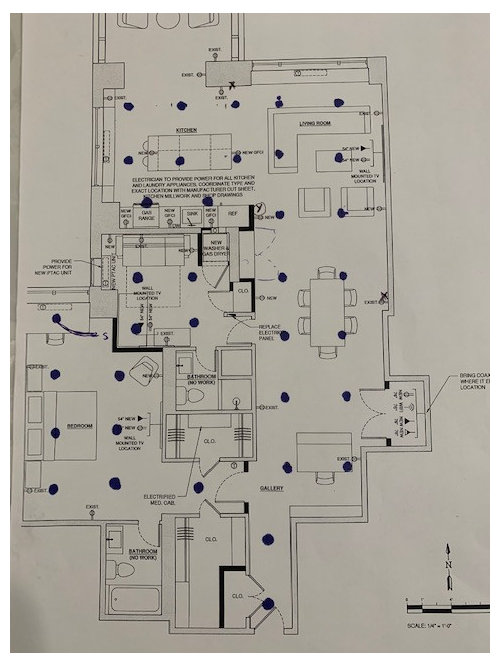

Hi! I need help with thermostat placement in the main living area of our apartment and would really appreciate your thoughts.


Our contractor is replacing the HVAC units in the kitchen/living room/dining area. One is to the left of the ktichen island, one is behind the living room couch by the windows. Neither can be moved. The contractor recommends putting in a wired thermostat to control both HVAC units (marked Y to the right of the refrigerator). He thinks that if we put in two thermostats they could cancel each other- with one thermostat potentially picking up the temperature from the other thermostat. He thinks that it will drive us crazy.


The HVAC company recommends going wireless.The walls are open now and we are leaning to wired thinking that we can switch to wireless later if we choose, but will never be able to switch to wired again. Their thinking is that you can place the thermostats later. If we want wired thermostats, they would place them where the Xs are-- on the column near the sunroom and near the living room HVAC and on the wall to the right of the dining room table.


Help! I really don't know what to think. The kitchen is likely to get hot when I cook, and I have no idea how that sunroom will play into the temperature (for what it's worth the apartment faces north). It might be good to have both units work together to lower temperature in that scenario. But the desk at the other end of that room (about 40 feet from the window) is far away. What are your thoughts? And thanks!!


Comments (23)

  • PRO
    3 years ago
    last modified: 3 years ago

    Thermostats should be located near your filtered return to the unit that serves it. Within the flow of air that is pulled to your air filter.

    The thermostat(s) more or less makes it's decision by return air temp. If the thermostat is not placed in the flow of air that is return air --- air that is being pulled to the filter of the HVAC system --- then the temperatures within the zone controlled by the HVAC system could be off by a wide margin.


    Typically it is best to place thermostat on an interior wall, not exterior.

  • 3 years ago

    Thanks very much for your insight. An issue here is that this is an apartment and that there are no vents anywhere in this long room. Do you think that it would be better to run the kitchen HVAC separately from the living room HVAC? Or to run them together?

  • PRO
    3 years ago

    Each HVAC system should have it's own air return (unless the units are twinned). The thermostat should be located within the return air stream for the system in which it is controlling.


    Twinning is a method of increasing capacity of HVAC systems to sizes that aren't manufactured. Typically these systems are installed in larger structures than what is typically built.

  • 3 years ago

    What type of HVAC systems are being installed in the apartment? Are these PTAC (package terminal air conditioner) type units? Will these units also be providing heat? Are the sizes (BTU rating) remaining the same? Did anyone confirm the sizes are correct? What is the location of this apartment? What floor is it located and is there an apartment above it?

    Your contractor does not appear to be knowledgeable about HVAC installations. I would not rely on him to make any decisions. If there are two HVAC units then each should be controlled by its own thermostat. The thermostat needs to be installed on an interior wall. I recommend hard wiring hard wiring so you don't have to worry about batteries. It also gives you many more thermostat choices including WiFi if that is important to you.

    If you like to cook and bake, then putting the thermostat in the kitchen is not the best location. The "Y" spot may be good for the kitchen unit. The thermostat for the living room could be placed to the left of the door going entering the bedroom. I assume there are other units in the apartment. It is difficult to tell if these locations are the best without knowing the location of every AC unit. Don't let ease of installation by the contractor influence your choice for thermostat location.

  • 3 years ago

    "PTAC (package terminal air conditioner)"

    Motel type heat/AC units. Usually under the window.

  • 3 years ago

    I suspect this an old apartment building and the units in question are for cooling only. Let's see if the original author can provide more information.

  • 3 years ago

    Thanks so much, everyone. I had to wait until the HVAC company that the contractor is ordering from opened on Monday.


    Yes, this is an old building but the fan coil units provide both heat and air conditioning. Unfortunately they are not PTAC units. The building decides when to change over from heat to air. The contractor has ordered Trane 600 hideaway units for the Living room, larger bedroom and kitchen and Trane 300 hideaway units for the smaller bedroom. I think that the HVAC technician picked the size, but they don't have down the BTUs of the units that they replaced.


    The apartment is on the 4th floor of a very large building and faces north. There are apartments both above and below it.


    I very much appreciate your thoughts!

  • PRO
    3 years ago

    Patagonia2,


    Sounds like furdown unit. I don't think Trane makes those at least I've never seen one made by Trane. It's either First Co. or Goodman AFAIK--- that said you can mix and match these with a condenser of your liking (if you know what you're doing that is.)


    These are usually placed above a bath tub with a panel that is closed up... the return is else where usually so it will need a filter return so anywhere near the filter of the system is where the Thermostat should be placed (on an interior wall).


    If you don't place them with condensate over flow in mind they can make a big mess if the condesate drain gets clogged. Not fun to work on when that happens.


    I've never heard these called hide away units. LOL. So that's funny.... I've called them many different things but never hide away. PITA, POC, POJ, POG

  • 3 years ago
    last modified: 3 years ago

    You might consider Honeywell T10 Pro or Honeywell T9 wired thermostats. These support remote, wireless sensors that you can place anywhere. You can program the thermostats to control the room temperature based on their built-in sensors, the remote sensor(s), or a combination. If you found that the sensor(s) built into the thermostat(s) were not controlling the room temperature(s) as desired, you could program one, the other, or both them to use the remote sensor(s) instead. Also, for example, you could put a sensor in the bedroom and program the thermostat to control the temperature based on that sensor during the night; that's what I've done.

  • 3 years ago

    Great idea! thank you

  • PRO
    3 years ago

    The guiding principle for placement of a thermostat is that it be located where a representative temperature can be measured. That may or may not be in proximity to a return. The option to use a number of remote sensors and either average their inputs or program the system to control based on different sensors at different times of day as wdccruise described above overcomes the limitations of a single temperature measurement. It's a great option.

  • 3 years ago

    wdccruise,

    How long is the battery life of the remote sensors?

  • 3 years ago
    last modified: 3 years ago

    @mike_home: "How long is the battery life of the remote sensors?"

    I don't know. I just set a new one up after an older one failed. (If a remote sensor fails, the thermostat simply switches back to using its built-in sensor.)

  • PRO
    3 years ago

    The option to use a number of remote sensors and either average their inputs or program the system to control based on different sensors at different times of day as wdccruise described above overcomes the limitations of a single temperature measurement. It's a great option.


    It's possible to have temp swings of 10F degrees or more within a structure (your house). The human body is likely to feel that disparity. This event is typical under "condition extremes" not likely to be solved by a sensor to reduce or induce further system run time.


    If the sensor(s) are placed in areas in the stream of conditioned air or some radiant heat this will only lead to more problems.


    The gadget market is a billion dollar a year market... not really known for producing things that actually work.


    If you live in a mild climate, maybe gadget is all you need. (Most of the time the system is off in a mild climate or if it is on it's on for a short amount of time.)


    If you are hot in one area and cool this area by forcing the unit to run more the other areas that are cooler will become cooler still or too cold. If you are too cold in one area and run heat to force this area to be warmer other areas will become too hot. Sensors aren't likely to fix these kinds of problems.


    The gimmick is hey all we need is this cheap product and all our problems will go away. Design problems aren't fixed with gimmicks. Keeping it real here.


    As always your mileage will vary primarily due to the climate concerns of where you live.


  • PRO
    3 years ago
    last modified: 3 years ago

    @Austin Air Companie,

    The use of multiple temperature sensors and the ability to select which one(s) control the system at any given time provide some of the benefits of a zoned system at a much lower cost. Given the relatively low cost to try it, and wdcruise's endorsement based on their experience, I wouldn't dismiss it as a gadget. I'd give it a go.

    If users were unwilling to try new and promising ideas, the innovative inverter-driven HVAC system would be relegated to the drawing board or at least to the test lab. Then what would you have to post about? Well, there would still be the R410-a fear mongering and the thermometers with cowboy hats.

  • PRO
    3 years ago
    last modified: 3 years ago

    Charles Ross the use of multiple temperature sensors does what to contain air flow?

    When you run the AC the temp coming from the vent is typically 20F less than return air.

    In one area the thermostat may read 70F, a sensor placed in a distant room may read 78F.

    In order to drop temp of the room that reads 78F from a sensor reading what do you think is going to happen to the temperature of the thermostat that reads 70F?

    Cool versus too cold. This is what you get from a room sensor solution... more trouble.

    When that happens you know what Charles Ross does?


    That's right he hires a Mechanical HVAC contractor. Now inquiring minds would like to know why Charles says anything here at all?

    Please tell us Charles.

  • 3 years ago
    last modified: 3 years ago

    @Austin Air Companie: "If the sensor(s) are placed in areas in the stream of conditioned air or some radiant heat this will only lead to more problems."

    Uh, don't do that.

    "If you are hot in one area and cool this area by forcing the unit to run more the other areas that are cooler will become cooler still or too cold. If you are too cold in one area and run heat to force this area to be warmer other areas will become too hot."

    The sensors merely allow the user to control the temperature from a location (or locations) other than where the wired thermostat is installed. Suppose a thermostat is installed a location Y and the user finds that the room temperature is adversely affected by nearby kitchen appliances. He could place a sensor a few feet away from the kitchen and program the thermostat to control the temperature based on that $28 sensor; he wouldn't have to move the wired thermostat to solve the problem.

    In my case, I want to control the temperature based on the downstairs temperature during the day and the upstairs (bedroom) temperature during the night. So I've installed one sensor and programmed the thermostat to use the upstairs sensor (only) at night.

  • PRO
    3 years ago

    Ray,

    You are confused on multiple levels. The limitation of a non-zoned HVAC system with a thermostat in a fixed location is just that--it's installed in a fixed location. It can only control to the setpoint temperature at that location. Installing multiple sensors and having the option to select which one is the input for control purposes gets around that limitation. It doesn't turn a fixed-speed air handler into a variable-speed air handler and it's not a substitute for a zoning system which modulates air flow. It can, however, provide the enhanced comfort that wdccruise describes clearly in the post above. The price for the additional flexibility and enhanced comfort in one space is that other areas in the home may be over-heated or over-cooled. The other option is to install multiple sensors and use the average of the temperatures to control the HVAC system. Sort of a meet in the middle approach, if you will.

  • 3 years ago

    @Charles Ross Homes: "The other option is to install multiple sensors and use the average of the temperatures to control the HVAC system."

    Which the Honeywell T10 thermostat (with sensors) supports.

  • PRO
    3 years ago

    Yes, I think it's a great invention!

  • PRO
    3 years ago

    ha, ha, ha.


    Job security in a 100 degree + 90% capable RH climate on a regular basis.

  • PRO
    3 years ago

    "Job security in a 100 degree + 90% capable RH climate...." Like P.T. Barnum famously said "there's a sucker born every minute." He was a show man--just like you, Ray. Now, if you could only get those thermometers in cowboy hats and boots in your videos to dance.

  • PRO
    3 years ago

    "there's a sucker born every minute."


    What the billion dollar gadget market was built upon no less. But let's not think about that.


    The imagination is a powerful thing... I didn't even have to make them dance and you're already imagining it and commenting on it.


    Thanks Charles.