Software
Houzz Logo Print
chamaegardener

Overwintering potted trees in a garage

I know putting potted trees in an unheated garage over winter has been discussed as one option to protect them in cold climates. I want to get more details how it works.


For example, they will get no sunlight. Does this require I wait until all the leaves are fallen? Does it require being taken back outside in spring before the buds emerge?

Comments (31)

  • 3 years ago
    last modified: 3 years ago

    If they are all entirely deciduous kinds they won't need light when they are leafless. They will however have to be kept watched to make sure their soil has not dried out, is watered as needed - you will need to be able to arrange them somewhere that water coming out of the pots and running away is not a problem. Also they will need to be checked periodically for pests like mites that came in with them as eggs hatching and infesting them in response to the shelter provided by the garage.

    chamaegardener (Z5) Northeast Illinois thanked Embothrium
  • 3 years ago

    Also:

    'cold climates' Is pretty vague. So is 'unheated garage'.


    What you really want to find out is what the coldest temperature your attached or unheated garage will get at any time during the winter. And how cold hardy are the plants you want to do this to.


    If your garage gets colder than the roots are zone hardy to, they will die.


    It's my understanding, that the roots are only hardy down to 2 zones warmer than the tree itself.

    So, if your trees are zone hardy down to zone 5, the roots will not stand colder than zone 7's lowest temperature.


    What Embo said about water and light are right on.


    chamaegardener (Z5) Northeast Illinois thanked BillMN-z4a
  • 3 years ago

    BillMN, just north of Chicago cold. It is attached garage which I have no clue how cold it gets relative to outside. They are japanese maples hardy to our zone 5.


    Maybe it is safer to sink the pots into the ground?

  • 3 years ago
    last modified: 3 years ago

    I've had a wall thermometer hanging out in my 'attached' garage for the last 4 years, so I know mine gets almost as cold inside as it does outside during winter. But it's uninsulated, no ceiling with vented soffits. So, it's not too far from being outside except it's not windy at all.

    I left 4 potted plants, zone 3 hardy, out there last winter and they all died (an experiment of course).

    Yours might be insulated and won't get too cold if enough heat escapes through the wall on the house side to keep things above 0F. Which is as cold as it would get in zone 7.

    I don't know if it's safer to put them outside in the ground, maybe cold wise it is but I do know that mice, voles and certain insects can wreak havoc with unprotected plants outside.

    Maybe one of our commercial tree growers can chime in with some insight on storing trees over winter. But think if your garage stays above Zero F, you'll be fine.

  • 3 years ago
    last modified: 3 years ago

    Japanese maples have roots that are extremely sensitive to cold temperatures. They can experience fatal root damage at temps below 24F. So a garage remaining above 0F is of no help in this case.

    Different species will have different levels of cold tolerance. Ideally, you want the storage facility to maintain a consistent temperature of between 30F-40F. Below 40F will ensure the plants remain fully dormant all winter but 30F or above will ensure no root damage due to extreme cold to any other zone hardy species. As noted, light is not important but soil moisture should not be allowed to dry out.

    Consistency is key. If your garage or other storage facility cannot provide these conditions, then you are better off digging holes in the ground and heeling the pots in.

    chamaegardener (Z5) Northeast Illinois thanked gardengal48 (PNW Z8/9)
  • 3 years ago
    last modified: 3 years ago

    I've heard that Japanese maples roots are more sensitive than other plants with the same zone rating. But had no idea it was that much different. 30-40 degrees would need supplementary heat in most cold zones.

    But thanks for catching that for me GG, I would hate to tell someone to do something only to see them fail.

    My best bet in my area was the underground 'cold frame' covered with mulch and snow. I lost nothing using that but did have a couple things come out of dormancy a bit early, once.

  • 3 years ago

    Japanese maples were part of an organized study using various popular decorative woody plants that revealed a shared tendency for specimens in pots to be about 20 degrees F. less hardy than the same kinds would be when growing in the ground. Pot walls tend to reduce aeration so pots to be protected are better plunged into piles of mulch or sand than sunk into holes dug out of the ground. Unless the ground on the involved site is sandy.

    chamaegardener (Z5) Northeast Illinois thanked Embothrium
  • 3 years ago

    So then, with 20d less hardy, A potted Japanese maple that is hardy down to z5a (-20F) would be okay in a garage that only get down no lower than 0F. (?)

    I know there are many different Japanese maples with different hardiness levels, which GG didn't specify when she stated damage @ 24F.

    This is one reason I said earlier that people need to be more specific when asking and answering questions, IF they want valid answers that are fitting to their particular situation.

  • 3 years ago

    Yes ken, dormant is one element of these trees surviving. If they come alive halfway through winter, they most likely are goners.


    The basic question here is how cold Japanese maples can get (and I'm sure that varies widely according to species) before root damage occurs.


    I'll never have to worry about it myself, but the OP I'm sure would like to know specifically what will and what won't hurt the z5 JM trees he's storing.

  • 3 years ago

    btw.. you would store it dormant AFTER the leaves fall off.. for no other reason than who wants to clean up dead leaves IN THE GARAGE .... dont you think .. lol ..

    ken

  • 3 years ago

    The first thing to keep in mind here is the distinct differences in hardiness criteria when growing something in a container year round versus growing that same plant in the ground. Ambient air temperatures can get far colder and much faster than the inground soil temps......which even when frozen solid, rarely drop below the high 20's and usually remain right around the freezing point or slightly below. Typically with regards to container growing, the primary concern is root hardiness. Plant roots in containers are exposed to far colder temperatures than is the exact same plant in the ground and their tolerance to these temp fluctuations is not something that is easily determined just by a hardiness zone rating. That's where the very arbitrary rule of thumb of "2 zones hardier" comes into play. Not at all 100% valid but a helpful guideline.

    Many of these conclusions are the results of data compiled by bonsai enthusiasts, who regularly expose a wide variety of trees to extreme temperature conditions and have learned by trial and error over many decades what trees can withstand what degree of winter cold before fatal root damage. And it will always be the roots of the tree that are the most sensitive to cold - the top growth may well withstand -20F before cold damage but the roots may not tolerate anything close to that temp!

    I would also question the notion of different hardiness ratings for Japanese maples. Zone 5 is pretty much the limiting demarcation point although some zone 4 gardeners are successful and some zone 5 gardeners are not :-) It depends heavily on microclimates and age/length of establishment but by and large, zone 5 is SOP for JM's regardless of cultivar. But that is ONLY the measurement of inground hardiness. If grown in a container, JM's should be considered a zone 8 plant requiring winter protection if temps drop below the mid 20's. A garage that drops down to 0F is no protection at all for most container plantings!


    chamaegardener (Z5) Northeast Illinois thanked gardengal48 (PNW Z8/9)
  • 3 years ago
    last modified: 3 years ago

    'by and large, zone 5 is SOP for JM's regardless of cultivar. But that is ONLY the measurement of inground hardiness. If grown in a container, JM's should be considered a zone 8 plant requiring winter protection if temps drop below the mid 20's.'

    Thanks GG! That explains it.

    I just didn't want to take anything for granted. :-)

  • 3 years ago
    last modified: 3 years ago

    Anything left in a container I don't care about that are strewn about my yard for me usually comes back no matter what kind of winter I get. Even my common 'Fire Glo' maple left against the back side of my house with no protection. Why? I don't know.

    Those that I deliberately want to protect, many perennials, fig trees, gardenia, citrus trees, and many zone 7 plants which I would never think of sinking into the ground in my climate, I just make it a habit of never letting the pots freeze over.

    It's just me. Some may come back but I just won't risk it.

    So I always find a location where I know the sun and wind can't get to them so if it warms up, they won't awake until spring, and I always keep them out of the wind and make sure they are hydrated.

    The ones in the cellar like banana trees, brugs and others, dry out very fast.

    Some I sink into the ground on the back side of my house, those that can handle my zone.

    For those that are require zone 7 or higher, I just keep on a very cold porch or unheated greenhouse that never drops below 32 or goes above 50.

    There are a couple that I just let freeze solid outside, but I always make sure the pot in filled with mulch and leaves so that standing water on the top when it starts to melt will not rot the plant, such as my rose, or I tilt them. I also surround other with leaves and drop leave on top all the while the pot makes contact with the earth.

    So many different methods.

    My goal is to keep any of my pots from freezing solid even if some can handle that.

    This works for all of my container tree and plants requiring dormancy.

    chamaegardener (Z5) Northeast Illinois thanked Meyermike(Zone 6a Ma.)
  • 3 years ago

    Done, in the ground.

  • 3 years ago

    I think you made the right decision. Burying it is the easiest and safest option IMO.

    chamaegardener (Z5) Northeast Illinois thanked charles kidder
  • 3 years ago

    Good!

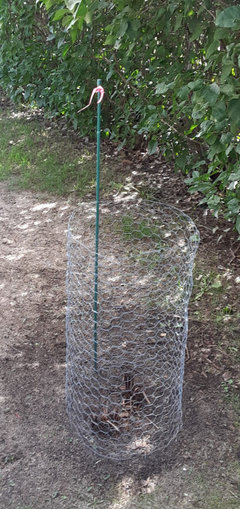
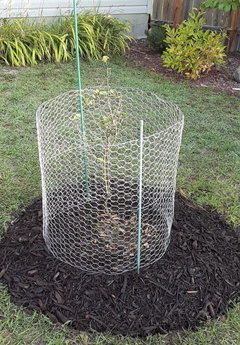
    And I don't know how big of problem 'varmints' are in your neck of the woods, but if I don't protect newer trees (mostly from rabbits), they have no remorse after chewing the bark off.

    Chicken wire or tree tubes work well too. Don't be afraid to add a layer of mulch over the root system, to slow temperature changes too.

    And we'll be looking forward to hearing about these in the spring. 8^)


    chamaegardener (Z5) Northeast Illinois thanked BillMN-z4a
  • 3 years ago

    I have a system for keeping varmints out of the yard.


  • 3 years ago

    My dormant potted fig trees are kept either in the garage where supplemental heating will be used if it threatens to get much below 20F, or in the garage apartment where temps are maintained at 40f or above (there are a number of potted perennials, shrubs and canna tubers up there too). Keys to dependable survival include having plants in large enough containers to limit temperature swings, and not letting root balls dry out. There's a lot of bad advice given for dormant perennials and woody plants to add "a little" water from time to time, which ensures that the lower root ball will not get enough. Much better to give a good soaking at intervals. Drought stress and cold temps are a bad combination.

    I also have some potted tree saplings in a cold frame with pots heavily mulched, and a few mouse traps inside to take care of invaders.

    chamaegardener (Z5) Northeast Illinois thanked rusty_blackhaw
  • 3 years ago

    In USDA z5b/6a, I over-winter about 125 deciduous, broadleaf evergreens, and conifers, in an attached, insulated, unheated garage that shares a common wall with our home. It does have its own suspended gas forced air heating unit I use only when working on plants in the winter, but the average interval of usage during any given work session would be only 4-6 hours, so it has no measurable impact on dormancy or dormancy chill requirements.

    Forgive the mess - I'm in the middle of rearranging everything to accommodate such a large table and still get 2 vehicles in the garage.


    I've been using the garage to winter over plants for about 30 years, and my losses to winter kill are almost zero, not taking into account the 10 or so trees that succumbed to cold when someone I'm married to left the garage door open all night as temps fell to -12*F. The plants I over-winter there are hardy to zone 7 and below, with the least hardy plants being placed on the garage floor to take advantage of the rising geothermal heat that conducts into the pots, keeping the plants warmer than other plants on an 8' x 8' table I construct from polypropylene planks. It might seem counterintuitive that plants on the garage floor would be warmer than plants on a table almost 5' above the floor, but it's true. Soil in pots on the table occasionally freeze (not a problem), while soil in pots on the garage floor never freeze.

    "For example, they will get no sunlight. Does this require I wait until all the leaves are fallen?" 'No light' is no problem for deciduous trees. Generally, it is no problem for broadleaf evergreens or conifers either, if they remain cold enough. The main worries are that plants will put on lanky growth w/o light, or they will deplete energy reserves by growing in the dark with no ability to create photosynthate to ameliorate depletion of reserves. Cold temps salves that worry while warm temps (above 45*F) exacerbates it, or should.

    Decreasing day length (actually, it's the increase in the dark period) starts plants on the march toward dormancy, then chill seals the deal. I always allow any deciduous plants I over-winter in the garage to get knocked back hard by frost. Most are left outside until I see danger of temps dropping below about 25*F. I try to remove all deciduous leaves before bringing plants in. Some plants (oaks, pear, hornbeams) want to hang onto their leaves until spring. For those trees I clip the leaves off. Leaves lying on the soil can cause a lot of fungal problems, so I also treat plants with a systemic fungicide before bringing them in.

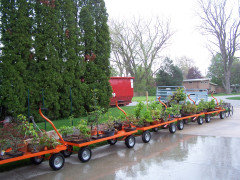
    Does it require being taken back outside in spring before the buds emerge? Yes. Deciduous plants in containers over-wintered in a garage will wake up long before their counterparts in the landscape. Here, the difference is about a month. The deciduous and broad-leaf evergreen trees are moved from the table I showed above to nursery carts,

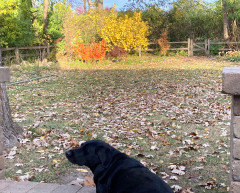
    which are moved in and out of the garage as temperatures allow. Notice there are no leaves on the deciduous trees in the landscape yet, but all species of deciduous trees in containers are in full leaf. The penalty for not following that practice (moving them in and out) is weak growth, long internodes, and leaves that later will likely be unable to adjust to a full sun position, causing them to be shed. After the leaves are shed, some leaves will be replaced with branches from axillary buds, normally a good thing, but now those branches will be too far apart with no resolution other than a hard pruning all the way back to tight growth. This last paragraph is offered from the perspective of appearance.

    Al

    chamaegardener (Z5) Northeast Illinois thanked tapla (mid-Michigan, USDA z5b-6a)
  • 3 years ago
    last modified: 3 years ago

    Tops of woody plants left out in the cold are the least reliable indicator of how they actually fared - the least hardy component is young roots on the outside of the root system. Followed by old roots back inside. And then the tops. So half the root system could have died in the cold and the tops could still be viable looking the following spring - if the roots have not been inspected it is not known with certainty that the specimen was not damaged.

  • 3 years ago

    I've said exactly what you said about chill affecting roots incrementally dozens of times. After 40 years of working on as many trees as I have, I have a very good sense of whether or not a tree was injured by chill over the winter. The primary indicator is, injured trees wake up later and more slowly than those of the same species with roots uninjured by cold or other cultural factors (too wet, too dry, biotic pathogens, .....).

    Al

  • 3 years ago

    Tapla, I love the orange train. I can't imagine the work that goes into maintaining those trees. Best of luck to you....

  • 3 years ago

    Thanks, Bill. What you see is not even half of what I care for. When the image was taken, there were somewhere near 100 tropical/ subtropical trees indoors under lights, and most of the conifers I tend to were still in the garage. The orange carts are from A M Leonard in OH.

    Al

  • 3 years ago

    We sure do a lot for our plants don't we? I'm positive they love us for it too. You stay well and keep enjoying the trees.

  • 3 years ago

    Al, is anything gained by placing a grow light over conifers when overwintering them in the garage or is it wasted electricity? Like you I have an attached unheated garage (z6) with temperatures usually staying between 30-45 throughout winter. I have been placing conifers near an east facing window with a cheap grow light above on a timer but I am unsure if its necessary.

  • 3 years ago

    The temperature range of about 32-42*F is ideal for over-wintering temperate trees. Below freezing temps can kill the very finest roots of some less hardy species, and temps slightly above about 42* will allow conifers and broadleaf evergreens to grow, albeit very slowly until temps rise above about 50*. Allowing temps to rise to the point (above 45*) where the amount of growth becomes conspicuous taxes energy reserves if there is no light to speak of.

    I have a garage with a large stained glass window between the 2 front doors, no windows IN the doors, and a 2x3 window on the both the N and E elevations, with curtains my wife decided were essential. During any winter's day, there is barely enough light to see well enough to move around the garage w/o being overly careful to avoid bumping into something, and my evergreens, both broadleaf and conifers, do just fine with no supplemental lighting and VERY little natural light.

  • 3 years ago

    Thank you for the info, that is good to know!

  • 3 years ago

    I have the luxury of choosing from more than one outbuilding for the storage of any deciduous potted plants, though I prefer the garage that is rarely opened once cold weather strikes. It is an unheated building with enough windows to allow for some natural light. It has an eastern exposure when the garage doors are up.

    Once the cold of winter in zone 5b has made the plants drop leaves, and the temperatures dip with accompanying cold winds, I dolly my larger potted items into the building and place them on a layer of cardboard so the pots aren't directly on the concrete.

    I keep an eye on moisture loss, and any time there is precipitation outdoors, mostly in snow form, I shovel a bit of it and place it on the surface of the pots' medium to simulate what they would be getting if left outdoors. It slowly melts, giving the plant what it needs.

    As the climate warms in early spring, I begin opening the garage door during the day and closing it back up at night... until temperatures and other cues given by natural trees and shrubs in the yard let me know it's time to move those potted plants back outside, keeping them in an eastern exposure where the sun isn't harsh and the pots are still protected from any errant cold winds.

    Shortly thereafter, I move them back to their normal placement where they will spend the rest of spring and summer, running into autumn and another drop in temperature indicating winter is arriving.

    I've had decent success using methods that take into account what Mother Nature would do, except I have the option of adding or subtracting given that the plants are in containers and not planted directly in the ground... two very different environments requiring differing actions on my part.

    Happy Gardening!

  • 3 years ago

    I have overwintered tender perennials and a fig tree in the garage. I figure that the attached garage against the wall to the interior of the house is warmest. I would imagine a free-standing shed would be as cold inside as outside, minus the wind, so I don't think that would work. That being said, it does reach below freezing outdoors and stays there in my area, but I noticed that the spring water stored in the garage never freezes, no matter how harsh the winter is. I was considering getting a thermometer for the garage, but today I hit on the brilliant idea of checking the temp on my dashboard right after I start the car. I don't recommend starting your car in the garage with the door closed, unless it is electric. But a thermometer is a cheap investment. I, too, pile some snow on the pots when it snows outside, for infrequent watering. I am trying to over-winter a Boston fern this winter. The advice I read said to cut off most of the fronds, which is a good idea, because they can make a terrible mess. It's probably not going to make it, but if you have no other choice but to try the garage, it's worth a shot.

  • 3 years ago

    For anything bordering on tender, I might use an unheated basement.

    I think it should be remembered that it's the outside of the pot that takes the brunt of the cold weather outdoors, mostly the winds which hurt the most, and the temperatures which are subject to dropping and rising depending on today's climate... which is a bit wonky.

    And then, we have to consider which gardening zone we live in, plus what our individual micro-climate/environment is like.

    Many years ago, I could just cluster all my potted deciduous plants together in a protected area, cover them in a pile of mulch and leaves, and they'd generally be fine once that blanket of snow was added. But weather and climate around the globe has made us guess what our winters might be like, and has us using different methods for protection.

    If I do use a garage, it's one that isn't used by cars. It's used for storage of garden and farm equipment, and not opened during the winter months.

Sponsored
Daniel Home
Average rating: 4.8 out of 5 stars20 Reviews
Premier Interior Design Team Transforming Spaces in Franklin Co, Ohio