Software
Houzz Logo Print
blueberrybundtcake

African violet leaves losing color

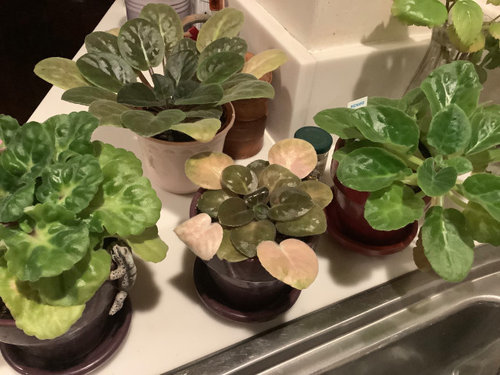
What does my African violet want? It's clearly less than thrilled, and I'm thinking it's probably a nutrient issue.


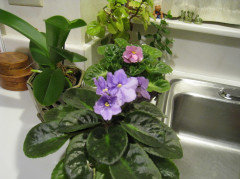
Referring to the middle one, of course:


This is the plant that had major issues a little over a year ago. It is in different soil than its friends.

Comments (24)

  • 3 years ago
    last modified: 3 years ago

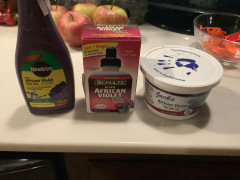
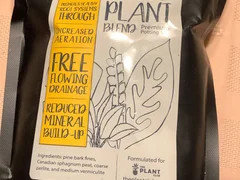
    Would any of these plant foods that I found in the closet be good for this?

    Miracle Gro's N-P-K is 7-7-7.

  • 3 years ago

    i doubt it.. tip it out of the pot.. and lets see if you rotted the roots off it....


    if it needs food.. we can do that later.. lets rule out some other things ....


    and i hope you mean its in different MEDIA than the others.. and not soil.. mother earth ...


    it seems like it stems are shorter than the others also ...


    ken


    ps: my God woman.. how many magical AV foods can one girl own.. its a magical closet no doubt .. lol .. i would presume.. its all marketing mumbo jumbo.. and one is little different that the other two.. so when its time to fert... flip a 3 sided coin ...

  • 3 years ago
    last modified: 3 years ago

    Yeah, yeah, dirt, soil, media ... same difference in my book. Comes in a bag and is for planting in pots. I go to get "dirt and mulch," buy a bag of "potting soil," and use that medium to my plants in. Call it whatever.

    The plant foods were bought at various times and then go to the closet to sit next to the shoe polish and be forgotten ... or maybe multiply. They don't really get used. I couldn't tell you for what purpose or in what year any of them were bought. I suspect the tub is the newest and the box is the oldest. They all have different NPKs, so I suspect one is for blooms and one is for growth and the third is for?

    Here are some older pictures of this violet:

    It is the back violet in this picturefrom 2020:


    After its recovery in 2021:


    Picture from 2017:


  • 3 years ago

    If you haven't been giving these AVs any fertilizer then you definitely should. They all seem to be showing signs of needing feeding and any of the products that you show should help them. I just use generic Miracle Gro (5-10-5), but very dilute -- like 1/4-1/2 tsp per gallon of water -- and use it most of the time when watering.

    BlueberryBundtcake - 6a/5b MA thanked party_music50
  • 3 years ago

    Of the 3 fertilizers you have, I'd use the Miracle Grow. You can dilute a lot as party_music said and use it every time you water, or fertilize specifically on a schedule (the label should say how often). Whichever makes more sense for you.


    N = nitrogen, leaf development

    P = phosphorus, mostly geared towards blooms. I don't like the ones with much higher P

    K = potassium, just general plant health


    Good luck getting your plant healthy!

    BlueberryBundtcake - 6a/5b MA thanked intwilight z6a KS
  • 3 years ago

    I don't think any of these plants have been fertilized in a long time if ever.


    That's very useful to know what each nutrient promotes. I'll mix up some of the Miracle Gro to dole out to the hungry violets.


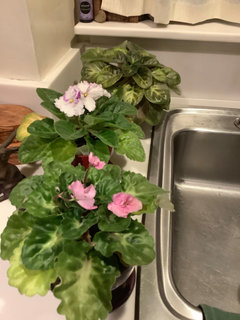
    Should I do something different for the one in the front (with the "girl" leaves) if it's practically in constant bloom? (It's not a coincidence that it's blooming in every picture ... it blooms at least once every couple weeks. The others aren't as frequent.) I think it'll have a bit of a respite after its current flowers, as I don't see any obvious buds, so that'd probably be the time to feed it, right?

  • 3 years ago
    last modified: 3 years ago

    Yes, I got that ... just wasn't sure if blooming plants indicated a different ideal ratio. I have one that's 4-3-6 from my Aerogarden, which I use if and when I fertilize tomatoes and pepper and for the Aerogarden when it's running.

    I tend to remove leaves when they lose their suppleness and twist off easily, but I can cut the discolored leaves off if it would help ... guess they don't really have much chlorophyll anyways, so probably not very useful.

  • 3 years ago

    No, not needed. Just stick with the balanced Miracle Grow.


    The discolored leaves do not heal, so you groom them off and expect new growth.

  • 3 years ago

    Jack’s is far better than MG or Shultz’. Use that in the fiture.

  • 3 years ago
    last modified: 3 years ago

    So, iochroma, you would recommend the Jack's even though it has such a high Phosphorus? What makes it better?

  • 3 years ago

    It is the result of the most advanced research on AF culture. Jack's is the descendant of Peter's which was the top choice of serious AF growers for decades. It is complete with micronutrients. MG and Shultz' are junk IMO and anyone who recommends a "balanced" fertilizer just doesn't know about plant physiology.

    Just use the Jack's and watch what happens.

  • 3 years ago
    last modified: 3 years ago

    2 more questions:

    1. Does it matter whether I have hard water or soft water? Calcium (and magnesium) obviously isn't part of the NPK formula, but is there any effect (good or bad) from different levels of water hardness?

    2. The Optimara site recommends 14-12-14 fertilizer as "high bloom fertilizer." Are they recommending that because it's what they sell, then? And why is it high bloom if Phosphorus is the element geared towards blooms and is the lowest in that formula.

  • 3 years ago
    last modified: 3 years ago

    Some nutrients are mobile in the plant (nitrogen, phosphorous, potassium, magnesium). The light older leaves is almost certainly indication the plant is robbing (at a minimum) nitrogen and magnesium from older leaves for use in newly emerging foliage. Magnesium is central to molecules of the green pigment, chlorophyll, while nitrogen is essential to formation of amino acids and an important structural component of chlorophyll.

    There are two theories regarding how plants take up and use nutrients. One is called the 'original theory' and suggests all plants need different NPK %s. The problem with that theory is, no one can decide on or agree what %s of nutrient each plant wants/ needs. That, and the thought that plants WILL take up more of some nutrients than they can use, casts doubt on that theory. Witness the hundreds of different NPK %s and ratios suggested as "critical" to growing healthy AVs as proof of the disagreement re what plants need/ want.

    In the 1980s, the work of Professor Tom Ericsson, researcher in plant nutrients at the Swedish Agricultural College in Ultuna showed specialty fertilizer products (tomato fertilizer, citrus tree fertilizer, "bloom boosters", orchid fertilizer, ad infinitum) aren’t necessary; that all plants use roughly 6X as much N as P and about 3/5 as much K as N. This is called the 'contrary theory' and has gained wide acceptance since it was discovered. Once the calculations are made, 3:1:2 ratio fertilizers (24-8-16, 12-4-8, and 9-3-6 are all 3:1:2 ratio fertilizers) provide nutrients at almost exactly those rates.

    The phrase "up - down - all around" came into being as a way to remind us that nitrogen is for the upper part of the plant /shoots and leaves, phosphorous is for the lower part of the plant/ roots, and potassium is for the plant's general well-being, right? Wrong. All nutrients are equally essential to normal growth. Some of you know about Liebig's Law, which states there are 6 factors that affect plant growth and yield; they are: air, water, light, temperature, soil/media, nutrients. Liebig's Law of Limiting Factors states the most deficient factor limits plant growth and increasing the supply of non-limiting factors will not increase plant growth. Only by increasing most deficient factor will the plant growth increase. There is also an optimum combination of the factors and increasing them, individually or in various combinations, can lead to toxicity for the plant.

    Since plants use 6X as much N as P, why would we ever provide them with such huge doses of P? The popular "Bloom Booster" type fertilizer 10-52-10, provides 13.6X as much P as the average plant can use, relative to N usage. A fertilizer that provides 10% nitrogen should contain about 1.67% P, which means the middle number should be about 3.9 or 4, not 52. 10-15-10 fertilizer provide about 3.9X as much P as a plant can/ will use.

    When phosphorous is present in excess, it limits uptake of Calcium, potassium, copper, zinc, and especially iron. High-P fertilizers also force the grower to fertilize at much higher EC/TDS (fertility) levels than when using fertilizers with more appropriate ratios.

    ".... is there any effect (good or bad) from different levels of water hardness?" Unless you know what the level of hardness is, what element(s) account for the hardness, and make allowances by adjusting your nutritional supplementation program for their presence, the effects are going to be deleterious. The question is, to what degree. Most of the issue will center around a slow upward creep in pH caused by carbonate build-up, which can be somewhat resolved by acidifying your water, changing your water source, or using an acid-forming fertilizer.

    Do you have any questions or input?

    Al

  • 3 years ago
    last modified: 3 years ago

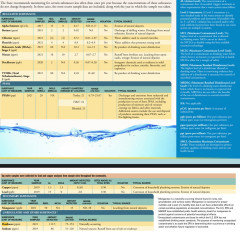
    I do know the hardness, actually ... here's the town water report:


    it doesn't specify whether hardness is calcium, magnesium, or combined, though. I think I might have some litmus strips somewhere that I could test the pH with ... just have to remember where they were last I saw them.

  • 2 years ago

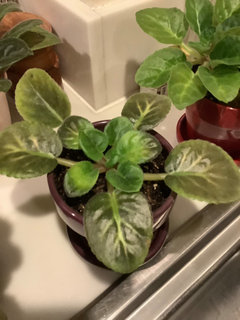
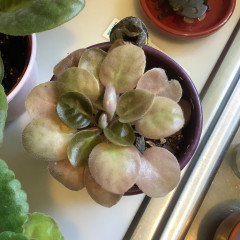
    I don't know what to do for this poor violet ... it gets the same care as its neighbors and is just getting worse ...


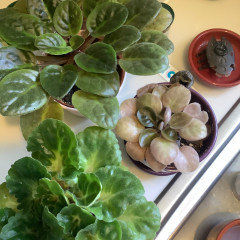
    Its neighbors are fine ...


    The missing neighbor in the red pot is in the ICU after trunk surgery, so its absence is unrelated. This is the only violet with this discoloration.

    (I do see the two old leaves on the back left plant, I'll take those off.)


    Recommendations?

  • 2 years ago

    If you have one that persistently just doesn't work out for you, I would get rid of it and get a different variety.

  • 2 years ago

    BlueberryBundtcake, is your AV the same? I’d guess the light is too strong and/or it’s getting overwatered. Does the pot have drainage? do you feed it? how much light is it getting?

    BlueberryBundtcake - 6a/5b MA thanked party_music50
  • 2 years ago
    last modified: 2 years ago

    This is the same plant featured earlier in this post with the purple flowers, if that's the question - front plant in 2017 picture, back plant in 2020 picture, plant that went through surgery/recovery in 2021. The four violets are all different varieties.

    It arrived with its neighbor with the pink flowers, which flowers almost constantly. The neighbor with the white flowers is the one that just had trunk surgery ... it should be able to come back in another week or so. (It's living in a plastic bag in a different area right now.) Plant is probably around ten years old, but it might be older ... thought is had to pretty much start over in 2021 when it underwent surgery that involved cutting it off just below the leaves.

    Yes, the pot has drainage. The ceramic pots are all identical other than color; single drainage hole of decent size in the middle of the bottom. It receives water the same as the others, which is not to say they all necessarily get watered together but based on the same criteria when they look/feel dry and in the same general way. They get watered from the top at the sink (which they sit next to).

    The window in front of the sink faces east. They sit to the left of the sink; this one currently sits in the middle ... pink one in front, white one switched with it to the back around when this violet had its surgery for root issues.. Back=least light, due to the height of the window (gets shaded by window sill.)

  • 2 years ago

    Ok, I can see two leaves that look brown. Since it should not be a light issue by your description, I suspect overwatering or staying saturated for too long… and probably a nutrient uptake issue. I also don’t like the cupped leaves at the crown. I’d get it out of the ceramic pot. I think that AVs do very poorly in ceramic or clay. I only use plastic pots with multiple drain holes and Pro-Mix potting mix… and depending upon which type I buy, I sometimes add additional perlite.


    Just because your other AVs tolerate or like certain conditions is no guarantee that all of your AVs will tolerate or like the same.


  • 2 years ago

    How is a glazed ceramic pot different from a plastic pot for the plant? Shouldn't both be nonporous? (Real question, not trying to be argumentative.)


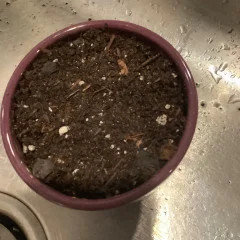
    It's definitely in potting mix ... I think that one is still in this ...


    So if it's too wet for its liking, would your recommendation be to leave it dry for a few days before watering it? (We currently water whenever we notice a plant has dried out - level dryness assessed mostly by weight of pot after initial finger test.) Any recommendation on how to thread the needle between (normal) desert test and actually dehydrating it?

  • 2 years ago

    When it comes to root health, and therefore the health of the entire organism, there is no difference between plastic and vitrified (ceramic) clay. They both eliminate gas exchange through the pot's walls, not a good thing, from the plant's perspective. When it comes to choosing what material your plant's pot is made from, consider low-fired clay (terra cotta). It's gas-permeable walls facilitate soil gas exchange. The larger volume of waste gasses (CO2, methane, hydrogen sulfide) common to pots without gas-permeable walls limits oxygen supply to roots and encourages growth of infectious fungi that cause root rot.

    It doesn't matter if a pot has a single drain hole or 100. The number of holes in a pot's bottom has no notable influence on how much water a medium can hold when it's saturated, and no bearing on how thoroughly the medium drains. It increases the RATE at which water drains from the medium, but plants don't care if it takes 50 seconds for a pot to stop draining, or 5 minutes.

    Over-watering always limits nutrient uptake, and some nutrients will be less available to the plant than others. Reason: The nutrient stream carries water and nutrients dissolved in that water from roots to shoots through xylem tissue; therefore, anything that limits uptake of water or otherwise slows the nutrient stream (low light, high humidity, soil compaction) must limit nutrient uptake. Low oxygen levels in soggy soils causes Fe (iron) and Mn (manganese) to become electron acceptors. This leads to the precipitation of both, even though these elements might be present in soils at normally adequate levels, and the plant’s inability to assimilate them. Soggy soils also make uptake of Ca difficult or impossible.

    Al

  • 2 years ago

    So I'm reading to repot the violet, but I'm not sure how else to apply what you've said to fixing it, Al. What does pink and weird looking mean for nutrients and how should I altwr this plant's watering? This violet is supposed to have green leaves ... so there's definitely something wrong with it.

  • 2 years ago

    AVs turning white is a very common occurrence. Because it's common, there are a good number of websites that provide lists of the several causes of white leaves. If you use the search words African violet turning white you can read what others say about the cause. Here are a couple of links:

    https://gardential.com/african-violet-leaves-turning-white

    https://www.howdoesyourgardenmow.com/african-violet-leaves-care/

    I'm not sure how ... to apply what you've said to fixing it ... . Because I don't know the cause, I didn't intend for you to apply what I said. My reply was offered to provide more info to eliminate potential confusion caused by PMs post a little above it, and to offer some insight into root health from the plant's perspective. Clay pots offer plants a superior opportunity to realize a greater measure of their genetic potential because their walls are gas-permeable. Other considerations are - they are cooler in the summer due to evaporative cooling afforded by the water and water vapor passing through the pot wall, and the added evaporation requires you to water more often. While the grower might find it an inconvenience, plants love a pot/soil combination that requires frequent watering.

    What does pink and weird looking mean for nutrients and how should I altwr this plant's watering? If the pink or purple was occurring on green leaves, it would probably mean that a cultural condition has put the brakes on growth and the accompanying use of sugars, but photosynthesis continues at a normal rate. The near complete absence of green in those leaves mean they contain no or nearly no chlorophyll. Very often, chloroplasts break down when Mg (magnesium) is not readily available. The green pigment chlorophyll masks several other pigments (anthocyanin and xanthophyll in this case) which become expressive when chlorophyll is absent, so I don't think the color pink is a primary concern, and likely not even a secondary or tertiary issue because the pigments were there all along, but were masked by chlorophyll.

    What do you use for fertilizer?

    Al