Software
Houzz Logo Print
rich_p24

Help with Kitchen Make-up air

3 years ago
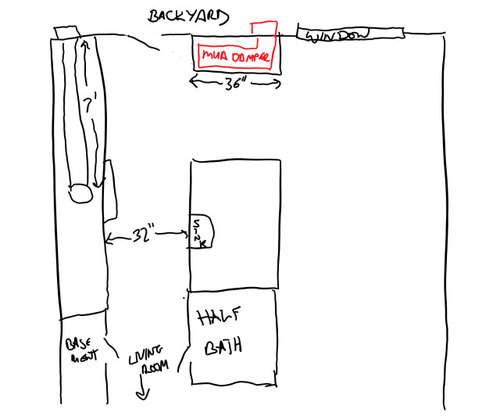
I'm remodeling my kitchen and trying to figure out the makeup air since the hood fan will be over 400cfm.
Details:

  • 90yr old brick townhouse attached on two sides, new windows
  • natural gas steam boiler and hot water heater in basement, no central air
  • Bluestar 30" rnb, ~50k BTUs
  • Hopefully hood with exterior wall mounted 760 or 1020 cfm fantech,
  • ducting will be 8" or 10" diameter depending on space and have 1 90 degree bend, about 7 ft laying on top of upper cabinets
  • NYC winters

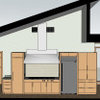
I attached a photo of the layout. Can I just put an electronically controlled damper that opens and closes when the hood is turned on? Is this going to let too much cold air in? Since the house is attached on the left and right side of the picture and the beams go from left to right, we are limited to keeping the ducts on top of the cabinets.


Comments (9)

  • 3 years ago

    So you have two gas combustion appliances in the basement. Is the basement sealed from the house proper? If not, you will need to either have MUA kits applied to these appliances that connect to outdoors, or else will need to control the kitchen ventilation MUA to a few pascals of negative pressure relative to outside, depending on the appliance design. This inherently requires a blower in the MUA path, as well as a controller that either can match the hood ventilation flow rate, or tracks the house differential pressure. CO monitors may also be helpful to survivability.

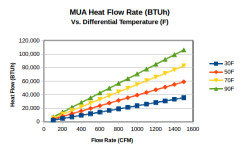
    Household heating is generally sized to compensate for leakage and heat conduction to the outside. A torrent of MUA is not included in the calculation. You may be able to heat the MUA using your boiler, or via a gas fed heater (like big garages use), or via an electrical heater.

    You might put a large thermostatically controlled heater in the basement and have passive (and large) ducts with electrically controlled dampers that feed MUA to the basement. In such a case you are controlling the pressure where if most needs to be controlled, but there still has to be a low pressure loss path to the kitchen or else the hood blower will be gagged or significant wall leakage will occur.

    Large passive MUA ducts may still be insufficient. You may need a blower scheme. A blower will be needed if you use a large furnace type filter in the MUA path.

    Bottom line: If you can isolate the gas appliances from the kitchen ventilation via their own MUA, then the degree of pressure/flow regulation of the kitchen MUA can be relaxed.

    Rough requirement on MUA heating. Use actual hood flow, not blower rating. Click to enlarge.


  • 3 years ago

    @kaseki thank you for your informative response


    I don't know what counts as sealed but I'm going to say that no the basement is not sealed. There is a standard interior door to the basement and there is nothing in particular sealing the wood floors or anything in the basement drywall ceiling.


    It sounds like you're suggesting that since the basement is not sealed off, it could be sufficient to provide makeup air to the basement alone?


    Was makeup air not a necessity before adding a high powered hood?


    Can makeup air be fed into the boiler area unconditioned then?

  • 3 years ago

    I am suggesting that you could most easily heat the basement air as a means of warming the MUA. The goal here is not only to provide MUA, but do it in an economical manner, if possible.

    If the MUA is brought into the basement, you will need a means of delivering it to the kitchen, such as a large floor grating, or louvered panel in the basement door, or registers in place of toe kick wood with holes under cabinets. You won't successfully pull MUA from the basement through the door-to-floor gap. MUA retrofitting is almost always an exercise in architectural redesign.

    Basement is only one option, but I think the one with the best chance of affordably keeping the gas combustion appliances from back drafting. Appliance MUA is a good idea in any case. If present, then a packaged MUA in the attic or such could be considered.

    Make up air is always a necessity, but sometimes under some conditions there is enough house leakage to allow it to be incidental. Once one gets into an adequate hood, then the MUA demand has to be evaluated for how it can be achieved.

  • 3 years ago

    @kaseki ok I understand. No attic, so make up air with blower that blows into the basement that is controlled by the vent hood.


    The air would be delivered into the kitchen essentially through a whole in the floor? Not ducting the makeup air directly to kitchen?


    Is the makeup air heated just by blowing around the boiler or connected directly to the heating system in some manner?


    Thanks again.

  • 3 years ago

    As I thought I wrote earlier, since you have gas you might use a gas heater of appropriate size. You could also use an electric heater.

    Air has to get from the basement to the kitchen. You can do it any way you want, keeping in mind the relative cleanliness of the two locations.

    I still argue for separate MUA kits for the two basement appliances. Otherwise, their air flow could be disrupted as your kitchen MUA changes the basement pressure.

    Please consult with a HVAC or furnace specialist.

  • 3 years ago

    Thanks, I reached out to the company who installed the boiler,hot water. 


    Can the makeup grate be directly under the oven?

  • 3 years ago

    Only with commercial equipment that generally sits on legs. Some high-end residential ranges have gaps underneath, but I have read here that one of them prohibits air flow into that space.

    Best is to introduce air so that it doesn't cause turbulence to the cooking plumes as they rise to the hood. However, one has to also consider what may fall down through the grate and what happens next.

    If the MUA goes into the basement, and a grate position can be found that doesn't routinely collect detritus (mud, onions, sesame seeds, etc., then I would put a furnace filter under the grate. This will catch anything that falls, can be easily replaced, and will have the effect of minimizing basement air rising into the kitchen when the hood is off. It will also keep basement dust from the kitchen.

    A HVAC distributor should have, or can make in their associated fabrication shop, a "cassette" that can hold such a filter. A 3M pleated Filtrite should do.

    Another option would be a cabinet that took basement air in at its base and released it from its face. If you have the wall space, such a scheme would be superior, I think, to having a dirt collector on the floor.

  • 3 years ago

    Remembered that the basement door has a 50 sq inch hole in it for the cats. But I'll try to find a good spot to add a grate.


    Spoke to my heating guy and he said that since we just enclosed the boiler/hot water we should add a fresh air source into that room regardless. Said to stick with the lower powered fan for now and see if I need more. Which the thermador hood im buying comes with a 600cfm internal anyway. Maybe I'll just have the wiring ran from the hood to the boiler should I decide to switch to more power external and add make up air fan.