Software
Houzz Logo Print
webuser_107854039

Return Vent (aka Wind Tunnel) in Ceiling

3 years ago
last modified: 3 years ago
I have a new home and the builders "smartly" decided to put in a return vent on the ceiling of the first floor (HVAC is on the second floor), directly below the HVAC unit. Every time the AC or heat kicks on it sounds like a wind tunnel. I had a tech out for another issue and asked him about the noise. After a rant about how stupid return vents in the ceiling are, he suggested that I try covering the vent (I have two other return vents on the second floor). I was a little surprised by this advice, as I had heard that you should NEVER cover a return vent (albeit, he did say to monitor the unit after covering the vent - to make sure that it's not overheating). Anyway, I was wondering if anyone has tried this. If not, I was wondering if insulating the return duct upstairs would help with the noise (or if there are any other ways to make this darn thing quieter)? Thanks in advance.


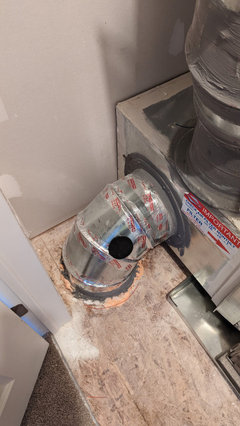
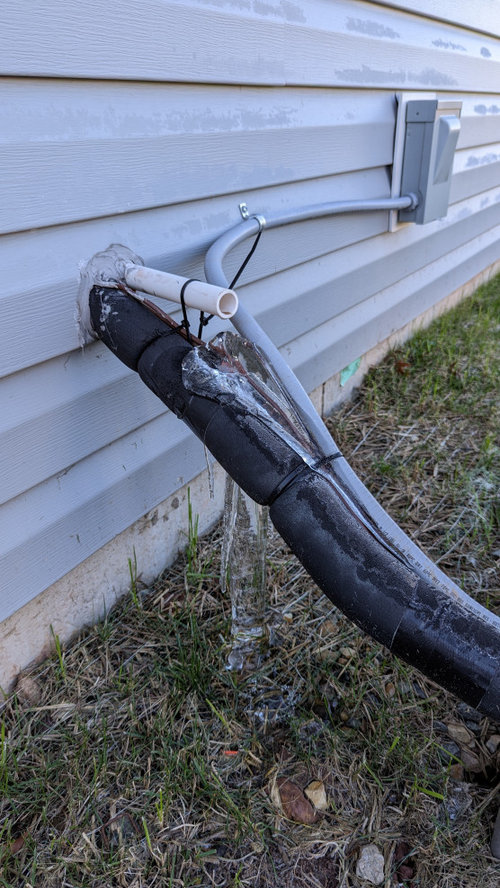
On a slightly different note - should I be worried about this?


Comments (16)

  • PRO
    3 years ago
    last modified: 3 years ago

    I would have a very reputable and INDEPENDENT HVAC COMPANY look at the entire set up.

    The picture you added rings nothing but alarm bells..of cheap and sloppy.

  • 3 years ago
    last modified: 3 years ago

    If there is flex duct connecting the return vent to the furnace, you can add an additional length (10' or so) to reduce the noise some but you will still have airflow noise at the vent itself. If the vent is directly connected to the furnace, of course, this can't be done.

    You could add a second return to the system to reduce the airflow noise.

    Check that the furnace speed isn't set too high (the last guy should have checked this first).

  • 3 years ago
    last modified: 3 years ago

    Thanks for all the replies.


    Yes, the photo is the condensate drain pipe. I've just never seen it positioned like that before nor the freezing of the whole line. I asked when I did the initial walk through, but of course - builder said it was fine and it passed "inspection"....


    In regard to the return duct - this is what I'm working with. I was wondering if maybe insulating that duct would help with the noise at all. I also saw some guy on youtube post a video where he straightened/opened the grates on the return vent and that had reduced some noise...I'm open to suggestions.


    One of the things that the tech adjusted when he had come out was the furnace speed, and he had actually turned it down (at least, that's what he said). Haven't noticed much of a difference in the sound though, and with how much cooler it is downstairs right now I don't know if I'd want to adjust it any lower.

  • 3 years ago

    Bending the grates on the return grill works if the grill is "singing" or whistling but won't do much to reduce general airflow noise.

    If the furnace isn't heating as well after turning down the fan speed, he might have turned it down too much (or messed with the dampers incorrectly).

  • 3 years ago

    You already have good advice on what to do with condensate. The ONLY things I can say for certain about the vent is (A) the tech that told you that is an idiot and (B) there is nothing unprofessional or sub-standard about returns in ceiling. I would advise asking builder for help (you said the knothead tech was there for something unrelated). If builder says the noise is average for his homes (I can hear air movement at all my returns and supplies) you can have the duct moved,resized or whatever for $1k-$1.5k if it's that important to you. Metal ductwork has a tendency to echo motor noise but metal is superior in performance so choose your own poison.

  • 3 years ago

    Can you post the size of the furnace and condenser so we can get a sense of how much air flow needs to flow through the return? There is a possibility the air flow will be higher when cooling and create even more noise.

    I don't see how in your situation insulating the return duct is going to reduce noise on the first floor. As an experiment you could wrap a heavy blanket around it and see if you notice any difference. If you think the grille is contributing to the noise then remove it temporarily and run a test.

    It is hard to tell from the photo but appears the duct going to the first floor is 6 or 7 inches. That is too small for the only return for the first floor. You also have a 90 degree turn causing turbulence and more noise. On top of this the blower motor is about 3 feet away from the return opening. The other return seems strange and possibly undersized. It is also adding to the noise problem.

    You going to have to spend money to make a noticeable difference in noise reduction. Maybe your builder will help you with the costs.


  • 3 years ago

    Thanks, everyone.


    - First floor temp difference has always been an issue (adjusting the fan speed did not cause this). Once I found out that my dampers did have adjustable levers, I did mess around with that a bit though (and it has helped a little).


    - All the homes in the development are the same - neighbors have all said that they basically turn up the volume on the tv everytime the HVAC kicks on.


    - There are two other returns (two return vents upstairs), and the noise upstairs is very minimal.


    Sounds like I basically have to move/resize the vent or just install a second return vent to get rid of the excessive noise.


    *Builder definitely will not help lol.

  • PRO
    3 years ago

    Hi, HU,

    There's nothing fundamentally wrong with locating an HVAC return in a ceiling, but locating one close to an air handler is a recipe for a noise complaint. Under-sizing a return adds the potential for air noise to the potential for equipment noise. Noise issues notwithstanding, if the return is the only one serving the 1st floor of your home, I suspect you'll have thermal comfort issues as well. Your builder should at least address those-- and doing so should reduce air noise.

    I agree that condensate shouldn't discharge directly on your line set, but extending it adds to the likelihood it will freeze up and shutdown you system just when you need it most. I don't know what your state's building code requires, but the 2018 International Residential Code (which forms the core of most statewide building codes) requires the following:

    R403.4.1 Protection of Piping Insulation “Piping insulation exposed to the weather shall be protected from damage, including that caused by sunlight, moisture, equipment maintenance, and wind, and shall provide shielding from solar radiation that can cause degradation of the material. Adhesive tape shall not be permitted.”

    It's pretty clear that the current installation doesn't meet that requirement.

  • 3 years ago

    " All the homes in the development are the same - neighbors have all said that they basically turn up the volume on the tv everytime the HVAC kicks on."


    I suspected that was the case. Locating return close to air handler is the rule rather than exception In affordable housing. For cost of equipment and operating cost , it's efficient. In order to get you get to the finish line quick as possible and put this to bed I have some questions to guide us on the solution best suited your situation.

    (A) Do you have experience and necessary tools for installing ductwork and doing drywall work?

    (B) If the answer to A is no,are you willing to spend $1k+ to hire it done?

    (C) If the answers to both A & B are no,what are you hoping for?

  • 3 years ago

    A. No.


    B. Yes (if that's guaranteed to resolve this noise issue).


    C. I was basically hoping that there was some simple hack (insulating or messing w/ the vent) that would help reduce the noise.


    Thanks.

  • PRO
    3 years ago

    Modifying your existing HVAC system will likely invalidate your builder's warranty. Before taking action on your own, you'll be well served to understand whatever performance standards your HVAC system is required to meet and what obligations your builder has to remedy any shortcomings.

  • 3 years ago

    Re condensate drain, in my area of CA, the drain is required to terminate 30” deep.


    Do you have nesting flying insects in your area?

  • 3 years ago

    HU-107854039

    A. No.

    B. Yes (if that's guaranteed to resolve this noise issue).

    C. I was basically hoping that there was some simple hack (insulating or messing w/ the vent) that would help reduce the noise.


    A. In that case I can tell you without reservation any instruction for change you acquire here then relay to a contractor will be lost in translation. Something me and my classmates learned in 3rd grade when our teacher had us play "gossip".


    B. You will likely receive the same guarantee as you did on the house.


    C. If well thought out proceedures are lost in translation as they are in A,to think you will be able to translate a hack and have it turn out well and carry a guarantee is fantasy.


    I'm not going out of my way just to rain on your parade. C Will turn out no different than if a barber told you (someone without a clue about cutting hair) how to style hair a particular way then you explain it to someone who failed to style it right the first time how to execute a hack for straightening things out.


    Instead of a hack,here's what I suggest. Hire a contractor and include an addendum to contract that reads " On completion of work,hvac vent shall have no higher than 40db noise at 20 feet away".

    When work is complete,beg,borrow,buy or steal a db meter and if noise exceeds 40db you aren't legally obligated to pay contractor.

  • PRO
    3 years ago

    Plotting a route to a particular destination is more efficient if you begin by knowing where you're starting from-- as well as where you'd like to go. To this end, getting "before" sound level measurements is just as important as getting "after" levels. You can purchase a decent sound meter for around $50. If you have an i-phone, you can download the NIOSH Sound Level Meter app for free. Sharing the sound level data for the existing system's operation with your home builder may be sufficient to motivate them to help bring it in line with what can reasonably be expected. If not, the data are still necessary to determine the amount of any improvement achieved.

    Sound levels in any room of your home are the product of multiple sources; the HVAC system is only one of them. It may not be possible, given the construction of your home and the ambient outdoor noise levels, to get to a 40 dB level.

    I suggest a more productive approach than threatening non-payment if 40 dB isn't achieved is to work collaboratively with a contractor--ideally your homebuilder on his dime . If it's another contractor, you may need to do so on a time-and-materials basis. Identify changes which have the potential to reduce sound levels. Implement them in a priority order beginning with those which have the best potential versus cost. Work your way down the list until you've achieved your objective or exhausted your resources or exhausted your spouse or your contractor.

  • 3 years ago

    Thank you, everyone. I will take everything proposed into account and try to determine the best route of action.